
MELU-316 · Lesson 11 of 12 · 21 min
Renewal and continuing education
▶ Video coming soon A video version of this lesson is on the way.
Every other spring, a small panic runs through South Dakota's electrical trade. Renewal notices go out, continuing education classes fill up, and someone at every shop discovers that a certificate is missing. At Coteau Ridge Electric, Joanne Riedel has made the panic smaller by keeping a spreadsheet of every licensee's hours, but she still remembers 2018, when a journeyman's renewal was returned for a missing code-hours certificate two days before June 30. This lesson covers South Dakota's license term, renewal, continuing education, reinstatement, inactive status and the city licenses that ride on the state license, and it shows Marit Halvorsen how her own first contractor cycle will run.
The license term
SDCL 36-16-25 sets a two-year term for South Dakota electrical licenses. Every license expires at midnight on June 30 of an even-numbered year, whatever date it was issued. A license issued in January 2027 therefore expires on June 30, 2028, less than eighteen months later. The statute allows renewal within thirty days after expiration. The Commission announces each renewal window; for the 2026 renewal, its licensing page listed a window from April 20 to June 30, 2026, with online renewal by credit card or a mailed check or money order with the license number.
The renewal fee depends on the class. ARSD 20:44:16:15 sets the two-year fees within the statutory caps of SDCL 36-16-17: 200 dollars for an electrical contractor, 80 dollars for a journeyman, 100 dollars for a Class B electrician, 100 dollars for an inspector and 80 dollars for an inactive license. A contractor or Class B renewal also needs the 50-dollar fund deposit unless the Commission has waived it because the fund is above its threshold, and the undertaking and insurance must still be on file.
| Class | Two-year fee (rule) | Statutory cap |
|---|---|---|
| Electrical contractor | 200 dollars | 200 dollars |
| Journeyman | 80 dollars | 80 dollars |
| Class B electrician | 100 dollars | 200 dollars |
| Inspector | 100 dollars | 120 dollars |
| Inactive | 80 dollars | 80 dollars |
Continuing education
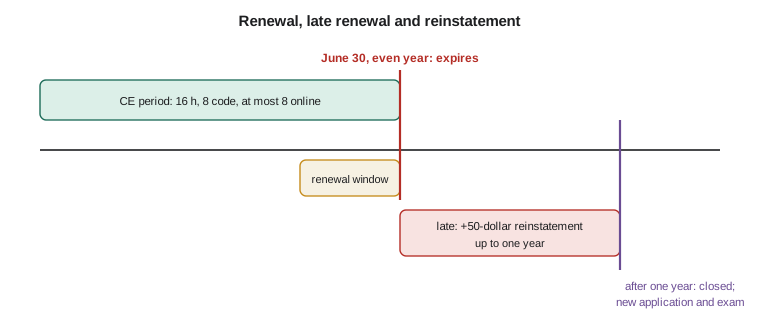
The Commission's rules in ARSD chapter 20:44:17 require sixteen hours of continuing education in each two-year license period, and at least half, eight hours, must be on the National Electrical Code. The rules allow no more than eight of the sixteen hours to come from pre-approved online courses. The licensing page asks for completion certificates covering the current period, which for the 2026 renewal ran from July 1, 2024 through June 30, 2026, and it says the hours are due by the time the licensee sends in the renewal or by June 30, whichever is sooner. Courses must be approved by the Commission; the course provider's certificate shows the approval and the hours.
The code hours matter more than ever after a code change. South Dakota moved to the 2023 NEC in late 2024, so the 2024 to 2026 cycle's code hours were a natural place to learn the changes. When the state adopts the 2026 edition, the following cycle's code classes will carry the same weight. Non-code hours can cover related topics the Commission approves, such as state law and rules, safety and NFPA 70E, or technical subjects like solar and energy storage.
Late renewal and reinstatement
The deadlines after June 30 are layered. The statute allows renewal within thirty days after expiration. The Commission's licensing page says that renewals submitted after June 30 incur a 50-dollar reinstatement fee on top of the renewal fee. ARSD 20:44:16:18 allows a license to be reinstated within one year after expiration by paying the reinstatement fee plus the license fee; SDCL 36-16-38 gives the Commission authority for these reinstatement rules, and the statute caps the reinstatement fee at 100 dollars. After one year, the license cannot be reinstated: the holder must apply for a new license and pass the exam again. For the 2026 cycle, the licensing page stated that licenses not renewed by June 30, 2027 would be closed.
Late renewal has a cost beyond the fee. Work done while a license is expired is unlicensed work, and for a contractor, permits cannot be bought on an expired license. Lesson 2 also noted that hours worked while unlicensed may not count toward the next license class. Treat June 30 as the real deadline, not the start of a grace period.
# Where does a renewal land? (rules from SDCL 36-16-25, ARSD 20:44:16:18 and the licensing page)
from datetime import date
expires = date(2026, 6, 30)
def status(submitted):
    if submitted <= expires:
        return "on time: renewal fee only"
    if submitted <= date(2027, 6, 30):
        return "late: renewal fee plus 50-dollar reinstatement fee"
    return "closed: new application and exam"
for d in [date(2026, 6, 12), date(2026, 7, 20), date(2027, 2, 1), date(2027, 8, 1)]:
print(d, "->", status(d))2026-06-12 -> on time: renewal fee only 2026-07-20 -> late: renewal fee plus 50-dollar reinstatement fee 2027-02-01 -> late: renewal fee plus 50-dollar reinstatement fee 2027-08-01 -> closed: new application and exam
Choosing courses that count and help
Only Commission-approved courses count, so the first check on any class is its approval. Providers that offer South Dakota courses usually print the approval number and the hours, split into code and non-code, on the certificate. Classes from apprenticeship programs, trade associations, manufacturers and the state's technical colleges are common sources. A good plan uses the requirement to learn something the company needs. For Coteau Ridge, that meant a class on the 2023 code changes for agricultural buildings in 2025, and a non-code class on energy storage systems in 2026, because customers had started asking for batteries with their solar arrays.
Keep every certificate. The Commission may audit renewals, and a licensee who cannot produce certificates for the hours claimed risks discipline for a false renewal as well as the missing hours. Coteau Ridge scans each certificate into the licensee's folder the day it arrives and records the date, course name, approval number, hours, code hours and whether the course was online.
What a renewal asks
A renewal is more than a fee. The licensee confirms current contact and employer information, which also satisfies the thirty-day notice duties if anything changed; answers questions about discipline in other jurisdictions and criminal convictions that SDCL 36-16-33 makes relevant; and certifies the continuing education. For contractors and Class B electricians, the undertaking and insurance must be current at renewal. An answer that turns out to be false can be a ground for discipline later, so take the questions seriously and attach explanations where needed.
Worked problem
A company-wide renewal check
In March 2026, Joanne reviews Coteau Ridge's five licensees before the window opens: Dale, contractor, 16 hours with 8 code; Marit, journeyman, 16 hours with 6 code; Ben, journeyman, 12 hours with 8 code, 8 online; Ruth, journeyman, 16 hours, 8 code, 4 online; and Sam, a registered apprentice.
Show solution
- Dale: meets both totals; confirm insurance and undertaking are current and the deposit is paid unless waived.
- Marit: total met, but only 6 code hours; she needs 2 more code hours.
- Ben: 4 hours short, and already at the online limit, so the missing 4 must be classroom.
- Ruth: complete.
- Sam: renew the apprentice registration on time, because licensed hours depend on it.
Answer: Two people need classes before June 30: Marit two code hours, Ben four classroom hours. Joanne books both into the April classroom session.
Inactive licenses
A licensee who stops working in the trade for a while, or moves out of state, can keep the credential by switching to an inactive license under SDCL 36-16-13.3. The fee is 80 dollars for the two-year term. An inactive contractor or Class B holder is exempt from the undertaking requirement, but may not do work that requires a Class B or contractor license while inactive. Returning to active status means meeting the active requirements again, including the undertaking, insurance and continuing education the Commission requires; ask the Commission what it will need before planning the return. Inactive status is often the right choice for an owner who sells a company but wants to keep the option of returning, which Dale Vermeer is considering for his own license after Marit takes over.
City licenses
Sioux Falls issues its own electrical licenses on top of the state license, and its 2025 form says the city accepts applications only with a valid South Dakota license and asks licensees to provide renewal certificates to the city on time. When the state license renews, the city needs proof; when the state license lapses, the city license is in doubt. Rapid City inspects within its limits and may have its own registration or license rules for contractors; this course did not confirm them. Coteau Ridge sends each year's state renewal confirmation to Sioux Falls the week it arrives.
Renewing as the company's licensee
When Marit becomes Coteau Ridge's licensee, her renewal is the company's renewal. If her license lapses, the company cannot buy permits, and every job without a permit is a job the company cannot legally start. That is why Joanne treats the licensee's renewal as a company deadline, files it in April rather than June, and checks the online license lookup afterward to confirm the new expiration date shows. The same applies to the insurance certificate and undertaking on file: if a policy changes carriers mid-term, the new certificate goes to the Commission the same week.
Working in other states
SDCL 36-16-23 allows the Commission to issue licenses by reciprocity to electricians from states that offer similar licensing, and other states have their own rules for South Dakota licensees. Minnesota, North Dakota, Iowa, Nebraska, Wyoming and Montana each license electricians differently, and reciprocity agreements change. A contractor who expects to work across the border should ask both the Commission and the other state's board what is currently available before bidding, and should expect to meet the other state's insurance, bonding and registration rules as well.
Marit's first contractor cycle
If Marit passes in early 2027 and her contractor license issues soon after, it will expire on June 30, 2028. Her continuing education for that renewal must cover the period from July 1, 2026 to June 30, 2028, so hours she takes in late 2026 count. She plans to take an eight-hour code class in the fall of 2027 and an eight-hour mix of state law, safety and solar in the winter of 2028, leaving the online limit unused so a missed class can be replaced. Joanne's spreadsheet shows every licensee's hours by type, with the code hours in a separate column.
Worked problem
Is this licensee ready to renew?
A journeyman's certificates for the period July 1, 2024 to June 30, 2026 show: an eight-hour online code update, a four-hour online safety class, and a four-hour classroom class on state rules.
Show solution
- Total hours: 16, which meets the requirement.
- Code hours: 8, which meets the minimum of eight.
- Online hours: 12, which exceeds the eight-hour online limit.
- Four of the online hours cannot count, leaving 12 counted hours.
Answer: Not ready. He needs four more classroom or otherwise non-online hours before renewing.
Common mistakes
MistakeAssuming a license issued in 2027 lasts two full years.
InsteadEvery license expires June 30 of the next even year.
MistakeTaking all sixteen hours online.
InsteadNo more than eight hours may come from pre-approved online courses.
MistakeSkipping code hours in favor of business classes.
InsteadAt least eight hours must be on the NEC.
MistakeWorking through July on an expired license.
InsteadWork while expired is unlicensed; renew by June 30.
MistakeLetting a license sit expired for over a year.
InsteadAfter one year it closes and a new application and exam are required.
Summary and key terms
- Licenses run two years and expire at midnight June 30 of even years.
- The contractor fee is 200 dollars; contractors also pay the fund deposit unless waived.
- Sixteen hours of continuing education per period, at least eight on the code, no more than eight online.
- Renewals after June 30 carry a 50-dollar reinstatement fee; reinstatement is possible for one year.
- After one year, a new application and exam are required.
- Inactive licenses keep the credential without the undertaking but allow no contractor work.
- License period
- The two years ending June 30 of an even-numbered year.
- Code hours
- Continuing education on the National Electrical Code; at least eight per period.
- Reinstatement
- Restoring an expired license within one year by paying the reinstatement and license fees.
- Inactive license
- A license kept without the right to do Class B or contractor work.
- Reciprocity
- Licensing based on another state's license.
Practice problems
Work each problem on paper first, then reveal the answer to check.
Marit's license issues March 1, 2027. When does it expire?
Show answer
June 30, 2028.
How many of the sixteen hours must be code hours?
Show answer
At least eight.
A contractor renews on July 15. What extra fee applies?
Show answer
The 50-dollar reinstatement fee.
A journeyman's license expired June 30, 2026 and he applies in September 2027. What now?
Show answer
It is past one year; he must apply for a new license and test again.
May an inactive contractor bid a job?
Show answer
No; inactive holders may not do contractor work.
Lesson quiz · 5 questions
Score 60% or more to complete this lesson.
Create a free account to save your progress, take quizzes and earn a certificate.