
MELU-316 · Lesson 10 of 12 · 20 min
Workplace safety law and OSHA for electrical contractors
▶ Video coming soon A video version of this lesson is on the way.
In 2018 a Coteau Ridge apprentice took a shock from a lighting circuit in a grain elevator office that a maintenance worker had said was off. He was not badly hurt, but he spent a night in the hospital for observation, and the company learned three things in one week: how its workers compensation carrier wanted injuries reported, what federal OSHA considers a reportable hospitalization, and how much a written lockout procedure would have helped. Marit Halvorsen was the journeyman on that job. As the licensee, she will set the company's safety program, and this lesson covers the safety and injury law that applies to a South Dakota electrical contractor.
Federal OSHA in South Dakota
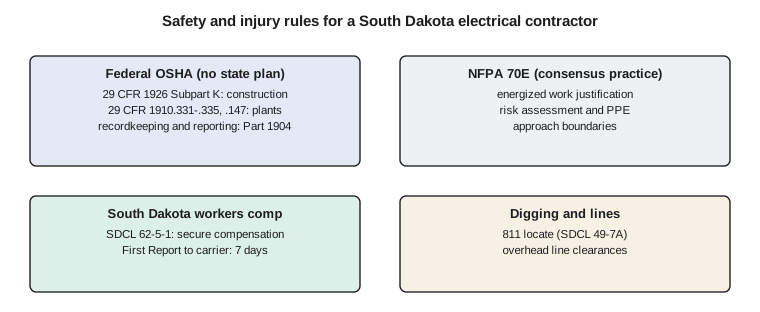
South Dakota does not operate an OSHA-approved state plan for private employers. Workplace safety for private electrical contractors in the state is enforced by the federal Occupational Safety and Health Administration under the federal Occupational Safety and Health Act. Federal OSHA standards, inspections, citations and penalties apply directly. That is different from neighbors such as Minnesota and Wyoming, which run their own state plans, so a contractor who works across those borders deals with different enforcing agencies on different jobs.
The standards an electrical contractor meets most often are in 29 CFR Part 1926 for construction, especially Subpart K on electrical safety, which includes the rules on ground-fault protection for temporary wiring, the assured equipment grounding conductor program, work near energized parts and lockout and tagging of circuits in sections 1926.404 through 1926.417. Subpart M covers fall protection, Subpart L scaffolds, Subpart X ladders, Subpart P excavations and Subpart CC cranes, including clearances from power lines. Maintenance and service work in operating plants can fall under 29 CFR Part 1910 general industry rules instead, including the electrical safety-related work practices in 1910.331 through 1910.335 and lockout in 1910.147. Many contractors and their customers also follow the NFPA 70E standard for electrical safety in the workplace as the recognized way to meet OSHA's general duty to protect workers from arc flash and shock.
The core electrical rules in plain words
The construction electrical rules require that employees not work near live parts unless protected by deenergizing and grounding, by guarding or by other effective means. When circuits are deenergized, they must be locked out or tagged so they cannot be reenergized while work is under way, and the employer must verify that they are actually dead. Temporary wiring on construction sites must be protected by ground-fault circuit interrupters or by an assured equipment grounding conductor program. Portable tools and cords must be inspected and kept in good repair. Workers must be trained to recognize and avoid the electrical hazards of their work. And minimum clearances must be kept between equipment, such as cranes, aerial lifts and ladders, and overhead power lines unless the lines are deenergized and grounded or other protections are used.
The grain elevator incident turned on the second rule. The maintenance worker had turned off a switch, but nobody had locked out the breaker or tested the circuit. Since then, Coteau Ridge's written procedure says that the crew that will work on a circuit locks and tags it, tests it with a meter proved on a known live source before and after, and never relies on someone else's word.
Reporting serious injuries to OSHA
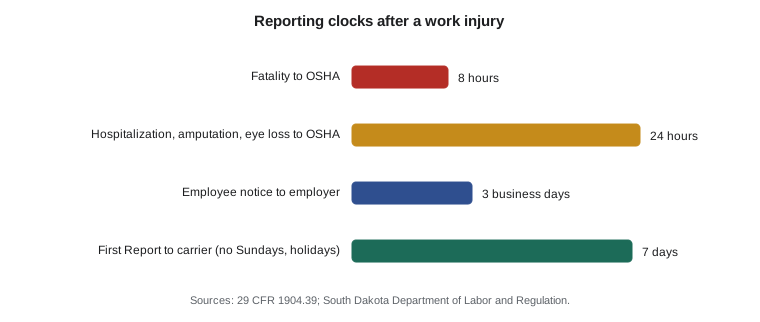
Under 29 CFR 1904.39, an employer must report to OSHA a work-related fatality within eight hours of learning of it, and a work-related in-patient hospitalization of one or more employees, an amputation or the loss of an eye within twenty-four hours. Reports can be made by phone to the nearest OSHA area office, to OSHA's national hotline, or online. An in-patient hospitalization means formal admission for care or treatment; observation alone may not count, but when in doubt, check OSHA's guidance and report.
Separately, 29 CFR Part 1904 requires many employers to keep injury and illness records on OSHA's forms 300, 300A and 301. Employers with ten or fewer employees during the previous year are partially exempt from routine recordkeeping, and certain low-hazard industries are exempt, but construction is not among the low-hazard exemptions. Coteau Ridge, with eleven employees, keeps the logs, posts the annual summary each February through April, and keeps the records for five years.
South Dakota workers compensation
SDCL 62-5-1 requires employers that come within the workers compensation title to secure the payment of compensation to their employees, by insurance or by qualifying to self-insure. When an employer has secured compensation, its liability for work injuries is limited to what the title provides. The Department of Labor and Regulation's employer page sets out the reporting duties. The employee must give the employer written notice of an injury within three business days, or as soon as practicable. The employer must complete the First Report of Injury and send it to its insurance carrier within seven days, not counting Sundays and holidays, after first learning of the injury, even if the employee never gave written notice. Failing to report within seven days can bring a Class 2 misdemeanor charge and a 100-dollar civil penalty from the department.
The same page lists other employer duties. The employer, through its insurer, furnishes necessary first aid, medical, surgical and hospital services. When a medical provider releases an employee to light duty, the employer should offer suitable work if it can, and an employee who refuses suitable light duty risks benefits. And an employer may not fire an employee for filing a workers compensation claim.
| Event | Who reports to whom | Deadline | Source |
|---|---|---|---|
| Work-related fatality | Employer to OSHA | 8 hours | 29 CFR 1904.39 |
| In-patient hospitalization, amputation, eye loss | Employer to OSHA | 24 hours | 29 CFR 1904.39 |
| Any work injury | Employee to employer, in writing | 3 business days or as soon as practicable | DLR employer page |
| Any work injury | Employer to carrier, First Report of Injury | 7 days, excluding Sundays and holidays | DLR employer page |
# Seven-day First Report of Injury deadline, skipping Sundays and holidays (illustrative)
from datetime import date, timedelta
holidays = {date(2026, 11, 26)}           # Thanksgiving, as an example
learned = date(2026, 11, 23)              # Monday
d, counted = learned, 0
while counted < 7:
    d += timedelta(days=1)
    if d.weekday() == 6 or d in holidays:  # Sunday or holiday: not counted
        continue
    counted += 1
print("Employer learned of injury:", learned)
print("First Report of Injury due to carrier by:", d)Employer learned of injury: 2026-11-23 First Report of Injury due to carrier by: 2026-12-02
A few practical points make the workers compensation system run smoothly. Post the notice the department requires so employees know how to report. Train foremen to call the office the same day anyone is hurt, however minor the injury looks, because the employer's clock runs from when it learns of the injury, and knowledge by a supervisor usually counts. Keep the carrier's claim number with the job file. And treat a return to light duty as a planned step, with the restrictions in writing, rather than an informal favor.
Digging and overhead lines
Electrical contractors dig trenches for services and feeders, set poles and drive ground rods, and South Dakota's one-call law in SDCL chapter 49-7A requires excavators to notify the state's one-call center, reached by calling 811, before excavating so that underground facilities can be located and marked. The law sets the advance notice period and the excavator's duty to respect marks and dig carefully near them; check the current notice period before each job. Federal OSHA's excavation rules in Subpart P separately require the employer to determine the location of underground installations before digging and to protect workers in trenches.
Overhead lines are the other major hazard in rural work. Grain bins, augers, booms and long ladders near farm service drops cause deaths every year. Federal rules set minimum approach distances for equipment and workers, with greater distances for higher voltages; when work must come closer, the line owner must deenergize and ground the line or install protective covering. A call to the rural electric cooperative before setting equipment is a standard step on Coteau Ridge's farm jobs.
Energized work and arc flash
The safest electrical work is done deenergized, and the federal rules and NFPA 70E both start from that point. Energized work is justified only when deenergizing would create a greater hazard, such as shutting down life support or alarm systems, or when it is infeasible because of the task, such as voltage testing and troubleshooting. When energized work is justified, NFPA 70E calls for a documented risk assessment, an energized work permit for most tasks beyond testing, the right personal protective equipment for the shock and arc flash hazard, insulated tools, and approach boundaries that keep unqualified people back. Equipment labels showing the arc flash hazard, required by NEC section 110.16 for certain equipment in commercial and industrial occupancies, help the crew choose protection. For an exam candidate, the code side is the labeling requirement in Article 110; the work-practice side belongs to OSHA and NFPA 70E.
When OSHA visits
Federal OSHA inspects after reports of serious injuries, after complaints and referrals, and through programs that target high-hazard work such as construction. On a multi-employer site, OSHA may cite the employer that created a hazard, the employer whose workers were exposed, the employer responsible for correcting it, and the controlling employer, usually the general contractor, that should have found it. An electrical subcontractor that leaves an unguarded live panel on a site where other trades work can be cited even if none of its own workers were exposed. The practical lessons are simple: keep the company's written programs and training records ready, have one person who accompanies the inspector, answer questions accurately without guessing, and fix any hazard the inspector points out immediately. Citations can be contested within a short time after receipt, so open the mail promptly and call counsel if a citation seems wrong.
Building a safety program
Federal law does not require every construction employer to have a written safety program in a single document, but many specific standards require written procedures or training records, and nearly every commercial customer asks for a program before awarding work. A practical program for a South Dakota electrical contractor covers hazard assessment and personal protective equipment, lockout and tagging, energized work permits and arc flash practices following NFPA 70E, ground-fault protection and assured equipment grounding, fall protection, ladders and lifts, excavation and trenching, overhead line clearances, first aid and injury reporting, and new-hire training. Toolbox talks each week keep the program alive on the jobs.
Worked problem
A hospital visit on a Friday
On a Friday afternoon an apprentice falls from a ladder in a Brookings warehouse, breaks a wrist and is admitted to the hospital overnight for surgery. Marit learns of it at 3 p.m.
Show solution
- OSHA: an in-patient hospitalization must be reported within 24 hours, so by 3 p.m. Saturday.
- Carrier: the First Report of Injury is due within seven days, excluding Sundays and holidays.
- The apprentice should give written notice within three business days, but the employer's duties do not wait for it.
- Record the injury on the OSHA 300 log within the time Part 1904 allows, and review ladder practices with the crew.
Answer: Report to OSHA by Saturday afternoon, file the First Report with the carrier within the seven-day count, log the case, and fix the hazard.
Common mistakes
MistakeCalling a South Dakota state OSHA office.
InsteadSouth Dakota has no state plan for private employers; federal OSHA enforces.
MistakeWaiting for the employee's written notice before reporting.
InsteadThe employer's seven-day clock runs from when it learns of the injury.
MistakeCounting Sundays in the seven days.
InsteadSundays and holidays are excluded from the seven-day count.
MistakeRelying on someone else's word that a circuit is off.
InsteadLock out, tag and test before work.
MistakeTreating a hospitalization as a carrier-only matter.
InsteadOSHA must also be told within 24 hours.
Summary and key terms
- Federal OSHA enforces workplace safety for private employers in South Dakota.
- 29 CFR 1926 Subpart K covers construction electrical safety; 1910 covers maintenance in operating facilities.
- Report fatalities to OSHA in 8 hours and hospitalizations, amputations and eye losses in 24.
- SDCL 62-5-1 requires employers to secure workers compensation.
- The employer sends the First Report of Injury to the carrier within seven days excluding Sundays and holidays.
- Call 811 before digging and keep clear of overhead lines.
- State plan
- An OSHA-approved state program; South Dakota has none for private employers.
- Lockout and tagging
- Procedures that keep deenergized circuits from being reenergized during work.
- Assured equipment grounding conductor program
- An alternative to GFCI protection for temporary construction wiring.
- First Report of Injury
- The employer's report of a work injury to its workers compensation carrier.
- One-call
- The 811 notice system for locating underground facilities before digging.
Practice problems
Work each problem on paper first, then reveal the answer to check.
Who enforces OSHA standards on a Coteau Ridge job in Watertown?
Show answer
Federal OSHA.
An electrician is killed on a job at 10 a.m. When must OSHA be notified?
Show answer
Within eight hours, by 6 p.m.
The company learns of an injury on Monday. When is the First Report due, with no holidays?
Show answer
Seven days excluding Sundays, the following Tuesday.
Who must give written notice within three business days?
Show answer
The injured employee, to the employer.
What must happen before trenching for a service lateral?
Show answer
An 811 locate request under SDCL 49-7A.
Lesson quiz · 5 questions
Score 60% or more to complete this lesson.
Create a free account to save your progress, take quizzes and earn a certificate.