
MELU-316 · Lesson 1 of 12 · 18 min
How electrical licensing works in South Dakota
▶ Video coming soon A video version of this lesson is on the way.
Marit Halvorsen has worked in the electrical trade around Brookings for eleven years. She registered as an apprentice with the South Dakota Electrical Commission in 2015, spent four years pulling wire on farm shops, houses and the occasional dairy barn, and in 2019 passed the journeyman exam. For the last seven years she has run crews for Coteau Ridge Electric, LLC, an eleven-person contractor on the east side of Brookings. The company is invented for this course, but the questions it faces are real. Its owner, Dale Vermeer, has held a South Dakota electrical contractor license since 1996 and is the licensee whose undertaking and insurance stand behind every permit the company pulls. Dale is sixty-three and wants to step back. He has asked Marit to earn her own contractor license so that the company can keep contracting, keep pulling wiring permits and keep its name on the trucks after he retires. This course follows her from her first question to exam day.
This is the South Dakota course in the HSM University master electrician exam prep series. The core courses, MELU-101 through MELU-107, teach the National Electrical Code skills that every master-level exam tests: navigating the code, load calculations, conductors and overcurrent protection, grounding and bonding, motors and transformers, special occupancies, and business and law. This course adds what is specific to South Dakota. The first thing to know is that South Dakota does not use the word master. The top license a working electrician can hold is the electrical contractor license, issued by the State Electrical Commission under South Dakota Codified Laws chapter 36-16. The catalog calls it the contractor's electrical license; the statute and the Commission's forms call it the electrical contractor license. They are the same credential, and it plays the role that a master license plays in other states.
Two cautions apply to every lesson. First, licensing rules change. The facts in this course were checked in November 2026 against SDCL chapter 36-16, the Commission's rules in the Administrative Rules of South Dakota, article 20:44, the Commission's licensing, exam, inspection, homeowner and insurance pages, the International Code Council's candidate bulletin for South Dakota, the lien statutes in SDCL chapter 44-9 and the Department of Labor and Regulation's workers compensation pages. The lessons say so when a fact comes from a secondary source or could not be confirmed. Before you apply, pay a fee or book an exam, check the current pages yourself. Second, electrical codes are copyrighted. This course cites code articles and sections by number and explains them in plain words, but it never reproduces their text, tables or figures. Keep your own copy of the code your exam uses open beside you.
One state commission
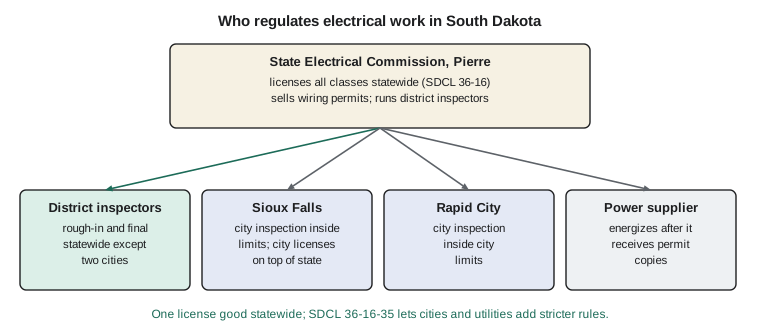
South Dakota licenses electricians at the state level. The State Electrical Commission is a seven-member body appointed by the Governor and housed within the Department of Labor and Regulation in Pierre. Its members serve three-year terms and include a representative of electric utilities, an electrical contractor, a journeyman, a fire safety expert and lay members who use electrical services, so the trade, the utilities and the public all have a voice. The Commission meets each July in Pierre and can call special meetings on short notice. Its staff in Pierre process applications, approve exam candidates, issue licenses, sell wiring permits and run a statewide corps of electrical inspectors.
Because one commission covers the whole state, a South Dakota license is good in every county. That is very different from neighbors such as Kansas, where licensing is local, and it simplifies life for a contractor like Coteau Ridge that works from Brookings to Watertown to the Sioux Falls suburbs. The state also adopts one edition of the National Electrical Code for the whole state, and the Commission's inspectors cover nearly all of it. The two important exceptions are Sioux Falls and Rapid City, which run their own electrical inspection inside city limits, and Sioux Falls also issues city electrical licenses on top of the state ones. Lessons 5, 6 and 8 return to these two cities.
The license classes
SDCL 36-16-2 defines the classes, and the Commission's rules fill in the experience. The apprentice electrician is learning the trade and must be registered with the Commission and work under the supervision of a licensed electrician. The journeyman electrician has at least four years of experience and has passed the journeyman exam; a journeyman may do the work but may not contract for it. The Class B electrician has at least thirty-six months of experience and is limited to farm and residential wiring, which a Class B may contract for under SDCL 36-16-14. The electrical contractor may plan, lay out, supervise, install and repair electrical work and may enter contracts to do it. There are also narrower classes: the electrical inspector, the maintenance electrician who works under a public or private entity's maintenance license, the 501(d) electrician limited to certain religious communal properties, and an inactive license for holders who want to keep a credential without working under it.
For an exam candidate, the key fact is in SDCL 36-16-14. Only a licensed electrical contractor may contract for the installation of electrical wiring, with the single exception of Class B electricians on farm and residential work. A journeyman who takes a side job for pay is contracting without a license, and SDCL 36-16-1 makes that a Class 2 misdemeanor. That is why Coteau Ridge cannot simply have Marit run the business on her journeyman card after Dale retires.
| Class | Experience before the exam | What the holder may do |
|---|---|---|
| Apprentice | Registration with the Commission | Work under supervision; may not contract |
| Journeyman | Four years (8,000 hours) as a licensed apprentice | Do electrical work; may not contract |
| Class B electrician | At least 36 months, with residential or farm work | Contract for farm and residential wiring only |
| Electrical contractor | Two years (4,000 hours) as a journeyman, at least 2,000 commercial | Plan, supervise, install and contract for all electrical work |
| Inactive | Held a license | Keep the credential; may not do Class B or contractor work |
Licensed hours only
South Dakota counts experience in hours, and it counts only hours worked while licensed. The rules define one year as 2,000 hours. The Commission's licensing page states plainly that experience hours must be licensed for the working time to count toward the hours required to take the exams. An apprentice who worked a summer before registering, or a journeyman who let a license lapse for six months, may find those months missing from the total. Marit's file is clean because Dale registered her the week she started in 2015, and she has renewed on time every cycle since. Lesson 2 shows how to document those hours.
The person and the company
SDCL 36-16-22 lets a partnership or corporation hold the benefit of a license through an officer or manager who qualifies, and SDCL 36-16-20 puts the financial protections on the licensee. Before the Commission issues an electrical contractor or Class B license, the applicant must file a 10,000-dollar undertaking, pay a 50-dollar deposit into a special fund, and keep public liability and property damage insurance on file at the minimum limits the statute sets. If the employer company meets those requirements, the licensed individual is exempt from meeting them separately. Lesson 8 covers these rules in detail.
The split matters for Coteau Ridge. The company contracts because Dale holds the contractor license and the company keeps the undertaking and insurance current. SDCL 36-16-26 addresses what happens when a licensee dies; for a planned retirement, the company needs another licensed contractor in place before Dale's license stops supporting it. That is the gap Marit is training to fill.
Wiring permits and the state inspector
South Dakota does not use the building-department permit counter familiar from other states. Instead, the contractor buys a wiring permit from the Commission, fills it out at the job, posts it at the service and sends copies to the Commission and to the power supplier. A state inspector assigned to the district then inspects the rough-in and the final. The power supplier will not energize a new service without the permit copy. Lesson 6 walks through the five-copy permit, the fifteen-day deadline for sending the Commission's copy, the 72 hours' notice before energizing and the fees.
Marit has done this hundreds of times as a journeyman, but always with Dale's license number at the top of the permit. As the licensee, she will be the one the Commission holds responsible when a white copy goes in late or a sticker is missing.
Enforcement
The Commission's tools are set out in SDCL 36-16-31 through 36-16-34.1. Inspectors can condemn a hazardous installation and order service disconnected after notice to the owner, and the installation may not be reconnected until it complies. The Commission can refuse, suspend or revoke a license for violating the law, the rules or the National Electrical Code, for aiding unlicensed work, for failing to report out-of-state discipline or address and employer changes within thirty days, and for conviction of a crime of violence. Failing to register, obtain a license or report wiring is a Class 2 misdemeanor, and the Commission may instead seek an injunction. SDCL 36-16-35 lets cities and utilities impose stricter requirements, which is how Sioux Falls and Rapid City run their own programs.
The exam picture
The Commission approves candidates, and the International Code Council delivers the exams through Pearson VUE test centers. The electrical contractor exam has 100 multiple-choice questions in five hours, is open book, and since December 2, 2024 has been based on the 2023 National Electrical Code. The Commission's rules set the passing score at 70 for the contractor, Class B, journeyman and 501(d) exams. Lessons 3 and 4 cover the application, approval, scheduling and format.
How this course is organized
The lessons follow Marit's path. Lesson 2 covers eligibility for the contractor's electrical license, Lesson 3 the application and booking process, and Lesson 4 the exam format and references. Lesson 5 explains the state adoption of the 2023 NEC and South Dakota's amendments, and Lesson 6 wiring permits and inspections. Lesson 7 covers the duties of the license holder, Lesson 8 the undertaking, insurance and other business licensing, and Lesson 9 contracts and mechanics' liens. Lesson 10 covers safety law, OSHA and workers compensation, Lesson 11 renewal and continuing education, and Lesson 12 a practice review and test-day strategy. Every lesson ends with a quiz that mixes multiple choice, true or false, number, ordering and matching questions, and the course ends with a final exam.
The calculator below shows the first check Marit ran. The contractor exam needs 4,000 licensed journeyman hours, at least 2,000 of them commercial. Change the numbers to fit your own record.
# Marit's experience check (hours from her payroll records, illustrative)
hours_by_year = {2019: 1150, 2020: 2010, 2021: 2080, 2022: 2040, 2023: 2100,
                 2024: 2060, 2025: 2120, 2026: 1700}
commercial_share = {2019: 0.3, 2020: 0.4, 2021: 0.5, 2022: 0.5, 2023: 0.6,
                    2024: 0.6, 2025: 0.5, 2026: 0.5}
total = sum(hours_by_year.values())
commercial = sum(round(h * commercial_share[y]) for y, h in hours_by_year.items())
print(f"Journeyman hours: {total} (need 4000) -> {'met' if total >= 4000 else 'short'}")
print(f"Commercial hours: {commercial} (need 2000) -> {'met' if commercial >= 2000 else 'short'}")Journeyman hours: 15260 (need 4000) -> met Commercial hours: 7615 (need 2000) -> met
Common mistakes
MistakeLooking for a South Dakota master electrician license.
InsteadSouth Dakota's top class is the electrical contractor license; there is no license called master.
MistakeThinking a journeyman may contract for small jobs.
InsteadUnder SDCL 36-16-14 only electrical contractors, and Class B electricians on farm and residential work, may contract.
MistakeCounting hours worked before registration.
InsteadOnly licensed hours count toward the exam requirements.
MistakeAssuming each city licenses electricians.
InsteadThe Commission licenses statewide; Sioux Falls adds city licenses and Sioux Falls and Rapid City inspect locally.
MistakeTreating the wiring permit as a city building permit.
InsteadWiring permits come from the Commission and are posted at the job with copies to the Commission and the power supplier.
Summary and key terms
- The State Electrical Commission, within the Department of Labor and Regulation, licenses electricians statewide under SDCL 36-16.
- The electrical contractor license is South Dakota's top class and plays the role of a master license.
- Only electrical contractors, and Class B electricians on farm and residential work, may contract for wiring.
- Experience is counted in licensed hours; one year is 2,000 hours.
- Contractors buy wiring permits from the Commission; state inspectors inspect, except inside Sioux Falls and Rapid City.
- Check current statutes, rules and Commission pages before relying on any detail.
- State Electrical Commission
- The seven-member body in Pierre that licenses electricians, sells wiring permits and inspects.
- Electrical contractor
- The license class that may plan, supervise, install and contract for electrical work.
- Class B electrician
- A license limited to farm and residential wiring, which the holder may contract for.
- Undertaking
- The 10,000-dollar obligation a contractor or Class B electrician files with the Commission.
- Wiring permit
- The multi-copy form bought from the Commission and posted at the job.
Practice problems
Work each problem on paper first, then reveal the answer to check.
May Marit wire a neighbor's garage for pay on her journeyman license?
Show answer
No; contracting requires an electrical contractor license (or Class B for residential and farm work).
Who issues Marit's contractor license?
Show answer
The State Electrical Commission in Pierre.
How many hours make one year of experience under the rules?
Show answer
2,000 hours.
Who inspects a new service in Brookings?
Show answer
The state electrical inspector for that district.
Who inspects a new service inside Sioux Falls city limits?
Show answer
The City of Sioux Falls, which runs its own inspection.
Lesson quiz · 5 questions
Score 60% or more to complete this lesson.
Create a free account to save your progress, take quizzes and earn a certificate.