
MELU-316 · Lesson 12 of 12 · 27 min
Practice exam review and test-day strategy
▶ Video coming soon A video version of this lesson is on the way.
In early November 2026, before she mailed her application, Marit Halvorsen took a full practice exam at the Coteau Ridge office on a Saturday morning: 100 questions, five hours, her tabbed 2023 code book, Ugly's and a calculator, with Joanne Riedel watching the clock. She scored in the low eighties, which was where she had been for three weeks of practice sets. Dale Vermeer looked at the score sheet and said what experienced contractors always say: the score is fine, now look at what you missed. This lesson brings together the whole course into a review method, a final study plan and a test-day routine, and it closes with what happens after the score report prints.
Reviewing a practice exam
A practice exam is useful only if the review is better than the test. For each missed question, Marit recorded four things in her error log: the content area from the exam outline, the code article or South Dakota rule that answered it, how long she had spent, and why she missed it. She sorted the reasons into four groups. Lookup misses meant she knew where the rule was but could not find it fast enough. Wrong-rule misses meant she went to the wrong article. Reading misses meant she answered a different question from the one asked. Calculation misses meant she set the problem up correctly but made an arithmetic or table error. Each group calls for a different fix: more index practice, more article mapping, a habit of reading the last line first, or slower, written calculations.
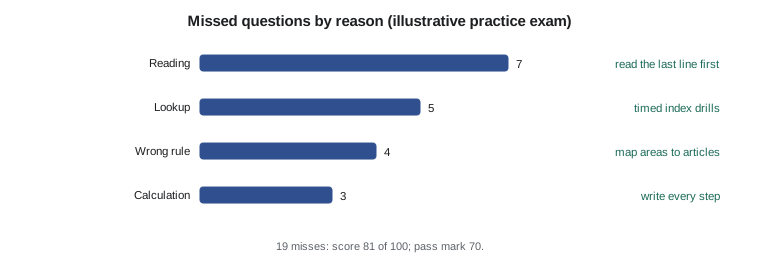
On that practice exam, the log showed nineteen misses: seven reading, five lookup, four wrong rule and three calculation. Her score was being limited mostly by how she read questions, not by what she knew. For the next week, she practiced reading the last line of every question first and underlining the limiting words: minimum, maximum, not, except, shall, permitted. Her next practice set had only two reading misses.
# Error-log summary from a practice exam (illustrative)
misses = ["reading"] * 7 + ["lookup"] * 5 + ["wrong rule"] * 4 + ["calculation"] * 3
fixes = {"reading": "read the last line first; underline limiting words",
         "lookup": "timed index drills",
         "wrong rule": "map outline areas to articles",
         "calculation": "write every step; check table units"}
score = 100 - len(misses)
print(f"Practice score: {score} of 100 (pass mark 70)")
for reason in sorted(set(misses), key=lambda r: -misses.count(r)):
print(f"{reason}: {misses.count(reason)} -> {fixes[reason]}")Practice score: 81 of 100 (pass mark 70) reading: 7 -> read the last line first; underline limiting words lookup: 5 -> timed index drills wrong rule: 4 -> map outline areas to articles calculation: 3 -> write every step; check table units
The last two weeks
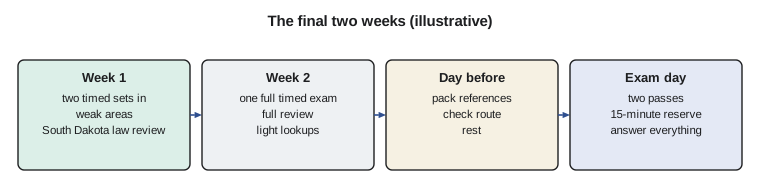
A final study plan should be lighter than the weeks before it. Marit's plan for the two weeks before her seat has three parts. First, two short timed sets per week in her weakest content areas, services and motors, using questions she had not seen. Second, one more full timed exam a week before the test, at the same hour as her real seat, followed by a full review. Third, a South Dakota law review, because the Commission's rules say the exam draws on state statutes and rules as well as the code. For the law review she will use the summary sections of Lessons 1 through 11 of this course and drill the numbers that most often appear in questions.
| Topic | Numbers to know | Lesson |
|---|---|---|
| Experience | 4,000 journeyman hours, 2,000 commercial; one year is 2,000 hours | 2 |
| Exam | 100 questions, 5 hours, open book, pass mark 70; retest after 30, then 90 days | 3, 4 |
| Code | 2023 NEC with TIAs 23-1 to 23-15; 210.8(F) not adopted; 334.10 clarified | 5 |
| Permits | Over 60 amperes; 20 dollars; 3 years; white copy in 15 days; 72 hours' notice; 250-dollar late fee | 6 |
| Duties | 30-day notices; personal supervision of apprentices; Class 2 misdemeanor for unlicensed contracting | 7 |
| Undertaking and insurance | 10,000 undertaking; 50 deposit; 100,000 and 300,000 liability; 25,000 property damage or 300,000 combined | 8 |
| Liens | 120 days to file; certified mail to owner first; 30 days after demand; 6 years to enforce | 9 |
| Safety and injuries | Federal OSHA; 8 and 24 hours; 3 business days; 7 days to the carrier | 10 |
| Renewal | June 30 of even years; 16 hours, 8 code, at most 8 online; 50-dollar reinstatement within one year | 11 |
Five practice questions with reasoning
The questions below are written for this course in the style of the exam. Work each one before reading the reasoning.
Worked problem
Practice 1: eligibility
A journeyman has 5,200 licensed hours, of which 1,900 are commercial. Can she sit the contractor exam?
Show solution
- Total licensed journeyman hours exceed 4,000.
- Commercial hours must be at least 2,000; she has 1,900.
- Both conditions must be met.
Answer: No; she needs 100 more commercial hours.
Worked problem
Practice 2: permits
A contractor starts a 200-ampere farm service on May 4 and mails the white copy on May 22. What is the consequence?
Show solution
- The white copy is due within 15 calendar days of starting, by May 19.
- May 22 is late.
- Late permit procedure carries an administrative fee.
Answer: A 250-dollar administrative fee under the permit rule.
Worked problem
Practice 3: liens
Last work on a private office was August 10. The contractor mails the statement to the owner by certified mail on December 1 and files on December 5. Is the lien timely?
Show solution
- 120 days after August 10 is December 8.
- Mailing came before filing, as SDCL 44-9-17 requires.
- Filing on December 5 is within 120 days.
Answer: Yes, if the statement's contents meet SDCL 44-9-16.
Worked problem
Practice 4: code adoption
A question asks whether South Dakota requires GFCI protection under section 210.8(F) for an outdoor outlet at a new house.
Show solution
- The question asks specifically about South Dakota.
- ARSD 20:44:14:01 excludes 210.8(F) from adoption.
- Other subsections of 210.8 may still apply to the same outlet.
Answer: Not under 210.8(F) in South Dakota; check whether another part of 210.8 applies.
Worked problem
Practice 5: injuries
An employee loses a fingertip in a saw accident on a Tuesday at noon. What must the employer do and when?
Show solution
- An amputation must be reported to OSHA within 24 hours, by Wednesday noon.
- The First Report of Injury goes to the carrier within seven days excluding Sundays and holidays.
- The case is recorded on the OSHA 300 log.
Answer: Report to OSHA by Wednesday noon, file the First Report with the carrier within the seven-day count, and record the case.
Reading questions the way the exam writes them
Exam questions follow patterns, and recognizing them saves time. A question that begins with a long story about a building and ends with a short demand, such as what is the minimum size, wants one number from one rule; the story supplies only the facts that pick the row of a table or the right exception. A question that asks which of the following is not permitted is usually four permitted options and one forbidden one, so look for the one that breaks a rule rather than checking every rule for every option. A question that gives a calculated value among its options often includes the values a candidate would get by making the common mistakes, such as forgetting a demand factor or using the wrong conductor temperature column, so an answer that appears among the options is not proof that it is right.
State law questions have patterns too. They tend to test the boundaries of a license class, the order of steps in a process, or a single number from a rule. When a South Dakota law question lists four numbers, check whether two of them are close variants, such as 15 days and 15 business days, or 30 days and one month. The rule's exact unit is usually the point of the question. Marit keeps a one-page sheet of South Dakota numbers, the table in this lesson, and drills it the way she drills code lookups. The sheet stays home on exam day; the goal is to have it in her head by then.
The day before and the morning of
The day before the exam is for rest and logistics, not new material. Marit's checklist says to pack her code book, Ugly's and her key word index, check each for loose papers and sticky notes, pack her identification and the confirmation from Pearson VUE, and check the drive time to the test center with an extra half hour for winter roads. Then bed early. On the morning of the exam: a real breakfast, arrival thirty minutes early, and the wait used to look at nothing more demanding than the parking lot.
At check-in, staff verify identification and inspect reference books. Lockers hold everything else. Once seated, the candidate usually gets a short tutorial on the computer interface. The exam clock starts when the first question appears.
During the exam
The two-pass method from Lesson 4 is the core of the plan. On the first pass, answer every question that takes under two minutes and flag the rest. Keep an eye on the clock: after about two and a half hours, Marit wants to be through the first pass with roughly seventy questions answered. On the second pass, work flagged questions in the order of how close you came the first time. Leave fifteen minutes at the end to make sure every question has an answer. Change an answer only for a clear reason, such as finding the rule that settles it; a vague feeling is not a reason.
Calculations deserve their own routine. Write the formula on the scratch material provided, write each value with its unit, find each table value in the book rather than from memory, and check the answer against common sense. A 2,000-square-foot house does not need a 600-ampere service.
After the score report
Results print at the test center. A candidate who passes takes the score report home and starts the licensing steps from Lesson 3: within ninety days, pay the 200-dollar license fee, file the notarized undertaking, pay the 50-dollar deposit and put the certificate of insurance on file, unless the employer already meets those requirements. Only when the Commission issues the license may the new contractor buy permits and contract in his or her own name. A candidate who does not pass waits thirty days to retest, uses the score report's content-area feedback to target study, and books the next seat inside the time the Commission allows.
For Marit, the plan after passing is already written on Joanne's calendar: notarize the bond application Monday, mail it with the fee and deposit, ask the agent to issue the certificate to the Commission, and update the company's letterhead and permit records once the license number arrives. Dale has promised to stay on as an inactive licensee for a year so she can call him with questions, which, he says, is the best continuing education there is.
Common mistakes
MistakeReviewing only the questions you got wrong because of knowledge gaps.
InsteadSort misses by reason; reading and lookup misses are often the biggest group.
MistakeCramming new topics the night before.
InsteadUse the last day for logistics and rest.
MistakeLeaving questions blank.
InsteadThere is no stated penalty for a wrong answer; answer every question.
MistakeChanging answers on a hunch.
InsteadChange only when you find a rule that settles it.
MistakeBuying permits the day after passing.
InsteadWait until the Commission issues the license after the undertaking, insurance and fee are filed.
Summary and key terms
- Review practice exams by reason for each miss, not just by topic.
- Use the last two weeks for weak areas, one full timed exam and a South Dakota law review.
- Know the key South Dakota numbers for experience, permits, insurance, liens, injuries and renewal.
- Prepare references and logistics the day before; arrive early.
- Use two passes and a fifteen-minute reserve.
- After passing, complete the licensing steps within ninety days before contracting.
- Error log
- A record of each practice miss with its area, rule, time and reason.
- Reading miss
- A wrong answer caused by misreading what the question asked.
- Two-pass method
- Answering quick questions first and returning to flagged ones.
- Score report
- The result printed at the test center, used to complete licensing or plan a retake.
- Limiting words
- Words such as minimum, maximum, not and except that decide what a question asks.
Practice problems
Work each problem on paper first, then reveal the answer to check.
What should Marit do first with a practice exam score?
Show answer
Sort every miss by reason and fix the largest group.
How long should the first pass take on a five-hour exam?
Show answer
About two and a half hours, leaving time for flagged questions and a reserve.
When may a new contractor buy permits after passing?
Show answer
Only after the Commission issues the license.
How long is the wait for a first retest?
Show answer
Thirty days.
What South Dakota law topics are worth reviewing?
Show answer
Experience, permits, undertaking and insurance, liens, injury reporting and renewal.
Lesson quiz · 5 questions
Score 60% or more to complete this lesson.
Create a free account to save your progress, take quizzes and earn a certificate.