
MELU-316 · Lesson 8 of 12 · 22 min
Contractor licensing, insurance and bonding
▶ Video coming soon A video version of this lesson is on the way.
Joanne Riedel keeps one drawer at Coteau Ridge Electric for paper that can stop the company cold: the undertaking on file with the State Electrical Commission, the receipts for the fund deposits, the current certificate of insurance, the company's registration with the Secretary of State, its tax licenses and the Sioux Falls city license. Every two years, and every time a policy renews, she checks each item against its expiration date. When Marit Halvorsen becomes the company's licensee, most of that drawer will be tied to her license number. This lesson explains what each item is, what the law requires, and how insurance differs from the undertaking and from the bonds public owners demand.
The undertaking
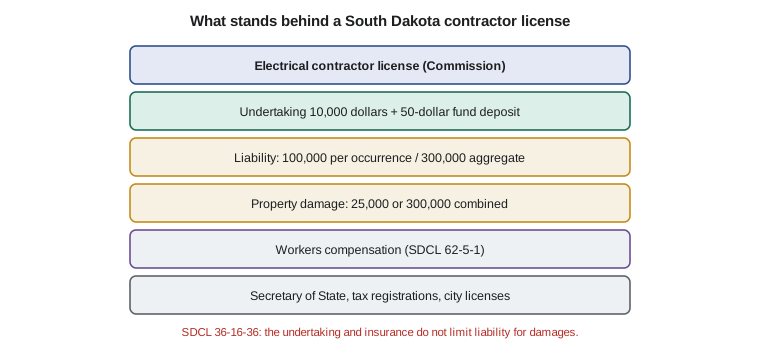
SDCL 36-16-20 requires each applicant for an electrical contractor or Class B electrician license to execute an undertaking of 10,000 dollars and deposit it with the State Electrical Commission before the license issues. The Commission's undertaking and insurance page explains how it works in practice. Each applicant pays a 50-dollar deposit when executing the undertaking and again at each biennial renewal. The deposits go into a special fund the Commission uses to correct or complete installations that a contractor or Class B electrician refuses or is unable to finish, to cover inspection or administrative fees that cannot be collected, and to pay the costs of maintaining the fund and enforcing the chapter. Disbursements may not exceed 10,000 dollars for any one occurrence. The deposit is waived at renewal when the fund is above 50,000 dollars.
The undertaking is filed on the Commission's electrical contractor and Class B electricians' bond application, which must be printed, notarized and returned. The undertaking and the required insurance must be in force at all times; a lapse in either is a lapse in the conditions for holding the license.
Two exemptions matter. First, when the licensee works for a partnership or corporation that meets the undertaking and insurance requirements, the licensed individual is exempt from meeting them separately. Second, a licensed electrical contractor or Class B electrician needs no additional undertaking for a municipal license, so a Sioux Falls license does not require a second state-style undertaking. An inactive license under SDCL 36-16-13.3 is also exempt from the undertaking, because the holder may not do contractor or Class B work.
Insurance minimums
SDCL 36-16-20 and the Commission's page set minimum insurance for contractors and Class B electricians. Public liability insurance must be at least 100,000 dollars per occurrence and 300,000 dollars in the aggregate for bodily injury. Property damage coverage must be at least 25,000 dollars per occurrence, or the policy may instead carry a combined single limit of 300,000 dollars. Certificates of insurance must be on file in the Commission's office. The statute allows security approved by the Commission in an equal amount as an alternative to the policy.
These are minimums for licensing, not recommendations. Many general contractors, public owners and commercial customers require far higher limits, often a million dollars per occurrence with an umbrella, and they will name the requirement in the contract. Coteau Ridge carries limits well above the state minimum because its commercial customers demand it. When Marit becomes the licensee, the agent will issue a certificate to the Commission naming her license, and certificates to each customer that asks.
| Requirement | Minimum | Source |
|---|---|---|
| Undertaking | 10,000 dollars | SDCL 36-16-20 |
| Fund deposit | 50 dollars at application and each renewal (waived when the fund exceeds 50,000) | SDCL 36-16-20; Commission page |
| Fund payout cap | 10,000 dollars per occurrence | Commission page |
| Public liability, bodily injury | 100,000 per occurrence; 300,000 aggregate | SDCL 36-16-20 |
| Property damage | 25,000 per occurrence, or 300,000 combined single limit | SDCL 36-16-20 |
Insurance protects whom?
Insurance, undertakings and bonds look similar on paper but protect different people. A general liability policy protects the contractor against claims by third parties for bodily injury and property damage caused by its work; the insurer defends the claim and pays within the limits. The undertaking and the Commission's fund protect the public and the Commission: when a contractor walks away from an unsafe or unfinished installation, the fund can pay to correct or complete it, up to its cap. A performance bond on a construction contract protects the project owner if the contractor fails to perform, and a payment bond protects subcontractors and suppliers who are not paid. SDCL 36-16-36 adds an important point: the undertaking and insurance do not limit the contractor's liability for damages. A contractor whose work causes harm is liable for the full loss, whatever the policy limits.
When the fund is used
The special fund exists for a specific problem: a contractor who leaves an unsafe or unfinished installation and will not or cannot fix it. Suppose a small contractor wires a house near Arlington, fails the rough-in for a long list of violations, and then closes the business. The owner cannot occupy the house without a final inspection, and no one is under contract to correct the work. The Commission can use the fund to pay for the correction or completion, up to 10,000 dollars for the occurrence, and can pursue the contractor for what the fund paid. The fund also covers inspection and administrative fees the Commission cannot collect. It is not a general customer-protection fund for poor workmanship, delays or price disputes; those remain contract claims between the owner and the contractor, and the contractor's insurance or the courts address them.
Worked problem
Is this a fund claim?
A homeowner in Castlewood complains to the Commission that her contractor finished the job, passed final inspection, but charged far more than the estimate and left drywall dust everywhere.
Show solution
- The installation passed final, so there is no unsafe or unfinished electrical installation to correct.
- The complaint is about price and cleanup, which are contract matters.
- The fund is limited to correcting or completing installations and uncollectable fees.
Answer: Not a fund claim. The homeowner's remedy is under her contract; the Commission may still look at whether any law or rule was broken.
Coverage details that matter on real jobs
Beyond the limits, a few policy features come up on almost every commercial contract. An additional insured endorsement adds the general contractor or owner to the electrical contractor's policy for claims arising from the contractor's work. Completed operations coverage protects against claims that arise after the job is finished, such as a fire traced to a connection years later; for an electrical contractor it may be the most important part of the policy. A waiver of subrogation, often required by owners, gives up the insurer's right to recover from the owner after paying a claim. And a primary and noncontributory clause makes the contractor's policy pay before the owner's own coverage. None of these is required by South Dakota's licensing law, but contracts commonly demand them, and an agent who understands electrical contracting will explain the cost of each.
Workers compensation
SDCL 62-5-1 requires employers that come within the workers compensation title to secure the payment of compensation to their employees, by insurance or by qualifying to self-insure. Coteau Ridge carries a workers compensation policy, and customers routinely ask for a certificate showing it. Lesson 10 covers injury reporting and the employer's other duties.
Other licenses and registrations
South Dakota has no state general contractor license. An electrical contractor's state trade license comes from the Commission, but the business also has to meet general business rules. A limited liability company or corporation registers with the Secretary of State and files annual reports. The Department of Revenue administers sales and use tax and a contractor's excise tax on gross receipts from construction work under SDCL chapter 10-46A; contractors register for the taxes that apply to them. This course does not give tax rates, because they are set by law and can change; check the Department of Revenue's contractor guide. Some cities also license contractors. Sioux Falls requires a valid South Dakota license before it issues city electrical licenses, and its form says the employer must be licensed as an electrical contractor in Sioux Falls.
Out-of-state contractors working in South Dakota need a South Dakota license, either by passing the exam or by reciprocity under SDCL 36-16-23, plus the undertaking and insurance, plus the business and tax registrations. A Minnesota company that wins a bid in Watertown cannot simply send a crew across the border.
Public works and surety bonds
Public owners in South Dakota rely on bonds rather than liens, because liens do not attach to public property. SDCL chapter 5-21 requires a contractor on a public improvement contract to furnish a bond with surety in an amount not less than the contract price, protecting the public body and those who furnish labor and materials. The chapter allows waiver of the bond for smaller contracts under a threshold tied to the state's bid limits; this course does not state that threshold, because it is set by reference to other statutes and changes. Claimants on the bond have time limits; SDCL 5-21-6 allows a claimant suit only after a set period following completion and final settlement, and requires it within a stated time after that. Lesson 9 returns to public projects.
For an electrical subcontractor on a school or city building, the practical steps are to get a copy of the general contractor's payment bond at the start of the job, keep records of every delivery and every hour, and track the bond claim deadlines alongside the payment schedule.
Keeping it all current
Every item in Joanne's drawer has a renewal date. Licenses expire on June 30 of even-numbered years. Insurance policies renew annually on their own dates. The fund deposit is due at each license renewal unless waived. Business filings with the Secretary of State and tax returns have their own calendars. A lapse in insurance is the most dangerous, because the license conditions require coverage at all times, and a claim during a gap may not be covered at all. Coteau Ridge's agent sends the Commission a renewal certificate each year, and Joanne confirms it arrived.
# Renewal calendar for Coteau Ridge's license-related items (illustrative dates)
from datetime import date
today = date(2026, 11, 20)
items = {"general liability policy": date(2027, 3, 1),
         "workers compensation policy": date(2027, 1, 1),
         "contractor license (Dale)": date(2028, 6, 30),
         "Secretary of State annual report": date(2027, 4, 1),
         "Sioux Falls city license": date(2027, 12, 31)}
for name, due in sorted(items.items(), key=lambda kv: kv[1]):
    days = (due - today).days
    flag = "renew now" if days < 60 else "ok"
print(f"{name}: due {due} ({days} days) {flag}")workers compensation policy: due 2027-01-01 (42 days) renew now general liability policy: due 2027-03-01 (101 days) ok Secretary of State annual report: due 2027-04-01 (132 days) ok Sioux Falls city license: due 2027-12-31 (406 days) ok contractor license (Dale): due 2028-06-30 (588 days) ok
Worked problem
Comparing coverage to a contract requirement
A Sioux Falls general contractor's subcontract requires 1,000,000 dollars per occurrence and 2,000,000 aggregate general liability, a 2,000,000 umbrella, and workers compensation. Coteau Ridge's policy carries 1,000,000 and 2,000,000 with a 1,000,000 umbrella.
Show solution
- Compare each line: per occurrence and aggregate meet the requirement.
- The umbrella is 1,000,000 short.
- State minimums are met by a wide margin, but the contract governs this job.
- Workers compensation must be shown on the certificate.
Answer: Increase the umbrella for the job or negotiate the requirement before signing; meeting the state minimum does not satisfy the contract.
Common mistakes
MistakeThinking the undertaking caps the contractor's liability.
InsteadSDCL 36-16-36 says the undertaking and insurance do not limit liability for damages.
MistakeLetting insurance lapse between policies.
InsteadCoverage must be in force at all times.
MistakeBuying a second undertaking for a city license.
InsteadNo additional undertaking is needed for a municipal license.
MistakeAssuming the state minimum satisfies a customer's contract.
InsteadContracts often require much higher limits.
MistakeLooking for a South Dakota general contractor license.
InsteadThere is none; the electrical license comes from the Commission and business and tax registrations are separate.
Summary and key terms
- Contractors and Class B electricians file a 10,000-dollar undertaking and pay a 50-dollar fund deposit.
- The fund pays up to 10,000 dollars per occurrence to correct or complete abandoned installations.
- Minimum insurance is 100,000 and 300,000 dollars bodily injury and 25,000 property damage, or a 300,000 combined limit.
- An employer that meets the requirements exempts its licensed employee.
- Undertakings and insurance do not limit liability.
- Public improvement contracts require surety bonds under SDCL 5-21.
- Undertaking
- The 10,000-dollar obligation filed with the Commission under SDCL 36-16-20.
- Special fund
- The Commission fund built from deposits, used to correct or complete installations.
- Combined single limit
- One insurance limit covering bodily injury and property damage together.
- Payment bond
- A surety bond that protects subcontractors and suppliers on public work.
- Certificate of insurance
- A document from the insurer showing the coverage in force.
Practice problems
Work each problem on paper first, then reveal the answer to check.
What undertaking amount does SDCL 36-16-20 require?
Show answer
10,000 dollars.
What is the most the fund pays for one occurrence?
Show answer
10,000 dollars.
Does Marit need her own undertaking if Coteau Ridge meets the requirement?
Show answer
No; the employer's compliance exempts her.
What protects an unpaid supplier on a city library project?
Show answer
The contractor's payment bond under SDCL 5-21.
Does a 300,000-dollar combined single limit satisfy the property damage rule?
Show answer
Yes; it is the alternative to 25,000 per occurrence.
Lesson quiz · 5 questions
Score 60% or more to complete this lesson.
Create a free account to save your progress, take quizzes and earn a certificate.