
MELU-316 · Lesson 6 of 12 · 20 min
Permits, inspections and the inspection authority
▶ Video coming soon A video version of this lesson is on the way.
Every South Dakota electrician has a story about a pink or yellow permit copy that went missing. At Coteau Ridge Electric the story is about a machine shed near Bruce in 2021: the crew finished early, the service was energized, and three weeks later the Commission's copy of the permit was still in a truck's door pocket. The fee for that lesson was 250 dollars. Marit Halvorsen was the foreman on the job. As the future licensee, she will be the person responsible for every permit the company files, and this lesson walks through the wiring permit system, the inspection process, condemnation and appeals, and how Sioux Falls and Rapid City fit in.
Who inspects
SDCL 36-16-29 gives the Commission inspectors with power to inspect and approve or condemn any wiring installation, except work exempt under SDCL 36-16-16. The Commission divides the state into districts, each served by a state electrical inspector working from a home base in or near the district, and posts a district map and the inspector list on its inspections page. Two cities, Rapid City and Sioux Falls, have local inspection departments for work inside their city limits. Everywhere else, including Brookings, Watertown, Aberdeen, Pierre and Mitchell and all of rural South Dakota, the state inspector for the district is the inspection authority.
The Commission's inspections page says that all electrical wiring must be inspected, and that two inspections are the norm: a rough-in and a final. Work is not approved until it passes the final, after which the inspector places a final sticker near the service panel. To request an inspection, contact the district's inspector, putting the permit number in the subject line of an email or leaving a voicemail during working hours.
When a wiring permit is required
ARSD 20:44:18:01 requires a wiring permit for three kinds of work. The first is any service entrance installation over 60 amperes; one permit may cover the temporary and the new service on the same project if the same contractor installs both. The second is wiring done by an owner under the owner exemption. The third is any other installation where the estimated inspection fee is 30 dollars or more. In practice, nearly every job that adds a service or more than a few circuits needs a permit. The homeowner page adds that an inspection may be requested for any installation even when no permit is required.
Only certain people may obtain a permit. ARSD 20:44:18:03 limits wiring permits to an electrical contractor or Class B electrician with an active license, or an owner using the exemption, and an owner's permit may not be used by anyone else. A journeyman cannot buy a permit. That is one more reason the company needs a licensed contractor: no contractor license, no permits, no legal work.
The five-copy permit
The state's wiring permit is a multi-part form sold by the Commission office. ARSD 20:44:18:02 sets the price at 20 dollars, within the 20-dollar cap in SDCL 36-16-30. A permit is valid for three years from issue; an installation that will run longer needs a new permit before the old one expires. The rule describes what happens to each copy, and the sequence is worth memorizing because it is a favorite of law questions.
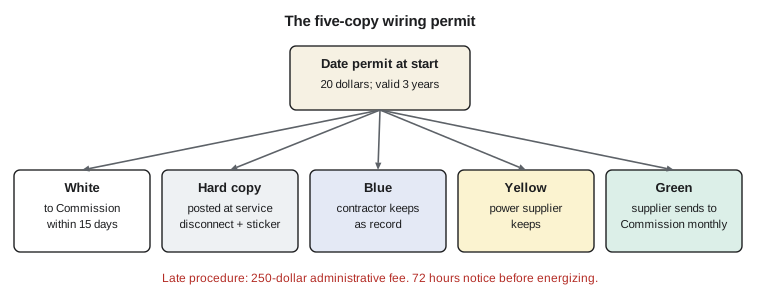
The contractor dates the permit when the job starts. The white copy goes to the Commission within fifteen calendar days after starting. The hard copy is posted near the service entrance disconnect, with its peel-off sticker attached to the outside of the service. The blue copy is the contractor's record. The yellow and green copies go to the power supplier, which needs them before it will energize the service; the supplier keeps the yellow copy and sends the green copies to the Commission each month. Because the power supplier reports energized services to the Commission, a job that was energized without the Commission receiving its white copy is easy to find.
| Copy | Where it goes | When |
|---|---|---|
| White | State Electrical Commission | Within 15 calendar days after the job starts |
| Hard copy and sticker | Posted near the service disconnect; sticker on the outside of the service | At the start of work |
| Blue | Kept by the contractor | At the start of work |
| Yellow | Power supplier, which keeps it | Before energizing |
| Green | Power supplier, which sends it to the Commission | Monthly, by the supplier |
Late procedure fees
The rule attaches a 250-dollar administrative fee to four failures: not dating the permit at the start of the job, not sending the white copy within fifteen days, not posting the permit form and sticker, and not renewing the permit for an incomplete installation before it expires. SDCL 36-16-30 caps the fee for late correction orders or late permit procedures at 250 dollars. ARSD 20:44:19:02 adds a separate charge: if an installation is connected and in use without a posted permit, the inspection fee is increased by 25 dollars. The Bruce machine shed cost Coteau Ridge the 250-dollar fee because the white copy reached Pierre long after fifteen days.
Joanne Riedel's fix was simple. Every permit is now logged in the office the day it is dated, with the job name and a white-copy deadline fifteen days later, and the foreman photographs the posted permit and sticker and texts the photo to the office. The calculator below shows the deadline check.
# White-copy deadline check for open permits (illustrative)
from datetime import date, timedelta
today = date(2026, 11, 20)
permits = [("P-1101", "Volga farm shop", date(2026, 11, 2), True),
           ("P-1102", "Brookings dental office", date(2026, 11, 9), False),
           ("P-1103", "Elkton house", date(2026, 11, 4), False)]
for num, job, started, white_sent in permits:
    due = started + timedelta(days=15)
    if white_sent:
        status = "sent"
    elif today > due:
        status = f"LATE since {due}; 250-dollar fee exposure"
    else:
        status = f"due {due}"
print(f"{num} {job}: {status}")P-1101 Volga farm shop: sent P-1102 Brookings dental office: due 2026-11-24 P-1103 Elkton house: LATE since 2026-11-19; 250-dollar fee exposure
Advance notice, energizing and the inspection stages
ARSD 20:44:19:01 requires 72 hours' notice before energizing an installation, and the homeowner page asks owners to give their inspector at least 72 hours' notice for inspections as well. The rough-in inspection must happen before insulation, drywall, paneling or other covering conceals the work; ARSD 20:44:19:03 describes the dated, signed blue rough-in tag the inspector places near the service disconnect. The final inspection follows completion, and approval is shown by the final sticker. The homeowner page notes that no law requires a green final sticker as such, but home inspectors often look for one when a house is sold, so a missing final can surface years later.
Large projects may need more visits, such as an underground or slab inspection before concrete, or a service inspection before the utility connects. Ask the district inspector at the start of a commercial job how many visits to plan and what must be open for each.
Worked problem
Planning inspections for a dental office
Coteau Ridge is wiring a 4,800 square foot dental office in Brookings with a new 400-ampere, three-phase service, an underground feeder from a pad-mounted transformer, and walls that will be closed in four weeks.
Show solution
- Permit: the service is over 60 amperes, so a permit is required; date it the day work starts and send the white copy within fifteen days.
- Underground: ask the district inspector whether to call before backfilling the feeder trench.
- Rough-in: schedule before the drywall crew arrives, with at least 72 hours' notice, and leave all boxes and cable runs visible.
- Service and energizing: give the power supplier its copies and coordinate with the inspector's approval.
- Final: after devices, fixtures and panel directories are complete; confirm the final sticker is placed.
Answer: Four inspection points, each with a date on the job schedule, and the permit log entry made the day work starts.
Inspection fees
Inspection fees are separate from the permit price. SDCL 36-16-30 sets maximum fees by type of installation: new residential installations and service connections in tiers by ampacity up to 390 dollars plus circuit fees, circuit installations or alterations up to 65 dollars, remodeling fees per opening and fixture, motors and special equipment up to 18 dollars each, apartment buildings up to 150 dollars per unit, mobile home services up to 100 dollars per unit, and RV services up to 25 dollars per unit. A statutory minimum fee applies when a calculated fee falls below it. The Commission's fee schedule sets the actual amounts within those caps, and the inspections page notes that residential fees cannot exceed the flat rate for wiring a complete home. Check the current schedule when pricing a job.
Condemnation and appeal
SDCL 36-16-31 lets an inspector condemn an installation found hazardous to life or property and order the service discontinued, but only after notice to the owner. The owner may appeal to the Commission, and from the Commission to circuit court under the state's administrative procedure chapter, SDCL 1-26. SDCL 36-16-32 says a condemned installation may not be reconnected until it is shown to comply. A correction order that is not met can also carry the late correction fee under SDCL 36-16-30.
For a contractor the practical lesson is that inspection disputes have a path. If an inspector rejects work and the contractor believes the inspector misread the code, the first step is a calm conversation with the code section open. If that fails, the contractor can ask the Commission office for guidance. Formal appeals are for real disagreements about the law or the code, not for avoiding a correction.
Sioux Falls and Rapid City
Inside Sioux Falls and Rapid City, the city's electrical inspectors inspect, and the city's permit process applies in place of the state's district inspection for work within city limits. ARSD 20:44:18:05 adds that permits are still required where local inspection systems operate, so the contractor should follow the city's permit and inspection rules for each job. Sioux Falls also issues city electrical licenses. Its 2025 license form says applications are accepted only with a valid South Dakota license, that the employer must be licensed as an electrical contractor in Sioux Falls, and it lists city license fees for journeymen, apprentices and inactive contractors. This course did not confirm the current permit fees or local amendments in either city, so read the city's own pages before bidding.
Working with inspectors is a relationship, and a good one saves time. Inspectors in large rural districts drive long distances, so a contractor who calls for inspection only when the work is truly ready, leaves the permit number and the address clearly, and has someone on site or the building open earns quick visits. Marking each correction item as it is fixed, with a photo sent to the inspector where the inspector allows it, can save a second trip.
Exempt work
SDCL 36-16-16 lists work that needs no electrician's license: utility employees working on generation and distribution up to the first point of attachment, communications and pipeline workers on their own systems, work on vehicles, ships, railway rolling stock and certain packing plant equipment, replacing lamps and plugging in portable devices, appliance repair shops, and certain power-limited alarm and communications work when designed, supervised or installed by qualified persons. Owner wiring under SDCL 36-16-15 is a separate exemption, with its own permit and inspection rules covered in Lesson 7. SDCL 36-16-25 exempts emergency repairs to farmstead and residential wiring. An exemption from licensing is not always an exemption from inspection, and questions often test that difference.
Common mistakes
MistakeLetting a journeyman buy the permit.
InsteadOnly an active electrical contractor or Class B electrician, or an exempt owner, may obtain a permit.
MistakeMailing the white copy at the end of the job.
InsteadIt is due within fifteen calendar days after the job starts.
MistakeEnergizing before notifying the inspector.
InsteadThe rules require 72 hours' notice before energizing.
MistakeAssuming one permit lasts until the job is done.
InsteadPermits last three years; renew before expiration for long installations.
MistakeCalling the state inspector for a job inside Sioux Falls.
InsteadSioux Falls and Rapid City inspect inside their own limits.
Summary and key terms
- State inspectors in districts inspect, except where Sioux Falls and Rapid City inspect inside city limits.
- Permits are required for services over 60 amperes, owner wiring and installations with an inspection fee of 30 dollars or more.
- The five-copy permit costs 20 dollars and lasts three years.
- The white copy goes to the Commission within fifteen days; the yellow and green copies go to the power supplier.
- Late procedure carries a 250-dollar administrative fee.
- Give 72 hours' notice before energizing; rough-in before cover, then final and sticker.
- Wiring permit
- The five-copy form bought from the Commission and posted at the job.
- Rough-in inspection
- The inspection of wiring before it is concealed.
- Final sticker
- The marker placed near the service panel when the final inspection passes.
- Condemnation
- An inspector's finding that an installation is hazardous, with an order to discontinue service.
- District inspector
- The state electrical inspector assigned to a part of the state.
Practice problems
Work each problem on paper first, then reveal the answer to check.
A job started November 3. When is the white copy due?
Show answer
Within fifteen calendar days, by November 18.
Who may obtain a wiring permit?
Show answer
An active electrical contractor or Class B electrician, or an owner using the exemption.
How long is a wiring permit valid?
Show answer
Three years from issue.
How much notice before energizing?
Show answer
72 hours.
Can a condemned installation be reconnected after a week?
Show answer
Only after it is shown to comply, under SDCL 36-16-32.
Lesson quiz · 5 questions
Score 60% or more to complete this lesson.
Create a free account to save your progress, take quizzes and earn a certificate.