
MELU-314 · Lesson 9 of 12 · 21 min
Contracts and mechanics' liens in Rhode Island
▶ Video coming soon A video version of this lesson is on the way.
Frank has a saying about money: you get paid on the day you sign the contract, not on the day you send the bill. What he means is that the contract decides whether a dispute can be won, and the paperwork done before the first wire is pulled decides whether the company keeps its lien rights. Rhode Island's mechanics' lien law is a good example. A contractor who deals directly with the owner and forgets one notice before starting work can lose its lien entirely, no matter how good its work was. As a Class A license holder and an officer of the company, Ana will sign contracts and decide when to use the lien law. This lesson covers the essentials of an electrical contract, change orders and consumer jobs, and then the Rhode Island lien law in Chapter 34-28 of the General Laws: who can claim a lien, the notice a direct contractor must give before starting, the notice of intention and its 200-day deadline, the 40-day deadline to enforce, and the rules for public work.
This lesson explains general rules, not legal advice for a particular dispute. Lien law is strict and technical, and a mistake in a notice or a missed deadline can be fatal to the claim. When real money is at stake, talk to a Rhode Island construction lawyer early. The lien facts below were checked in November 2026 against the statutes and published lien guides.
What a good electrical contract says
A contract does not have to be long, but it has to be clear. For an electrical contractor, the essentials are the parties and the job address, the scope of work described specifically enough that both sides can tell what is included and what is not, the price or the method of pricing, the payment schedule and any retainage, the start and completion dates, and the procedure for changes. Electrical contracts should also say who obtains and pays for the permit, which code edition the price is based on, how concealed conditions will be handled, who supplies which equipment, and what warranty the contractor gives. Rhode Island requires the contractor license number on contracts and consumer bids, as Lesson 7 explained, and for a direct contract with an owner, the contract is a convenient place to include the notice of possible mechanic's lien discussed below.
The code edition clause matters even in a state with one code, because a new edition can take effect during a long project, as it did on December 1, 2025. A clause stating the edition the price is based on turns a code change into a change order. The concealed conditions clause matters in Rhode Island's older housing stock, where knob-and-tube wiring, undersized services and old aluminum branch circuits turn up behind plaster. Ana's standard proposal says that the price assumes the conditions visible at the walkthrough and that hidden conditions will be priced as a change.
| Contract term | Why it matters |
|---|---|
| Scope of work and exclusions | Defines what the price covers and what is extra |
| Price, payment schedule and retainage | Sets when money is due and how much is held back |
| Change order procedure | Makes extra work billable and documented |
| Code edition and permits | Puts the risk of a code change where it belongs |
| Concealed conditions | Prices hidden problems as changes, not losses |
| Pre-work lien notice (direct contracts) | Preserves the direct contractor's lien rights under 34-28-4.1 |
| License number | Required on contracts and consumer bids by 5-6-2 |
Changes and payment
Changes are the biggest source of payment disputes. The contract should require changes to be in writing, signed before the work is done, with a price or a method for pricing them. In the field, someone always asks for one more outlet or one more circuit, and a foreman who does the work without a signed change order may be doing it for free. Marcus carries a pad of one-page change order forms, and the company rule is no signature, no work. Invoices should match the contract and the approved change orders line for line, so that an owner or lender can see at a glance what is owed and why.
Retainage, the share of each payment held back until the end of the job, is common on commercial work. Rhode Island has statutes on payment timing and retainage on public contracts, including provisions in Chapter 37-12 and the state's prompt payment rules for public work, and private contracts usually set their own terms. Read the contract and the current statutes before relying on any particular number.
Consumer jobs
Work for a homeowner is a consumer transaction. Rhode Island's Deceptive Trade Practices Act, Chapter 6-13.1, prohibits unfair and deceptive practices, such as misrepresenting what work is needed or what it will cost. When a contract is signed at the customer's home, federal and state rules on sales made away from the seller's place of business can give the customer a short right to cancel, which must be explained in writing. For residential jobs, a clear written estimate, a signed contract with the license number and the lien notice, and honest explanations of what the code requires protect both the customer and the company.
What a mechanics' lien is
A mechanics' lien is a claim against real property, the land and the building, for the value of labor and materials furnished to improve it. It allows an unpaid contractor, subcontractor or supplier to ask the court to have the property sold to pay the debt. In Rhode Island the law is Chapter 34-28 of the General Laws, titled Mechanics' Liens. Section 34-28-1 gives a lien to those who furnish work or materials under a contract with, or at the request of, the owner, and later sections extend it to work for lessees and tenants and to equipment rental. Rhode Island's lien is available to subcontractors and suppliers down the chain, not only to the contractor hired by the owner. The lien is powerful because it ties the debt to the property, and it is strict because it affects owners who may already have paid someone else.
Before work starts: the notice of possible mechanic's lien
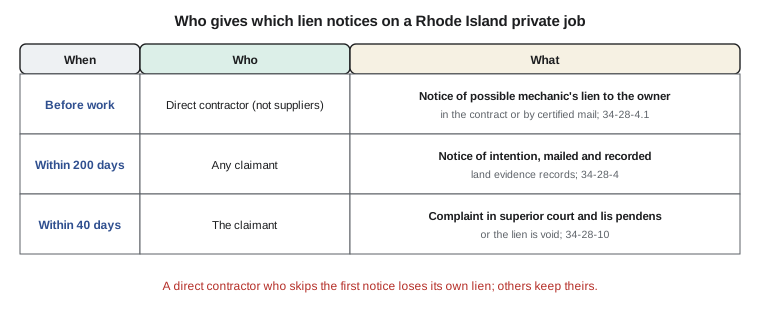
Section 34-28-4.1 imposes a requirement that catches many contractors. A person who contracts directly with the owner, or with a lessee or tenant, must give the owner a notice of possible mechanic's lien before commencing work or delivering materials. Material suppliers are excluded from the requirement. The notice must be either included conspicuously in the written contract or sent by certified mail, return receipt requested, and the statute provides the form. It tells the owner that the contractor and those it hires may file liens if they are not paid, and that the owner is responsible for seeing that they are paid.
The consequences of skipping the notice are severe for the direct contractor. A direct contractor who fails to give it is not entitled to claim a lien under the chapter, and must indemnify the owner against payments or costs from liens filed by others not in contract with the owner, unless the owner has not yet paid that contractor. The failure does not affect the lien rights of subcontractors and suppliers, who can still claim if they follow the procedure. For Pawtuxet Mill, the lesson is simple: every direct contract with an owner, from a panel change in a house to a fit-out for a store owner, includes the statutory notice, conspicuously, in the contract itself.
After work: the notice of intention and the 200 days
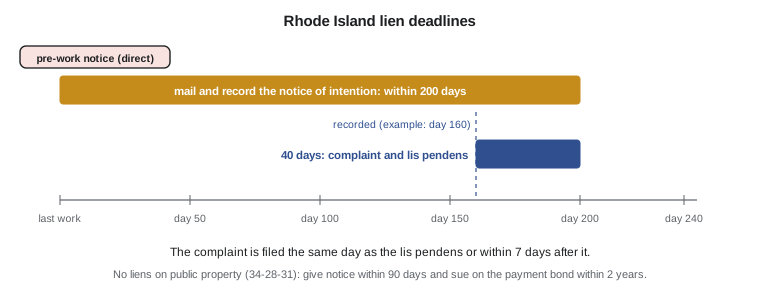
To claim a lien, a claimant must mail a notice of intention to the owner of record and record a copy in the land evidence records of the city or town where the property is located. Under section 34-28-4, this must be done before, or within 200 days after, the date the claimant last performed work or furnished materials. The notice must be mailed by certified or registered mail, return receipt requested, to the owner's last known residence or place of business, or to the property if no address can be found. It must be sworn and must contain the information the statute requires, including the owner's name, a description of the land, the nature of the work and materials, their value, and a statement that payment has not been made. If the mailed notice comes back undelivered, the statute requires the claimant to record it again with the returned envelope within thirty days after it comes back.
Recording is done with the town or city clerk or the recorder of deeds who keeps the land evidence records, and a small fee is charged. Section 34-28-9 addresses how far back the lien reaches, and published guides describe it as covering work done within the 200 days before recording, with retainage covered from the start of the job. Because the lien reaches back only so far, a contractor on a long job who is falling behind on payment should not wait until the end to act.
Enforcing the lien: the 40 days
Recording the notice of intention is not the end. Under section 34-28-10, the claimant must file a complaint to enforce the lien in the superior court for the county where the property lies, together with a notice of lis pendens, within forty days after recording the notice of intention. The lis pendens is recorded in the land evidence records and states that the complaint has been or will be filed, and the complaint must be filed the same day or within seven days after the lis pendens. If these steps are not taken in time, the statute says the lien is void and wholly lost. Forty days is a short time to hire a lawyer and prepare a complaint, so a contractor should involve counsel before recording the notice of intention, not after.
# Rhode Island lien deadline helper (days counted from the dates shown; confirm with counsel)
from datetime import date, timedelta

last_work = date(2026, 8, 20)
latest_notice = last_work + timedelta(days=200)
print("Mail and record the notice of intention by:", latest_notice)

recorded = date(2026, 11, 2)          # the day the notice of intention was actually recorded
latest_complaint = recorded + timedelta(days=40)
print("File the complaint and lis pendens by:", latest_complaint)

lis_pendens = date(2026, 12, 1)
print("Complaint no later than:", lis_pendens + timedelta(days=7), "if not filed the same day")Mail and record the notice of intention by: 2027-03-08 File the complaint and lis pendens by: 2026-12-12 Complaint no later than: 2026-12-08 if not filed the same day
The helper counts calendar days. Courts can be strict about how a deadline that falls on a weekend or holiday is treated, so do not plan to file on the last day.
Lien waivers
Owners, lenders and general contractors usually ask for lien waivers before releasing payment. A waiver gives up lien rights, so it must be handled with care. A conditional waiver gives up rights only when the stated payment is actually received. An unconditional waiver gives them up at once, whether or not the money arrives. Never sign an unconditional waiver for money you have not received, and read each waiver for its scope, because a waiver for one progress payment should not waive rights to retainage or unpaid change orders.
Public work
Under section 34-28-31, no lien attaches to improvements made by or for the state, a city or town, or their agencies, or to land they own. On public work, the protection comes from bonds. Chapter 37-12 requires prime contractors on covered public contracts to furnish payment bonds for the benefit of those who furnish labor and materials. A claimant who has a contract with a subcontractor but not with the prime contractor must give written notice to the prime contractor within ninety days from the date it last performed work or furnished materials, by certified mail, stating the amount claimed and the party it worked for, under section 37-12-2. Section 37-12-5 bars suit after two years from the last day of labor or materials, or a longer time if the bond allows. Before starting public work, get a copy of the payment bond and note the deadlines.
Collecting without a lawsuit
Most payment problems end before a lien is recorded. A polite call, an invoice that matches the contract and the change orders, and a written reminder that lien rights exist usually work. Recording a notice of intention clouds the owner's title and starts a short clock to sue, so it is a serious step. Ana's rule is to send a written demand that states the amount owed and the date the company will record its notice of intention, and to have a lawyer ready to file the complaint within forty days if it comes to that.
Good records make every step easier. For each job, Deb keeps the signed contract with its lien notice, every signed change order, each invoice and the payments received, the lien waivers signed, the daily logs showing who worked and when, the permit and inspection records, and the delivery tickets for major equipment. When a payment is late, she can tell in minutes what is owed and when the 200 days run out. When a dispute reaches a lawyer, the same file is the evidence.
Common mistakes
MistakeStarting a direct job for an owner without the notice of possible mechanic's lien.
InsteadSection 34-28-4.1 requires it before work begins, in the contract or by certified mail; without it the direct contractor loses its lien.
MistakeWaiting until day 199 to record the notice of intention.
InsteadRecord well inside the 200 days, and involve counsel before recording.
MistakeRecording the notice and then waiting for the owner to call.
InsteadThe complaint and lis pendens must be filed within forty days of recording or the lien is lost.
MistakeRecording a lien against a town library.
InsteadLiens do not attach to public property; give notice and claim on the payment bond.
MistakeSigning an unconditional waiver before payment.
InsteadUse a conditional waiver until the money is received.
Summary and key terms
- A clear contract with scope, price, payment, change orders, code edition and the license number prevents most disputes.
- A direct contractor must give the owner a notice of possible mechanic's lien before starting work, in the contract or by certified mail, or lose its lien (34-28-4.1).
- Any claimant must mail a sworn notice of intention to the owner and record it in the land evidence records within 200 days after the last work (34-28-4).
- The complaint to enforce and a lis pendens must be filed within forty days after recording, or the lien is void (34-28-10).
- Public property has no liens; payment bond claimants without a contract with the prime give notice within ninety days and sue within two years (Chapter 37-12).
- Mechanics' lien
- A claim against real property for unpaid labor or materials used to improve it.
- Pre-work lien notice
- The notice of possible mechanic's lien a direct contractor must give the owner before starting work under 34-28-4.1.
- Intention notice
- The notice of intention, the sworn notice a lien claimant mails to the owner and records in the land evidence records.
- Lis pendens
- A recorded notice that a lawsuit affecting the property has been or will be filed.
- Land evidence records
- The municipal records of deeds and other documents affecting real property in Rhode Island.
Practice problems
Work each problem on paper first, then reveal the answer to check.
Pawtuxet Mill signs a contract directly with a homeowner for a service upgrade. What must the contract include for lien purposes?
Show answer
The notice of possible mechanic's lien, conspicuously, or the company must send it by certified mail before starting work.
Pawtuxet Mill worked for a general contractor and finished on March 3. When must it mail and record its notice of intention?
Show answer
Within 200 days after March 3.
The notice of intention was recorded on June 1. What is the next deadline?
Show answer
File the complaint and a lis pendens in superior court within forty days, by July 11.
Does a supplier that sold Pawtuxet Mill wire for a job need to give the pre-work notice?
Show answer
No. Material suppliers are excluded from the 34-28-4.1 notice requirement.
Pawtuxet Mill, a sub-subcontractor on a state building, is unpaid. What must it do?
Show answer
Give written notice to the prime contractor within ninety days of its last work and sue on the payment bond within two years.
Lesson quiz · 5 questions
Score 60% or more to complete this lesson.
Create a free account to save your progress, take quizzes and earn a certificate.