
MELU-314 · Lesson 10 of 12 · 18 min
Workplace safety law and OSHA for electrical contractors
▶ Video coming soon A video version of this lesson is on the way.
Two years ago, a Pawtuxet Mill apprentice took a fall from a stepladder while pulling wire in a drop ceiling. He broke his wrist, missed six weeks of work, and recovered fully. Frank still talks about that week, not because the injury was the worst the company has had, but because of how many clocks started at once: the call to the insurer, the report to the state, the question of whether federal OSHA had to be told, the doctor's notes, the light-duty plan. An electrical contractor in Rhode Island answers to two separate systems when someone gets hurt: federal workplace safety law, enforced by OSHA, and the state workers' compensation system. This lesson covers both: which safety agency has jurisdiction, the standards that matter most to electrical work, the injury records and reports OSHA requires, and the Rhode Island workers' compensation rules on coverage, reporting and claims.
The license holder is not just the person who signs permits. In most electrical companies, she also sets the safety program, decides how energized work is handled and makes sure injuries are reported correctly. The exam may test the reporting clocks and the jurisdiction question directly, and the job tests the rest every day.
Who enforces workplace safety in Rhode Island
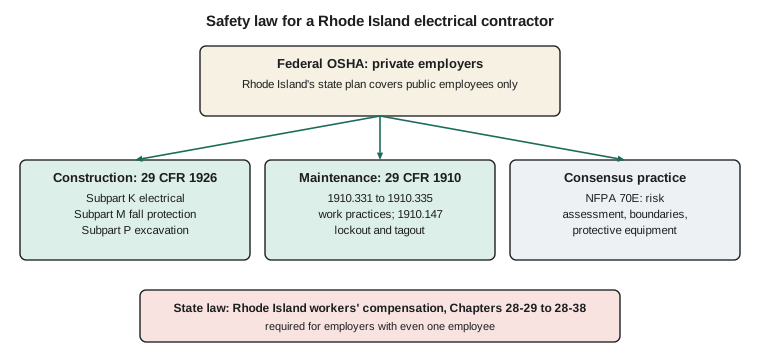
The federal Occupational Safety and Health Act lets states run their own approved safety programs, called state plans. Rhode Island's state plan covers only state and local government employees. Private employers in Rhode Island, including electrical contractors, are covered by federal OSHA, which enforces its standards in the state from its area office. A Pawtuxet Mill crew working on a city school is still a private employer's crew, so federal OSHA has jurisdiction over the company's safety on that job; the state plan would apply to the school district's own employees.
The standards that matter most
OSHA's construction standards are in 29 CFR Part 1926, and its general industry standards are in Part 1910. Construction work, including new installation, alteration and repair, falls under Part 1926; maintenance work in an existing facility can fall under Part 1910. For electrical contractors, the most important rules are in a handful of subparts.
| Subject | Where OSHA addresses it | What it means on the job |
|---|---|---|
| Electrical safety in construction | 29 CFR 1926 Subpart K | Ground-fault protection for temporary power, safe wiring methods, guarding of live parts |
| Lockout and tagging in construction | 29 CFR 1926.417 and Subpart K | Deenergize, lock and tag circuits before work, and verify |
| Control of hazardous energy in general industry | 29 CFR 1910.147 | Written lockout and tagout procedures in existing facilities |
| Electrical safety-related work practices | 29 CFR 1910.331 to 1910.335 | Qualified persons, approach distances, protective equipment |
| Fall protection and ladders | 29 CFR 1926 Subparts M and X | Guardrails, harnesses and correct ladder use |
| Excavation | 29 CFR 1926 Subpart P | Protective systems for trenches five feet deep or more |
OSHA does not adopt NFPA 70E, the Standard for Electrical Safety in the Workplace, but it treats it as a recognized consensus standard. Employers commonly use 70E to meet OSHA's general requirements for protecting workers from electrical hazards: an electrical safety program, risk assessments for shock and arc flash, approach boundaries, energized work permits, arc-rated clothing and protective equipment, and the rule that equipment is put in an electrically safe work condition before work whenever that is feasible. Under the general duty clause, an employer must protect employees from recognized hazards even where no specific standard applies, and arc flash is a recognized hazard.
Pawtuxet Mill's policy is short: no energized work unless deenergizing creates a greater hazard or is infeasible, and then only with a written energized work permit signed by Frank or the foreman, a documented risk assessment and the protective equipment the assessment calls for. Ana will keep that policy and plans to add annual refresher training for everyone, including the office staff who answer service calls and sometimes have to tell a customer to wait.
Training
OSHA requires training throughout its standards: employees must be trained in the safe work practices for their jobs, qualified persons must be trained in the hazards of energized parts, and employees using fall protection or working in trenches must be trained in those hazards. Many contractors use the OSHA Outreach 10-hour and 30-hour construction courses as a baseline, and some public contracts and owners require them. DLT's electrician page lists approved trainers for an OSHA-related electrical safety course; check whether any course is required for a particular license, apprentice program or project before assuming it is optional. Keep training records for each employee, including the date, the course and the trainer.
Injury records and reports to OSHA
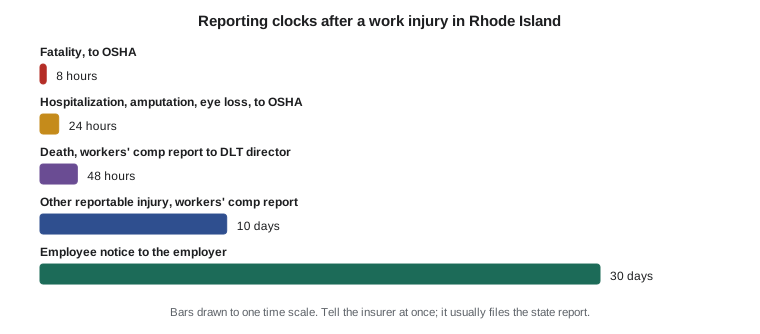
OSHA's recordkeeping rule, 29 CFR Part 1904, requires covered employers to record work-related injuries and illnesses that meet its criteria, such as those involving days away from work, restricted work, medical treatment beyond first aid or loss of consciousness, on the OSHA 300 log, with an incident report for each case, and to post an annual summary from February 1 to April 30. Employers with ten or fewer employees at all times during the year are partly exempt, and some industries are exempt, but specialty construction trades are generally covered once a company is larger than ten. Separately, every employer must report severe events to OSHA under 29 CFR 1904.39: a work-related fatality within eight hours, and an in-patient hospitalization, an amputation or the loss of an eye within twenty-four hours.
The apprentice's broken wrist was recordable, because he lost work days, but it was not reportable to OSHA within the short clocks, because he was treated and released rather than admitted to the hospital as an in-patient. If he had been admitted, the twenty-four-hour report would have applied. Frank's rule is that the foreman calls the office immediately after any injury that goes to a hospital, so that someone can decide within the hour which clocks apply.
Rhode Island workers' compensation
Rhode Island's workers' compensation act, in Chapters 28-29 through 28-38 of the General Laws, requires employers to provide benefits for work-related injuries and diseases. All employers with even one employee must carry workers' compensation insurance or be approved to self-insure. The act provides medical benefits and wage replacement, and in exchange, under section 28-29-20, the right to compensation replaces the employee's right to sue the employer for the injury. The system is administered by DLT's Division of Workers' Compensation, and disputes go to the Rhode Island Workers' Compensation Court. Section 5-65-7 also requires the coverage, as Lesson 8 explained.
The reporting clocks
Several deadlines run after an injury, and they are set by different laws. Under section 28-32-1, the employer must report to the director of DLT any work-related injury that causes death, keeps the employee from earning full wages for at least three days, or requires medical treatment. A fatal injury must be reported within forty-eight hours, and other reportable injuries within ten days. In practice, the employer reports to its insurer, which files with the state, so the employer's job is to tell the insurer immediately. Under section 28-33-30, an employee is expected to give notice of the injury to the employer within thirty days. Under section 28-35-57, a claim for compensation must generally be filed within two years after the injury, with special rules for injuries that are not discovered right away.
# Which clocks start after an injury? (rules from 29 CFR 1904.39 and R.I. Gen. Laws 28-32-1)
def clocks(fatal=False, inpatient=False, amputation=False, eye_loss=False, days_lost=0, medical_treatment=False):
    out = []
    if fatal:
        out += ["OSHA report within 8 hours", "Workers' compensation report within 48 hours"]
    elif inpatient or amputation or eye_loss:
        out += ["OSHA report within 24 hours"]
    if not fatal and (days_lost >= 3 or medical_treatment):
        out += ["Workers' compensation report within 10 days"]
    return out or ["Record internally; check the OSHA 300 log criteria"]

print("Broken wrist, treated and released, 6 weeks lost:", clocks(days_lost=42, medical_treatment=True))
print("Fall, admitted overnight:", clocks(inpatient=True, days_lost=10, medical_treatment=True))Broken wrist, treated and released, 6 weeks lost: ["Workers' compensation report within 10 days"] Fall, admitted overnight: ['OSHA report within 24 hours', "Workers' compensation report within 10 days"]
After an injury
The first priority is care for the injured worker. After that, a short, practiced routine keeps the company on the right side of every clock. Ana is writing Pawtuxet Mill's routine as a one-page card for every truck.
- Get the worker medical care; call 911 for anything serious.
- Make the site safe and preserve the scene if the injury was serious.
- Call the office at once; the office decides within the hour whether an OSHA report is due.
- Notify the workers' compensation insurer the same day, so the state report is filed on time.
- Record the case on the OSHA 300 log if it meets the criteria, and complete the incident report.
- Review what happened and fix the cause, then train the crew on the fix.
Return to work and costs
Workers' compensation costs are driven by the company's claims history, through the experience modification rate that insurers use to adjust premiums. Fewer and less severe injuries mean lower premiums and a better standing with general contractors, many of whom screen subcontractors by their rate. A good return-to-work program, which offers light duty consistent with the doctor's restrictions, helps the worker recover and keeps the claim smaller. The apprentice who broke his wrist spent four of his six weeks doing material takeoffs and organizing the shop, which kept him paid, involved and learning.
Building a safety program
OSHA does not require a single written safety program for every construction employer, but many of its standards require written elements, such as a hazard communication program, lockout procedures and, for some work, a written excavation or fall protection plan, and general contractors increasingly require a written program as a condition of work. A short, real program is better than a thick binder that no one reads. Pawtuxet Mill's program fits in twenty pages: the company's safety policy and who is responsible, the electrical safety and energized work rules, lockout and verification procedures, fall protection and ladder rules, trenching, hazard communication, personal protective equipment, injury reporting, training and the weekly toolbox talk schedule.
Toolbox talks are the part of the program crews actually experience. Each foreman leads a ten-minute talk at the start of the week on one subject, such as testing before touching, ladder setup, or what to do if someone is shocked, and records who attended. Over a year, that is fifty short sessions per crew, and they are the strongest evidence a contractor has, to OSHA and to its insurer, that training is real.
Common mistakes
MistakeCalling Rhode Island's state plan for a private contractor's injury.
InsteadRhode Island's plan covers public employees; private employers are under federal OSHA.
MistakeWaiting a week to report an in-patient hospitalization to OSHA.
InsteadIn-patient hospitalizations, amputations and eye losses must be reported within twenty-four hours.
MistakeThinking a company with two employees needs no workers' compensation.
InsteadRhode Island requires coverage for employers with even one employee.
MistakeLetting the injured worker's notice substitute for the employer's report.
InsteadThe employer must report reportable injuries to the director within ten days, usually through its insurer.
MistakeTreating NFPA 70E as optional because OSHA has not adopted it.
InsteadOSHA uses it as a recognized consensus standard for meeting its general requirements on electrical hazards.
Summary and key terms
- Federal OSHA covers private employers in Rhode Island; the state plan covers only public employees.
- Key standards include 29 CFR 1926 Subpart K, lockout and tagging, electrical work practices, fall protection and excavation; NFPA 70E is the usual consensus standard.
- OSHA requires a fatality report within eight hours and an in-patient hospitalization, amputation or eye loss report within twenty-four hours.
- Rhode Island requires workers' compensation for employers with even one employee; compensation is the exclusive remedy against the employer.
- The employer reports reportable injuries to DLT's director within ten days and deaths within forty-eight hours; employees give notice within thirty days; claims are generally due within two years.
- State plan
- A state-run workplace safety program approved by federal OSHA; Rhode Island's covers public employees only.
- OSHA 300 log
- The log of recordable work-related injuries and illnesses required by 29 CFR Part 1904.
- NFPA 70E
- The consensus Standard for Electrical Safety in the Workplace, used to meet OSHA's electrical hazard requirements.
- Exclusive remedy
- The rule that workers' compensation replaces the employee's right to sue the employer for a work injury.
- Experience modification rate
- A factor based on claims history that insurers use to adjust workers' compensation premiums.
Practice problems
Work each problem on paper first, then reveal the answer to check.
A Pawtuxet Mill electrician is admitted to the hospital overnight after an arc flash. What OSHA deadline applies?
Show answer
A report to OSHA within twenty-four hours.
Which agency inspects Pawtuxet Mill's crew on a city school job?
Show answer
Federal OSHA, because the crew works for a private employer.
An apprentice misses four days of work after a cut that needed stitches. Is a workers' compensation report required?
Show answer
Yes. It keeps him from earning full wages for at least three days and required medical treatment, so the employer must report within ten days.
A new electrical company has one employee. Does it need workers' compensation insurance?
Show answer
Yes. Rhode Island requires coverage for employers with even one employee.
Can an injured employee sue Pawtuxet Mill for negligence instead of taking workers' compensation?
Show answer
Generally no. Under section 28-29-20 compensation is the exclusive remedy against the employer.
Lesson quiz · 5 questions
Score 60% or more to complete this lesson.
Create a free account to save your progress, take quizzes and earn a certificate.