
MELU-314 · Lesson 7 of 12 · 18 min
Duties and responsibilities of the Class A Electrical Contractor License holder
▶ Video coming soon A video version of this lesson is on the way.
Frank keeps a framed card on the wall of his office with three lines written on it in his own hand: the license is mine, the work is mine, the people are mine. He wrote it the week he first qualified the company, more than thirty years ago, after an older contractor told him that the state does not care whose name is on the truck, only whose name is on the license. When Ana's name goes on Pawtuxet Mill's certificate, the card will be hers. This lesson sets out what that responsibility means under Rhode Island law: the rules on licensing a business, on advertising and bidding, on supervising apprentices and employing journeypersons, on carrying and showing licenses, and on the conduct that leads to penalties and discipline.
The duties come from several places: Chapter 5-6 of the General Laws, the board's regulation, 260-RICR-30-15-7, and the State Building Code provisions on permits. They are among the most testable facts on the exam, because they are short, specific and important.
The license stands behind the business
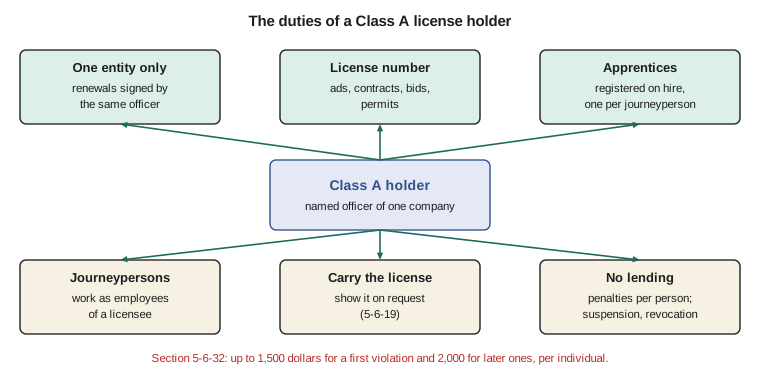
The A certificate is what allows a person, firm or corporation to conduct business as an electrical contractor. When the license is issued to a corporation, it names the officer whose examination supports it, and that officer must be a duly elected officer of the corporation. The regulation limits each license holder to one firm or corporate certificate, and while that certificate is in effect, the holder's license is restricted to that entity. Section 5-6-23 makes licenses non-transferable. Firm and corporate renewals must be signed by the same officer who originally obtained the license. The practical effect is that the license holder is personally tied to the company's licensed status: she cannot qualify a second company, cannot hand the license to someone else, and must sign its renewals.
That tie works in both directions. If Ana leaves Pawtuxet Mill, the company loses the license that rests on her, and she cannot use it for a new company until the old certificate no longer depends on her. A company planning for that risk names a second officer who is licensed or working toward the license, and keeps DLT informed of officer changes. Ask DLT what notice is required when a qualifying officer leaves, and how long a company may operate while a replacement qualifies, before relying on any assumption about it.
Bidding, contracting and advertising
Only licensed electrical contractors may bid for, solicit, advertise or contract for electrical work. Section 5-6-2 forbids any person, firm or corporation to enter into, engage in, solicit, advertise, bid for or perform licensed work without the required license and certificate, and the regulation says only licensed electrical contractors may bid, solicit or advertise electrical work. The regulation allows a general contractor to solicit bids from licensed electrical contractors, which is how most commercial work is bought. A general contractor without an A license cannot itself contract to perform the electrical work with its own unlicensed staff.
Advertising carries its own rules. Section 5-6-2 requires licensees to show the contractor license number on advertisements, contracts, consumer bids and applicable permits. Section 5-6-19 requires every sign, listing or advertisement by a license holder to include the holder's name, address and license number. It also provides that only Class A license holders may advertise for journeypersons or electrical apprentices, which keeps job advertising in the hands of licensed employers. Pawtuxet Mill's trucks, website, proposals and yard signs all carry the company's name, address and license number, and Deb checks every new advertisement before it runs.
| Document or item | What it must show | Source |
|---|---|---|
| Advertisement, sign or listing | Name, address and license number | R.I. Gen. Laws 5-6-19 |
| Contract and consumer bid | Contractor license number | R.I. Gen. Laws 5-6-2 |
| Permit | License number; signed by the licensed person | 5-6-2 and 23-27.3-113.3.1 |
| Help-wanted ad for journeypersons or apprentices | Placed only by a Class A holder | R.I. Gen. Laws 5-6-19 |
| License card | Carried on the person and shown on request | R.I. Gen. Laws 5-6-19 |
Employing journeypersons and supervising apprentices
The people who do the hands-on work must be licensed or properly registered. A Class B journeyperson works as an employee of a licensee, as section 5-6-13 requires. An apprentice must register with DLT's Division of Professional Regulation immediately on employment with a properly licensed contractor, under section 5-6-24, and must work under supervision. The statute allows one electrical apprentice under the direct personal supervision of an appropriately licensed journeyperson electrician. Direct personal supervision means the journeyperson is with the apprentice on the job, not across town checking in by phone. The regulation's experience rules and DLT's application, which asks apprentices for a ratio sheet signed by a licensed electrician, show how seriously the state treats the ratio.
Ratios are a scheduling problem as much as a legal one. On a busy week, a foreman can be tempted to send two apprentices with one journeyperson, or to leave an apprentice to finish trim alone. Ana's crew plans start with the ratio: count the journeypersons first, then assign apprentices one to one, and never the other way around.
# Crew ratio check: one electrical apprentice per licensed journeyperson, under direct personal supervision
crews = {"mill conversion": {"journeypersons": 3, "apprentices": 3},
         "service change, Apponaug": {"journeypersons": 1, "apprentices": 2},
         "office fit-out": {"journeypersons": 2, "apprentices": 1}}
for job, c in crews.items():
    ok = c["apprentices"] <= c["journeypersons"]
print(f"{job:28s} J={c['journeypersons']} A={c['apprentices']} {'OK' if ok else 'over ratio: reassign'}")mill conversion J=3 A=3 OK service change, Apponaug J=1 A=2 over ratio: reassign office fit-out J=2 A=1 OK
Other trades in the chapter have their own ratios. A licensed burnerperson may supervise one burner apprentice, a fire alarm installer one fire alarm apprentice, a maintenance electrician holding a Class M license one apprentice, a lightning-protection installer one apprentice, and an electrical sign installer two sign apprentices. The exam may ask about the sign installer's ratio because it is the exception.
Carrying and showing licenses
Section 5-6-19 requires holders of the B, F, BF, CF, M, A, E, AF, SCF, LPC and LPI licenses to carry the evidence of licensure DLT issues, such as a card, on their person and to show it on request. Section 5-6-2 repeats that licensees must carry their license while working. A local building official can ask for it at any time under section 23-27.3-113.3.1, and DLT's investigators check licenses on job sites. An electrician who left his card at home has a problem to explain; an electrician who has no license has a violation. Pawtuxet Mill keeps a copy of each employee's card and apprentice registration in the office and checks expiration dates every month.
Penalties and discipline
Rhode Island uses both civil penalties and license discipline. Under section 5-6-28, anyone, including a firm, a corporation, an employee or an officer, who does electrical work without complying with the chapter is assessed penalties under section 5-6-32. That section lets the director of DLT assess a penalty of up to 1,500 dollars for a first violation and up to 2,000 dollars for each later violation, after notice and a hearing and on the recommendation of the board, and it counts each individual working in violation as a separate offense. The director or a designee may issue a cease-and-desist order. Section 5-6-23 lets the board suspend or revoke a license and subpoena evidence. Outstanding penalties or fines block renewal until they are paid, under the regulation's renewal rules.
Grounds for discipline include doing or contracting for work without the proper license, lending a license or allowing it to be used by an unqualified business, employing unlicensed or unregistered workers, violating the apprentice ratio, making false statements on an application or renewal, and failing to comply with the code, permit or inspection requirements. The common thread is that the license holder is responsible for what the company does under her license, even if she did not personally do it.
| Violation | Possible consequence |
|---|---|
| Unlicensed person doing electrical work | Penalty against the worker and the contractor, per individual |
| First violation under 5-6-32 | Up to 1,500 dollars |
| Later violation under 5-6-32 | Up to 2,000 dollars |
| Continuing violation | Cease-and-desist order |
| Serious or repeated misconduct | Suspension or revocation under 5-6-23 |
| Unpaid penalty | No renewal until it is paid |
License lending
Lending a license means allowing a business to operate on a license that the holder does not actually stand behind. The classic version is a licensed electrician who lets an unlicensed company pull permits under his name for a monthly fee while he has nothing to do with the work. Rhode Island's rules make that hard to do openly, because the license holder must be an officer of the company, may qualify only one entity, and must sign permits personally. It still happens, and it remains one of the most serious violations: the holder is exposed to penalties and to losing the license, and the public is exposed to work that no qualified person has supervised.
Day-to-day habits
Frank's card on the wall is a reminder that most of these duties are habits. Ana plans to keep them in a short weekly routine.
- Review the permit list: every active job has an issued and posted permit.
- Review the crew list: every worker's license or registration is current, and every crew meets the ratio.
- Review new advertising, proposals and contracts for the license number and company details.
- Review inspection results and close out corrections promptly.
- Note any license, insurance or officer change that must be reported or renewed.
When the license holder is not on site
The A license holder cannot be on every job, and the law does not require her to be. What it requires is that the work be done by licensed people under the company's license, that apprentices be supervised by journeypersons on site, and that the company comply with the code and its permits. The license holder meets that responsibility through systems: hiring only licensed and registered workers, assigning crews that meet the ratio, training foremen to check their own work before inspections, and reviewing inspection results and complaints. When something goes wrong, the board and DLT will ask what the license holder did to prevent it, and the honest answer should be a system that was actually followed, not a promise.
Frank's practice has been to visit every active job at least once a week, to read every correction notice the day it arrives, and to meet each new employee personally to check his license or registration. Ana plans to keep the weekly visits and to add a short monthly meeting with each foreman to review corrections and near misses. The time is small compared with the cost of a disciplinary case or a serious injury on a job that no one was watching.
Common mistakes
MistakeSending two apprentices with one journeyperson to save time.
InsteadThe ratio is one electrical apprentice per journeyperson under direct personal supervision.
MistakeAdvertising without the license number.
InsteadAdvertisements must show the name, address and license number.
MistakeLetting a general contractor's unlicensed staff do electrical work.
InsteadOnly licensed electricians may do the work, and only licensed electrical contractors may contract for it.
MistakeQualifying a second company on the same license.
InsteadEach holder may obtain only one firm or corporate certificate.
MistakeIgnoring an unpaid fine until renewal.
InsteadOutstanding penalties block renewal until they are paid.
Summary and key terms
- The A license stands behind one business; a corporate license names a duly elected officer, who signs its renewals.
- Only licensed electrical contractors may bid, solicit, advertise or contract for electrical work; general contractors may solicit bids from them.
- Advertisements show the name, address and license number; contracts, consumer bids and permits show the license number.
- Apprentices register on hire and work one to one under direct personal supervision; journeypersons work as employees of a licensee.
- Penalties under 5-6-32 reach 1,500 dollars for a first violation and 2,000 dollars for later ones, per individual; the board can suspend or revoke licenses.
- Direct personal supervision
- Supervision by a licensed journeyperson who is present with the apprentice on the job.
- Cease-and-desist order
- An order from the DLT director to stop a violation of the licensing law.
- License lending
- Allowing a business to operate on a license whose holder does not actually stand behind its work.
- Duly elected officer
- An officer of a corporation elected under its bylaws and listed with the Secretary of State.
- Consumer bid
- A price proposal to a homeowner or other consumer, which must show the contractor license number.
Practice problems
Work each problem on paper first, then reveal the answer to check.
A help-wanted ad for apprentices is placed by a staffing company with no electrical license. Is that allowed?
Show answer
No. Only Class A license holders may advertise for journeypersons or electrical apprentices.
An investigator finds two unlicensed workers on a Pawtuxet Mill job. How many violations can be charged?
Show answer
Each individual working in violation is a separate offense, so at least two.
Ana's B license card is in her other jacket when an inspector asks for it. What does the law require?
Show answer
Licensees must carry the evidence of licensure on their person and show it on request.
How many sign apprentices may one licensed electrical sign installer supervise?
Show answer
Two, under direct personal supervision.
Can Frank renew the company's license after Ana becomes the named officer?
Show answer
No. Corporate renewals must be signed by the officer who obtained the license.
Lesson quiz · 5 questions
Score 60% or more to complete this lesson.
Create a free account to save your progress, take quizzes and earn a certificate.