
MELU-314 · Lesson 4 of 12 · 18 min
The exam format and the references allowed
▶ Video coming soon A video version of this lesson is on the way.
Ana has helped several apprentices study for the journeyperson exam, and one thing she tells every one of them is that Rhode Island's exam is not like the open book contractor exams in many other states. In those states, candidates carry a tabbed code book into a test center and spend the exam looking things up. In Rhode Island, the regulation says that using notes or books without the board's permission leads to disqualification, and candidates who have taken the electrical exams describe them as closed book. Preparing for a closed book exam means knowing the code, not just knowing where to find things in it. This lesson sets out what the regulation says about the exam, what candidates report, how to treat the parts that are not published, and how to study for a test you must answer from memory.
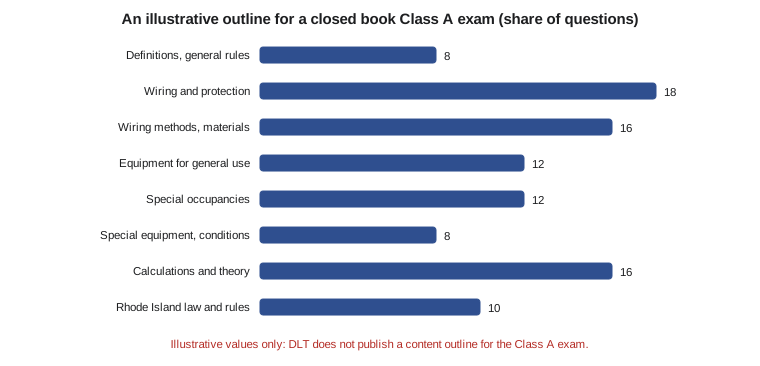
One caution comes first. DLT does not publish a detailed candidate bulletin for the Class A exam of the kind national testing companies publish, with a question count, a time limit and a content outline. Where this lesson describes the number of questions, the time or the weight of topics, the figures are illustrative. The exam notice DLT sends to an approved candidate is the authority on what to bring and what is allowed.
What the regulation says
The board's regulation, 260-RICR-30-15-7, sets the basic rules. Examinations are written and may include practical demonstrations. They are based on the National Electrical Code as adopted in Rhode Island. The passing score is a 70 average. Answers must be written in ink. The use of notes or books without the permission of the board leads to disqualification. Applicants who score at least 60 may review the exam with the board. DLT's application adds that the recommended study materials are the current NEC, meaning the latest state-approved edition, and general trade knowledge.
| Rule | What it means for Ana |
|---|---|
| Written exam, possibly with practical demonstrations | Prepare for written questions, and be ready for a hands-on or oral element if the notice mentions one |
| Based on the NEC as adopted in Rhode Island | Study the 2023 NEC and the state amendments in RISBC-5 |
| Passing score of 70 | Aim well above 70 in practice to leave room for a bad day |
| Answers in ink | Bring the pens the notice allows; expect a paper exam |
| No notes or books without board permission | Plan to answer from memory unless the notice says otherwise |
| Review available at 60 or more | If the first attempt falls short, request the review |
Because the exam is based on the NEC as adopted in Rhode Island, the state amendments are fair game. The amendments are short, and Lesson 5 lists the sections they change. A candidate who knows that Rhode Island replaced the rules on branch circuits in multi-occupancy buildings and on equipment allowed ahead of the service disconnect, for example, has an edge on any question that touches those sections. Since December 1, 2025, the adopted edition has been the 2023 NEC. Confirm with DLT which edition the exam tests if an exam is given close to a code change.
What candidates report
Electricians who have taken Rhode Island's electrical exams describe a paper, multiple-choice exam answered without a code book, with questions drawn from theory, the code and practical knowledge. Some recall basic calculations, such as finding a motor's synchronous speed from the frequency and the number of poles, converting temperatures, or applying Ohm's law, and some recall that a formula aid was supplied. These accounts come from online forums and prep course descriptions rather than from DLT, and they may be out of date, so treat them as background. The safe plan is to prepare for a closed book exam that mixes code recall with calculations and practical judgment, and to read the exam notice carefully for anything that changes that plan.
What a closed book exam rewards
An open book exam rewards navigation: the candidate who can find the right table in thirty seconds wins. A closed book exam rewards understanding and memory. The candidate must know the common numbers, know the structure of the code well enough to reason about where a rule would apply, and recognize the right answer among plausible wrong ones. Questions tend to focus on the rules used every day and on the principles behind them, because those are what a working contractor should know without looking. Expect questions on the numbers that come up constantly in the field: required receptacle spacing and GFCI and AFCI locations in dwellings, working space around equipment, conductor ampacity for common sizes, overcurrent protection for small conductors, grounding electrode conductor sizing for typical services, box fill basics, burial depths and clearances.
Calculation questions on a closed book exam usually give the candidate any table values needed or stick to formulas that every electrician should know. Ohm's law, power in single-phase and three-phase circuits, voltage drop, transformer currents and motor synchronous speed are the usual set. The technical core courses in this program, MELU-101 to MELU-107, cover the code topics and the calculations in depth; this course focuses on the Rhode Island rules and the strategy for the exam.
# Formulas worth knowing cold for a closed book exam (worked examples)
import math

# Synchronous speed of an AC motor: 120 x frequency / poles
f, poles = 60, 4
print("Synchronous speed:", 120 * f / poles, "rpm")

# Three-phase current from power: I = P / (sqrt(3) x V x pf)
p_watts, volts, pf = 45000, 208, 0.9
print("Three-phase current:", round(p_watts / (math.sqrt(3) * volts * pf), 1), "A")

# Temperature conversion: F = C x 9/5 + 32
c = 30
print("30 C in F:", c * 9 / 5 + 32)

# Ohm's law: I = V / R
print("Current through 24 ohms at 120 V:", 120 / 24, "A")Synchronous speed: 1800.0 rpm Three-phase current: 138.8 A 30 C in F: 86.0 Current through 24 ohms at 120 V: 5.0 A
Studying for recall
Reading the code from front to back is not an efficient way to prepare for a closed book exam. What works is active recall: testing yourself on a fact, checking the answer, and testing again later. Ana built a set of question cards from the sections she uses most, with the question on one side and the answer and the code section on the other, and she reviews them on a spacing schedule: cards she gets wrong come back the next day, cards she gets right come back after a few days, then a week, then two weeks. The schedule spends her time where she is weakest.
- Make cards from the field rules you apply every week, then from the rules you rarely use.
- Write the code section on every card, so recall and location reinforce each other.
- Say the answer before turning the card; reading the answer is not recall.
- Mix calculation cards into every session so formulas stay fresh.
- Add a card for every question missed on a practice exam.
# A simple spacing schedule for review cards (days until the next review)
schedule = [1, 3, 7, 14, 28]

def next_gap(level, correct):
    # correct answers move a card up one level; a miss sends it back to the start
    level = min(level + 1, len(schedule) - 1) if correct else 0
    return level, schedule[level]

level = 0
for result in [True, True, False, True, True, True]:
    level, gap = next_gap(level, result)
print("answer correct" if result else "answer missed", "-> review again in", gap, "days")answer correct -> review again in 3 days answer correct -> review again in 7 days answer missed -> review again in 1 days answer correct -> review again in 3 days answer correct -> review again in 7 days answer correct -> review again in 14 days
Pacing
Without a published question count and time limit, a candidate cannot calculate an exact pace until the exam notice or the exam itself gives the numbers. The method still works: divide the time allowed by the number of questions to get the minutes per question, set aside ten minutes at the end for review, and do not spend more than twice the average on any single question during the first pass. On a closed book exam, a question either comes to mind or it does not; sitting on it longer rarely helps. Mark it, move on and come back. Lesson 12 sets out a full three-pass plan.
# Pacing check (illustrative numbers; use the real ones from the exam notice)
questions, minutes = 100, 180
review_reserve = 10
per_question = (minutes - review_reserve) / questions
print(f"Minutes per question on the first pass: {per_question:.1f}")
print(f"Move on after about {2 * per_question:.1f} minutes on any one question")Minutes per question on the first pass: 1.7 Move on after about 3.4 minutes on any one question
What to bring and what to leave
Bring the exam notice, the government ID it requires, the pens it allows and, if it permits one, a calculator of the allowed type. Leave the code book, notes, cards and phone in the car unless the notice says otherwise. Disqualification for having unpermitted notes or books is a real risk under the regulation, and it is a terrible way to lose a licensing date. If the notice is unclear about a calculator or any other item, call DLT before the exam day, not on the morning of it.
Rhode Island law on the exam
Expect some questions on Rhode Island's own rules, because the board is testing someone who will run an electrical contracting business in the state. The likely subjects are the license classes and their scope, the apprentice supervision rule, the requirement that licensees carry their license card, the requirement that advertisements show the license number, renewal on the licensee's birthday every two years, the fifteen hours of continuing education, and the requirement that a licensed person sign the permit. These are short facts that are easy to memorize, and they are covered in Lessons 1, 2, 6, 7 and 11.
Practical demonstrations
The regulation allows the board to include practical demonstrations in an examination. Whether a particular Class A exam includes one is something the exam notice will say. A practical element, where it is used, tests what an experienced electrician should be able to do without looking anything up: identify components and conductors, recognize a code violation in a sample installation, or explain how a circuit should be connected and protected. The best preparation is the same as for the written part: knowing the everyday rules well enough to apply them on sight. Ana's daily work as a foreman is her preparation for that, and she has started to explain to herself, out loud, why each installation she inspects on the company's jobs is or is not compliant.
A closed book format also changes how to read a question. With no book to check, the wording of the question is the only source of facts, so read the stem twice, underline the key words in your mind or on scratch paper if allowed, and note the occupancy, the voltage, the conductor material and any word such as not or except before looking at the choices.
Common mistakes
MistakeBringing a tabbed code book as in an open book state.
InsteadThe regulation disqualifies candidates who use notes or books without the board's permission; follow the exam notice.
MistakeStudying only by reading the code.
InsteadA closed book exam rewards recall; test yourself and space the reviews.
MistakeIgnoring the Rhode Island amendments.
InsteadThe exam is based on the NEC as adopted in Rhode Island, including the RISBC-5 amendments.
MistakeRelying on a forum post for the question count.
InsteadDLT's exam notice is the authority; forum accounts may be out of date.
MistakeWriting answers in pencil.
InsteadThe regulation requires answers in ink.
Summary and key terms
- Rhode Island exams are written, may include practical demonstrations, and are based on the NEC as adopted in Rhode Island.
- The passing score is 70; answers are in ink; notes or books without the board's permission lead to disqualification.
- Candidates describe the electrical exams as closed book, with code recall, calculations and practical questions.
- DLT does not publish a question count, time limit or content outline; follow the exam notice.
- Prepare with active recall and spaced review, know the common formulas, and learn Rhode Island's own rules.
- Closed book exam
- An exam answered without a code book or notes.
- Active recall
- Studying by answering a question from memory before checking the answer.
- Spaced review
- Reviewing material at growing intervals, with missed items returning sooner.
- Synchronous speed
- The speed of an AC motor's rotating field, 120 times the frequency divided by the number of poles.
- Practical demonstration
- A hands-on part of an exam, which the regulation allows the board to include.
Practice problems
Work each problem on paper first, then reveal the answer to check.
Ana's exam notice says nothing about a calculator. What should she do?
Show answer
Call DLT before exam day to ask, rather than bringing one and risking a problem.
What is the synchronous speed of a 6-pole motor on 60 hertz?
Show answer
120 times 60 divided by 6, or 1,200 rpm.
Why should Ana study the Rhode Island amendments?
Show answer
Because the exam is based on the NEC as adopted in Rhode Island, which includes the amendments.
Ana misses a card on GFCI locations in a dwelling. When does it come back under her schedule?
Show answer
The next day, because a miss sends the card back to the first level.
A friend says the exam has 50 questions. How should Ana treat that?
Show answer
As unconfirmed background; the exam notice and the exam itself give the real numbers.
Lesson quiz · 5 questions
Score 60% or more to complete this lesson.
Create a free account to save your progress, take quizzes and earn a certificate.