
MELU-314 · Lesson 3 of 12 · 18 min
Applying, approval and booking the exam
▶ Video coming soon A video version of this lesson is on the way.
In many states, a candidate for a contractor license books a seat with a national testing company and takes the exam at a commercial test center. Rhode Island works differently. The Department of Labor and Training reviews the application, decides whether the candidate is eligible, and gives the exam itself. There is no separate booking step with an outside company: approval and scheduling come from DLT. This lesson walks through the application as Ana prepared it in October 2026, what happens after it is mailed, how the exam date is set, the fees, and what happens after the score arrives, including the right to review a failed exam.
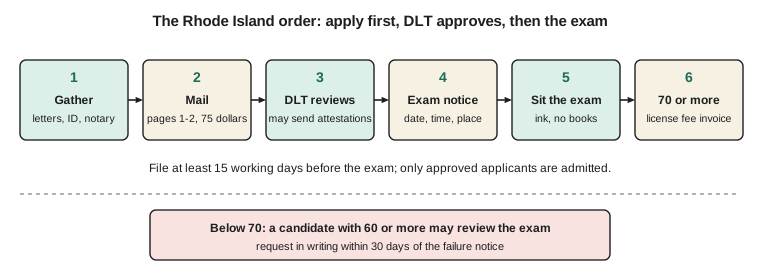
The order matters. In Rhode Island the candidate applies first, DLT approves the application, and only then is the candidate admitted to an exam. The regulation says applications must be filed at least fifteen working days before the exam date and that only approved applicants are admitted. A candidate who waits until the last minute can lose a full exam cycle.
The application package
DLT publishes one application for its trade licenses, covering the electrician classes and the related oil burner, fire alarm, sign and lightning-protection classes. The applicant marks the license class, using DLT's computer code for that license, and completes the first two pages. Only those two pages are sent, along with the supporting documents. The application lists what must come with it.
| Item | What DLT asks for | Ana's notes |
|---|---|---|
| Identification | A legible government-issued ID such as a driver's license or passport | Copy of her driver's license |
| Application | Pages 1 and 2, signed and notarized | Notarized at the bank on October 9 |
| Processing fee | 75 dollars, non-refundable, by check or money order payable to R.I. Department of Labor and Training | Company check |
| Experience proof | Notarized letter on company letterhead from present or past employers, with a detailed list of experience | Frank's letter and her Massachusetts summer employer's letter |
| Out-of-state licenses | A valid copy and an official verification from the issuing state | Not needed |
| Language | Say whether the exam is needed in a language other than English | English |
The application is mailed to the Professional Regulation unit at 1511 Pontiac Avenue, P.O. Box 20247, Cranston, RI 02920-0943, unless DLT's current instructions give another way to file. DLT notes that credit cards are accepted only in person, so most applicants pay the processing fee by check or money order. Applications are processed in the order received. Deb, Pawtuxet Mill's office manager, sent Ana's package by certified mail on October 14, 2026, and kept a full copy, including the check number, in the company's licensing file.
# Application checklist: what is still missing? (Ana's file, October 2026)
needed = ["government ID copy", "pages 1-2 signed", "pages 1-2 notarized", "75 dollar processing fee",
          "employer letter: Pawtuxet Mill", "letter on letterhead", "letter notarized"]
have = {"government ID copy", "pages 1-2 signed", "pages 1-2 notarized", "75 dollar processing fee",
        "employer letter: Pawtuxet Mill", "letter on letterhead"}
missing = [item for item in needed if item not in have]
print("Missing:", missing if missing else "nothing")Missing: ['letter notarized']
The first run of Deb's checklist caught a real problem: Frank had signed his letter, but it had not been notarized. They fixed it before mailing. A missing notary stamp is one of the most common reasons an application comes back.
After the application is mailed
DLT reviews the application against the eligibility rules in Lesson 2. It may contact the employers listed, and it may send attestation forms to employers or customers, which must be notarized and returned before DLT acts. If something is missing, DLT tells the applicant what it needs. If the application is approved, DLT notifies the candidate and gives the date, time and place of the exam, or tells the candidate how the exam will be scheduled. DLT offers an online status lookup for applications through its professional regulation portal, which saves phone calls.
If the application is denied, the regulation gives the applicant thirty days to appeal in writing to the secretary of the board. An appeal should be specific: say which requirement DLT found unmet and provide the evidence that shows it is met. In practice most denials are cured by sending the missing document rather than by appeal.
How the exam is scheduled
Because DLT gives the exam, the schedule is DLT's. The exams are given at DLT on dates the department sets, and approved candidates are notified. The application and the regulation do not publish a fixed calendar, so a candidate who has a deadline, such as a retiring qualifying officer, should ask DLT early when the next Class A exam will be given and plan backward from that date, leaving fifteen working days for the application plus time for DLT's review. Ana's approval arrived in early November 2026, and she is scheduled to sit the exam in December 2026.
Bring what the exam notice says to bring and nothing else. The regulation says that answers must be written in ink and that using notes or books without the board's permission leads to disqualification. Lesson 4 covers the reference rules in detail. Arrive early with the notice, a government ID and any items the notice lists.
Fees
Rhode Island sets its license fees in section 5-6-16. The Class A license fee is 240 dollars, and the Class B license fee is 72 dollars. Licenses are renewed every two years, and the renewal fee is the same as the license fee. On top of the license fee, DLT charges the 75 dollar non-refundable processing fee with the application, and the regulation sets a 100 dollar fee for the certificate needed to do business under a firm or corporate name. Section 5-6-17 provides for an examination fee, and DLT's application lists test and license fees by computer code; read the current amounts on the application for the class you are applying for rather than relying on a figure from someone else's experience.
The application says that candidates who score 70 or higher are invoiced for the license fee. In other words, the license fee is not paid up front: the candidate pays it after passing, and the license issues once it is paid. A corporation that will be licensed under its own name should be ready to pay the firm certificate fee at the same time.
# Ana's budget for the Class A license (statute and regulation amounts in dollars;
# the exam fee is set on DLT's application by license code, so it is a placeholder here)
costs = {"processing fee (application)": 75,
         "Class A license fee (5-6-16)": 240,
         "firm or corporate certificate (regulation)": 100,
         "exam fee (check DLT's current application)": 0}
for item, amount in costs.items():
    print(f"{item:45s} {amount:5d}")
print(f"{'known total':45s} {sum(costs.values()):5d}")processing fee (application) 75 Class A license fee (5-6-16) 240 firm or corporate certificate (regulation) 100 exam fee (check DLT's current application) 0 known total 415
Deb also budgets for the code book, a practice exam course and the time Ana spends studying instead of working. Those costs are larger than the fees, and a company that wants a smooth handover should plan for them.
After the exam: passing
A candidate who passes is invoiced for the license fee and, once it is paid, receives the license. DLT issues evidence of licensure in card form or otherwise, and section 5-6-19 requires the holder to carry it and show it on request. For a corporation, the certificate is issued in the corporation's name and names the officer whose examination supports it. Before Pawtuxet Mill moves its license onto Ana, Deb will confirm with DLT the exact form to file and whether Frank's name stays on the certificate until his retirement or comes off at once. Lesson 7 covers what changes for the company and what Ana must do from that day forward.
After the exam: failing and reviewing
A candidate who scores below 70 does not pass. The regulation lets an applicant who scored at least 60 review the exam with the board, and DLT's application says that a request for review of a failure must be made in writing to the Division of Professional Regulation within thirty days of the failure notice. A review is worth the effort: it shows which areas cost points, which is the most useful study information a candidate can get. The regulation and the application do not set out a waiting period before a retake or a limit on attempts; ask DLT how to reapply and whether a new application and fee are required.
- Read the failure notice for the score and the date it was issued.
- If the score was 60 or more, request a review in writing within thirty days.
- Use the review to build an error log by topic, as Lesson 12 explains.
- Ask DLT for the next exam date and how to reapply.
Keeping the file
Every licensing step produces paper, and Pawtuxet Mill keeps all of it in one file: the application and its attachments, the certified mail receipt, the approval and exam notice, the score report, the license fee invoice and receipt, and the license itself. The same file will hold every renewal, every continuing education certificate and every change of officer. When DLT or a local building official asks a question years later, the answer is in the file.
A timeline that works
For a candidate with a deadline, the application is a project with its own schedule. Ana's started in August 2026, when Frank and the board agreed on the handover. September went to the officer election, the employer letters and the notarizing. Early October went to Deb's checklist and the mailing. DLT's review and the exam notice took the rest of October and early November. That leaves the December exam date and, if needed, a later one before Frank's retirement in mid-2027. The lesson for any candidate is that the paperwork takes longer than the studying expects, so start both at once.
- Three to four months before the target exam: confirm eligibility dates and request employer letters.
- Two months before: complete, sign and notarize the application; assemble every attachment.
- Six to eight weeks before: mail the package by a trackable method and keep a copy.
- After mailing: watch the online status and answer any DLT request the same week.
- On approval: read the exam notice carefully and plan the day of the exam.
Common mistakes
MistakeBooking with a testing company before applying.
InsteadDLT approves the application and gives the exam itself; there is no outside booking step.
MistakePaying the license fee with the application.
InsteadThe application carries the 75 dollar processing fee; candidates who score 70 or more are invoiced for the license fee.
MistakeMailing the application a few days before the exam.
InsteadApplications must be filed at least fifteen working days before the exam date.
MistakeSending all six pages of the application form.
InsteadDLT asks for pages 1 and 2 and the required documents.
MistakeWaiting two months to ask about a failed exam.
InsteadA written request for review must be made within thirty days of the failure notice.
Summary and key terms
- In Rhode Island the candidate applies to DLT, DLT approves the application, and DLT gives the exam; there is no outside booking step.
- The package includes ID, pages 1 and 2 signed and notarized, the 75 dollar processing fee and notarized employer letters on letterhead.
- Applications are due at least fifteen working days before the exam, and only approved applicants are admitted.
- The Class A license fee is 240 dollars under section 5-6-16, invoiced after a passing score of 70; a firm or corporate certificate costs 100 dollars.
- A failing candidate who scored at least 60 may review the exam with the board; request a review in writing within thirty days.
- Processing fee
- The 75 dollar non-refundable fee sent with every DLT trade license application.
- Computer code
- The code DLT uses on its application to identify each license class and its fees.
- Exam notice
- DLT's notice to an approved applicant giving the exam date, time and place.
- Failure review
- A review of a failed exam with the board, available to applicants who scored at least 60.
- Firm certificate
- The certificate, with a 100 dollar fee, needed to do business under a firm or corporate name.
Practice problems
Work each problem on paper first, then reveal the answer to check.
Ana learns on November 20 that DLT is giving an exam on December 1. Can she still get in?
Show answer
Probably not. Applications are due at least fifteen working days before the exam, and DLT must also approve the application.
What does a candidate who passes the Class A exam pay next?
Show answer
The license fee of 240 dollars, which DLT invoices after a score of 70 or more, plus the firm certificate fee if the license is issued to a business.
Marcus scored 64 on a journeyperson exam. What can he do?
Show answer
Request in writing, within thirty days of the failure notice, a review of the exam with the board, since he scored at least 60.
Can a candidate pay the processing fee by credit card through the mail?
Show answer
No. DLT accepts credit cards only in person; by mail, pay by check or money order.
DLT denies an application for lack of a notarized letter. What are the options?
Show answer
Send the missing document, or appeal in writing to the secretary of the board within thirty days.
Lesson quiz · 5 questions
Score 60% or more to complete this lesson.
Create a free account to save your progress, take quizzes and earn a certificate.