
MELU-314 · Lesson 8 of 12 · 18 min
Contractor licensing, insurance and bonding
▶ Video coming soon A video version of this lesson is on the way.
Deb keeps a calendar on the wall behind her desk, and almost every month has a box on it for something that expires: the company's annual report to the Secretary of State, the general liability policy, the workers' compensation policy, the commercial auto policy, an employee's license, a bond for a school job. A license is only one of the things a Rhode Island electrical contractor must keep current. This lesson covers the rest of the business foundation: how the business itself is organized and registered, how the electrical license relates to the state's general contractor registration, what insurance the law requires, how bonds differ from insurance, and when bonds are required. It closes with the records that keep it all current.
Ana will be the named officer on the license, but she will also be one of the people who signs contracts, insurance applications and bond indemnity agreements for the company. Understanding what each document does, and what it exposes her and the company to, is part of the job.
Organizing and registering the business
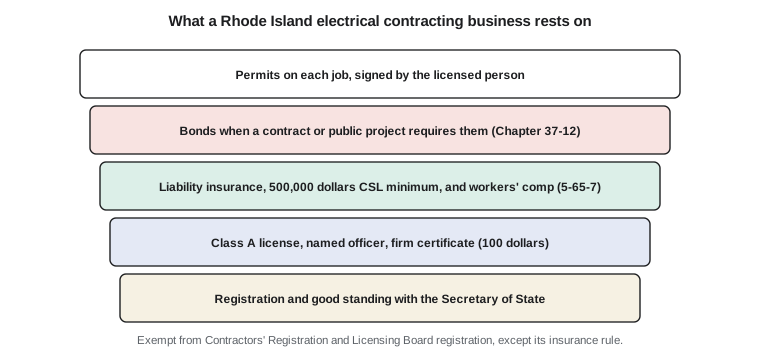
Pawtuxet Mill is a Rhode Island corporation registered with the Secretary of State, which is the common form for an electrical contractor. The regulation requires a corporate A license holder to be a duly elected officer certified by the Secretary of State, and doing business under a firm or corporate name requires a certificate from DLT, for which the regulation sets a 100 dollar fee. A business must stay in good standing with the Secretary of State, which means filing its annual report and keeping its registered agent current. A company that falls out of good standing can lose the ability to show that its license holder is an officer, which is a problem at renewal.
Other forms exist. A sole proprietor who holds an A license can do business under his own name. A firm or partnership can be licensed through a member who passed the exam. Limited liability companies are common in construction, and DLT will issue a license to one, but how the officer requirement applies to an LLC's managers or members is a detail to confirm with DLT before forming one for a licensed business. The company also needs the usual tax registrations with the Division of Taxation and the IRS, and it must withhold and report payroll taxes for its employees.
The Contractors' Registration and Licensing Board
Rhode Island's Contractors' Registration and Licensing Board registers general contractors, home improvement contractors and many specialty trades under Chapter 5-65. Section 5-65-2 lists the exemptions, and one of them covers any person or business entity licensed by the state that employs licensed tradespersons under Chapters 5-6, 5-20 and 5-56, which include the electrician chapter, Chapter 5-6. Such entities are exempt from all of Chapter 5-65 except section 5-65-7, the insurance requirement. In plain terms, a licensed electrical contractor does not register with that board to do electrical work, but must carry the insurance that section 5-65-7 requires.
The exemption covers the licensed work. If Pawtuxet Mill took on work outside its electrical license, for example a kitchen renovation in which it supplied the carpentry, drywall and plumbing coordination as the prime contractor, the company would need to look carefully at whether that work required registration with the board. Most electrical contractors avoid the question by working as subcontractors to registered general contractors on that kind of job, or by limiting their scope to electrical work.
Liability insurance
Section 5-65-7 requires public liability and property damage insurance of at least 500,000 dollars, combined single limit, for bodily injury and property damage, kept in force for the whole registration period, along with workers' compensation insurance under Chapter 28-29. Because licensed electrical contractors are exempt from the rest of Chapter 5-65 but not from that section, the 500,000 dollar minimum is the baseline for their liability coverage. DLT's electrician page lists a certificate of insurance resource, which indicates that DLT expects licensees to provide proof of coverage. Confirm with DLT how and when a certificate must be filed, and whether it is checked at renewal.
The legal minimum is rarely the practical minimum. General contractors, property managers and public owners routinely require a subcontractor to carry one million dollars per occurrence and two million in aggregate, plus an umbrella policy, and to name them as additional insureds. Pawtuxet Mill carries more than the minimum because its customers require it, and because a single serious fire can exceed 500,000 dollars in damage. When a contract requires specific limits or endorsements, read the requirement before signing, and send it to the insurance agent before the job starts.
| Coverage | Required by | Typical practice |
|---|---|---|
| General liability | R.I. Gen. Laws 5-65-7: at least 500,000 dollars combined single limit | Often 1 million per occurrence and 2 million aggregate, with additional insured endorsements |
| Workers' compensation | R.I. Gen. Laws 5-65-7 and Chapter 28-29, for employers with even one employee | Statutory coverage plus employer's liability |
| Commercial auto | State motor vehicle insurance law for company vehicles | Limits matched to the liability policy |
| Umbrella or excess | Usually a contract requirement | Adds limits over liability, auto and employer's liability |
| Inland marine or tools | Not required | Covers tools and equipment in trucks and on job sites |
Workers' compensation
Rhode Island's workers' compensation act applies to employers with even one employee. Section 5-65-7 also refers to it, so workers' compensation is part of the insurance a licensed contractor must carry. A corporation's officers may have options under the act about their own coverage, but every other employee must be covered. Lesson 10 covers the reporting rules and the benefits system. For this lesson, the point is that workers' compensation is not optional for a contractor with a crew, and a lapse can stop work and lead to penalties.
What a bond is, and why it is not insurance
Insurance protects the contractor: when a covered loss occurs, the insurer pays, and the contractor's premium reflects the risk. A surety bond protects someone else. It is a three-party agreement in which the surety promises the obligee, such as a project owner, that the principal, the contractor, will perform its obligation. If the contractor fails, the surety pays the obligee and then looks to the contractor to repay it. That is why bonding companies ask the company and its owners to sign an indemnity agreement, which makes them personally responsible to repay the surety. Ana read Pawtuxet Mill's indemnity agreement before she became an officer, because as an officer she may be asked to sign one.
| Instrument | Who it protects | What happens on a claim |
|---|---|---|
| General liability insurance | The contractor, against claims by others | Insurer pays covered losses; no repayment by the contractor beyond deductibles |
| Performance bond | The project owner | Surety completes the work or pays the owner, then seeks repayment from the contractor |
| Payment bond | Subcontractors, suppliers and workers | Surety pays valid claims, then seeks repayment from the contractor |
| Bid bond | The owner during bidding | Surety pays if the low bidder refuses to sign the contract |
When bonds are required
Rhode Island's electrician licensing law does not set a license bond requirement that this course could find, so a contractor does not post a bond just to hold an A license. Confirm that point with DLT, because license bond rules can change. Bonds come up instead through contracts and public work. On public projects, Rhode Island's public works bond law, Chapter 37-12 of the General Laws, requires the prime contractor to furnish bonds that protect the public owner and those who furnish labor and materials. Section 37-12-1 sets the contracts that require bonds, and its text includes a threshold of 150,000 dollars for public road and bridge contracts; read the current section for the thresholds and conditions that apply to public buildings and other work.
An electrical subcontractor on a public job usually does not furnish the prime bond itself, but it is protected by it. If the prime contractor does not pay, the subcontractor's remedy is a claim on the payment bond, because mechanics' liens do not attach to public property. Lesson 9 covers the bond claim deadlines. When Pawtuxet Mill bids directly to a city or school district as the prime contractor on an electrical-only project, it furnishes the bonds the bid documents require, and its surety's approval is part of preparing the bid.
Private owners and general contractors sometimes require bonds too, especially on larger commercial projects. A subcontract may require performance and payment bonds from the electrical subcontractor, or a bid bond with the bid. Before bidding, read the bonding requirements in the bid documents and confirm with the surety that the company's bonding capacity covers the job.
Keeping it all current
Each of these requirements has a renewal date, and missing one can stop work. An expired liability policy can breach every subcontract the company has. A lapsed workers' compensation policy can lead to a stop work order. A corporation that falls out of good standing complicates the license renewal. Deb's wall calendar is backed up by a simple list in the company's computer, and she reviews it on the first of every month.
# Expiration tracker (Pawtuxet Mill's renewal list; dates illustrative)
from datetime import date

today = date(2026, 11, 10)
items = {"general liability policy": date(2027, 1, 15),
         "workers' compensation policy": date(2027, 1, 15),
         "commercial auto policy": date(2026, 12, 1),
         "Secretary of State annual report": date(2027, 3, 1),
         "Frank's Class A license (birthday renewal)": date(2027, 2, 9)}
for name, due in sorted(items.items(), key=lambda kv: kv[1]):
    days = (due - today).days
    flag = "ACT NOW" if days <= 30 else ("soon" if days <= 90 else "")
print(f"{name:45s} {due} {days:4d} days {flag}")commercial auto policy 2026-12-01 21 days ACT NOW general liability policy 2027-01-15 66 days soon workers' compensation policy 2027-01-15 66 days soon Frank's Class A license (birthday renewal) 2027-02-09 91 days Secretary of State annual report 2027-03-01 111 days
Certificates of insurance are the other half of the job. General contractors ask for them before a subcontractor starts work, and Pawtuxet Mill asks for them from its own lower-tier subcontractors, such as the low-voltage company it sometimes hires. Every certificate goes into the job file, and Deb checks that the limits, the additional insured wording and the dates match what the contract requires.
Prequalification by owners and general contractors
Larger owners and general contractors prequalify subcontractors before inviting them to bid. A prequalification form usually asks for the license number, proof of insurance with stated limits, the workers' compensation experience modification rate, bonding capacity, safety program documents and references. Keeping those items current and ready is part of maintaining the business, because a company that cannot produce them quickly loses invitations. Deb keeps a prequalification packet updated every quarter, so that Ana can answer a request the same day it arrives.
Common mistakes
MistakeRegistering with the Contractors' Registration and Licensing Board for electrical work.
InsteadLicensed electrical contractors are exempt from Chapter 5-65 except its insurance requirement.
MistakeCarrying only the 500,000 dollar minimum on a commercial subcontract.
InsteadContracts often require higher limits and endorsements; read the insurance requirements before signing.
MistakeTreating a bond like an insurance policy.
InsteadThe surety pays the obligee and then seeks repayment from the contractor and its indemnitors.
MistakeFiling a lien on a public school job.
InsteadLiens do not attach to public property; claim on the payment bond.
MistakeLetting the corporation fall out of good standing.
InsteadThe license holder must be an officer of a registered corporation; keep annual reports current.
Summary and key terms
- A corporate electrical contractor registers with the Secretary of State, stays in good standing and holds a DLT firm certificate.
- Licensed electrical contractors are exempt from Chapter 5-65 registration except its insurance requirement in section 5-65-7.
- Section 5-65-7 requires at least 500,000 dollars combined single limit liability coverage and workers' compensation.
- Bonds protect others: performance bonds protect the owner and payment bonds protect subcontractors and suppliers.
- Public works bonds are required under Chapter 37-12; no license bond requirement was found in the electrician licensing law.
- Combined single limit
- One limit that applies to bodily injury and property damage together for each occurrence.
- Surety
- The company that issues a bond and promises the obligee that the principal will perform.
- Obligee
- The party a bond protects, such as a project owner.
- Indemnity agreement
- An agreement by which a contractor and its owners promise to repay the surety for claims it pays.
- Additional insured
- A party, such as a general contractor, added to a contractor's liability policy by endorsement.
Practice problems
Work each problem on paper first, then reveal the answer to check.
Pawtuxet Mill is asked to register with the Contractors' Registration and Licensing Board before wiring a store. Must it?
Show answer
Not for the electrical work; licensed electrical contractors are exempt from Chapter 5-65 except its insurance requirement.
What minimum liability coverage does section 5-65-7 require?
Show answer
500,000 dollars combined single limit for bodily injury and property damage.
A general contractor requires 1 million per occurrence and an additional insured endorsement. What should Ana do?
Show answer
Send the requirement to the insurance agent and get the coverage and endorsement in place before the job starts.
The prime contractor on a town library job fails to pay Pawtuxet Mill. What is the remedy?
Show answer
A claim on the payment bond, because liens do not attach to public property.
Why does a surety ask Ana to sign an indemnity agreement?
Show answer
Because the surety will seek repayment from the company and its indemnitors for any claim it pays.
Lesson quiz · 5 questions
Score 60% or more to complete this lesson.
Create a free account to save your progress, take quizzes and earn a certificate.