
MELU-314 · Lesson 6 of 12 · 18 min
Permits, inspections and the inspection authority
▶ Video coming soon A video version of this lesson is on the way.
Every job Pawtuxet Mill does under a permit ends the same way: an inspector from the city or town walks the work, and either approves it or writes a correction. In Rhode Island the license comes from the state, but the permit and the inspection come from the municipality where the work is done, under the State Building Code. This lesson covers who issues electrical permits, what a licensed contractor must do to obtain one, the inspections a typical job goes through, what happens when work fails, the owner-occupant exception, the role of the state's own investigators, and how to appeal a decision. It closes with the records that keep a contractor out of trouble.
For a Class A holder, permits are not paperwork to be left to the office. The license holder is the person the state holds responsible for the company's electrical work, and the permit is where that responsibility becomes official on each job.
Who issues permits
Chapter 23-27.3, the State Building Code statute, gives each city and town a building official to administer and enforce the code. The building official's office issues permits for construction, including electrical work, and inspects the work. Larger communities have full-time electrical inspectors, and smaller ones may share inspectors or use part-time staff. All of them enforce the same state code, the Rhode Island Electrical Code, but each office has its own procedures for filing, paying fees and scheduling inspections, and section 5-6-25 requires licensees to comply with the rules and requirements of the city or town. Many Rhode Island municipalities take applications through the state's online permitting system, and others still take paper or their own online forms. Check the town's building department page before the first job there.
The permit is required before the work starts. Work done without a required permit can be ordered stopped and uncovered for inspection, and it can lead to fines and to a complaint to the licensing board. Most electrical work requires a permit; the building code's administrative provisions and the local office define the limited cases, such as minor repairs and replacement of like devices, where no permit is needed. When in doubt, ask the building official before starting, not after.
What the licensed contractor must do
Section 23-27.3-113.3.1 sets the rule for permits that require licensed persons. Before the permit is approved, the licensed person must show identification from the state licensing board and sign the permit. The local official may ask for proof of a worker's license at any time, may take remedial action under the code if unlicensed work is found, and reports unlicensed workers to the licensing board. Section 5-6-2 adds that the person or business obtaining a permit for electrical work must have the work done by licensed electricians, and that the contractor's license number must appear on applicable permits.
At Pawtuxet Mill, the license holder signs every permit application. Today that is Frank; after the handover it will be Ana. Deb prepares the application, but she cannot sign it, and the company's rule is that no job starts until the permit is issued and posted at the site. The foreman checks for the posted permit on the first day, the same way he checks for the dig-safe ticket before trenching.
| Step | Who does it | What to watch |
|---|---|---|
| Apply for the permit | The company, signed by the licensed person | License ID shown; license number on the application |
| Permit issued and posted | Building official; foreman posts it | Do not start work before issue |
| Rough and intermediate inspections | Electrical inspector | Call before covering anything |
| Service inspection and release | Electrical inspector, then the utility | The utility connects only after approval |
| Final inspection | Electrical inspector | All devices, labels and panel schedules complete |
| Close the permit | Building office | Keep the approval in the job file |
The inspections
The number and timing of inspections depend on the job and the town, but the pattern is the same everywhere. Work that will be concealed is inspected before it is covered. Services are inspected before the utility connects them. Everything is inspected again at the end. On a new building, the inspections usually run in the order of the work: underground or slab work, rough-in after boxes and cable or raceway are installed and before insulation and drywall, the service, and the final. A temporary service for construction power is inspected when it is set. Additions, renovations and service changes have fewer stages but follow the same logic.
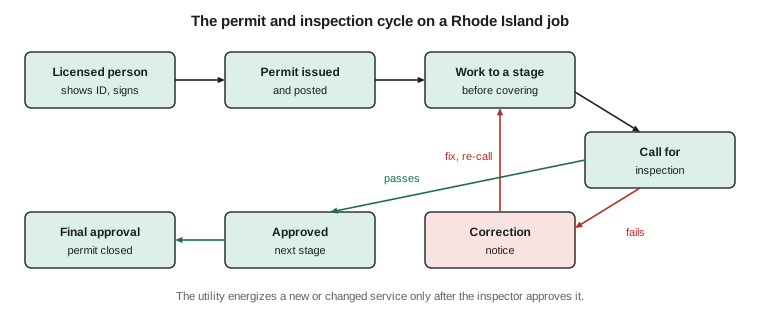
Rough-in is where most corrections are found, because it is the last look at what will be hidden. Typical problems are missing or improper box support, too many conductors in a box, unprotected cable in a location subject to damage, missing bonding jumpers, and receptacle spacing that does not meet the code. Marcus, the foreman on the mill conversion, walks every unit himself the day before the rough inspection with a short checklist, and fixes what he finds before the inspector arrives.
# Rough-in readiness check before calling for inspection (illustrative checklist)
unit_7 = {"boxes secured": True, "box fill checked": True, "cables stapled and protected": True,
          "bonding jumpers installed": False, "receptacle spacing checked": True,
          "smoke alarm circuits roughed": True, "permit posted": True}
open_items = [item for item, done in unit_7.items() if not done]
print("Ready to call" if not open_items else "Not ready, fix: " + ", ".join(open_items))Not ready, fix: bonding jumpers installed
Corrections, stop work and re-inspection
If work does not comply, the inspector issues a written correction notice listing the problems. The contractor makes the corrections and calls for a re-inspection. Some towns charge a re-inspection fee. Work must not be covered until it is approved. If work proceeds in violation of the code, or without a permit, the building official can issue a stop work order under the building code's administrative provisions, and work must stop until the order is lifted. A pattern of serious violations can also lead to a complaint to the electricians' board, which can discipline the license holder under section 5-6-23.
The professional response to a correction is to fix it, not to argue about it on the spot. If the contractor believes the inspector misread the code, the right step is a polite conversation, then a written request that cites the code section, and if that fails, an appeal. Inspectors work in every town for years, and a contractor's reputation with them is built job by job.
The service and the utility
New services and service changes involve a third party: the electric utility. Rhode Island Energy will not energize a new service or reconnect a changed one until the local inspector has approved it and the approval has reached the utility, by whatever method the town and the utility use. The utility's own service requirements govern meter locations, meter sockets and service entrance details, and section 5-6-26 requires licensees to comply with the electric company's requirements. Removing and reattaching an existing meter is licensed work under section 5-6-2, and it is not covered by the homeowner exception. On a service change, Ana schedules the utility disconnect, the inspection and the reconnect together, because a customer without power overnight is a customer who does not call back.
The owner-occupant exception
Rhode Island allows a limited exception for homeowners. Under section 23-27.3-113.3.1, an owner or occupant of a single-family dwelling is exempt from the licensing requirement for work on that dwelling, but must still obtain a permit, have the work inspected by the local official and receive approval before using it. The exception applies only if the owner or occupant does the work personally, without help from others. Section 5-6-2 also excludes owner-occupied single-family homes from the rule that permit work be done by licensed electricians, but not the meter removal and reattachment work. A homeowner who hires an unlicensed friend is not covered by the exception, and neither is the friend.
Rhode Island has also limited who may examine wiring when a home is sold. A recent amendment to state law provides that only licensed electricians may open panels and examine, alter or handle a home's wiring as part of an inspection, so a home inspector who is not a licensed electrician must refer that part of the work to one. For an electrical contractor, that has created a steady source of short inspection jobs, each of which should be documented as carefully as any other service call.
State investigators
DLT's electrical investigators enforce the licensing law, not the building code. Section 5-6-2.1 provides for inspection and a right of entry, and investigators visit job sites to check that the people doing electrical work are licensed and that apprentices are registered and properly supervised. They respond to complaints from inspectors, contractors and customers. The penalties under section 5-6-32 apply per individual in violation, so a crew with two unlicensed workers can lead to two penalties, against both the workers and the contractor. Everyone on a Pawtuxet Mill crew carries a license card or an apprentice registration, as Lesson 7 explains.
Appeals
A contractor who disagrees with a building official's decision on the code can appeal. The State Building Code provides for appeals of local decisions, first to a local board of appeals where one exists and then to a state building code board of appeals, with deadlines and procedures set in the statute and the code's administrative provisions. An appeal should cite the code section, explain why the work complies, and include photos and the inspector's written notice. Appeals of decisions by the electricians' board on licenses are a separate matter: the regulation gives thirty days to appeal in writing to the secretary of the board.
Records
Keep the permit, every inspection result and correction notice, the final approval and the utility release in the job file. The records protect the company if a later owner claims the work was never inspected, and they are part of the evidence if a payment dispute reaches a lien, as Lesson 9 explains. Ana is moving Pawtuxet Mill to a single scanned file per job, so that the permit history for any address the company has worked on can be found in a minute.
Working in a new town
Because every municipality enforces the same code but runs its own office, the first job in a new town is the one most likely to stumble. Ana's checklist for a new town is short: find the building department's page and the permit application method, note the fee schedule and how fees are paid, learn how inspections are requested and how much notice is needed, and ask whether the town wants drawings or a load calculation with service permits. She calls the electrical inspector before the first permit, introduces herself and the company, and asks what the inspector most often sees done wrong. That call has saved more failed inspections than any checklist.
Common mistakes
MistakeLetting the office manager sign the permit application.
InsteadThe licensed person must show state license identification and sign the permit.
MistakeCovering a ceiling before the rough inspection.
InsteadConcealed work must be inspected and approved before it is covered.
MistakeTelling a homeowner his unlicensed brother-in-law can do the work under the homeowner exception.
InsteadThe exception applies only to an owner or occupant doing the work personally, without help.
MistakePulling a meter on a homeowner's own job without a license.
InsteadMeter removal and reattachment is licensed work and is not covered by the homeowner exception.
MistakeArguing with the inspector at the site instead of appealing.
InsteadAsk for the code section in writing and use the appeal process if needed.
Summary and key terms
- Local building officials issue permits and inspect under the State Building Code, Chapter 23-27.3; DLT licenses the people.
- The licensed person must show state license identification and sign the permit, and the license number must appear on it.
- Concealed work is inspected before covering, services before utility connection, and everything at the final.
- An owner or occupant of a single-family dwelling may do his own work with a permit and inspection, but not with help and not for meter work.
- DLT investigators check licenses on job sites; penalties apply per individual in violation.
- Building official
- The municipal officer who administers and enforces the State Building Code, including permits and inspections.
- Correction notice
- A written list of code violations found at an inspection.
- Stop work order
- An order from the building official requiring work to stop until a violation is resolved.
- Owner-occupant exception
- The rule letting an owner or occupant of a single-family dwelling do his own electrical work with a permit and inspection.
- Utility release
- A message to the electric utility that a service has passed inspection and may be energized.
Practice problems
Work each problem on paper first, then reveal the answer to check.
Marcus wants to start rough wiring on Monday, but the permit has not been issued. What should he do?
Show answer
Wait. Work must not start before the permit is issued and posted.
An inspector in Coventry asks a Pawtuxet Mill apprentice for proof of registration. Is that allowed?
Show answer
Yes. The local official may ask for proof of licensure, and the apprentice should carry his registration.
A homeowner in Warwick wants to replace his own panel and have his friend help. Does the owner-occupant exception apply?
Show answer
No. It applies only if he does the work himself without help, and meter work is not covered.
What must happen before Rhode Island Energy energizes a new service?
Show answer
The local inspector must approve the service and the approval must reach the utility.
Ana disagrees with a correction on a service clearance. What is the proper path?
Show answer
Ask for the code section in writing, discuss it, and if needed use the State Building Code's appeal process.
Lesson quiz · 5 questions
Score 60% or more to complete this lesson.
Create a free account to save your progress, take quizzes and earn a certificate.