
MELU-314 · Lesson 11 of 12 · 18 min
Renewal and continuing education
▶ Video coming soon A video version of this lesson is on the way.
Frank's Class A license comes due on his birthday every other February, and for thirty years Deb's predecessor and then Deb have put a reminder on the calendar in November, three months ahead, with a note: continuing education first. Rhode Island ties every electrician license to the holder's birthday and to fifteen hours of approved continuing education, and the two rules together explain most renewal problems. A license that lapses is not a paperwork issue; working on it is unlicensed work, and for a company whose license rests on one officer, a lapse can stop every job. This lesson covers the renewal cycle and fees, the continuing education requirement and how to meet it, late renewal and forfeiture, special cases such as military service, and the habits that keep a license current for a whole career.
Ana will soon have two licenses to keep: her B license, which she has renewed three times, and the A license that the company's certificate will rest on. The rules for both are in Chapter 5-6 and in the board's regulation, 260-RICR-30-15-7.
The renewal cycle
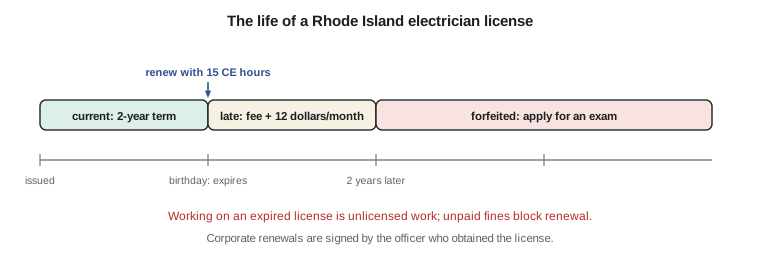
Under section 5-6-20, certificates and licenses are issued for two years and are renewable for two-year periods. Each license expires on the birthday of the person who qualified for it. That means a corporation's license expires on the birthday of its named officer, not on the anniversary of the company's founding. The regulation repeats that licenses renew on the licensee's birthday for a two-year period, and that firm and corporate renewals must be signed by the same officer who originally obtained the license. DLT handles renewals through its online licensing system, which accepts payment and continuing education information.
The renewal fee is the same as the license fee in section 5-6-16: 240 dollars for a Class A license and 72 dollars for a Class B license. Renewal is blocked while any penalty or fine is outstanding, under the regulation, so a contractor with an unpaid fine must pay it, or resolve it, before renewing.
| Rule | Class A | Class B |
|---|---|---|
| Term | Two years | Two years |
| Expiration | Birthday of the qualifying officer | Licensee's birthday |
| Renewal fee | 240 dollars | 72 dollars |
| Continuing education | 15 hours of board-approved instruction | 15 hours of board-approved instruction |
| Late renewal | Fee plus unpaid fees plus 12 dollars a month | Fee plus unpaid fees plus 12 dollars a month |
| Forfeiture | Not renewed within two years of expiration | Not renewed within two years of expiration |
Continuing education
Section 5-6-20.1 makes continuing education mandatory. Since 1997, no license under the chapter has been renewable unless the licensee shows completion of at least fifteen clock hours of continuing education approved by the board. The requirement applies only to Class A and Class B electricians; the other classes in the chapter do not have it. The purpose, in the statute's words, is to ensure current competency in each licensee's area of certification and licensing, and in practice the courses focus on the current code. DLT's electrician page lists the approved providers for the 2023 electrical code update, which is the course most Rhode Island electricians take for the current cycle.
The courses must be approved by the board and by the office of the state building commissioner. Approved providers include vocational schools, trade associations, labor and employer training programs and private instructors, and instructors must be Rhode Island licensed electrical contractors approved by the board. The regulation sets further rules for instructors, including attendance at a preparation seminar every three years, teaching each code cycle, a minimum class size unless approved otherwise, and filing the curriculum and schedule with the department. An instructor actually teaching a fifteen-hour course does not have to attend one. A licensee who completes a course receives a standard certificate and submits it with the renewal.
Out-of-state residents who hold a Rhode Island license have an alternative. Under the statute, they may submit a fifteen-hour course taken in their home state if it meets Rhode Island's standards and their state accepts Rhode Island certificates. The regulation adds that an out-of-state resident without access to approved courses may take an NEC course and obtain the Rhode Island amendments. A Massachusetts or Connecticut electrician with a Rhode Island license should confirm with DLT, before taking a course, that it will be accepted.
Late renewal and forfeiture
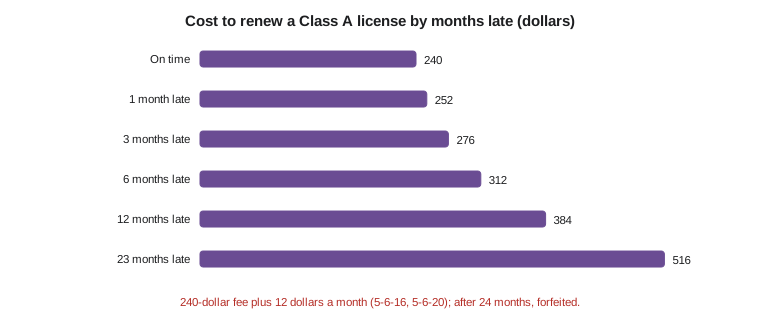
A license that is not renewed by the birthday has expired, and working under an expired license is working without a license. Section 5-6-20 still allows late renewal for a time. The late renewal fee is the regular license fee, plus any outstanding license fees, plus an administrative assessment of twelve dollars for each month of delinquency. A license that is not renewed within two years of its expiration is deemed forfeited. After forfeiture, the former holder must submit a written application for an examination before DLT will issue a new license. For an A holder, that means applying, qualifying and passing the Class A exam again.
# Late renewal cost for a Class A license (5-6-16 fee plus 12 dollars a month, 5-6-20)
fee = 240
for months_late in [0, 1, 3, 6, 12, 23]:
    print(f"{months_late:2d} months late: {fee + 12 * months_late} dollars")
print("24 or more months late: forfeited; apply for an examination")0 months late: 240 dollars 1 months late: 252 dollars 3 months late: 276 dollars 6 months late: 312 dollars 12 months late: 384 dollars 23 months late: 516 dollars 24 or more months late: forfeited; apply for an examination
The money is the smallest part of the cost. A company whose license has lapsed cannot lawfully bid or contract for electrical work, its permits can be questioned, and its general contractors may hold payments until the license is current. For an individual, working on an expired license exposes the worker and the employer to penalties under section 5-6-32. Pawtuxet Mill treats a license expiration exactly like an insurance expiration: it is on the calendar ninety days ahead, and it is done before the date.
Special cases
Section 5-6-21 addresses certificates that expire while the licensee is in federal service. The regulation lets military personnel renew without re-examination if they apply within four years and four months of enlistment, which protects an electrician who serves a typical enlistment and comes home. Licensees in that position should keep their discharge papers and apply promptly.
A corporate license whose named officer leaves or dies is another special case. The license rests on that officer, so the company must act quickly to have another qualified officer named, as Lesson 7 discussed. Renewals are not the place to fix that problem, because the regulation requires the same officer who obtained the license to sign its renewal. Ask DLT what to file when the qualifying officer changes, and do it as soon as the change is known.
A licensee who moves out of state but wants to keep a Rhode Island license can keep renewing it on the normal cycle, with the fifteen hours met by an approved course or by an accepted home-state course as described above. Letting it lapse and hoping to renew later is risky, because after two years the only way back is a new examination, and the rules on eligibility may have changed by then.
Keeping two licenses
Many A holders also keep their B license, because the A certificate allows the holder to conduct business but does not by itself let the holder perform the work, as section 5-6-8 says. Both licenses expire on the holder's birthday every two years. Whether one fifteen-hour course satisfies the continuing education requirement for both licenses at the same renewal is a question to confirm with DLT; many licensees renew both together with a single code update course, but the department's current practice controls. Ana plans to renew both on the same day and to keep both certificates in the file.
A career-long routine
A license is kept current by habit, not by memory. Ana wrote out her own routine and the company's, and the two are nearly the same.
- Ninety days before the birthday: book the fifteen-hour course with an approved provider.
- Sixty days before: finish the course and file the certificate in the license folder.
- Thirty days before: check that there are no unpaid fines, confirm the officer details, and renew online.
- On renewal: download the new license, give copies to the office, and replace the card in the wallet.
- Monthly: check every employee's license and apprentice registration for upcoming expirations.
# Renewal reminders for Pawtuxet Mill's licensed people (birthdays illustrative)
from datetime import date, timedelta

today = date(2026, 11, 10)
people = {"Frank Medeiros (A, company)": date(2027, 2, 9), "Ana Rezendes (B)": date(2027, 4, 22),
          "Marcus Pina (B)": date(2026, 12, 18)}
for name, expires in people.items():
    course_by = expires - timedelta(days=60)
    status = "book the course now" if course_by - today <= timedelta(days=30) else "on schedule"
print(f"{name:30s} expires {expires} finish CE by {course_by} {status}")Frank Medeiros (A, company) expires 2027-02-09 finish CE by 2026-12-11 on schedule Ana Rezendes (B) expires 2027-04-22 finish CE by 2027-02-21 on schedule Marcus Pina (B) expires 2026-12-18 finish CE by 2026-10-19 book the course now
The reminder for Marcus shows why the routine starts early: with his birthday in December, his course should already be finished, and a busy November can push it past the date. Deb called him the day she ran the list.
Choosing a course
Not every fifteen-hour course is equal, even among approved providers. A good code update course goes through the changes between editions article by article, explains why each change was made, and shows how it affects common installations, with time for questions. Ana looks for an instructor who works in the field, a course schedule that fits the company's busy season, and a provider whose certificates are accepted by DLT without trouble. She also asks the instructor for the course materials afterward, because a good set of notes on the changes is a study aid for the next exam an employee takes.
Continuing education is also a planning tool for the company. When a new edition of the code takes effect, every licensed person at Pawtuxet Mill takes an update course in the same cycle, and the foremen bring back a list of changes that affect the company's typical work. That list becomes the subject of several toolbox talks and the basis for updating the company's standard details, such as its typical service and kitchen layouts. The fifteen hours meet the law, and the follow-up makes the hours pay for themselves.
Records to keep
Keep every continuing education certificate, every renewal confirmation and every license card for the life of the license. DLT can ask for proof of continuing education, and a certificate lost between renewals is a certificate that has to be replaced, if the provider still exists. Pawtuxet Mill scans each certificate into the employee's file the day it arrives and keeps the paper copy in the license folder, next to the renewal receipts.
Common mistakes
MistakeAssuming a company license expires on its founding date.
InsteadIt expires on the birthday of the officer who qualified for it.
MistakeTaking any fifteen-hour online class.
InsteadThe course must be approved by the board and the building commissioner's office.
MistakeWorking a week after the birthday on an unrenewed license.
InsteadAn expired license is no license; working on it is unlicensed work.
MistakeWaiting three years to renew a lapsed license.
InsteadA license not renewed within two years of expiration is forfeited and requires a new examination.
MistakeRenewing with a fine outstanding.
InsteadOutstanding penalties or fines block renewal until they are resolved.
Summary and key terms
- Rhode Island electrician licenses run two years and expire on the qualifying licensee's birthday (5-6-20).
- Renewal fees equal the license fees: 240 dollars for Class A and 72 dollars for Class B (5-6-16).
- Class A and B holders need fifteen clock hours of board-approved continuing education to renew (5-6-20.1).
- Late renewal adds unpaid fees and twelve dollars a month; a license unrenewed for two years after expiration is forfeited.
- Corporate renewals are signed by the officer who obtained the license; unpaid fines block renewal; military personnel have special protection.
- Renewal
- Extending a license for another two-year period by paying the fee and meeting continuing education requirements.
- Continuing education
- The fifteen clock hours of board-approved instruction required of Class A and B licensees at each renewal.
- Administrative assessment
- The twelve dollars a month added to a late renewal under section 5-6-20.
- Forfeiture
- Loss of a license not renewed within two years of its expiration, after which a new examination is required.
- Approved provider
- A school, association, program or instructor approved to give continuing education courses.
Practice problems
Work each problem on paper first, then reveal the answer to check.
When does Pawtuxet Mill's Class A license expire?
Show answer
Every two years on the birthday of the officer whose license it rests on.
Marcus's B license expired four months ago. What will it cost to renew?
Show answer
The 72 dollar fee plus any unpaid license fees plus 48 dollars, twelve dollars for each of the four months.
An electrician let his license lapse twenty-six months ago. Can he renew?
Show answer
No. It was forfeited after two years; he must apply for an examination.
Ana's cousin took a ten-hour safety course. Does it satisfy the continuing education rule?
Show answer
No. The requirement is fifteen clock hours in a board-approved course.
Who must sign the company's renewal after Ana becomes the named officer?
Show answer
Ana, as the officer who obtained the license.
Lesson quiz · 5 questions
Score 60% or more to complete this lesson.
Create a free account to save your progress, take quizzes and earn a certificate.