
MELU-314 · Lesson 2 of 12 · 19 min
Eligibility for the Class A Electrical Contractor License
▶ Video coming soon A video version of this lesson is on the way.
Before Ana could think about the exam, she had to show that she was allowed to sit for it. Rhode Island sets the bar for the Class A license in two places: the electrician statute, R.I. Gen. Laws Chapter 5-6, and the board's regulation, 260-RICR-30-15-7. Together they require a minimum age, a minimum amount of verified experience in the trade, and a period of holding the Class B journeyperson license. This lesson explains each requirement, how the experience is counted and proved, and the path that leads to it, starting with the apprenticeship that produces a journeyperson. It ends with the common reasons an application is delayed or turned down.
The requirements are simple to state and easy to get wrong in the details, especially the difference between years of experience and years of holding a license, and the paperwork that proves both. Frank has signed experience letters for a dozen former apprentices over the years, and he tells each of them the same thing: the board cannot see your work, only your paperwork.
The three requirements
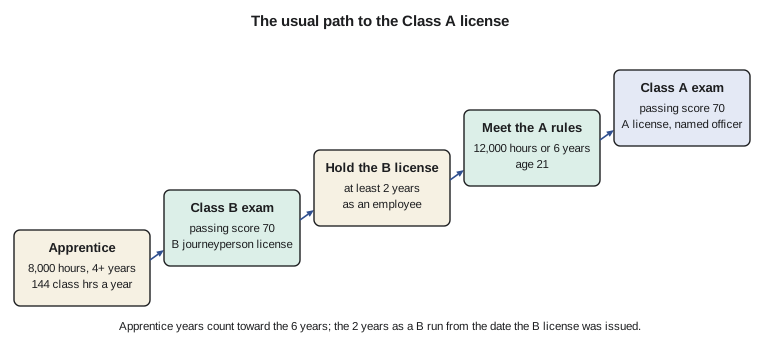
Under the regulation, an applicant for the A certificate must be at least 21 years old. The age is 18 for most installer classes and 21 for the contractor classes, A, E, AF, LPC and SCF, because contractor licenses carry business responsibility. Second, the applicant must have 12,000 hours, or six years, of experience in the trade. Third, the applicant must have held a Class B journeyperson certificate for two years. DLT's application puts the same requirements in its own words: at least six years of verified experience in the trade, plus a Rhode Island journeyperson license that has been valid for at least two years before the application for the contractor exam.
The two time requirements run together, not one after the other. A journeyperson's apprenticeship years count toward the six years of trade experience, and the two years as a B are measured from the date the B license was issued. A typical candidate who finished a four-year apprenticeship and then worked two years as a licensed journeyperson reaches both requirements at about the same time, six years after starting as an apprentice. Ana is well past both: she started as a registered apprentice in August 2015, finished in August 2019, passed the B exam that fall and has held her B license since December 2019.
| Requirement | Class B journeyperson | Class A electrical contractor |
|---|---|---|
| Minimum age | 18 | 21 |
| Experience | 8,000 hours over at least 4 years as a registered apprentice | 12,000 hours, or 6 years, of verified experience in the trade |
| Classroom instruction | 144 hours a year of related instruction, 576 in all | No separate classroom requirement in the regulation |
| License held first | Apprentice registration for the full period | Class B for at least 2 years |
| Passing score | 70 | 70 |
The path to the B license
Almost every A candidate comes up through the B license, so the apprenticeship rules matter. Section 5-6-24 requires an electrical apprentice to register with DLT's Division of Professional Regulation as soon as he or she is employed by a properly licensed electrical contractor. To qualify for the B exam, the apprentice must complete at least 8,000 hours of on-the-job training over at least four years, along with 144 hours of related instruction each year in a registered program. DLT's application states the instruction as 576 hours approved by the department. Limited credit is available for trade school: up to 144 classroom hours from a vocational school, or up to 288 hours over two academic years from an approved accredited trade school.
Apprentices must work under supervision. Section 5-6-24 allows one electrical apprentice under the direct personal supervision of an appropriately licensed journeyperson electrician. Apprentices who apply for the journeyperson exam must document their hours with employer letters and, for indentured apprentices, a certificate of completion from DLT's apprenticeship office. A maintenance electrician with a Class M license has a defined route to the B exam: registering as a fourth-year apprentice under a B electrician while employed by an A contractor.
What counts as experience
The experience must be in the trade, meaning electrical work of the kind the license covers. Time as a registered apprentice and as a licensed journeyperson counts. Time spent in an unrelated job, even in construction, does not. The application asks for a detailed list of work-related experience, so a candidate should describe the kinds of work done, such as services, feeders, commercial branch circuits, motor controls, fire alarm interfaces and estimating, rather than simply writing electrician. A broad record helps, because the A license is for running a business that may take on any kind of electrical work.
Experience gained outside Rhode Island can help a candidate's case, but Rhode Island lists no general reciprocity agreement, so an out-of-state electrician still has to meet the Rhode Island requirements and pass the Rhode Island exam. Section 5-6-24.1 addresses apprentices registered in other states, and the application tells out-of-state licensees to submit a valid copy of their trade license and an official verification from the issuing state. The application says that photocopies or computer printouts of trade licenses will not be accepted as proof. Because the two-year requirement is for a Rhode Island journeyperson license, an electrician moving into the state should plan on holding a Rhode Island B license for two years before applying for the A. Confirm the current treatment of out-of-state experience with DLT before relying on it.
Proving experience
The proof is paper. The application requires a notarized letter on company letterhead from each present or past employer, giving a detailed list of the applicant's work-related experience, and the application itself must be signed and notarized. DLT may send attestation forms to listed employers or customers, and those forms must be notarized and returned before DLT acts on the application. A candidate whose former employer has closed or moved away should start early, because the board has no way to accept experience it cannot verify.
Accuracy matters. Section 5-6-15 deals with false statements in applications, and a false statement about hours or the nature of the work can lead to denial and to discipline later. Ana asked Frank for a letter covering her whole time at Pawtuxet Mill, and she asked the contractor she worked for during one summer in Massachusetts for a second letter, even though she did not need those hours, so that her file would be complete.
# Ana's eligibility check (her real dates; rules from 260-RICR-30-15-7)
from datetime import date

def years_between(a, b):
    return (b - a).days / 365.25

apprentice_start = date(2015, 8, 3)
b_license_issued = date(2019, 12, 2)
application_date = date(2026, 10, 14)
born = date(1995, 4, 22)

trade_years = years_between(apprentice_start, application_date)
b_years = years_between(b_license_issued, application_date)
age = years_between(born, application_date)
print(f"Years in the trade: {trade_years:.1f} (need 6)")
print(f"Years holding Class B: {b_years:.1f} (need 2)")
print(f"Age: {age:.0f} (need 21)")
print("Eligible:", trade_years >= 6 and b_years >= 2 and age >= 21)Years in the trade: 11.2 (need 6) Years holding Class B: 6.9 (need 2) Age: 31 (need 21) Eligible: True
The check uses calendar years as a stand-in for hours. The regulation counts 12,000 hours as equivalent to six years, so a candidate with gaps in employment or long layoffs should count hours from pay records rather than assume that six calendar years means 12,000 hours.
Firms and corporations
Eligibility belongs to a person, but the license may be issued to a business. Section 5-6-8 provides that the A certificate names the applicant and the individual who passed the examination, who must be a member of a firm or an officer of a corporation. The regulation adds that the holder must be a duly elected officer, certified by the Secretary of State, and the application lists a separate corporation electrical contractor class, AC. A person who wants to qualify a corporation should be elected an officer before the corporation applies, and the corporation should be in good standing with the Secretary of State. The regulation also limits each A holder to one firm or corporate certificate at a time, so an electrician cannot lend her examination to two companies.
Why applications are delayed or denied
Most problems are avoidable. The most common are missing or unsigned employer letters, an application that is not notarized, experience letters that describe the work too vaguely, a B license held for less than two years at the date of application, applications sent too close to an exam date, and missing fees. The regulation requires applications to be filed at least fifteen working days before the exam, and only approved applicants are admitted. An applicant who disagrees with a decision of the board can appeal in writing to the secretary of the board within thirty days, under the regulation's appeal section.
- Check the date the B license was issued, not the date of the B exam.
- Get a notarized letter on letterhead from every employer whose hours you need.
- Describe the work in detail: types of installations, systems, sizes and roles.
- Have the application signed and notarized, and keep copies of everything sent.
- For a corporate license, confirm that you are a duly elected officer and that the corporation is registered.
A note on the limited and specialty classes
The exam questions on eligibility often compare classes. The installer classes for fire alarms, oil burners and signs, BF, F and CF, require 4,000 hours over at least two years as a registered limited apprentice. The lightning-protection installer, LPI, requires 4,000 hours over at least two years with a recognized lightning-protection company. The contractor versions of those classes, AF, E, SCF and LPC, require a minimum age of 21. A Class A holder does not need a separate burner contractor or fire alarm installer license for work within the A scope, according to section 5-6-8, but a company that only installs fire alarms or signs can hold the narrower contractor class instead. Know the numbers for the A and B classes cold, and know the others well enough to recognize them.
Planning the timing
Because both time requirements must be met on the day the application is filed, timing matters most for candidates who are close to the line. A journeyperson who received the B license in March two years ago is not eligible in February, even if the A exam date falls in April. Work backward from the exam date DLT announces: subtract at least fifteen working days for the application deadline, then check that the B license will be two years old and the trade experience will reach six years by the date the application is mailed, not by the exam date. A candidate who misses by a few weeks should simply plan for the next exam.
Ana did not have to worry about the line, but Frank used her case to set a rule for the company. Every journeyperson at Pawtuxet Mill now has an eligibility date written in his personnel file: the later of the date six years after the start of his apprenticeship and the date two years after his B license was issued. When that date passes, Frank asks whether he wants to sit for the A. Several have said yes, and the company now has a second officer candidate behind Ana.
Common mistakes
MistakeCounting two years from the B exam date.
InsteadThe two years run from the date the B license was issued and must be met when the A application is filed.
MistakeAssuming an out-of-state master license transfers.
InsteadRhode Island lists no general reciprocity; the candidate must meet Rhode Island's rules and pass its exam.
MistakeSending an unsigned or unnotarized employer letter.
InsteadThe application requires notarized letters on company letterhead.
MistakeApplying for a corporate license as a non-officer employee.
InsteadThe named license holder must be a member of the firm or a duly elected officer of the corporation.
MistakeFiling a week before the exam.
InsteadApplications are due at least fifteen working days before the exam date.
Summary and key terms
- An A applicant must be 21, have 12,000 hours or six years of verified trade experience, and have held a Class B license for two years.
- The B license requires 8,000 hours over at least four years as a registered apprentice and 144 hours of related instruction a year.
- Experience is proved by notarized employer letters on letterhead and a notarized application; DLT may send attestation forms.
- A corporate A license names an officer who passed the exam, and each holder may qualify only one entity.
- Applications are due at least fifteen working days before the exam; decisions can be appealed within thirty days.
- Verified experience
- Trade experience documented by employer letters and confirmed by DLT.
- Registered apprentice
- An apprentice registered with DLT's Division of Professional Regulation on employment.
- Related instruction
- Classroom training that accompanies an apprenticeship, 144 hours a year for electricians.
- Attestation form
- A form DLT may send to an employer or customer to confirm an applicant's experience.
- AC license
- The corporation electrical contractor class listed on DLT's application.
Practice problems
Work each problem on paper first, then reveal the answer to check.
Marcus got his B license on May 1, 2025, after an apprenticeship that began in 2019. Can he apply for the A license in December 2026?
Show answer
No. He has more than six years in the trade but has held the B license for less than two years.
A 20-year-old with an unusually long record of work asks to sit for the A exam. What is the problem?
Show answer
The minimum age for the A license is 21.
Ana's summer employer in Massachusetts has closed. What should she do?
Show answer
She does not need those hours, but a candidate who does should gather pay records and other evidence early, because DLT must be able to verify experience.
How many hours of related instruction does a four-year electrical apprentice complete?
Show answer
144 hours a year, 576 in all.
Can Ana qualify two companies at once with her A license?
Show answer
No. Each holder may obtain only one firm or corporate certificate at a time.
Lesson quiz · 5 questions
Score 60% or more to complete this lesson.
Create a free account to save your progress, take quizzes and earn a certificate.