
MELU-314 · Lesson 1 of 12 · 20 min
How electrical licensing works in Rhode Island
▶ Video coming soon A video version of this lesson is on the way.
Pawtuxet Mill Electric, Inc. has wired houses, storefronts and mill conversions in Warwick and the towns around it for thirty-one years. Its president, Frank Medeiros, is the person whose examination stands behind the company's electrical contractor license, and he plans to retire in 2027. The company's choice to replace him is Ana Rezendes, a Class B journeyperson who finished her apprenticeship with Pawtuxet Mill and has run its largest jobs for the last three years. In September 2026 the board of directors elected her vice president, so that she will be an officer of the corporation when the time comes to put her name on the company's license. This course follows Ana from that point through the Class A examination and into the duties she will carry once she holds the license. Lesson by lesson it covers who licenses electrical work in Rhode Island, what the Class A license requires, how the exam is applied for and taken, which code applies, how permits and inspections work, and the business law that comes with running an electrical contractor.
This first lesson draws the map. Rhode Island is unusual among the states in two ways that shape everything else. First, licensing is entirely statewide and run by one agency, so a Rhode Island license works in every city and town and no municipality issues its own electrician license. Second, the state uses letter classes rather than the master, journeyman and contractor titles common elsewhere. The license this course prepares for is the Class A electrical contractor certificate, often just called the A license. Rhode Island does not issue a separate master electrician license; the A license is the top electrical credential and the one a business needs to contract for electrical work.
The law and the agency
The electrician licensing law is Chapter 5-6 of the Rhode Island General Laws, titled Electricians. It says what work requires a license, creates the Board of Examiners of Electricians, defines the classes of license, sets the fees, and gives the Department of Labor and Training power to enforce it. The board's detailed rules are in the Rhode Island Code of Regulations at 260-RICR-30-15-7. Licensing is administered by the Professional Regulation unit of the Department of Labor and Training, usually shortened to DLT, at 1511 Pontiac Avenue in Cranston. DLT takes applications, gives the exams, issues and renews licenses, and investigates complaints through its electrical investigators.
Section 5-6-2 sets the scope. A license is required to install, maintain, service or test wires, conduits and electrical apparatus, including their support systems, along with fixtures, electrical signs, lightning-protection equipment and the control of electrical devices. It also covers appliances that carry or use electricity for light, heat, fire alarm or power, and the removal and reattachment of existing electric meters. Low-voltage wiring for heating and refrigeration equipment is excluded. The same section forbids any person, firm or corporation to enter into, solicit, advertise, bid for or perform that work without the required license, and it requires licensees to show their contractor license number on advertisements, contracts, consumer bids and permits.
| Question | Rhode Island answer | Where it is found |
|---|---|---|
| Who licenses electricians? | The state, through DLT and the Board of Examiners of Electricians | R.I. Gen. Laws Chapter 5-6 |
| Do cities or towns license electricians? | No; one state license covers the whole state | Chapter 5-6; local officials verify licenses on permits |
| What is the top electrical license? | Class A electrical contractor | R.I. Gen. Laws 5-6-8 |
| What license does a working electrician hold? | Class B journeyperson | R.I. Gen. Laws 5-6-9 |
| Who adopts the electrical code? | The state, as the Rhode Island Electrical Code (RISBC-5) | 510-RICR-00-00-5 |
| Who issues permits and inspects? | The local building official in each city or town | R.I. Gen. Laws Chapter 23-27.3 |
The classes of license
Section 5-6-7 lists the forms of license, and the regulation defines each class. The letters matter on the exam and in daily work, because each class carries a defined scope and each contractor class has an installer class that does the hands-on work.
| Class | Name | What it allows, in short |
|---|---|---|
| A | Electrical contractor | Conduct business as an electrical contractor |
| B | Journeyperson electrician | Do electrical work as an employee of a licensed contractor |
| C and D | Limited premises and limited maintenance | Limited work on existing premises of a single employer |
| M | Limited maintenance journeyperson | Maintenance work under the rules for that class |
| E and F | Burner contractor and burnerperson | Oil and gas burner electrical work for heating equipment |
| AF and BF | Fire alarm contractor and installer | Fire alarm systems |
| SCF and CF | Electrical sign contractor and installer | Electrical signs |
| LPC and LPI | Lightning-protection contractor and installer | Lightning-protection systems |
| REP | Renewable energy professional | Defined renewable energy work, with core electrical work by licensed electricians |
Two features of this structure are easy to miss. The first is that the A license is a business license. Section 5-6-8 says the A certificate allows the holder to conduct business as an electrical contractor, and states that it does not by itself let the holder individually perform the electrical work. In practice, an A holder also holds or has held a B license, because two years as a B is a condition of eligibility, and keeps the B current if she wants to keep working with tools. The second feature is that the B license is an employee license. Section 5-6-13 restricts journeypersons to working as employees of a licensee, so a B electrician cannot take a side job for a neighbor under her own name. Ana understands both points well: for a decade she has worked under Frank's A license, and once she passes, the company's license will rest on her.
Corporations, firms and the named officer
Most electrical contractors are corporations or limited liability companies, and Rhode Island has specific rules for them. The A certificate must name the applicant, whether a person, firm or corporation, and must also name the individual who passed the examination. For a firm, that person must be a member. For a corporation, the regulation says the license holder must be a duly elected officer, certified by the Secretary of State. DLT lists a corporate electrical contractor class, AC, on its application. A license holder may obtain only one firm or corporate certificate, and while it is in effect the individual's license is restricted to that entity. Renewals of firm and corporate licenses must be signed by the same officer who originally obtained the license.
This is why Pawtuxet Mill made Ana an officer before she applied. When she passes and the company's certificate is reissued in her name, Frank can retire without leaving the corporation unlicensed. Planning the handover early matters, because a corporation whose qualifying officer leaves without a replacement has no one to stand behind its license. Lesson 7 returns to these duties in detail.
Licensing statewide, enforcing locally
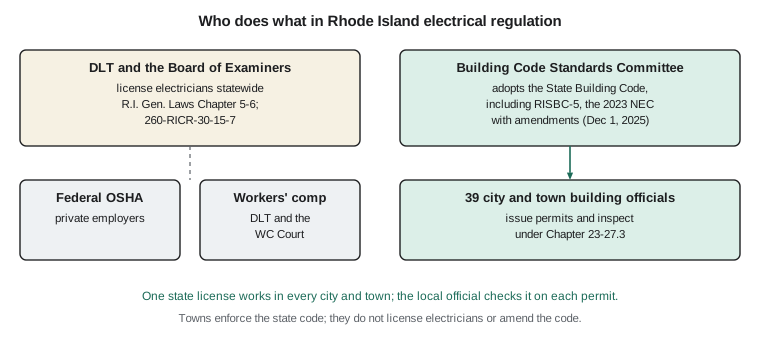
Rhode Island splits the work between the state and its thirty-nine cities and towns. The state licenses people and adopts the codes. The municipalities enforce the codes on individual jobs. Each city or town has a building official, and most have an electrical inspector, who issues permits and inspects work under the State Building Code in Chapter 23-27.3. Before a permit for electrical work is approved, the licensed person must show identification from the state licensing board and sign the permit, and the local official may ask to see a license at any time. Unlicensed work found by a local official is reported to the licensing board. That division of labor means a contractor deals with DLT for the license and with thirty-nine local offices for permits, all enforcing the same state code.
The electrical code itself is statewide. The Building Code Standards Committee adopts the National Electrical Code as the Rhode Island Electrical Code, known as RISBC-5, with a short list of state amendments. Since December 1, 2025, the adopted edition is the 2023 NEC. Municipalities do not adopt their own editions or amendments, which makes Rhode Island simpler than states where each city chooses. Lesson 5 covers the adoption and amendments, and Lesson 6 covers permits and inspections.
The board, the investigators and enforcement
The Board of Examiners of Electricians is made up of members appointed under section 5-6-4, and it has a policy-making role: it writes the rules, approves examinations and continuing education, and recommends penalties. DLT's electrical investigators check licenses on job sites, respond to complaints and bring cases. Under section 5-6-32, the director of DLT may assess a penalty of up to 1,500 dollars for a first violation and up to 2,000 dollars for a later one, after notice and a hearing and on the board's recommendation, and each individual working in violation counts as a separate offense. The director may also issue a cease-and-desist order. Section 5-6-23 lets the board suspend or revoke licenses, and licenses cannot be transferred. Lesson 7 covers the grounds for discipline.
The rest of the legal picture
An electrical contractor in Rhode Island works under several other laws besides Chapter 5-6. The Contractors' Registration and Licensing Board registers general and home improvement contractors under Chapter 5-65, but an entity licensed by the state that employs licensed trades under Chapter 5-6 is exempt from that chapter except for its insurance requirement, so an electrical contractor does not register with that board for electrical work but must carry the insurance it requires. The mechanics' lien law in Chapter 34-28 gives unpaid contractors a claim against the property. The workers' compensation act in Title 28 requires coverage for employees. Workplace safety for private employers is enforced by federal OSHA, because Rhode Island's state plan covers only public employees. Lessons 8 through 10 take these up in turn.
# Ana's planning check: is the company's license covered through Frank's retirement?
# (illustrative dates; the license must always rest on a qualified officer)
from datetime import date

frank_retires = date(2027, 6, 30)
ana_exam_planned = date(2026, 12, 15)
months_of_margin = (frank_retires.year - ana_exam_planned.year) * 12 + (frank_retires.month - ana_exam_planned.month)
print("Months between Ana's planned exam and Frank's retirement:", months_of_margin)
print("Room for one retake if needed:", months_of_margin >= 4)Months between Ana's planned exam and Frank's retirement: 6 Room for one retake if needed: True
Frank's rule is simple: the transition plan has to survive one failed attempt. If Ana's first attempt does not go well, there should still be time for a second before he leaves. The check above shows why the company started early.
How the exam fits in
The Class A exam is given by DLT itself rather than by a national testing company. It is a written examination based on the National Electrical Code as adopted in Rhode Island, and the regulation says it may include practical demonstrations. The passing score is 70. The application lists the current state-approved edition of the NEC and general trade knowledge as the study materials. Candidates should expect the exam to test code knowledge, calculations and the rules that apply to contractors. Lessons 2 through 4 set out the eligibility rules, the application and the format in detail, and Lesson 12 covers practice and test-day strategy.
How this course is organized
The twelve lessons follow the order in which a candidate meets each subject. Lessons 2 to 4 cover eligibility, the application and the exam. Lesson 5 covers the Rhode Island Electrical Code and its amendments, and Lesson 6 covers permits and inspections. Lesson 7 covers the duties of the A license holder, Lesson 8 the business requirements of contracting, Lesson 9 contracts and liens, Lesson 10 safety and workers' compensation, Lesson 11 renewal and continuing education, and Lesson 12 the practice exam method. The technical code content of the exam, such as load calculations, grounding and bonding, and wiring methods, is covered by the core courses in this program, MELU-101 through MELU-107, which this course builds on.
Rhode Island facts in this course were checked in November 2026 against the statutes, the regulations, DLT's application and the published state code. Laws and fees change, and DLT's own forms and notices are the final word for a candidate. Where the course could not confirm a detail against an official source, it says so and gives the rule in general terms.
Common mistakes
MistakeCalling the A license a master license.
InsteadRhode Island issues a Class A electrical contractor license; it has no separate master license.
MistakeAssuming a city license is needed in Providence or Warwick.
InsteadLicensing is statewide; municipalities issue permits and inspect but do not license electricians.
MistakeLetting a journeyperson take side work under her B license.
InsteadA B licensee must work as an employee of a licensed contractor (section 5-6-13).
MistakeThinking the A certificate alone lets the holder do the work personally.
InsteadSection 5-6-8 says the A certificate allows conducting business; the hands-on work is done by licensed electricians.
MistakeRegistering with the Contractors' Registration and Licensing Board for electrical work.
InsteadLicensed electrical contractors are exempt from that chapter except for its insurance rule.
Summary and key terms
- Rhode Island licenses electricians statewide under R.I. Gen. Laws Chapter 5-6, through DLT and the Board of Examiners of Electricians.
- The Class A electrical contractor license is the top electrical credential and the license a business needs to contract for electrical work.
- The Class B journeyperson license allows electrical work as an employee of a licensee.
- A corporation's A certificate names an officer who passed the exam; that officer signs its renewals.
- The state adopts the Rhode Island Electrical Code (RISBC-5), the 2023 NEC with amendments since December 1, 2025; local building officials issue permits and inspect.
- Penalties under section 5-6-32 reach 1,500 dollars for a first violation and 2,000 dollars for a later one, per individual.
- Class A license
- The Rhode Island electrical contractor certificate, which allows a person, firm or corporation to conduct business as an electrical contractor.
- Class B license
- The Rhode Island journeyperson electrician certificate, which allows electrical work as an employee of a licensee.
- DLT
- The Rhode Island Department of Labor and Training, whose Professional Regulation unit administers electrician licensing.
- Named officer
- The officer of a corporation whose examination and license stand behind the corporation's A certificate.
- RISBC-5
- The Rhode Island Electrical Code, the state's adoption of the NEC with amendments.
Practice problems
Work each problem on paper first, then reveal the answer to check.
A homeowner in Cranston asks whether Ana needs a Cranston electrician license to work there. What is the answer?
Show answer
No. Rhode Island licenses electricians statewide; Cranston issues the permit and inspects, but it does not license electricians.
Ana's cousin, a B journeyperson, wants to wire a garage for a friend on weekends and bill him directly. Is that allowed?
Show answer
No. A B licensee may work only as an employee of a licensee; contracting for the job requires an A license.
Why did Pawtuxet Mill elect Ana vice president before she applied?
Show answer
Because a corporation's A license must rest on a duly elected officer who passed the exam.
Which edition of the NEC has applied statewide since December 1, 2025?
Show answer
The 2023 NEC, adopted with amendments as the Rhode Island Electrical Code.
Who enforces workplace safety standards for Pawtuxet Mill's crews?
Show answer
Federal OSHA, because Rhode Island's state plan covers only public employees.
Lesson quiz · 5 questions
Score 60% or more to complete this lesson.
Create a free account to save your progress, take quizzes and earn a certificate.