
MELU-314 · Lesson 12 of 12 · 18 min
Practice exam review and test-day strategy
▶ Video coming soon A video version of this lesson is on the way.
Ana took her first full practice exam on a Saturday morning in early October 2026, at the kitchen table, with a timer, a pen and no code book, the way she expects the real exam to be. She scored 66. Three weeks later she scored 74, and on November 7 she scored 81. The improvement did not come from reading more of the code. It came from studying her mistakes and from changing how she studied. This last lesson sets out the method she used: how to take a practice exam under closed book conditions, how to review it with the book open afterward, how to turn the review into a plan, and how to manage the clock, the paper and the nerves on exam day. It ends with what happens after the score arrives.
The method assumes the closed book format described in Lesson 4. The numbers in the examples are illustrative, because DLT does not publish a question count, time limit or content outline for the Class A exam. When the exam notice arrives, replace the illustrative numbers with the real ones.
Taking a practice exam properly
A practice exam is useful only if it is taken the way the real exam will be. That means the full set of questions in one sitting, a realistic time limit, no code book and no notes, a pen, the same calculator if one is allowed, and no looking at answers until the end. Partial question sets are fine for drilling a topic, but at least three full timed exams, spaced over the study period, show whether recall, pacing and stamina are where they need to be. Use practice questions written for the 2023 NEC; questions written for older editions can teach the wrong answer. The core courses in this program, MELU-101 through MELU-107, have topic-by-topic practice questions that work well for drilling between full exams.
Closed book practice feels harder than open book practice, and that is the point. Every time Ana is tempted to reach for the code during a practice exam, she writes a small mark next to the question instead and answers from memory. Those marks become the first items in her review, because they show exactly what she does not yet know without looking.
Reviewing every question
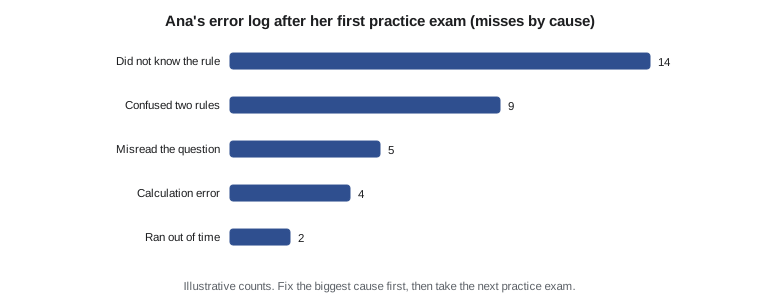
The review is where the learning happens, and it should take longer than the exam. Now the code book comes out. Go through every question, not just the wrong ones, because a right answer reached by a guess is a weakness too. For each question, find the code section or the formula that answers it, confirm the answer, and if you got it wrong or guessed, decide why. Ana sorts each miss into one of five causes.
- Did not know the rule: the fact or the section was not in memory at all.
- Confused two rules: knew something close, such as the rule for a different occupancy, size or location.
- Misread the question: missed a word such as minimum, maximum, not or except, or a detail such as the voltage.
- Calculation error: a wrong formula, a skipped step or a keying mistake.
- Ran out of time: never reached the question or guessed in the final minutes.
Each cause has its own fix. Not knowing the rule calls for new question cards and spaced review. Confusing two rules calls for a comparison card that puts the two side by side, for example the GFCI rules for dwelling kitchens and for commercial kitchens. Misreading calls for slowing down on the question stem and underlining the key words. Calculation errors call for working every calculation the same way every time and checking units. Running out of time calls for the pacing plan below.
The error log
Ana keeps an error log: one line for each missed or guessed question, giving the topic, the code section, the cause and a one-sentence note on what she should have known. After each practice exam, she counts misses by topic and by cause, and the counts decide where the next two weeks go. After her first exam, the biggest cause was not knowing the rule, mostly in special occupancies and motor circuits, so she wrote sixty new cards for those chapters. After her second, the biggest cause was confusing two rules, so she built comparison cards. After her third, the misses were spread thin, which is what readiness looks like.
# Error log summary after a practice exam (Ana's first exam, simplified)
from collections import Counter
log = [("special occupancies", "did not know"), ("motors", "did not know"), ("grounding", "confused"),
       ("motors", "calculation"), ("special occupancies", "did not know"), ("services", "misread"),
       ("dwellings", "confused"), ("special occupancies", "did not know"), ("wiring methods", "time"),
       ("Rhode Island law", "did not know")]
by_cause = Counter(cause for _, cause in log)
by_topic = Counter(topic for topic, _ in log)
print("By cause:", ", ".join(f"{c} {n}" for c, n in by_cause.most_common()))
print("By topic:", ", ".join(f"{t} {n}" for t, n in by_topic.most_common()))By cause: did not know 5, confused 2, calculation 1, misread 1, time 1 By topic: special occupancies 3, motors 2, grounding 1, services 1, dwellings 1, wiring methods 1, Rhode Island law 1
From review to a study plan
A good plan spends time in proportion to lost points. A topic with many misses and many questions on the exam gets the most time; a topic with one miss gets a card and nothing more. Ana divides each study week into three parts: new cards from the latest error log, spaced review of older cards, and one mixed set of timed questions to keep recall and speed together. She also adds a short session on Rhode Island's own rules each week, because those questions are easy points that a busy candidate forgets to study: the license classes, the apprentice ratio, the advertising rule, renewal on the birthday, fifteen hours of continuing education, and the signature on the permit.
# Where should next week's study time go? (illustrative: misses times exam weight)
topics = {"special occupancies": (5, 0.12), "motors": (3, 0.08), "grounding": (2, 0.10),
          "dwellings": (2, 0.10), "Rhode Island law": (2, 0.06), "services": (1, 0.08)}
hours = 10
scores = {t: misses * weight for t, (misses, weight) in topics.items()}
total = sum(scores.values())
for t, s in sorted(scores.items(), key=lambda kv: -kv[1]):
print(f"{t:22s} {hours * s / total:4.1f} hours")special occupancies 4.2 hours motors 1.7 hours grounding 1.4 hours dwellings 1.4 hours Rhode Island law 0.8 hours services 0.6 hours
The three-pass plan for a closed book exam
On exam day, a simple plan keeps the clock under control. On the first pass, answer every question you know at once, and mark every question that needs thought or calculation. Do not linger; on a closed book exam, a rule either comes to mind or it does not. On the second pass, go back to the marked questions and work them, starting with calculations, where method produces answers. On the third pass, in the last minutes, answer anything still blank with your best guess. Unless the instructions say otherwise, a blank answer earns nothing and a guess may earn a point.
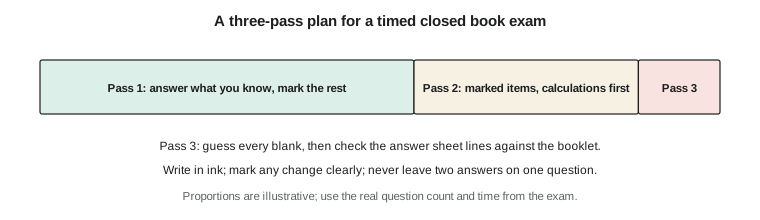
The exam is answered in ink, so changes must be clear. If you change an answer, mark the change the way the instructions say, and make sure no question ends up with two answers. On a paper answer sheet, check every ten questions that the question number on the sheet matches the question number in the booklet; a skipped line can shift every later answer by one, which is the most expensive mistake on any paper exam.
Managing the clock
Once the exam notice or the exam itself gives the question count and the time, work out the pace before starting: minutes per question, the time to be at the halfway question, and a reserve for review. Write the halfway time at the top of the scratch paper if scratch paper is allowed. Check it once at the halfway question and adjust. Ana's practice exams taught her that she runs fast on code questions and slow on calculations, so she now saves calculations for the second pass and finishes the first pass with time to spare.
# Pacing plan (illustrative numbers; use the real ones from the exam)
questions, minutes, reserve = 100, 180, 15
per_q = (minutes - reserve) / questions
halfway_q = questions // 2
print(f"Minutes per question: {per_q:.2f}")
print(f"Be at question {halfway_q} by minute {round(halfway_q * per_q)}")
print(f"Reserve for the third pass and checking: {reserve} minutes")Minutes per question: 1.65 Be at question 50 by minute 82 Reserve for the third pass and checking: 15 minutes
The day before and the day of
The day before the exam is for rest and logistics, not cramming. Ana plans to review only her comparison cards and the Rhode Island rules, check the exam notice, put the notice, her ID and the allowed pens in one envelope, and find the parking at DLT in Cranston. On the day, she will arrive early, read every instruction on the exam, and leave the code book, notes and phone in the car unless the notice says they are allowed. If something in the room is unclear, such as whether scratch paper may be used, she will ask the proctor before starting rather than guess.
- Read the exam notice twice, and follow it exactly.
- Bring the notice, government ID and allowed pens; bring a calculator only if it is allowed.
- Leave books, notes, cards and phone outside the room unless permitted.
- Use the three-pass plan and check the answer sheet alignment every ten questions.
- Answer every question before time is called.
After the score
A score of 70 or more is a pass. DLT invoices the license fee, and once it is paid the license issues, as Lesson 3 explained. For Pawtuxet Mill, passing starts the handover: the corporate certificate is updated to name Ana, the company's advertising, proposals and permit forms are checked for the license number, and Frank begins signing less and supervising less. Ana's first permit as the named officer will be a moment the whole office notices.
A score below 70 is not the end. A candidate who scored at least 60 may review the exam with the board, and a written request for review must reach the Division of Professional Regulation within thirty days of the failure notice. Use the review exactly like a practice exam review: count the misses by topic and cause, build the plan, and ask DLT for the next exam date and how to reapply. Frank planned the handover with room for one more attempt precisely so that a bad day would not decide the company's future.
Nerves
Most experienced electricians who fail a licensing exam do not fail for lack of knowledge. They fail because they rush, misread, or let one hard question shake their confidence. The three-pass plan helps because it gives the mind a job to do when it meets a hard question: mark it and move on. Ana also practices the opening minutes of the exam, reading the instructions and answering the first ten questions calmly, so that the start of the real exam feels familiar.
Common mistakes
MistakePracticing with the code book open.
InsteadTake practice exams closed book and open the book only for the review.
MistakeReviewing only the wrong answers.
InsteadReview every question; a lucky guess is a weakness too.
MistakeSpending ten minutes trying to remember one rule.
InsteadMark it, move on, and come back on the second pass.
MistakeLeaving answers blank at the end.
InsteadUnless instructions say otherwise, answer every question before time is called.
MistakeLetting the answer sheet drift out of line with the booklet.
InsteadCheck the question numbers every ten answers.
Summary and key terms
- Take full practice exams closed book, timed, with only what the exam allows.
- Review every question with the code book afterward, and sort misses by cause: did not know, confused, misread, calculation or time.
- Keep an error log, and spend study time in proportion to lost points; include Rhode Island's own rules every week.
- On exam day, use three passes, answer every question, write clearly in ink and check answer sheet alignment.
- A score of 70 passes; a candidate with at least 60 may request a review within thirty days of a failure notice.
- Error log
- A record of each missed or guessed practice question with its topic, code section and cause.
- Comparison card
- A study card that sets two easily confused rules side by side.
- Three-pass plan
- An exam method: answer the known, work the marked, then guess the rest.
- Answer sheet alignment
- Making sure each answer is marked on the line for the matching question.
- Readiness
- Consistent closed book practice scores comfortably above the passing score, with misses spread thin.
Practice problems
Work each problem on paper first, then reveal the answer to check.
Ana misses three questions on grounding electrode conductors because she mixed up copper and aluminum sizes. Which cause is that, and what is the fix?
Show answer
Confused two rules; make a comparison card and review it on a spacing schedule.
Halfway through the time, Ana is on question 38 of 100. What should she do?
Show answer
Speed up the first pass, mark harder questions for later and keep calculations for the second pass.
Ana notices that her answer for question 41 is on line 42 of the sheet. What should she do?
Show answer
Stop, find where the shift began, correct the marks clearly as the instructions allow, and check alignment more often.
Ana's three practice scores were 66, 74 and 81. Is she likely to be ready?
Show answer
The trend is good; if her misses are spread across topics and the next practice is also comfortably above 70, she is likely ready.
Ana scores 67 on her first attempt. What should she do within thirty days?
Show answer
Request a review in writing, since she scored at least 60, and use it to build her next study plan.
Lesson quiz · 5 questions
Score 60% or more to complete this lesson.
Create a free account to save your progress, take quizzes and earn a certificate.