
MELU-314 · Lesson 5 of 12 · 18 min
The NEC as adopted in Rhode Island and state amendments
▶ Video coming soon A video version of this lesson is on the way.
When Ana bid her first job as the company's estimator, an apartment conversion in an old mill in West Warwick, Frank asked her one question before she sent the number: which code is this priced on? In Rhode Island the answer is the same in every city and town, which is one of the advantages of working there. The state adopts a single electrical code, the Rhode Island Electrical Code, as part of the State Building Code, and municipalities enforce it without adding amendments of their own. This lesson explains how that code is adopted, what edition is in force, what the state amendments change, how the electrical code fits with the other state codes, and what to do when a new edition takes effect partway through a project.
The details matter on the exam because the Class A exam is based on the NEC as adopted in Rhode Island. They matter even more on the job, because a price or a layout based on the wrong rule is expensive to fix after the inspector has seen it.
How the state adopts the code
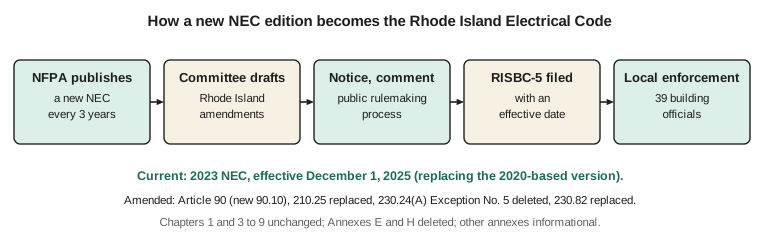
The State Building Code is created by Chapter 23-27.3 of the Rhode Island General Laws. Under that chapter, the Building Code Standards Committee adopts and amends the codes that make up the State Building Code, through the state's rulemaking process, with public notice and a chance to comment. The electrical part is published in the Rhode Island Code of Regulations as 510-RICR-00-00-5, titled RISBC-5 Rhode Island Electrical Code. It adopts the National Electrical Code, NFPA 70, by reference, and then lists the Rhode Island amendments. The statute's purpose section says that electrical work in the state must follow the latest edition of the NEC, and the committee updates RISBC-5 as new editions are published.
Because the code is adopted by reference, the text of the NEC itself is not reprinted in the regulation; a contractor needs a copy of the adopted edition of NFPA 70 and a copy of the RISBC-5 amendments. The regulation adopts the NEC only to the extent its provisions do not conflict with Chapter 23-27.3 or with the amendments, and it says the electrical code must be read together with the building code statute and the amendments.
The edition in force
The current RISBC-5 adopts the 2023 edition of the NEC, effective December 1, 2025. It replaced the earlier version, which adopted the 2020 NEC. The adoption covers the 2023 edition only, not later editions or later changes by NFPA. When a 2026 or later edition is adopted, the committee will issue a new version of RISBC-5 with its own effective date and amendments. Check the Secretary of State's rules database or the building code office's laws and rules page for the version in force before starting a large project.
| Part of the NEC | Rhode Island treatment in RISBC-5 |
|---|---|
| Article 90, Introduction | Amended: references to the NEC become references to the Rhode Island Electrical Code; 90.6 deleted; 90.10 added to relate the electrical code to the other state codes |
| Chapter 1, General | Adopted without change |
| Chapter 2, Wiring and Protection | Amended: 210.25 replaced; Exception No. 5 to 230.24(A) deleted; 230.82 replaced |
| Chapters 3 to 9 | Adopted without change |
| Annexes A, B, C, D, F, G, I, J and K | Adopted for information only |
| Annexes E and H | Deleted |
What the amendments change
The amendments are few, and each has a practical reason. The changes to Article 90 are administrative. They rename the code as the Rhode Island Electrical Code, delete a section of the introduction, and add a new section, 90.10, that connects the electrical code to Rhode Island's other codes: the building, residential, plumbing, mechanical, fuel gas, energy conservation and fire safety codes. That link matters when rules overlap, for example where the fire safety code or the building code sets requirements for fire alarm, emergency lighting or equipment rooms that the electrical installation must meet.
The changes to Chapter 2 are technical. Section 210.25 in the NEC deals with branch circuits in buildings with more than one occupancy, and Rhode Island replaces it with its own version, which addresses how dwelling units and common areas are supplied. Section 230.24(A) deals with the vertical clearance of overhead service conductors, and Rhode Island deletes one of its exceptions, Exception No. 5. Section 230.82 lists the equipment permitted to be connected on the supply side of the service disconnecting means, and Rhode Island replaces it with its own list, including rules on meter disconnect switches. Read the exact wording of each amendment in RISBC-5 rather than relying on a summary, because the details decide what an inspector will accept.
For a contractor, those three Chapter 2 amendments show up most often on multifamily and mixed-use work, which is a large part of the market in Rhode Island's older cities. Ana's mill conversion is a good example. The building has apartments, a common hallway system, a laundry room and a ground-floor commercial space, so both the branch circuit rule for multi-occupancy buildings and the service equipment rules apply. She marked both sections in her code book and attached the RISBC-5 text to the estimate file.
Annexes
The NEC's annexes are informational in the published code, and Rhode Island adopts most of them for information only. It deletes two entirely, Annexes E and H. Annex H in the NEC is a model administration and enforcement article, which a state with its own building code statute does not need, because Chapter 23-27.3 and the state building code's administrative provisions govern permits, inspections and appeals. That is a useful reminder: in Rhode Island, the rules on permits and inspections come from the state building code statute and its administrative chapter, not from the NEC.
One code for the whole state
Rhode Island's State Building Code applies throughout the state. Municipal building officials enforce it, but the code itself is adopted by the state, and a city or town does not adopt its own edition of the NEC or its own electrical amendments. That uniformity means a contractor who knows the Rhode Island Electrical Code can work in Providence, Westerly or Woonsocket under the same rules. Local practice still varies in matters such as how permits are filed, what drawings are requested and how inspections are scheduled, so a call to the building office before a first job in a new town is still wise. Lesson 6 covers permits and inspections.
Other requirements can still apply on particular jobs. The electric utility, Rhode Island Energy, sets service and metering requirements in its own specifications, and section 5-6-26 requires compliance with the requirements of the electric company. The state fire safety code, adopted by a separate board, governs fire alarm and life safety requirements in many occupancies. Section 5-6-25 requires compliance with the rules and requirements of the city or town, which covers local procedures such as permit filing. None of these is an electrical code amendment, but each can change what the installation must look like.
# Which NEC edition applies? (illustrative rule of thumb: the edition in force when the
# permit application is filed; confirm the transition rule with the building official)
from datetime import date

cutover = date(2025, 12, 1)   # RISBC-5 adopting the 2023 NEC took effect

def edition_for(permit_filed):
    return "2023 NEC with RISBC-5 amendments" if permit_filed >= cutover else "2020 NEC with the prior RISBC-5 amendments"

for filed in [date(2025, 11, 14), date(2025, 12, 1), date(2026, 9, 30)]:
print(filed, "->", edition_for(filed))2025-11-14 -> 2020 NEC with the prior RISBC-5 amendments 2025-12-01 -> 2023 NEC with RISBC-5 amendments 2026-09-30 -> 2023 NEC with RISBC-5 amendments
When the code changes during a project
Code changes cause trouble on long projects. A job designed and priced under one edition can reach permit or inspection after a new edition takes effect. How the transition works depends on the adopting rule and on the state building code's administrative provisions, and it is usually tied to the date of the permit application. The safe practice is to confirm with the building official, before pricing, which edition will apply to the permit, and to put that edition in the contract so that a change caused by a new code becomes a change order rather than a loss. Lesson 9 returns to that contract clause.
The exam tests the edition in force when the exam is given, unless DLT says otherwise. A candidate who learned the 2020 NEC should spend part of her study time on the changes in the 2023 edition, such as the revised GFCI and AFCI requirements, reorganized and new articles, and the other revisions that affect everyday work. The core courses in this program cover the technical changes; for this course the point is to know which edition is in force and what Rhode Island changed.
- Keep the adopted edition of NFPA 70 and the current RISBC-5 text in the shop and in the truck.
- Check the Secretary of State's rules database for the version in force before a large bid.
- Mark the amended sections, 90.10, 210.25, 230.24(A) and 230.82, in your code book.
- Put the code edition in every contract and every proposal.
- On multifamily and mixed-use work, read the Rhode Island version of 210.25 and 230.82 before laying out services and branch circuits.
Reading an amendment correctly
An amendment can replace a section, delete part of one, or add something new, and each works differently. When Rhode Island replaces a section, such as 210.25 or 230.82, the published NEC text for that section no longer applies at all, and only the Rhode Island version counts. When Rhode Island deletes an exception, such as Exception No. 5 to 230.24(A), the rest of the section and its other exceptions still apply, but the deleted exception cannot be used. When Rhode Island adds a section, such as 90.10, it supplements the published text without removing anything. An inspector will read the code the same way, so a contractor who relies on the published text of a replaced section is relying on a rule that is not in force.
Ana keeps the RISBC-5 amendment text folded into the front of her code book and has written a short note in the margin at each affected section: replaced in Rhode Island, see the state text, or exception deleted in Rhode Island. The notes take ten minutes to make and save hours on a job. On the exam, the same knowledge helps her recognize when a question is about a Rhode Island rule rather than the national one.
The 2023 cycle will not be the last. NFPA publishes a new NEC every three years, and Rhode Island has followed with new adoptions on a regular schedule. When a new edition is proposed for adoption, the committee publishes notice of the proposed rule and accepts comments. Contractors and their associations can and do comment on proposed amendments, and watching the proposals gives a contractor months of warning before a change takes effect.
Common mistakes
MistakeAssuming each town chooses its own NEC edition.
InsteadThe State Building Code, including RISBC-5, applies statewide.
MistakeReading the published NEC version of 210.25 on a multifamily job.
InsteadRhode Island replaces 210.25 with its own version; read RISBC-5.
MistakeLooking to NEC Annex H for permit rules.
InsteadRhode Island deletes Annex H; permits and inspections are governed by the state building code statute and its administrative provisions.
MistakeUsing the 2020 NEC on a permit filed in 2026.
InsteadThe 2023 NEC has been in force since December 1, 2025.
MistakeTreating utility service rules as optional.
InsteadSection 5-6-26 requires compliance with the electric company's requirements.
Summary and key terms
- The Building Code Standards Committee adopts the NEC as the Rhode Island Electrical Code, RISBC-5, under Chapter 23-27.3.
- Since December 1, 2025, RISBC-5 adopts the 2023 NEC, replacing the version based on the 2020 NEC.
- Rhode Island amends Article 90 (including a new 90.10), replaces 210.25 and 230.82, and deletes Exception No. 5 to 230.24(A).
- Chapters 1 and 3 to 9 are adopted unchanged; Annexes E and H are deleted and the rest are informational.
- The code applies statewide; municipalities enforce it but do not amend it; utility and fire code requirements still apply.
- RISBC-5
- The Rhode Island Electrical Code, 510-RICR-00-00-5, which adopts the NEC with state amendments.
- Building Code Standards Committee
- The state body that adopts and amends the codes making up the State Building Code.
- Adoption by reference
- Adopting a published code by citing it rather than reprinting its text.
- State Building Code
- Rhode Island's statewide set of construction codes under Chapter 23-27.3.
- Multi-occupancy building
- A building with more than one occupancy, such as apartments with common areas, addressed by 210.25.
Practice problems
Work each problem on paper first, then reveal the answer to check.
Ana is bidding work in Newport and Woonsocket in the same week. Does she need two different code books?
Show answer
No. The Rhode Island Electrical Code applies statewide.
Which three Chapter 2 provisions does Rhode Island change?
Show answer
It replaces 210.25 and 230.82 and deletes Exception No. 5 to 230.24(A).
Where do Rhode Island's rules on permits and inspections come from?
Show answer
From the state building code statute, Chapter 23-27.3, and its administrative provisions; NEC Annex H is deleted.
A permit for a long project was filed in October 2025. Which edition is likely to apply?
Show answer
Probably the earlier edition in force when the permit was filed, but confirm the transition rule with the building official.
What does the new section 90.10 do?
Show answer
It relates the electrical code to Rhode Island's other state codes, such as the building, fire safety and energy codes.
Lesson quiz · 5 questions
Score 60% or more to complete this lesson.
Create a free account to save your progress, take quizzes and earn a certificate.