
MELU-313 · Lesson 9 of 12 · 19 min
Contracts and mechanics' liens in Pennsylvania
▶ Video coming soon A video version of this lesson is on the way.
In the spring of 2025 Schuylkill Line wired a four-story mixed-use building in Point Breeze for a developer the company had never worked for. The job went well; the payments did not. The developer paid the first two draws, then stopped answering calls, and by the time the building was finished the company was owed about 86,000 dollars. Frank knew what to do because he had been through it before, and he walked Keisha through every step: the formal notice of intent, the lien claim, service on the owner, and the leverage the Contractor and Subcontractor Payment Act gave him. The company was paid in full four months later, with interest. This lesson covers the contract and payment law every Pennsylvania license holder should know.
The facts here come from summaries of the Pennsylvania Mechanics' Lien Law of 1963 and the Contractor and Subcontractor Payment Act by Pennsylvania construction law practitioners, including a summary of the 2018 amendments to the payment act, as checked in November 2026. Lien and payment deadlines are strict, and missing one by a day can cost the right entirely. This lesson gives an outline for exam and planning purposes; for any real claim, read the statute and talk to a Pennsylvania construction lawyer early.
Contracts first
Most payment problems are prevented, or made winnable, by a good contract. A written contract should identify the parties and the property, describe the scope of work and what is excluded, state the price and the payment schedule, set out how change orders are requested, priced and approved, explain retainage, set the schedule and what happens if it slips, and say how disputes are resolved. For home improvement work, the contract must also meet the Home Improvement Consumer Protection Act, covered in Lesson 8, or it may be unenforceable. Keisha's first act as license holder-in-waiting was to update Schuylkill Line's residential contract form with counsel to make sure it met HICPA.
Change orders deserve particular attention because they are where most disputes start. The homeowner who asks for 'just two more outlets' and the general contractor who says 'the drawings were wrong, just fix it' both create work outside the contract. Get it in writing, with a price or a method for pricing, signed before the work is done. Frank's rule was no signature, no extra work, and in thirty-eight years he never lost a change order dispute that had a signature behind it.
The Mechanics' Lien Law: who can claim
Pennsylvania's Mechanics' Lien Law of 1963 lets contractors and subcontractors who improve real property claim a lien on that property for unpaid work and materials. A lien is a claim against the property itself, which gives the owner a strong reason to see that the claimant is paid, because a lien clouds the title and can eventually lead to a sale of the property. The law defines who may claim: generally contractors who contract directly with the owner and subcontractors who contract with them, with limits on how far down the chain the right extends. Practitioners' summaries note a minimum claim amount of 500 dollars for a lien to exist.
There is an important limit for residential work. Under the statute, as practitioners summarize it, a subcontractor has no lien right on certain residential property, such as a single townhouse or a one- or two-unit residence used as the owner's or tenant's home, where the owner or tenant has paid the general contractor in full. A subcontractor usually has no way of knowing whether the owner has paid, so lawyers often advise filing anyway when unpaid, but the defense can defeat the lien. The law also allows a stipulation against liens, a written waiver of subcontractors' lien rights that must be filed at specific times, on most residential projects and on any project where the contractor posts a payment bond.
Lien deadlines
The deadlines are the heart of the law. Practitioners summarize them this way. A subcontractor must serve a formal notice of intent to file a lien on the owner at least 30 days before filing the lien claim. Any claimant must file the lien claim in court within six months of the claimant's last work. Within one month after filing, the claimant must serve written notice of the filing on the owner, by sheriff rather than by mail, and within 20 days after that service, file an affidavit of service. The claim must then be enforced by filing a complaint within two years of the date the claim was filed, unless the owner agrees in writing to extend that time, and judgment must be entered within five years or the lien is lost.
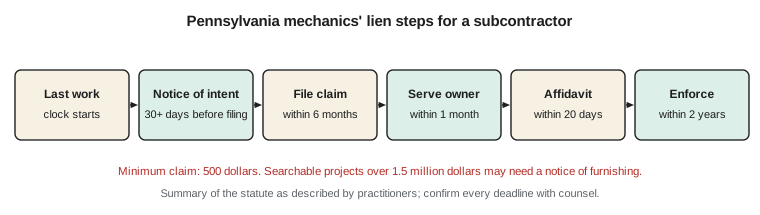
Large projects add one more requirement. Since the end of 2016, Pennsylvania has had a state construction notices directory for searchable projects, which practitioners describe as projects over 1,500,000 dollars. On a searchable project where the owner has filed and posted a notice of commencement, subcontractors must file a notice of furnishing within 45 days after first performing work or providing materials, or they may lose lien rights. The Point Breeze job was well over that threshold, and Linh had filed Schuylkill Line's notice of furnishing within the first month, which kept the company's lien rights intact.
Worked problem
Working the lien deadlines
Schuylkill Line, a subcontractor, last worked on the Point Breeze building on August 14, 2025. It wants to preserve its lien. Using the practitioners' summary, what are the key dates?
Show solution
- Lien claim must be filed within six months of last work: by February 14, 2026.
- The notice of intent must be served at least 30 days before filing: for a February 10 filing, by January 11, 2026 at the latest.
- Within one month after filing, serve the owner by sheriff: by March 10, 2026 for a February 10 filing.
- Within 20 days after service, file the affidavit of service.
- Enforce by complaint within two years of filing: by February 10, 2028.
Answer: File by February 14, 2026, with the notice of intent at least 30 days earlier; then serve within a month and enforce within two years. Confirm with counsel.
The Contractor and Subcontractor Payment Act
The Contractor and Subcontractor Payment Act, usually called CASPA, governs payment on private construction contracts in Pennsylvania. It requires owners to pay contractors, and contractors to pay subcontractors, according to the contract terms, with interest and penalties for wrongful withholding. It was significantly amended in 2018, with the changes applying to contracts entered into on or after October 10, 2018, according to a practitioner summary. CASPA cannot generally be waived by contract.
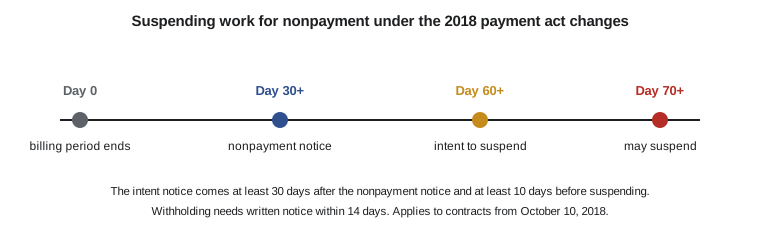
The 2018 amendments made several changes that matter in the field. An owner or contractor who wants to withhold payment for deficient work must give written notice of the deficiency items within 14 days of receiving the invoice, explaining the good-faith reason, and must still pay undisputed amounts; missing the 14-day deadline waives the right to withhold. Contractors and subcontractors can secure release of retainage at substantial completion by posting a maintenance bond for 120 in 100 of the retainage held. Statutory interest is described as one in 100 per month. And a contractor or subcontractor may suspend work for nonpayment, even if the contract says otherwise, after following specific notice steps.
The suspension steps are precise. A written notice of nonpayment can be sent at least 30 days after the end of the billing period. A written notice of intent to suspend can be sent at least 30 days after the nonpayment notice and at least 10 days before suspending. That means suspension can begin no earlier than about 70 days after the billing period ends, for unpaid amounts that are undisputed or were not properly disputed in time. A party that wrongfully withholds payment can face penalty interest and the other side's attorneys' fees as well.
| Rule | Deadline or amount | Source |
|---|---|---|
| Subcontractor notice of intent | At least 30 days before filing the lien claim | Mechanics' Lien Law (practitioner summary) |
| File lien claim | Within six months of last work | Mechanics' Lien Law |
| Serve owner after filing | Within one month, by sheriff | Mechanics' Lien Law |
| Filed notice of furnishing | Within 45 days of first work, on searchable projects with a notice of commencement | Pennsylvania construction notices directory |
| CASPA withholding notice | Within 14 days of the invoice | CASPA as amended in 2018 |
| CASPA suspension | No earlier than about 70 days after the billing period, after two notices | CASPA as amended in 2018 |
Public projects
Mechanics' liens generally cannot be filed against public property. On public works, the protection for subcontractors and suppliers comes from payment bonds, which Pennsylvania's public works bond law requires on many public contracts, and from public prompt payment rules that are separate from CASPA. A subcontractor on a public job should know the bond claim deadlines in the contract and the statute, because they are strict too. Lesson 8 introduced bonds; on a public job, the payment bond is the subcontractor's main remedy.
What Frank did on the Point Breeze job
Frank's strategy combined the two laws. First, he sent a CASPA nonpayment notice and then a notice of intent to suspend, and he stopped work on a small punch list when the time came, which got the developer's attention. Second, he served a formal notice of intent to file a lien and then filed the claim well inside the six-month window, and had the sheriff serve the owner. Third, he sent a letter citing CASPA's interest and attorneys' fees provisions. The developer's lender, facing a lien on a building it was about to refinance, insisted the developer pay. Schuylkill Line received the full balance with interest. The program below is the deadline calculator Linh built after that job.
from datetime import date, timedelta

def add_months(d, months):
    y, m = divmod(d.month - 1 + months, 12)
    return date(d.year + y, m + 1, min(d.day, 28))

last_work = date(2025, 8, 14)
file_by = add_months(last_work, 6)
planned_filing = date(2026, 2, 10)
notice_by = planned_filing - timedelta(days=30)
serve_by = add_months(planned_filing, 1)
enforce_by = add_months(planned_filing, 24)
print("File lien claim by:      ", file_by)
print("Serve notice of intent by:", notice_by)
print("Serve owner by:           ", serve_by)
print("Enforce by:               ", enforce_by)
print("Filing inside window? ", planned_filing <= file_by)File lien claim by: 2026-02-14 Serve notice of intent by: 2026-01-11 Serve owner by: 2026-03-10 Enforce by: 2028-02-10 Filing inside window? True
Common mistakes
MistakeFiling a lien without the subcontractor's 30-day notice of intent.
InsteadA subcontractor must serve the formal notice of intent at least 30 days before filing.
MistakeCounting six months from the invoice date.
InsteadThe lien claim must be filed within six months of the claimant's last work.
MistakeMailing the notice of filing to the owner.
InsteadPractitioners note it must be served by sheriff within one month after filing.
MistakeWithholding payment without a written 14-day notice.
InsteadUnder CASPA as amended, missing the 14-day notice waives the right to withhold.
MistakeFiling a mechanics' lien on a public school.
InsteadLiens generally do not attach to public property; use the payment bond.
Summary and key terms
- A clear written contract and signed change orders prevent most payment disputes.
- The Mechanics' Lien Law lets contractors and subcontractors claim liens on improved private property, with a 500-dollar minimum claim.
- Subcontractors serve a notice of intent at least 30 days before filing; claims are filed within six months of last work.
- After filing, the owner is served within one month, and the claim is enforced within two years.
- Searchable projects over 1.5 million dollars can require a notice of furnishing within 45 days.
- CASPA, as amended for contracts from October 10, 2018, requires 14-day withholding notices and allows suspension after notice steps.
- Mechanics' lien
- A claim against improved real property for unpaid work or materials.
- Formal notice of intent
- A subcontractor's formal notice to the owner, served at least 30 days before filing a lien claim.
- Searchable project
- A project over 1.5 million dollars listed in the state construction notices directory.
- Filed notice of furnishing
- A subcontractor's filing on a searchable project, within 45 days of first work, when a notice of commencement exists.
- CASPA
- The Contractor and Subcontractor Payment Act, governing payment on private construction contracts.
- Stipulation against liens
- A filed waiver of subcontractors' lien rights, allowed in defined situations.
Practice problems
Work each problem on paper first, then reveal the answer to check.
How long after last work does a claimant have to file a lien claim?
Show answer
Six months.
How far ahead must a subcontractor serve the notice of intent?
Show answer
At least 30 days before filing the lien claim.
Under CASPA as amended, how quickly must a party give written notice of deficiency items to withhold payment?
Show answer
Within 14 days.
Can a lien be filed against a public library?
Show answer
Generally no; the subcontractor's remedy is the payment bond.
What is the earliest suspension can begin under CASPA's notice steps?
Show answer
About 70 days after the end of the billing period, after the nonpayment notice and the notice of intent to suspend.
Lesson quiz · 5 questions
Score 60% or more to complete this lesson.
Create a free account to save your progress, take quizzes and earn a certificate.