
MELU-313 · Lesson 3 of 12 · 19 min
Applying, approval and booking the exam
▶ Video coming soon A video version of this lesson is on the way.
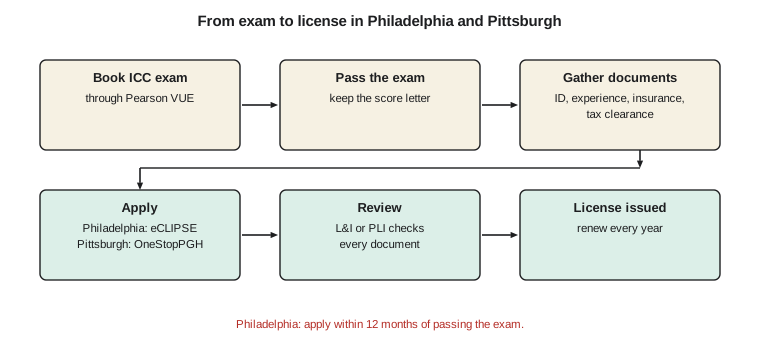
In most states the order of events is application first, exam second: the board approves you, then you book the test. Pennsylvania's local licenses usually work the other way around. In both Philadelphia and Pittsburgh, the candidate books the ICC exam directly, passes it, and then applies for the license with the passing score in hand. Keisha learned this when she called L&I to ask for an exam application and was told, politely, that there is no exam application to send: she should schedule exam 211 with the International Code Council, pass it, and then bring the score and the rest of her documents to the city. This lesson walks through that sequence for both cities.
The facts here come from Philadelphia L&I's license page and information sheet, Pittsburgh PLI's Electrical Trade License page, and the ICC's candidate bulletin for Philadelphia, as checked in November 2026. Fees, systems and addresses change, so confirm each one before you pay or travel.
Booking the ICC exam
The International Code Council develops the exams both cities use, and its testing partner, Pearson VUE, delivers them. A candidate creates an account with the ICC, chooses the exam, pays the exam fee and schedules a date and location through Pearson VUE. For Philadelphia the exam is number 211, Pennsylvania (Philadelphia) Standard Master Electrician. For Pittsburgh, PLI's page tells candidates to schedule through the ICC and Pearson VUE using code T16, G16 or F16 for the National Standard Master Electrician exam, and to choose the version that covers the most recent code year adopted by the Pennsylvania Uniform Construction Code. As of November 2026 PLI lists T16 as the 2020 NEC version, G16 as 2017 and F16 as 2014.
Read the ICC candidate bulletin before booking. It describes identification rules, rescheduling and cancellation deadlines, what happens if you arrive late, the reference books allowed, and how scores are reported. The bulletin for Philadelphia lists exam 211 as a 100-question, open book exam with a five-hour time limit and names the references allowed, which Lesson 4 covers. Exam fees are set by the ICC, not by the city, and are listed in the ICC's catalog; they are separate from the city's license fees.
Keisha booked a Saturday morning at a Pearson VUE center near the Delaware County line, eleven weeks out, to give herself a firm deadline for studying. Owen, who already passed the national exam years ago, called PLI to ask whether his old score would be accepted, because PLI's page says it will evaluate previous versions of the exam and passing letters from the older Pittsburgh-proctored exam. He was told to submit the letter with his application and let the License Officer decide.
Test-day rules at a Pearson VUE center
Testing centers run on strict procedures, and the candidate bulletin spells them out. Expect to show a current, government-issued photo ID whose name matches your exam registration exactly; a mismatch between 'Keisha M. Brennan' on the registration and 'Keisha Brennan' on a license is the kind of thing that can cost a sitting, so fix it in your ICC account ahead of time. Expect to store your phone, bag, watch and notes in a locker. Expect the staff to inspect the reference books you bring, page by page, for loose notes or writing that the bulletin does not allow. Expect to be photographed and, at some centers, to have a palm scan. Arrive early: late arrivals can be turned away and the fee forfeited.
Reference book rules deserve particular care because the master exams are open book. The bulletin lists which books may be brought and in what form, such as whether tabs and highlighting are allowed and whether handwritten notes are permitted. Keisha bought a new copy of the NEC edition named for exam 211, put the publisher's tabs on it, and did all her practice work in that book so she would know its layout cold. She left her old, annotated copy at home, because a book full of margin notes is exactly what a proctor will reject. Lesson 4 lists the references allowed for each exam.
Some ICC exams can also be taken through online proctoring, with a webcam and a cleared desk at home. Whether a given exam is offered that way, and what the room and equipment rules are, is set by the ICC and Pearson VUE and can change. The Philadelphia bulletin Keisha downloaded mentioned Pearson VUE delivery without describing remote testing for exam 211, so she chose a test center. If you prefer to test from home, check the current bulletin and the exam's catalog listing before you count on it, and run the system check well before exam day.
Accommodations are available for candidates with disabilities who document their needs, and requests must usually be made well before the exam date. The bulletin explains the process. A candidate who needs extra time, a separate room or another accommodation should start that request at the same time as registering, not the week before the test.
After the exam: scores and timing
The ICC reports results according to its bulletin, and a passing candidate receives documentation of the passing score. Keep it safe; you will upload or present it with the license application. In Philadelphia, timing matters: L&I's page says the exam must reference the current Philadelphia Code or the application must be submitted within twelve months of passing. A candidate who passes and then waits two years may have to test again. Keisha set a calendar reminder for nine months after her exam date as her personal deadline, leaving three months of margin for gathering paperwork.
If you fail, the bulletin explains how soon you may retake the exam and whether you pay again. Treat a failing score report as a study guide: it usually shows performance by subject area, which tells you which chapters of the NEC to practice. Lesson 12 returns to retake strategy.
Applying in Philadelphia
Philadelphia accepts license applications online through its eCLIPSE system or in person at the Permit and License Center. The Electrical Contractor License application form and the information sheet list what to include. In outline, the file includes the completed application; proof of a passing ICC exam score; proof of four years of qualifying experience, such as tax records showing employment by a licensed electrical contractor or proof of licensure elsewhere; proof of at least eight hours of NFPA 70 coursework from an L&I-approved provider within the prior twelve months; a signed employment statement on company letterhead if not self-employed; a two-by-two-inch color photo; a certificate of insurance meeting the city's minimums; a Business Income and Receipts Tax account number and a Commercial Activity License; and proof that city taxes are current.
Fees are paid in two steps. L&I's page lists a license fee of 262 dollars, of which a 60-dollar non-refundable application fee is paid with the application and applied to the total, with the balance due after approval. Card payments carry processing charges. The annual renewal fee is listed as 202 dollars. These amounts change from time to time, so confirm the current figures before paying. Keisha paid the application fee online and kept the receipt in the same folder as her exam score letter.
| Item | Philadelphia (from L&I's page) | Notes |
|---|---|---|
| Application fee | 60 dollars, non-refundable | Applied to the license fee |
| License fee | 262 dollars total | Balance due after approval |
| Renewal fee | 202 dollars per year | Annual renewal |
| Late renewal | Monthly charge after 60 days | Figured from the license fee for each month since expiry |
| Where to apply | eCLIPSE online or the Permit and License Center | In-person rules may require an appointment |
Applying in Pittsburgh
Pittsburgh takes trade license applications through its OneStopPGH platform or in person at the OneStopPGH counter at 412 Boulevard of the Allies. A new applicant submits a valid government-issued photo ID, proof of passing the certified standardized test, and a resume or documentation showing at least six years of combined experience and education. Before permits can be pulled under the license, PLI also requires a general liability certificate naming the City as certificate holder and additional insured, a workers' compensation certificate naming the City as certificate holder or a notarized statement for a business with no employees, and a tax compliance letter from the City's Department of Finance.
PLI's page does not list fee amounts directly; it points to the current year's fee schedule. It also warns that once a license has been issued, refunds are not provided. Owen read the fee schedule, paid online, and uploaded his documents in one sitting, then waited for the License Officer's review. Because the license is issued to him personally, his future employer's insurance certificate had to name the City in the form PLI requires before he could pull a permit under his license.
What reviewers look for
Licensing staff are not trying to trip you up, but they have checklists, and incomplete files go to the bottom of the pile. The common problems are predictable: experience records that do not show the employer's name or license, employment letters without a signature or letterhead, insurance certificates that name the wrong certificate holder or omit the additional insured wording, education certificates more than twelve months old, unpaid city taxes, and exam score letters for the wrong exam. When a reviewer asks for more, respond quickly and completely, and keep a copy of everything you send.
Keisha's application came back once. Her insurance certificate listed Schuylkill Line as the insured but showed the general liability limit as an aggregate rather than per occurrence, and L&I's minimum is stated per occurrence. Frank's agent issued a corrected certificate the same afternoon. The episode taught her to read certificates line by line against the city's sample before sending them, a habit she will need every year at renewal.
Planning the calendar
Because the exam comes first, the calendar is mostly in the candidate's hands. Work backward from the date the license is needed. Allow time to study, to sit the exam and possibly retake it, to finish the eight hours of NEC education, to gather tax records and letters, to sort out any city tax issues, and for the city's review. The calculator below lays out Keisha's plan with real calendar dates and checks the Philadelphia twelve-month window.
from datetime import date, timedelta

exam_day = date(2027, 2, 13)          # Keisha's booked exam (example)
education_done = date(2027, 3, 20)    # 8 hours of NFPA 70 completed
apply_day = date(2027, 4, 15)

window_end = exam_day + timedelta(days=365)
edu_ok = (apply_day - education_done).days <= 365
print("Twelve-month window ends:", window_end)
print("Applying within the window?", apply_day <= window_end)
print("Education within 12 months of applying?", edu_ok)
print("Days of margin left:", (window_end - apply_day).days)Twelve-month window ends: 2028-02-13 Applying within the window? True Education within 12 months of applying? True Days of margin left: 304
One more planning point: renewals. Both cities renew annually, so the date your license is issued becomes the date you will be thinking about every year. Some licensees prefer to time their application so renewal falls in a quiet season. Lesson 11 covers renewal in detail.
Other municipalities
Where another municipality licenses or registers electricians, the process is usually simpler but less documented. Expect a form, an insurance certificate naming the municipality, a fee, and sometimes proof of a passing ICC exam or another municipality's license. Some offices still want paper forms dropped off in person, and some process registrations only once a year. Call before you bid, ask what they need, and ask how long it takes. A license or registration that arrives a week after the job was supposed to start is a problem you can avoid with one phone call.
Common mistakes
MistakeWaiting for the city to send an exam application.
InsteadBook the ICC exam directly through the ICC and Pearson VUE, then apply to the city with the score.
MistakeBooking the wrong version of the Pittsburgh exam.
InsteadChoose the version covering the most recent code year adopted by the UCC; T16 covers the 2020 NEC.
MistakeSending an insurance certificate without reading it against the city's requirements.
InsteadCheck the limits, the certificate holder and the additional insured wording line by line.
MistakeLetting the Philadelphia twelve-month window run out.
InsteadApply within twelve months of passing the exam.
MistakeExpecting a refund after a Pittsburgh license is issued.
InsteadPLI says refunds are not provided once a license has been issued.
Summary and key terms
- In Philadelphia and Pittsburgh, candidates book the ICC exam directly through Pearson VUE and apply after passing.
- Philadelphia uses exam 211; Pittsburgh uses the National Standard Master Electrician exam in the version for the UCC's current NEC.
- Philadelphia applications go through eCLIPSE or the Permit and License Center, with a 60-dollar application fee toward a 262-dollar license fee.
- Pittsburgh applications go through OneStopPGH, with fees from the current fee schedule.
- Insurance certificates, tax clearance and education records are the most common sources of delay.
- Plan backward from the date the license is needed and leave margin for a retake.
- ICC
- The International Code Council, which develops the exams used by Philadelphia and Pittsburgh.
- Pearson VUE
- The testing company that delivers ICC exams.
- Exam 211
- The ICC's Pennsylvania (Philadelphia) Standard Master Electrician exam.
- T16
- The ICC National Standard Master Electrician exam version based on the 2020 NEC, as listed by Pittsburgh PLI.
- eCLIPSE
- Philadelphia's online system for licenses and permits.
- OneStopPGH
- Pittsburgh's online platform for permits and licenses.
Practice problems
Work each problem on paper first, then reveal the answer to check.
In what order do Philadelphia candidates take the exam and apply?
Show answer
They book and pass the ICC exam first, then apply to L&I with the passing score.
Which exam code does Pittsburgh list for the 2020 NEC version?
Show answer
T16.
How much of Philadelphia's 262-dollar license fee is paid with the application?
Show answer
The 60-dollar non-refundable application fee, applied to the total; the balance is due after approval.
Name three documents a Philadelphia application includes.
Show answer
Any three of: passing score, experience proof, eight hours of NFPA 70 education, employment letter, photo, insurance certificate, BIRT and Commercial Activity License, tax clearance.
Owen has an old passing letter from the Pittsburgh-proctored exam. What should he do?
Show answer
Submit it with his application; PLI's License Officer evaluates previous versions and old passing letters.
Lesson quiz · 5 questions
Score 60% or more to complete this lesson.
Create a free account to save your progress, take quizzes and earn a certificate.