
MELU-313 · Lesson 5 of 12 · 20 min
Local code adoption and amendments in Pennsylvania
▶ Video coming soon A video version of this lesson is on the way.
Frank Mazzola keeps three code books on the shelf above his desk: a worn 2014 NEC, a 2017 edition with a cracked spine, and a 2020 edition still stiff from the shrink wrap. When Keisha asked why he had not thrown out the old ones, he pulled a permit folder for a job Schuylkill Line had designed in late 2025 and finished in the spring of 2026. 'That one went in under the 2018 codes,' he said. 'The one next door, same owner, went in under the 2021 codes. Same block, same wire, different book.' This lesson explains how that happens: how Pennsylvania adopts building codes, how the NEC rides along with them, which edition applies to a given job, and where local amendments fit.
The facts in this lesson come from the Pennsylvania Department of Labor and Industry's Uniform Construction Code pages, a summary of the 2026 UCC update published in the Pennsylvania Bulletin, and Philadelphia L&I's code bulletin on implementing the 2021 International Codes, as checked in November 2026. Code adoption dates and transition rules are exactly the kind of detail that changes with each cycle, so confirm the current status before relying on any date here.
The UCC and the Construction Code Act
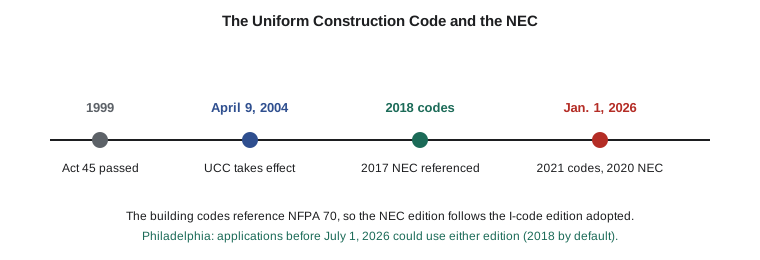
The Pennsylvania Construction Code Act, Act 45 of 1999, created the Uniform Construction Code as a single statewide building code. The UCC took effect on April 9, 2004. It preempts most local building codes, so a township cannot simply write its own building code that conflicts with the UCC, though the law preserved some local provisions that predated it and allows changes through a defined process. The UCC regulations are in Title 34 of the Pennsylvania Code, Chapters 401 through 405, and they adopt the International Code Council's model codes by reference, with Pennsylvania amendments.
The model codes adopted include the International Building Code for commercial buildings, the International Residential Code for one- and two-family dwellings and townhouses, and the International Mechanical, Plumbing, Fuel Gas, Energy Conservation and Existing Building Codes. Electrical work enters through these codes. The International Building Code points to NFPA 70, the National Electrical Code, for electrical installations, and the International Residential Code contains electrical provisions based on a referenced edition of the NEC. That is why Pennsylvania electricians speak of the UCC 'adopting' a particular NEC edition, even though the state's regulation names I-code editions rather than adopting the NEC as a stand-alone code.
How new editions are adopted
The ICC publishes new model code editions every three years, but Pennsylvania does not adopt each one automatically. Under the Construction Code Act, a review and advisory council examines new editions and decides which provisions to recommend, and the Department of Labor and Industry then adopts the recommended provisions by regulation. The process has been revised by later legislation, and in recent cycles the state has skipped some editions entirely. For many years Pennsylvania used the 2015 codes, then moved to the 2018 codes, and most recently moved to the 2021 codes, skipping the 2024 edition for now.
The 2026 update is the one every current candidate needs to know. According to the official summary, Pennsylvania updated the UCC to the 2021 International Codes with Pennsylvania amendments, published in the Pennsylvania Bulletin on November 8, 2025, effective January 1, 2026, applying to permits applied for on or after that date. The 2021 codes reference the 2020 edition of the NEC, so electrical work permitted under the new UCC follows the 2020 NEC, with any Pennsylvania amendments. Under the earlier 2018 codes, the referenced electrical code was the 2017 NEC. That is why Philadelphia's exam 211 bulletin lists the 2020 NEC.
Which edition applies to a job?
The general rule under the new UCC is tied to the permit application date: permits applied for on or after January 1, 2026 fall under the 2021 codes and therefore the 2020 NEC. There is a transition rule as well. Under the Construction Code Act, a project with a design or construction contract signed before the new code took effect may be permitted under the code that was in effect when the contract was signed, if the permit application is submitted within the period the law allows. Philadelphia's bulletin describes this provision, Section 304(c)(4), as applying when the application is submitted within six months after the new regulations take effect.
Philadelphia added its own transition. Its bulletin says applications received before July 1, 2026 could be reviewed under either the 2018 or the 2021 editions, with the applicant naming the edition on the application or plans, and with the 2018 code applying by default if no edition was named. Applications received on or after July 1, 2026 must comply with the 2021 editions. That explains Frank's two folders: the earlier job was applied for under the 2018 codes during the window, and the later one under the 2021 codes.
Worked problem
Which code applies?
Schuylkill Line has three Philadelphia jobs. Job A's permit application was filed on December 10, 2025. Job B's was filed on March 3, 2026 and named the 2018 codes. Job C's was filed on August 20, 2026. Which edition governs each?
Show solution
- Job A: filed before January 1, 2026, so the 2018 codes and the 2017 NEC.
- Job B: filed before July 1, 2026 and named the 2018 codes, so Philadelphia's transition allows the 2018 codes.
- Job C: filed on or after July 1, 2026, so it must comply with the 2021 codes and the 2020 NEC.
- Always confirm with the permit record, because the edition is set at application.
Answer: A: 2018 codes (2017 NEC); B: 2018 codes by choice during Philadelphia's window; C: 2021 codes (2020 NEC).
Local amendments and the UCC
Because the UCC preempts local building codes, municipalities have limited room to change it. The Construction Code Act allows a municipality to adopt amendments that are stricter than the UCC only through a defined process, which includes showing a local need and, in some cases, approval by the state. Some local provisions in effect before the UCC were preserved. In practice, most Pennsylvania municipalities enforce the UCC as written. Philadelphia is the main exception because it adopts the UCC codes through its own Philadelphia Code, with city amendments, and publishes them as the Philadelphia Building Code, Residential Code and related subcodes.
Philadelphia's own guidance says electrical work in the city is governed by the Building Code, the Residential Building Code and the Existing Building Code, and that the NEC is applied as referenced in those codes. In other words, an electrician working in Philadelphia uses the NEC edition the city's adopted codes reference, along with any city amendments in those codes. Philadelphia publishes code bulletins and FAQs on specific electrical topics, such as when an emergency disconnect is required and how residential service equipment is handled, and those bulletins are worth reading before you design a job there.
| Situation | Code that applies | Where to check |
|---|---|---|
| Permit applied for on or after January 1, 2026 (statewide) | 2021 I-codes with PA amendments; 2020 NEC | L&I UCC pages |
| Design contract signed before the change, application within the allowed period | May use the prior code under Section 304(c)(4) | Construction Code Act; local code office |
| Philadelphia application before July 1, 2026 | 2018 or 2021 editions, as named; 2018 by default | Philadelphia code bulletin |
| Philadelphia application on or after July 1, 2026 | 2021 editions; 2020 NEC as referenced | Philadelphia code bulletin |
| Local amendments | Allowed only through the UCC process; Philadelphia adopts with city amendments | Municipal ordinance; L&I |
Exclusions and special cases
The UCC has scope limits that matter to electricians. Some structures and work are excluded or partly excluded, such as certain agricultural buildings, some utility installations, and work covered by other state programs. Manufactured housing has its own federal standard. Elevators are handled by the state. Repairs and minor work may not need a permit under the UCC's rules or a municipality's ordinance, though the work must still meet the code. When a job falls near one of these lines, ask the local code official before you assume the UCC does or does not apply.
Existing buildings deserve a special mention because so much electrical work in Pennsylvania is renovation. The International Existing Building Code, adopted as part of the UCC, sets how much of an existing building must be brought up to current requirements when it is repaired, altered or changed in use. Keisha's row-house jobs often involve replacing a panel, adding circuits and rewiring a kitchen, and the existing building rules decide how far the rest of the house must be updated. Philadelphia's guidance lists the Existing Building Code among those that govern electrical work.
Keeping track of editions
With two editions in recent use, a careful contractor records the governing edition on every job. Frank's system is a field on the job sheet: permit date, code edition, and any special conditions from the plan review. When a job straddles an adoption date, the edition on the permit governs, and the inspection agency will inspect to that edition. Keisha added a step to the company's checklist: before ordering materials for a job, confirm the edition, because some requirements that changed between the 2017 and 2020 NEC, such as GFCI and surge protection provisions, affect what goes on the truck.
The move from the 2017 to the 2020 NEC is a good example of why the edition matters. Among the changes commonly discussed by inspectors and trainers are a new requirement for surge protection on services to dwelling units in Article 230, an outdoor emergency disconnect for one- and two-family dwellings in 230.85, expanded GFCI requirements in 210.8, and changes to receptacle and feeder rules elsewhere. Philadelphia's FAQ on when a project requires an emergency disconnect shows how quickly these changes reach the field. Read each one in your own 2020 code book rather than relying on a summary, and when a job's permit says 2018 codes, remember that these newer requirements may not apply to it, though meeting them anyway is rarely a mistake.
Electricians who work in more than one municipality should also keep in mind that the date of adoption is the same statewide, but the way each code office handles transition questions, plan review and interpretations can differ. When in doubt, ask the code official or inspection agency for the edition in writing before you start.
The short program below is the check Keisha wrote for the company's job list. It assigns a code edition to each Philadelphia job from its application date and any edition the applicant named during the transition window.
from datetime import date

def phila_edition(applied, named=None):
    """Code edition for a Philadelphia permit application (summary of the city bulletin)."""
    if applied < date(2026, 1, 1):
        return "2018 codes (2017 NEC)"
    if applied < date(2026, 7, 1):
        return "2021 codes (2020 NEC)" if named == "2021" else "2018 codes (2017 NEC)"
    return "2021 codes (2020 NEC)"

jobs = [("Tasker St kitchen", date(2025, 12, 10), None),
        ("Point Breeze fit-out", date(2026, 3, 3), "2018"),
        ("Fishtown cafe", date(2026, 4, 22), "2021"),
        ("Passyunk row house", date(2026, 8, 20), None)]
for name, applied, named in jobs:
print(f"{name:22s} {applied} {phila_edition(applied, named)}")Tasker St kitchen 2025-12-10 2018 codes (2017 NEC) Point Breeze fit-out 2026-03-03 2018 codes (2017 NEC) Fishtown cafe 2026-04-22 2021 codes (2020 NEC) Passyunk row house 2026-08-20 2021 codes (2020 NEC)
Why this matters on the exam and on the job
On the exam, the edition question is mostly settled for you: the bulletin names the edition, and you study from it. On the job, editions matter every day, because the inspection agency will hold you to the edition on the permit. A contractor who installs to the newer edition on an older permit is usually safe, since newer editions tend to be stricter, but a contractor who installs to the older edition on a newer permit will fail inspection. Knowing how Pennsylvania adopts codes, and how Philadelphia handles transitions, keeps you on the right side of that line.
Common mistakes
MistakeThinking Pennsylvania adopts the NEC directly on its own cycle.
InsteadThe UCC adopts I-code editions, which reference an NEC edition; the 2021 codes reference the 2020 NEC.
MistakeAssuming the code in effect on the day of inspection applies.
InsteadThe edition is set by the permit application date, subject to transition rules.
MistakeBelieving any township can write its own electrical code.
InsteadThe UCC preempts most local codes; local amendments must follow the UCC process.
MistakeForgetting Philadelphia's transition window.
InsteadApplications before July 1, 2026 could use 2018 or 2021 editions, with 2018 as the default.
MistakeIgnoring the Existing Building Code on renovations.
InsteadThe IEBC, part of the UCC, decides how much of an existing building must be updated.
Summary and key terms
- The UCC, created by Act 45 of 1999, took effect on April 9, 2004 and preempts most local building codes.
- The UCC adopts ICC model codes with Pennsylvania amendments; electrical work follows the NEC edition those codes reference.
- The 2021 I-codes took effect January 1, 2026 for permits applied for on or after that date, bringing the 2020 NEC.
- Section 304(c)(4) allows the prior code for projects with contracts signed before the change, within the allowed period.
- Philadelphia allowed 2018 or 2021 editions for applications before July 1, 2026, with 2018 as the default.
- Record the governing edition on every job; the inspection follows the permit.
- Pennsylvania Construction Code Act
- Act 45 of 1999, the statute creating the UCC.
- Review and advisory council
- The council that reviews new model code editions and recommends provisions for adoption.
- Pennsylvania Bulletin
- The official publication where new regulations, including UCC updates, are published.
- Section 304(c)(4)
- The Construction Code Act provision allowing the prior code for projects contracted before a change, within a set period.
- IEBC
- The International Existing Building Code, part of the UCC, for repairs, alterations and changes of use.
- Referenced edition
- The NEC edition named by the adopted building code, which is the edition that applies to electrical work.
Practice problems
Work each problem on paper first, then reveal the answer to check.
When did the 2021 I-codes take effect under the UCC?
Show answer
January 1, 2026, for permits applied for on or after that date.
Which NEC edition do the 2021 I-codes reference?
Show answer
The 2020 NEC.
A Philadelphia application filed May 1, 2026 named no edition. Which codes apply?
Show answer
The 2018 codes by default, under Philadelphia's transition.
What must a municipality do to make the UCC stricter locally?
Show answer
Follow the UCC amendment process in the Construction Code Act, including showing local need; most municipalities enforce the UCC as written.
Which code decides how much of an old house must be updated during a renovation?
Show answer
The International Existing Building Code, adopted as part of the UCC.
Lesson quiz · 5 questions
Score 60% or more to complete this lesson.
Create a free account to save your progress, take quizzes and earn a certificate.