
MELU-313 · Lesson 11 of 12 · 20 min
Renewal, reciprocity and working in other jurisdictions
▶ Video coming soon A video version of this lesson is on the way.
Owen's first Pittsburgh license, years before he moved to Philadelphia, ended with a lesson he still talks about. He took a job in Philadelphia, forgot about the Pittsburgh renewal, and found out on day sixty-four that the license had lapsed. Getting it back meant applying all over again as a new licensee. Now, coming home, he has to do exactly that. 'Put the renewal date in three places,' he tells every new license holder. 'Your phone, your office calendar and the inside cover of your code book.' This lesson covers keeping a Pennsylvania local license alive, and what happens when you want to work somewhere it does not reach.
The facts here come from Philadelphia L&I's electrical contractor license page and Pittsburgh PLI's Electrical Trade License page as checked in November 2026. Renewal rules, fees and grace periods are set by each municipality and can change at any time, so check the current page before each renewal.
Renewing in Philadelphia
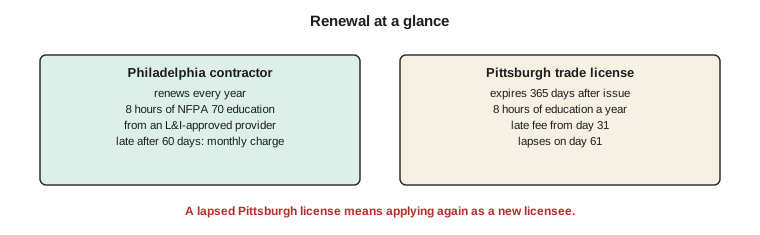
Philadelphia's Electrical Contractor License renews every year. To renew, the licensee must show proof of active insurance, be current on city taxes and fines, and complete eight hours of NFPA 70 coursework during the previous license period from a provider approved by the Pennsylvania Department of Labor and Industry. The renewal fee is listed at 202 dollars. Renewals filed more than sixty days after the due date incur a late charge, figured as a fraction of the license fee for each month since expiration, so a late renewal costs more the longer it waits.
The education requirement is specific: NFPA 70, meaning the National Electrical Code, in the current or a later edition, from an approved provider. General safety or business classes, however useful, do not satisfy it unless they are approved NEC coursework. Keisha found an approved provider that offers an eight-hour class on the 2020 NEC changes on two Saturdays a year, and she booked the class for the spring before her first renewal so that her certificate would fall well inside the license period.
Renewing in Pittsburgh
Pittsburgh's Electrical Trade License expires 365 days after issuance. To renew, the licensee needs a valid government-issued photo ID and proof of eight hours of continuing education units within the previous twelve months. One CEU equals one hour. PLI accepts courses from providers on the ICC Preferred Provider Directory, the Department of Labor and Industry's UCC provider list, and trade-specific union and apprenticeship programs. For any other course, the licensee can email PLI with the course title, content, instructor qualifications and relevance, and PLI will decide within ten business days, though a pending review does not excuse late renewal.
Pittsburgh's lapse rules are strict. A late fee applies if the license is not renewed within thirty days after expiration, starting on the thirty-first day. If the license is not renewed within sixty days after expiration, it automatically lapses on the sixty-first day. A lapsed licensee must apply for a new license and meet all the requirements for a new license, and permits connected to the lapsed license are suspended until a valid license is connected to the work. That is what happened to Owen years ago, and it is why he is now applying from scratch.
Worked problem
Pittsburgh renewal timing
Owen's new Pittsburgh license is issued on April 20, 2027. On what day does it expire, from which day does a late fee apply, and on which day does it lapse if not renewed?
Show solution
- Expiry: 365 days after issuance, which is April 19, 2028 (2028 is a leap year, so 365 days lands one day before the anniversary).
- Late fee: applies from the 31st day after expiration.
- Lapse: the license automatically lapses on the 61st day after expiration.
- Count from the actual expiry date on the license; the program below does the arithmetic.
Answer: Expiry about one year after issue; late fee from day 31 after expiry; lapse on day 61. Use the date printed on the license.
from datetime import date, timedelta

issued = date(2027, 4, 20)
expires = issued + timedelta(days=365)
late_fee_from = expires + timedelta(days=31)
lapses_on = expires + timedelta(days=61)
reminders = [expires - timedelta(days=d) for d in (60, 30, 7)]
print("Expires:      ", expires)
print("Late fee from:", late_fee_from)
print("Lapses on:    ", lapses_on)
print("Reminders: ", ", ".join(str(r) for r in reminders))Expires: 2028-04-19 Late fee from: 2028-05-20 Lapses on: 2028-06-19 Reminders: 2028-02-19, 2028-03-20, 2028-04-12
Keeping CE records
Continuing education certificates are easy to lose and painful to replace. Keep a copy of every certificate with the provider's approval number, the course title, the hours and the date, and keep them for several years after the renewal they supported, in case of an audit. If you hold licenses in more than one place, check whether one course can count for both. Philadelphia wants NFPA 70 coursework from an L&I-approved provider; Pittsburgh accepts L&I's UCC provider list among others. A single approved eight-hour NEC course might satisfy both, but confirm with each office before relying on that.
Reciprocity: does one license count elsewhere?
Because Pennsylvania has no state license, there is no statewide reciprocity agreement with other states for electricians. Each municipality decides whether to accept another jurisdiction's license, exam or experience. Philadelphia accepts licensure from a local or state jurisdiction as one way to prove experience, but still requires its own exam and license. Pittsburgh accepts the ICC National Standard Master Electrician exam and evaluates previous versions and old Pittsburgh exam letters, but still requires its own license, insurance and documents. Some smaller municipalities accept a license from a nearby city in place of their own testing; some do not license at all.
The practical answer to most reciprocity questions in Pennsylvania is that your exam may travel but your license does not. A passing score on an ICC national exam can satisfy the testing requirement in places that accept it, saving you from retesting, but each place still issues its own license or registration with its own insurance, tax, fee and renewal rules. Owen's old passing letter may spare him the exam in Pittsburgh; it will not spare him the application, the insurance certificates or the renewal calendar.
| Question | Philadelphia | Pittsburgh | Elsewhere |
|---|---|---|---|
| Accepts another jurisdiction's license? | As proof of experience; own exam and license still needed | Own license needed; evaluates older exam scores | Varies; some accept a nearby city's license |
| Renewal period | Annual | 365 days from issue | Set locally |
| Continuing education | 8 hours of NFPA 70 from an L&I-approved provider | 8 CEUs within 12 months, from listed providers | Set locally; some require none |
| Late or lapse rules | Monthly late charge after 60 days | Late fee from day 31; lapse on day 61 | Set locally |
Working in other states
Pennsylvania electricians near the borders often work across state lines, into New Jersey, Delaware, Maryland, Ohio, West Virginia or New York. Those states have their own systems. New Jersey and Delaware, for example, license electrical contractors at the state level, and New York has no statewide license but licenses electricians locally in places such as New York City. A Pennsylvania local license does not authorize work in any of them. An electrician who plans to work across the line should study that state's requirements and, where a state exam is needed, prepare for it. The HSM University master electrician series has a course for each state.
Philadelphia contractors cross the Delaware River into New Jersey constantly, and many hold a New Jersey electrical contractor license as well as their Philadelphia license. Frank held both for twenty years. Keisha plans to add New Jersey eventually, but she will start with Philadelphia, because that is where Schuylkill Line does almost all its work.
Working across municipal lines inside Pennsylvania
Even without leaving the state, a contractor can face a dozen sets of rules in a single season. Schuylkill Line's work is mostly in Philadelphia, but the company also takes jobs in Delaware County and Montgomery County suburbs. Each of those townships and boroughs enforces the UCC, and some register contractors, require their own business licenses or ask for certificates of insurance naming the municipality. Linh keeps a table of every municipality the company has worked in during the last three years, with what each requires, the renewal date of any registration and the contact at the code office. Before the company bids in a new place, Linh calls the office and adds a row.
The same discipline applies to permits. A permit in a suburban township is applied for and inspected under that township's process, which may mean its own code official, a contracted third-party agency or, in an opt-out municipality, an agency the owner hires for residential work and L&I for commercial work. Philadelphia's private inspection agency system does not follow you across City Line Avenue. Plan the inspection logistics for each place separately.
Changes during the license period
A license holder's circumstances change, and licensing offices expect to be told. A change of address, a change of employer, a new company name or a change in insurance carrier can each affect the license file. In Philadelphia, a license holder who is not self-employed files an employment statement on company letterhead, so a change of employer means a new statement. In Pittsburgh, the license belongs to the individual, so a change of employer means new insurance and workers' compensation certificates from the new employer before permits issue under the license there. Report changes promptly, and keep a copy of what you sent.
Retirement deserves a plan of its own. When Frank retires, his Philadelphia license will simply not be renewed after his last open permits close. Before that happens, he and Keisha will make sure every open permit under his license is either closed or transferred as the city allows, that customers know who to call for warranty work, and that the company's insurance and city records list Keisha. Some licensing systems offer an inactive or retired status that keeps a license on file without active privileges; check whether your municipality offers one before letting a license expire if you might want it back.
Name changes need attention too. If a license holder changes her legal name, the exam registration, the license, the insurance certificates and the tax accounts should all match. Keisha's colleague Marisol married last year and learned that the city's system would not match her new name to her old exam score until she sent a copy of her marriage certificate. A five-minute fix, but only if you know it is needed.
When a statewide license comes
Pennsylvania legislators continue to propose statewide licensing, and a future law could change everything in this lesson. If a statewide license is created, expect provisions for grandfathering experienced electricians, for recognizing existing local licenses for some period, and for a state board and exam. Watch the trade associations and the General Assembly's bill tracker. Until a law passes and takes effect, the local systems remain the rule, and renewal calendars remain the most important tool a license holder has.
A renewal routine
Keisha's renewal routine, adapted from Linh's, runs on a fixed schedule. Ninety days before renewal, she checks that her eight hours of education are done or booked. Sixty days before, Linh asks the insurance agent for updated certificates and checks the company's city tax status. Thirty days before, Keisha files the renewal online and saves the confirmation. On the renewal date, Linh confirms that the license shows as active on the city's lookup. The routine has never failed, because each step happens well before the deadline rather than on it.
Common mistakes
MistakeLetting a Pittsburgh license sit unrenewed past sixty days.
InsteadIt lapses on day 61, and you must apply again as a new licensee.
MistakeTaking a general safety class for Philadelphia renewal credit.
InsteadPhiladelphia requires eight hours of NFPA 70 coursework from an L&I-approved provider.
MistakeAssuming a Pennsylvania license works in New Jersey or Delaware.
InsteadThose states license separately; a Pennsylvania local license does not cover them.
MistakeTreating a passing ICC score as a license.
InsteadThe exam may satisfy testing in places that accept it, but each place issues its own license.
MistakeLosing CE certificates.
InsteadKeep certificates with provider approval numbers for several years.
Summary and key terms
- Philadelphia's license renews annually with insurance proof, current city taxes and fines, and eight hours of NFPA 70 education.
- Philadelphia charges a monthly late fee on renewals more than sixty days late.
- Pittsburgh's license expires 365 days after issue and needs eight CEUs within the previous twelve months.
- In Pittsburgh a late fee starts on day 31 after expiry and the license lapses on day 61.
- There is no statewide reciprocity; each municipality decides what it accepts.
- Other states license separately; a Pennsylvania local license does not reach across state lines.
- CEU
- Continuing education unit; Pittsburgh counts one CEU as one hour.
- Lapse
- The automatic end of a Pittsburgh license not renewed within sixty days after expiry.
- Reciprocity
- One jurisdiction's acceptance of another's license or exam.
- Approved provider
- A course provider accepted by the licensing office for continuing education.
- Renewal routine
- A fixed schedule of steps that keeps a license from expiring.
- Grandfathering
- Recognition of existing practitioners when a new licensing law takes effect.
Practice problems
Work each problem on paper first, then reveal the answer to check.
How many hours of continuing education does Philadelphia require for renewal, and on what subject?
Show answer
Eight hours of NFPA 70 coursework from an L&I-approved provider.
On which day after expiry does a Pittsburgh license lapse?
Show answer
The 61st day.
What must a lapsed Pittsburgh licensee do?
Show answer
Apply for a new license and meet all new-license requirements.
Does a Philadelphia license allow work in New Jersey?
Show answer
No. New Jersey licenses electrical contractors separately.
Name two providers Pittsburgh accepts for CEUs.
Show answer
Any two of: ICC Preferred Providers, L&I's UCC provider list, trade union and apprenticeship programs.
Lesson quiz · 5 questions
Score 60% or more to complete this lesson.
Create a free account to save your progress, take quizzes and earn a certificate.