
MELU-313 · Lesson 2 of 12 · 21 min
Eligibility for the Local Master Electrician Licenses
▶ Video coming soon A video version of this lesson is on the way.
Keisha assumed eligibility would be the easy part. She has fourteen years in the trade, a completion certificate from her apprenticeship, and a stack of pay stubs going back to her first week as a helper. But when she read Philadelphia's requirements closely, she found that the city does not ask how long you have been an electrician. It asks how long you have worked doing electrical work for a company licensed by a local or state jurisdiction, and it wants proof in a particular form. Owen, reading Pittsburgh's page, found a different test entirely: six years of combined experience and education, documented with a resume. This lesson walks through both, and through the habits that make eligibility painless anywhere in Pennsylvania.
The facts in this lesson come from the official license pages of Philadelphia L&I and Pittsburgh PLI as checked in November 2026. Requirements in other municipalities vary too widely to list, so the lesson ends with a checklist for finding and documenting them. As always, read the current page before you apply, because eligibility details are among the things cities revise most often.
Philadelphia: four years with a licensed company
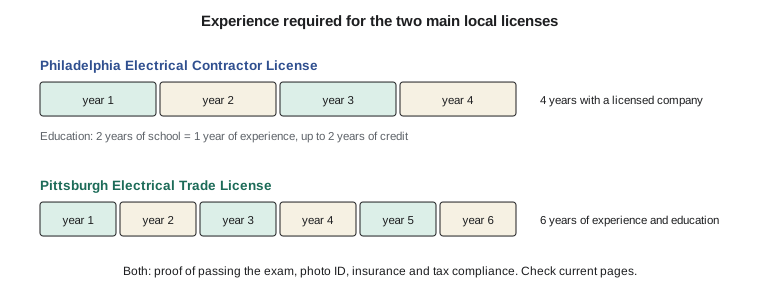
Philadelphia's Electrical Contractor License requires a minimum of four years of employment doing electrical work for a company that is licensed by a local or state jurisdiction. The phrase matters. The experience does not have to be in Philadelphia, and it does not have to be in Pennsylvania, but the employer has to have been licensed somewhere: by a city, a county or a state that licenses electrical contractors. Experience working for an unlicensed handyman business, or doing your own work on rental properties, does not fit the wording, however skilled the work was. Keisha's entire career has been with licensed Philadelphia contractors, so the employer test is easy for her.
L&I also allows education to stand in for part of the experience. Two years of electrical education count as one year of practical experience, up to a maximum of two years of credit. In other words, a candidate could, in principle, use four years of qualifying electrical schooling to replace two of the four years of work, leaving two years of employment to document. The page does not say which programs count, so a candidate relying on education credit should ask L&I before applying. Keisha's apprenticeship classroom hours were part of her employment, so she does not need the education route, but her younger coworker Marisol, who finished a two-year technical college program before joining Schuylkill Line, might.
Worked problem
Philadelphia experience with education credit
Marisol completed a two-year electrical technology program and has worked three years for licensed contractors. Does she meet the four-year requirement?
Show solution
- Education credit: 2 years of education counts as 1 year of experience.
- Experience counted: 3 years of employment + 1 year of education credit = 4 years.
- The education credit is within the 2-year maximum.
- Total meets the 4-year minimum, subject to L&I accepting her program.
Answer: Yes, on the figures given, if L&I accepts her program as qualifying electrical education.
How Philadelphia wants experience proved
Philadelphia's page names the forms of proof it accepts. Employment by a licensed electrical contractor can be shown with tax records, and licensure from a local or state jurisdiction can also serve as proof, subject to L&I's approval. In practice that means W-2 forms, tax transcripts or similar records that show the employer's name and the years worked, matched to the employer's license. Keisha requested her wage and income transcripts from the IRS website and printed the W-2s Frank's bookkeeper keeps on file, then added a list of Schuylkill Line's license numbers by year. Her earlier employer, a large shop in Northeast Philadelphia, closed in 2015; she found its old license number in a permit she had saved from a job there.
If you are not self-employed, L&I also asks for a signed employment statement on company letterhead. Self-employed applicants face a harder road, because their own unlicensed work does not meet the employer test. An electrician who has held a license in another jurisdiction can use that licensure as proof, which is one reason electricians who move into Philadelphia from licensing cities sometimes find the process smoother than long-time residents who never held a license anywhere.
Philadelphia: the other conditions
Experience is only one condition. A Philadelphia applicant also needs a passing score on the Philadelphia electrical contractor exam administered by the International Code Council, and the application must reference the current Philadelphia Code or be submitted within twelve months of passing. The applicant needs at least eight hours of coursework in the current or a later edition of NFPA 70 from a provider approved by the Pennsylvania Department of Labor and Industry, completed within the twelve months before applying. The applicant must be current on all City of Philadelphia taxes and must have a Business Income and Receipts Tax account and a Commercial Activity License. Insurance must be in place, as Lesson 8 explains. A two-inch color photo completes the file.
Two newer conditions are worth noting. First, Philadelphia's page says that starting July 1, 2026, the contractor listed on any permit application that includes an electric vehicle charger must hold Electric Vehicle Infrastructure Training Program certification, known as EVITP. That is not a condition of the license itself, but it affects what work a license holder can permit. Second, the city ties licensing to tax compliance. An applicant who owes city taxes, or a renewing licensee who owes fines, will not be licensed until the debt is resolved.
Pittsburgh: six years of experience and education
Pittsburgh's Electrical Trade License asks new applicants for three things: a valid government-issued photo ID, proof of passing the certified standardized test, and a resume or documentation showing a minimum of six years of a combination of experience and education. The test PLI names is the ICC National Standard Master Electrician exam. The six years can combine work and schooling, though PLI's page does not set a conversion rate the way Philadelphia's does, so a candidate counting heavily on schooling should ask PLI how it will be weighed.
Owen has eleven years in the trade, eight of them in Philadelphia and three earlier in Pittsburgh, so the six-year test is not a problem for him. What took him time was the resume. PLI wants documentation, and the best documentation is specific: employers, dates, the kind of work, the size of the jobs, and any licenses held. Owen listed each employer, the years and months, and two or three representative projects, and he attached his union apprenticeship completion certificate as education. He kept copies of everything in a folder labeled for Pittsburgh, because PLI's page says the License Officer evaluates submissions such as older exam scores, and he wanted to be ready for questions.
| Requirement | Philadelphia Electrical Contractor License | Pittsburgh Electrical Trade License |
|---|---|---|
| Experience | 4 years doing electrical work for a licensed company | 6 years combined experience and education |
| Education credit | 2 years of education = 1 year, up to 2 years | Counted within the 6 years; ask PLI how |
| Exam | ICC exam 211, Philadelphia | ICC National Standard Master Electrician |
| Recent education | 8 hours of NFPA 70 within the prior 12 months | 8 CEUs a year to renew |
| Taxes | Current on city taxes; BIRT account and Commercial Activity License | Tax compliance letter for permits |
| Issued to | The individual contractor licensee | Individuals, not companies |
Counting hours and years
Neither city sets an hour count on its page the way some states do, but a year of experience usually means a year of substantially full-time electrical work. If your history includes part-time work, seasonal layoffs or time in another trade, be ready to explain how you counted. A simple way is to total the hours from pay records and divide by a typical full-time year of about two thousand hours, which gives you a number you can defend if asked. The calculator below does that for a work history like Owen's, with an illustrative layoff in one year.
# Converting pay-record hours to full-time years (illustrative)
history = [
    ("2015", 1880), ("2016", 2040), ("2017", 1510),  # 2017 included a layoff
    ("2018", 2100), ("2019", 2080), ("2020", 1720),
    ("2021", 2010), ("2022", 2060), ("2023", 2090),
    ("2024", 2050), ("2025", 2070),
]
FULL_YEAR = 2000
total = sum(h for _, h in history)
print(f"Total hours: {total:,}")
print(f"Full-time years: {total / FULL_YEAR:.1f}")
print("Meets 6 years?", total / FULL_YEAR >= 6)Total hours: 21,610 Full-time years: 10.8 Meets 6 years? True
Keep the result honest. A jurisdiction can ask for the records behind your count, and misstatements on a license application are a serious matter. If an employer will not confirm your work, say so and offer other evidence rather than inventing a figure. Keisha's rule of thumb, borrowed from Frank, is that every number on an application should be one she could defend to an L&I clerk with a folder in her hand.
Experience that may not count
Some experience is risky to rely on. Work for an employer that was not licensed anywhere does not meet Philadelphia's wording. Work performed without permits, or in violation of local licensing laws, can raise questions about an applicant's history rather than support it. Low-voltage, alarm or communications work may or may not count as electrical work, depending on the jurisdiction's view. Maintenance work inside a plant is real electrical work, but it may not be employment by a licensed contractor. And experience in a related trade, such as HVAC, usually counts only for the electrical portion. If any part of your history falls into a gray area, ask the licensing office before you apply.
Military electrical experience deserves a separate word. Many licensing offices give credit for documented military electrical work, but the documentation needs to translate military job codes into civilian electrical tasks. Bring your service records and a plain-language description of the work. Pennsylvania and several of its cities have programs to help veterans with licensing; check the current state and city resources.
Other municipalities
Outside Philadelphia and Pittsburgh, eligibility rules range from formal to nonexistent. Some municipalities require a passing ICC exam and a number of years of experience, some accept a license from another jurisdiction, and some simply register contractors who show insurance and pay a fee. A few require a local exam or interview. When Owen called the borough where his first Pittsburgh-area job sits, the clerk told him the borough registers contractors annually, requires an insurance certificate naming the borough, and accepts a Pittsburgh trade license as evidence of competence. Another borough a few miles away had no registration at all and simply required a UCC permit.
Owen also asked both boroughs a question that saved him trouble later: did they want the license or registration in his name or in the company's? One borough registered companies, the other individuals, and the paperwork followed from that answer. In a state where licensing is local, the same word can mean different things a few miles apart, so ask what each office means by license, registration and contractor before you fill in a form.
The lesson for the exam is not to memorize the rules of every borough. It is to know where requirements come from, to recognize that Pennsylvania licensing is local, and to know the standard pieces most jurisdictions ask for: experience, an exam, insurance, tax compliance and, often, continuing education.
An eligibility checklist
Keisha and Owen built the same checklist for their applications, and it works for any Pennsylvania jurisdiction. List every employer with dates, license numbers and a contact. Gather tax records or transcripts that show each employer and year. Get signed employment letters on letterhead where required. Collect education records, apprenticeship certificates and continuing education certificates. Confirm the exam the jurisdiction accepts and its NEC edition. Check tax status with the city before applying. Line up insurance certificates naming the right certificate holder. Finally, read the current official page again the week you apply, in case anything changed.
Common mistakes
MistakeCounting years in the trade without checking whether each employer was licensed.
InsteadPhiladelphia counts employment doing electrical work for a company licensed by a local or state jurisdiction.
MistakeUsing four years of school to replace all four years of Philadelphia experience.
InsteadEducation counts at two years for one, up to a maximum of two years of credit.
MistakeApplying in Philadelphia more than twelve months after passing the exam.
InsteadApply within twelve months of passing, or the score may not be accepted.
MistakeForgetting the city tax requirements.
InsteadPhiladelphia requires current city taxes, a BIRT account and a Commercial Activity License.
MistakeSending Pittsburgh a vague resume.
InsteadDocument employers, dates, the work done and education so the six years are clear.
Summary and key terms
- Philadelphia requires four years doing electrical work for a company licensed by a local or state jurisdiction.
- Philadelphia counts two years of education as one year of experience, up to two years.
- Philadelphia also requires the ICC exam, eight recent hours of NFPA 70 education, insurance and city tax compliance.
- Pittsburgh requires a passing ICC National Standard Master Electrician exam and six years of combined experience and education.
- Other municipalities vary; ask the local office what it requires.
- Keep records that would let you defend every number on the application.
- Licensed company
- An employer licensed by a local or state jurisdiction, as Philadelphia's experience rule requires.
- Education credit
- Philadelphia's rule that two years of electrical education count as one year of experience, up to two years.
- BIRT
- Philadelphia's Business Income and Receipts Tax; an account is required for the contractor license.
- Commercial Activity License
- A Philadelphia license required to do business in the city.
- EVITP
- Electric Vehicle Infrastructure Training Program certification, required in Philadelphia for permits that include EV chargers from July 1, 2026.
- Full-time year
- A rough measure of about 2,000 working hours, useful for converting pay records into years.
Practice problems
Work each problem on paper first, then reveal the answer to check.
How many years of experience does Philadelphia require for the Electrical Contractor License?
Show answer
Four years of employment doing electrical work for a company licensed by a local or state jurisdiction.
What is the most education credit Philadelphia allows?
Show answer
Two years of credit, earned at two years of education per year of credit.
What does Pittsburgh require for a new Electrical Trade License?
Show answer
Photo ID, proof of passing the ICC National Standard Master Electrician exam, and documentation of at least six years of combined experience and education.
A candidate has 13,200 hours on pay records. About how many full-time years is that?
Show answer
About 6.6 years at 2,000 hours a year.
Name two Philadelphia tax-related requirements for the license.
Show answer
Current on city taxes; a BIRT account; a Commercial Activity License (any two).
Lesson quiz · 5 questions
Score 60% or more to complete this lesson.
Create a free account to save your progress, take quizzes and earn a certificate.