
MELU-313 · Lesson 8 of 12 · 20 min
Contractor licensing, insurance and bonding
▶ Video coming soon A video version of this lesson is on the way.
Linh Tran, Schuylkill Line's office manager, has a filing cabinet drawer she calls the paper wall. It holds the company's insurance policies, the certificates of insurance sent to the city and to customers, the Home Improvement Contractor registration, the Commercial Activity License, the tax account letters, and a binder of bond forms from the two public jobs the company did last year. When Keisha started preparing to take over the license, Linh walked her through the drawer folder by folder. 'None of this is on the exam,' Linh said, 'but all of it is on the license.' This lesson covers the business side of holding a Pennsylvania local license: the license itself, insurance, home improvement registration, and bonds.
The facts here come from Philadelphia L&I's electrical contractor license page, Pittsburgh PLI's Electrical Trade License page, and the Pennsylvania Office of Attorney General's Home Improvement Consumer Protection Act materials, as checked in November 2026. Insurance amounts and fees change, so confirm current figures before buying coverage or applying.
Philadelphia's Electrical Contractor License
Philadelphia's Electrical Contractor License is the license that lets a person, and the company working under that person's license, perform electrical work in the city. Lesson 2 covered eligibility and Lesson 3 the application. On the business side, L&I requires a Business Income and Receipts Tax account number and a Commercial Activity License, current city taxes, and a certificate of insurance meeting the city's minimums. The license fee is listed at 262 dollars and renewal at 202 dollars a year. L&I also requires, from July 1, 2026, that the contractor listed on any permit application including an EV charger hold EVITP certification.
The license is renewed every year, and renewal requires proof of active insurance, current city taxes and fines, and eight hours of NFPA 70 education earned during the previous license period. L&I charges a late fee on renewals more than sixty days late, figured as a small fraction of the license fee for each month since expiration. In other words, the business obligations do not end when the license is issued; they recur every year.
Philadelphia's insurance minimums
L&I's page lists three insurance minimums for the Electrical Contractor License. General liability must be at least 500,000 dollars per occurrence. Automobile liability must be at least 300,000 dollars. Workers' compensation must provide at least 100,000 dollars for each accident, 100,000 dollars for each employee, and a 500,000-dollar policy limit, which are the employer's liability limits of a workers' compensation policy. The certificate of insurance must be issued in the form L&I requires; the city publishes a sample certificate with instructions, and following it avoids the most common rejections.
Look closely at how the general liability minimum is stated: per occurrence. That was the detail that got Keisha's first certificate rejected, because her agent's certificate showed the limit as an aggregate. A general liability policy usually has both a per-occurrence limit, the most it pays for one incident, and an aggregate limit, the most it pays in a policy year. The city's minimum applies to the per-occurrence figure.
Pittsburgh's insurance requirements
Pittsburgh's page lists the documents required to pull permits under an Electrical Trade License. The general liability certificate must name the City as certificate holder and as additional insured, with minimums of 1,000,000 dollars each occurrence and 2,000,000 dollars general aggregate. The workers' compensation certificate must name the City as certificate holder; a business with no employees can submit a notarized statement instead. A tax compliance letter from the City Department of Finance completes the set. Because the license is issued to an individual, these certificates come from the business the licensee works for or owns.
Owen's new employer in Pittsburgh carries 2,000,000 dollars per occurrence, so the limits were no problem, but the certificate had to be reissued to show the City as additional insured, not just as certificate holder. The distinction matters: a certificate holder simply receives the certificate, while an additional insured is covered by the policy for claims arising from the insured's work. Many municipalities and customers require additional insured status, and an agent can add it by endorsement.
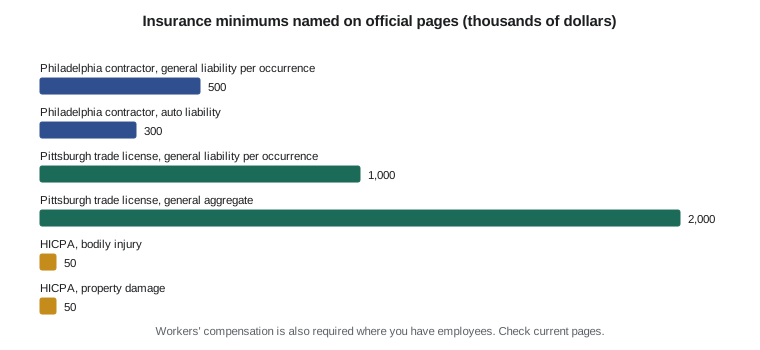
| Coverage | Philadelphia contractor license | Pittsburgh trade license | HICPA registration |
|---|---|---|---|
| General liability | 500,000 per occurrence | 1,000,000 per occurrence; 2,000,000 aggregate; City as additional insured | 50,000 bodily injury; 50,000 property damage |
| Automobile liability | 300,000 | Not listed on the license page | Not listed |
| Workers' compensation | 100,000 each accident; 100,000 each employee; 500,000 policy limit | Certificate naming the City, or a notarized no-employee statement | Not part of HICPA; required by state law for employers |
| Certificate holder | As in L&I's sample certificate | The City of Pittsburgh | Filed with the Attorney General |
Home Improvement Consumer Protection Act
The Home Improvement Consumer Protection Act, known as HICPA, applies statewide, including in Philadelphia and Pittsburgh. It requires people who own or operate a home improvement business, or who offer or perform home improvements, to register with the Office of Attorney General. The Attorney General's instructions say individuals who perform home improvements valued at less than 5,000 dollars in a calendar year do not have to register, and certain large retailers are exempt, though their subcontractors are not. Electrical work on a home, such as a panel upgrade or kitchen rewiring, is home improvement work under the act, so most residential electrical contractors must register.
Registration requires an application, a 50-dollar fee and proof of insurance with at least 50,000 dollars for bodily injury and 50,000 dollars for property damage. Each registrant receives a Pennsylvania Home Improvement Contractor number in the form PA followed by digits, and the Attorney General's materials say that number must be included in all advertisements, contracts, estimates and proposals used by the business in Pennsylvania. Registration must be renewed periodically; check the Attorney General's site for the current term and renewal process.
HICPA also sets rules for home improvement contracts. The Attorney General's materials warn that contractors must use contracts that comply with the act, and that noncompliance can bring civil and criminal penalties and can make a contract voidable and unenforceable. The act's contract requirements include, among other things, a written and signed contract with specific content, a right for the homeowner to cancel within a short period after signing, and limits on deposits before work begins. Read the act itself, or have counsel review your contract forms, because a home improvement contract that does not meet HICPA can leave a contractor unable to collect.
Worked problem
Does this contractor need to register under HICPA?
Owen plans to do side jobs on homes in a township near Pittsburgh. He estimates three jobs this year: a 1,800-dollar service upgrade, a 1,200-dollar basement circuit and a 2,400-dollar kitchen rewire. Does he need to register?
Show solution
- Total home improvement work: 1,800 + 1,200 + 2,400 = 5,400 dollars.
- The individual exemption applies only below 5,000 dollars in a calendar year.
- 5,400 dollars exceeds the threshold.
- He must register, carry the required insurance, and show his PA number on contracts and estimates.
Answer: Yes. His planned work totals 5,400 dollars, above the 5,000-dollar threshold; he also needs any local license the township requires.
Bonds
Neither Philadelphia's nor Pittsburgh's license page lists a license bond for electricians, but bonds still matter in Pennsylvania contracting. Public owners commonly require bid bonds, performance bonds and payment bonds on public works, and many private owners and general contractors require them on large jobs. A bid bond backs the promise to sign the contract if awarded; a performance bond guarantees the work will be completed; a payment bond guarantees that subcontractors and suppliers will be paid. Some municipalities that register contractors require a license or permit bond. Read each municipality's rules and each contract's bonding requirements before you bid.
Bonds are not insurance for the contractor. If a surety pays a claim on a bond, it expects to be repaid by the contractor, usually under an indemnity agreement the contractor and often its owners signed personally. Linh's binder of bond forms included the indemnity agreement Frank signed when the company first got bonding capacity; Keisha read it carefully before agreeing to sign a similar one.
Coverage beyond the minimums
The minimums on a city page are a floor, not a recommendation. Customers, general contractors and property managers routinely ask for more: commercial clients often want 1,000,000 dollars per occurrence and 2,000,000 dollars aggregate, an umbrella or excess policy on top, and additional insured status with primary and non-contributory wording. A residential contractor may never need more than the city minimum; a contractor doing tenant fit-outs in Center City may need several times that. Schuylkill Line carries 1,000,000 dollars per occurrence and a 2,000,000-dollar umbrella because its commercial customers ask for it, even though Philadelphia's minimum is half the per-occurrence figure.
Other policies are worth knowing about even when no city requires them. Inland marine or tools and equipment coverage protects the company's tools and materials on trucks and job sites. Builder's risk covers a building under construction, usually bought by the owner or general contractor. Professional liability can matter for contractors who do design-build work. Commercial auto coverage is required in Philadelphia at the stated minimum, but many contractors carry more because a serious crash can exceed 300,000 dollars quickly. A good agent who works with electrical contractors can explain which policies fit the work you actually do.
Certificates in practice
A certificate of insurance is a summary, not the policy itself, and it is only as good as the policies behind it. Customers and cities rely on certificates, so contractors issue a lot of them: one for each city license, one for each general contractor, one for each property manager. Linh tracks every certificate in a spreadsheet with the holder, the limits shown, the additional insured status, and the policy expiry dates, and when policies renew she has the agent send updated certificates to every holder on the list. When a customer asks for a certificate with unusual wording, she sends the request to the agent rather than editing anything herself, because altering a certificate is a serious matter.
Workers' compensation deserves a final word here, because it appears on both cities' lists. Pennsylvania law generally requires employers to carry workers' compensation insurance for their employees, and the Philadelphia license page specifies minimum employer's liability limits on that policy. Pittsburgh accepts a notarized statement from a business with no employees. A sole proprietor with no employees may not be required to cover himself, but the moment the first helper is hired, coverage is needed. Lesson 10 covers misclassification, which is how many small contractors get into trouble on workers' compensation.
Other business requirements
A Pennsylvania electrical contractor also needs the usual business registrations: a business entity registered with the Department of State if it is a corporation or limited liability company, state tax accounts, and in Philadelphia the Business Income and Receipts Tax account and Commercial Activity License that L&I requires. Employers need workers' compensation coverage, unemployment compensation accounts and payroll tax registrations. The Construction Workplace Misclassification Act, covered in Lesson 10, sets strict rules for treating workers as independent contractors. Federal rules apply to employers too.
The program below is the certificate check Linh runs each spring before renewal season. It compares the company's coverage with each requirement and flags any shortfall.
coverage = {"gl_per_occurrence": 1_000_000, "gl_aggregate": 2_000_000,
            "auto": 1_000_000, "wc_each_accident": 500_000,
            "additional_insured_pittsburgh": True}
requirements = {
    "Philadelphia license": {"gl_per_occurrence": 500_000, "auto": 300_000, "wc_each_accident": 100_000},
    "Pittsburgh trade license": {"gl_per_occurrence": 1_000_000, "gl_aggregate": 2_000_000},
    "HICPA (bodily injury)": {"gl_per_occurrence": 50_000},
}
for name, req in requirements.items():
    short = [k for k, v in req.items() if coverage.get(k, 0) < v]
    print(f"{name:26s} {'OK' if not short else 'SHORT: ' + ', '.join(short)}")
print("Pittsburgh additional insured:", coverage["additional_insured_pittsburgh"])Philadelphia license OK Pittsburgh trade license OK HICPA (bodily injury) OK Pittsburgh additional insured: True
Common mistakes
MistakeSending a certificate showing only the aggregate limit.
InsteadPhiladelphia's general liability minimum is per occurrence; show the per-occurrence limit.
MistakeNaming Pittsburgh only as certificate holder.
InsteadPittsburgh requires the City as certificate holder and additional insured on general liability.
MistakeSkipping HICPA because the company holds a city license.
InsteadHICPA registration is a separate statewide requirement for home improvement work.
MistakeLeaving the PA registration number off estimates.
InsteadThe number must appear on all advertisements, contracts, estimates and proposals.
MistakeTreating a bond like insurance that protects the contractor.
InsteadA surety that pays a bond claim expects the contractor to repay it under the indemnity agreement.
Summary and key terms
- Philadelphia's license requires 500,000 dollars general liability per occurrence, 300,000 dollars auto, and workers' compensation employer's liability of 100,000 / 100,000 / 500,000.
- Pittsburgh requires 1,000,000 dollars per occurrence and 2,000,000 dollars aggregate, with the City as certificate holder and additional insured.
- HICPA requires registration for home improvement work of 5,000 dollars or more a year, a 50-dollar fee and 50,000 / 50,000 insurance.
- The HICPA number must appear on all advertisements, contracts, estimates and proposals.
- Non-compliant home improvement contracts can be voidable and unenforceable.
- Bonds protect owners and others, and the contractor indemnifies the surety.
- Per occurrence
- The most a liability policy pays for one incident.
- Aggregate
- The most a liability policy pays in a policy period.
- Additional insured
- A party added to a policy by endorsement and covered for claims arising from the insured's work.
- HICPA
- Pennsylvania's Home Improvement Consumer Protection Act.
- PA number
- The Home Improvement Contractor registration number issued by the Attorney General.
- Indemnity agreement
- The agreement under which a contractor repays a surety for bond claims it pays.
Practice problems
Work each problem on paper first, then reveal the answer to check.
What general liability minimum does Philadelphia require for the contractor license?
Show answer
500,000 dollars per occurrence.
What must Pittsburgh's general liability certificate show about the City?
Show answer
The City as certificate holder and additional insured.
Below what yearly value of home improvements is an individual exempt from HICPA registration?
Show answer
Less than 5,000 dollars in a calendar year.
Where must a HICPA registration number appear?
Show answer
On all advertisements, contracts, estimates and proposals.
Name the three common construction bonds.
Show answer
Bid bond, performance bond and payment bond.
Lesson quiz · 5 questions
Score 60% or more to complete this lesson.
Create a free account to save your progress, take quizzes and earn a certificate.