
MELU-313 · Lesson 4 of 12 · 21 min
The exam format and the references allowed
▶ Video coming soon A video version of this lesson is on the way.
Keisha's first full practice exam went better than she feared and worse than she hoped. She sat at her kitchen table on a Sunday with a 100-question practice set, her tabbed code book, a basic calculator and a five-hour timer, and finished with forty minutes to spare. Her score was 68. The time was fine; the problem was that she had answered too many questions from memory instead of checking the book, and memory had failed her on a dozen of them. This lesson describes the exams Philadelphia and Pittsburgh use, the references allowed, and how to use an open book well when the clock is running.
The facts here come from the International Code Council's candidate bulletin for Philadelphia and from Pittsburgh PLI's license page, as checked in November 2026. Exam formats, NEC editions and reference lists change with the code cycle. Download the current bulletin for your exam before you study, and again before you test.
Philadelphia: ICC exam 211
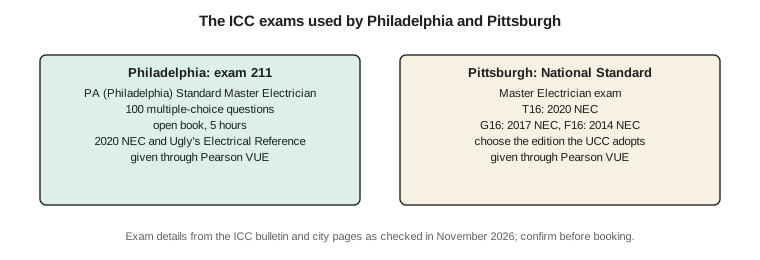
Philadelphia's electrical contractor exam is the ICC's exam 211, titled Pennsylvania (Philadelphia) Standard Master Electrician. The bulletin describes it as 100 multiple-choice questions, open book, with a five-hour time limit, delivered through Pearson VUE. The references listed are the 2020 National Electrical Code and Ugly's Electrical Reference, any edition. Look at what is not on the list: the bulletin Keisha downloaded does not name the Philadelphia Code as a reference for this exam. The questions are about the NEC and electrical practice, with calculations, rather than about city administrative law.
The 2020 NEC on the list matches the edition Pennsylvania adopted when the UCC moved to the 2021 I-codes on January 1, 2026, which Lesson 5 explains. When the state adopts a newer edition in a future cycle, the ICC typically updates the exam's references to match, and a candidate who studies from the wrong edition can lose points on the sections that changed. Always study from the edition named in the bulletin you will test under.
Pittsburgh: the National Standard Master Electrician exam
Pittsburgh does not write its own exam. PLI's page tells applicants to schedule the ICC National Standard Master Electrician exam through the ICC and Pearson VUE, using code T16, G16 or F16, and to choose the version covering the most recent code year adopted by the Pennsylvania UCC. PLI lists T16 as the 2020 NEC version, G16 as the 2017 version and F16 as the 2014 version. With the UCC now referencing the 2020 NEC, T16 is the natural choice for a new candidate. PLI also says it accepts previous versions of this exam, or a passing letter from the older Pittsburgh-proctored exam, for evaluation by the License Officer.
The national standard exam is broadly similar in style to exam 211: multiple choice, open book, NEC-based, with calculations. Its question count, time limit and reference list are set in the ICC's catalog and bulletin for the national exam, and they are not on PLI's page. Owen downloaded the national exam's bulletin before he started practicing and found the format close to what he remembered from his first attempt years ago, but with the newer code edition.
What the questions cover
Both exams test whether you can find and apply NEC requirements accurately and quickly. Expect questions on definitions and general requirements, wiring methods and materials, branch circuits, feeders and services, overcurrent protection, grounding and bonding, conductor ampacity with correction and adjustment, box and conduit fill, motors and transformers, special occupancies such as health care and hazardous locations, special equipment such as generators, solar and EV chargers, and communications and limited-energy circuits. Calculation questions typically include dwelling and commercial load calculations, service and feeder sizing, voltage drop and motor circuit sizing. The core courses MELU-101 through MELU-106 teach each of these areas.
A useful way to think about the mix is that most questions are lookups and a smaller share are multi-step calculations. Lookups reward a well-tabbed book and fluent use of the index. Calculations reward a consistent method, careful reading and checking units. Ugly's, which exam 211 allows, is handy for formulas, conversions and quick tables, but it is not a substitute for the NEC when a question asks what the code requires.
| Rule | What it means for you | Source |
|---|---|---|
| Exam 211: 100 questions, 5 hours | About 3 minutes per question on average | ICC bulletin for Philadelphia |
| Exam 211: open book | Bring the books the bulletin lists, in the form it allows | ICC bulletin |
| Exam 211 references | 2020 NEC and Ugly's Electrical Reference (any edition) | ICC bulletin |
| Pittsburgh: T16 version | National Standard Master Electrician, 2020 NEC | Pittsburgh PLI page |
| Passing score | Set by the ICC; see the exam catalog | ICC bulletin and catalog |
| Delivery | Pearson VUE | ICC bulletin and PLI page |
A study routine that works
Keisha's study plan ran eleven weeks. For the first four she worked through the core course material one area at a time, ending each week with a timed drill of twenty questions on that area. For the next four she mixed areas in fifty-question sets, because the real exam does not announce its topics in order and switching between grounding, motors and special occupancies is a skill in itself. For the last three she took a full 100-question practice exam each Saturday under real conditions: five hours, her tabbed book, Ugly's, her calculator and nothing else, with her phone in another room. She scored each one the same afternoon and spent Sunday reworking every miss with the book open until she could point to the section that settled it.
Two habits made the biggest difference. First, she kept an error log, a simple list of each missed question, the section that answered it and the reason she missed it: misread the question, did not check the exception, used the wrong table, arithmetic slip, or did not know where to look. After three weeks the log showed that more than half her misses came from reading too fast, not from gaps in knowledge, and she slowed down. Second, she practiced the index. For every question she answered from a tab, she also found the same section through the index, so that on exam day an unfamiliar topic would not stall her.
Common calculation traps
Calculation questions are written so that common mistakes produce one of the wrong answer choices. The usual traps are applying a demand factor to the wrong part of a load, forgetting the continuous-load rule when sizing overcurrent protection, using the wrong temperature column for a conductor, applying correction and adjustment factors in the wrong order or forgetting one, mixing single-phase and three-phase formulas, and rounding too early. Work each calculation fully before looking at the choices, write the units at each step, and check that the answer is in a sensible range. A 200-ampere answer for a small apartment, or a number-14 conductor for a large motor, should make you look again.
The passing score
The Philadelphia bulletin does not state the passing score; it refers candidates to the ICC's exam catalog. ICC exams are generally scored on a scale, and the score needed to pass is published with each exam. Find the figure for your exam before test day so you can plan how many questions you can afford to miss. The worked example below shows the arithmetic with an illustrative pass mark of 75 out of 100; replace it with the published figure for your exam.
Worked problem
How many can you miss?
Suppose an exam has 100 scored questions and, for illustration, requires 75 correct to pass. Keisha is confident of 61 answers after her first pass and has 39 left. How many of the remaining 39 must she get right?
Show solution
- Needed: 75 correct (illustrative pass mark).
- Already confident: 61.
- Still needed: 75 − 61 = 14.
- From 39 remaining questions, she needs 14 right, about 36 in 100 of them.
Answer: 14 of the remaining 39, using the illustrative pass mark; use the published figure for your exam.
Using an open book well
Open book does not mean easy. It means the exam writers expect you to look things up, so they write questions where the answer depends on an exception, a footnote to a table, or a definition in Article 100. The candidates who do well treat the book as a tool they have practiced with, not a safety net. They know which article covers a topic without searching, they use the index for anything unfamiliar, and they read the whole section, including exceptions, before choosing an answer.
Keisha's second practice exam, after a week of drills, followed a simple rule: every answer gets a reference. If she could not point to a section number, she did not mark the answer as final. She wrote the section number next to each answer on her scratch paper and found that the habit cost her about thirty seconds a question and raised her score to 81. The extra time was worth it, because she still finished with twenty minutes left.
Tabbing is the other half of fluency. Most candidates use a commercial tab set placed at the start of each article and the most-used tables, plus the index. Whatever system you use, practice with it until your hand goes to the right tab without thinking. The bulletin sets the rules on tabs, highlighting and notes, so confirm that your book will pass inspection at the test center before exam day.
The calculator
ICC bulletins describe which calculators are allowed, typically silent, non-programmable models without communication features. A basic scientific calculator with square root is usually all a master exam needs. Practice with the calculator you will bring, because order of operations and memory functions differ between models. Keisha memorized the square root of 3 as 1.732 for three-phase calculations and practiced keying it in until she could do it without looking.
The short program below shows the kind of check Keisha ran on her practice results to see where her points were going. It groups missed questions by topic and shows how much time each topic consumed.
missed = [
    ("grounding and bonding", 4), ("load calculations", 3), ("motors", 2),
    ("special occupancies", 3), ("box and conduit fill", 1), ("wiring methods", 2),
]
minutes = {"grounding and bonding": 38, "load calculations": 61, "motors": 27,
           "special occupancies": 33, "box and conduit fill": 12, "wiring methods": 24}
total_missed = sum(n for _, n in missed)
print("Missed:", total_missed)
for topic, n in sorted(missed, key=lambda t: -t[1]):
    print(f"{topic:22s} missed {n}  time {minutes[topic]} min")
worst = max(missed, key=lambda t: t[1])[0]
print("Study first:", worst)Missed: 15 grounding and bonding missed 4 time 38 min load calculations missed 3 time 61 min special occupancies missed 3 time 33 min motors missed 2 time 27 min wiring methods missed 2 time 24 min box and conduit fill missed 1 time 12 min Study first: grounding and bonding
Time management
Exam 211's five hours for 100 questions gives an average of three minutes per question. That is generous for lookups and tight for long calculations, so the average hides the real risk, which is spending fifteen minutes on one hard calculation and running short at the end. A two-pass approach works well: answer everything you can do quickly on the first pass, flag the long or uncertain ones, then return to them with the remaining time. Never leave a question blank, because an unanswered question is always wrong and a guess has a chance. Lesson 12 develops a full test-day plan.
Owen's habit from his first exam was to glance at the clock every twenty-five questions and compare it with a target: seventy-five minutes per quarter of the exam, leaving fifteen minutes at the end. If he was behind, he flagged more aggressively; if he was ahead, he slowed down and double-checked units. The habit costs nothing and catches a slow start before it becomes a crisis.
What the exam does not test
Because exam 211's reference list does not include the Philadelphia Code, and the national exam is national by design, neither exam is likely to ask detailed questions about Philadelphia's licensing fees or Pittsburgh's renewal rules. Those matter to you as a license holder, and this course covers them, but the exams themselves focus on the NEC and electrical practice. That makes the core NEC courses the heart of your preparation, with this course supplying the local knowledge you need to apply, practice legally and stay licensed.
Common mistakes
MistakeStudying from an NEC edition other than the one named in the bulletin.
InsteadUse the edition the bulletin lists; exam 211 lists the 2020 NEC as checked in November 2026.
MistakeBringing an annotated or loose-leaf code book.
InsteadBring only the references and forms the bulletin allows, and check tabs and notes rules.
MistakeAssuming exam 211 tests the Philadelphia Code.
InsteadThe bulletin lists the NEC and Ugly's, not the Philadelphia Code.
MistakeBooking an older Pittsburgh exam version.
InsteadChoose the version for the UCC's current NEC; T16 covers the 2020 NEC.
MistakeLeaving hard questions blank.
InsteadFlag them, return later, and always mark an answer.
Summary and key terms
- Philadelphia's exam 211 has 100 multiple-choice questions, is open book and allows five hours.
- Exam 211's references are the 2020 NEC and Ugly's Electrical Reference, as listed in November 2026.
- Pittsburgh uses the ICC National Standard Master Electrician exam; T16 is the 2020 NEC version.
- The passing score is set by the ICC; check the exam catalog.
- Open book rewards fluent tabbing, index use and reading exceptions.
- Average about three minutes per question on exam 211, using two passes.
- Open book
- An exam that allows specified reference books; questions are written to require looking things up.
- Ugly's Electrical Reference
- A pocket reference of formulas and tables allowed for exam 211.
- National Standard Master Electrician
- The ICC exam Pittsburgh accepts, offered in versions keyed to NEC editions.
- Candidate bulletin
- The ICC document describing exam rules, references, identification and scoring.
- Two-pass method
- Answering quick questions first and returning to flagged ones with the time left.
- Lookup question
- A question answered by finding the right section, table or definition.
Practice problems
Work each problem on paper first, then reveal the answer to check.
How many questions and how much time does exam 211 have?
Show answer
100 multiple-choice questions in five hours.
Which references does the Philadelphia bulletin list?
Show answer
The 2020 NEC and Ugly's Electrical Reference, any edition.
Which version of the national exam matches the 2020 NEC?
Show answer
T16.
At three minutes per question, how long should 25 questions take?
Show answer
75 minutes.
Why read exceptions on open book questions?
Show answer
Because questions are often written so that the answer depends on an exception or footnote.
Lesson quiz · 5 questions
Score 60% or more to complete this lesson.
Create a free account to save your progress, take quizzes and earn a certificate.