
MELU-313 · Lesson 6 of 12 · 19 min
Permits, inspections and the inspection authority
▶ Video coming soon A video version of this lesson is on the way.
On Keisha's first day as a helper, nineteen years old and nervous, Frank sent her to a row house in South Philadelphia with a journeyman and a folded permit. 'The inspector's coming at two,' he said. 'He's not from the city.' She spent the morning wondering what that meant. In most of the country, electrical inspections are done by a city or county inspector. In Philadelphia, they are done by private electrical inspection agencies licensed by the city. Across the rest of Pennsylvania, inspections are done by municipal code officials, by private third-party agencies certified by the state, or by the Department of Labor and Industry itself, depending on choices each municipality made in 2004. This lesson sorts out who inspects what.
The facts in this lesson come from Philadelphia L&I's electrical permit and inspection agency pages, the Pennsylvania Department of Labor and Industry's UCC pages and municipal election information, and Pittsburgh PLI's license page, as checked in November 2026. Procedures differ from one municipality to the next, so check with the local code office before every job in an unfamiliar place.
Opt-in and opt-out under the UCC
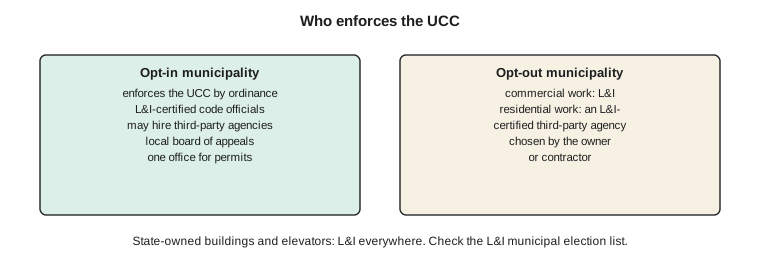
When the UCC took effect in 2004, each of Pennsylvania's roughly 2,500 municipalities chose whether to administer and enforce the code itself. The great majority opted in. An opt-in municipality enforces the UCC through an ordinance, using code officials certified by L&I, either on its own staff or through a contracted third-party agency. It has a local board of appeals, publishes a fee schedule, and acts as the single point of contact for permits. Municipalities can change their election, with advance notice to L&I, so the list is not frozen.
In a municipality that opted out, enforcement works differently. Commercial construction goes to the Department of Labor and Industry for plan review and inspection. Residential construction, meaning one- and two-family dwellings and townhouses within the residential code's scope, goes to a third-party agency certified by L&I, which the owner or contractor selects and hires. L&I enforces the UCC for state-owned buildings and for elevators everywhere, whatever the municipality's election. L&I publishes the list of municipal elections and contacts on its website; check it before you bid outside your usual area.
Certified code officials and agencies
Under the UCC, the people who review plans and inspect work must be certified by L&I in the relevant categories, such as building, electrical, plumbing, mechanical, energy and fire, at residential or commercial levels. Third-party agencies, the private companies that municipalities contract with or that owners hire in opt-out areas, must themselves be certified by L&I, carry professional liability insurance and employ certified individuals. L&I maintains public lists of certified third-party agencies. For an electrician, this means that the inspector on your job, whether a municipal employee or an agency employee, should hold an L&I certification for electrical inspection at the right level, and you can ask to see it.
Electrical inspection under the UCC is part of the building permit process rather than a separate state electrical program. A building permit for a new house or a commercial fit-out normally includes electrical work, reviewed and inspected by a certified electrical inspector, whether that person works for the municipality, for a contracted agency, or for an agency the owner hired. Some municipalities issue separate electrical permits; others handle electrical work within the building permit. The details are in each municipality's ordinance and fee schedule.
Philadelphia: permits
Philadelphia handles electrical work through its own permit system. L&I's page says an electrical permit is needed for installing, altering, renewing, replacing or repairing electrical and communication systems and components, with some maintenance exempt: replacing lamps, circuit breakers, fuses or receptacles, for example, may not need a permit. Some routine work qualifies for EZ permits without plans. Any property owner or authorized agent can apply for the permit, and authorized agents include a licensed electrical contractor, a Pennsylvania design professional, an attorney or a licensed expediter. But L&I's page is clear that a licensed electrical contractor must perform all electrical work.
In practice, Schuylkill Line pulls its own permits through eCLIPSE for nearly every job, listing the company's license. When Keisha becomes the license holder, permits will be filed under her license, and she will be responsible for the work they cover. That responsibility, and how to manage it across twenty-two employees, is the subject of Lesson 7.
Philadelphia: licensed inspection agencies
Here is the part that surprised nineteen-year-old Keisha. Philadelphia's electrical permit page says the owner or the owner's agent must hire a licensed electrical inspection agency to perform all inspections. The agency inspects the work at the required stages, completes an electrical permit inspection certification, and L&I issues a certificate of approval after all required inspections pass. The city licenses the agencies and the inspectors who work for them, but the inspections themselves are done by private companies hired on the job.
L&I's page for the inspection agency license sets the bar for those companies. An agency must employ licensed electrical inspectors to perform all inspections, must have at least one person who has held a Philadelphia Electrical Inspector's License for at least a year, must carry at least one million dollars of general liability insurance per occurrence plus workers' compensation, must file a quality control plan covering organization, training and quality assurance, must keep a complete rate schedule on file, and must be current on city taxes. The agency license fee is listed as 2,730 dollars, with annual renewal at 2,530 dollars. The agency page also mentions maintenance inspections on work done under electrical permits.
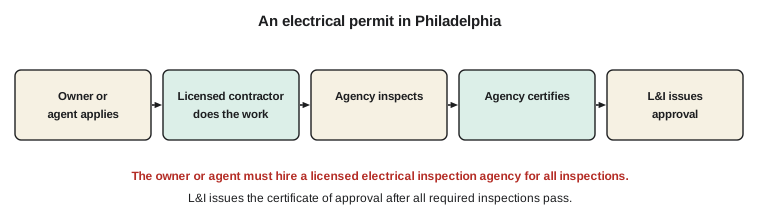
The arrangement has practical consequences. The contractor or owner chooses the agency, schedules inspections directly with it, and pays the agency's fees according to its rate schedule. Inspection timing depends on the agency's availability rather than on a city queue. And because the agency certifies the inspections to L&I, the agency's records become part of the permit file. Frank's long relationship with one agency is common: a good agency knows the contractor's work, schedules promptly and explains its calls, which saves everyone time.
| Place | Who inspects electrical work | Who issues the approval |
|---|---|---|
| Philadelphia | A city-licensed electrical inspection agency hired by the owner or agent | Philadelphia L&I, after all inspections pass |
| Opt-in municipality | The municipality's certified official or its contracted third-party agency | The municipality |
| Opt-out municipality, commercial | The Pennsylvania Department of Labor and Industry | L&I |
| Opt-out municipality, residential | An L&I-certified third-party agency chosen by the owner or contractor | Per the UCC process for that agency |
| State-owned buildings and elevators | L&I | L&I |
Pittsburgh and other cities
Pittsburgh enforces the UCC as an opt-in municipality through PLI, which issues permits and inspects work in the city. PLI's license page notes that permits connected to a lapsed trade license are suspended until a valid license is connected to the work, which shows how closely PLI ties permits to licensed individuals. Owen learned that PLI expects the license holder named on a permit to be responsible for the work, and that insurance and tax compliance documents must be in place before permits issue under his license.
Elsewhere, the experience varies with the municipality's election and size. A large township with its own code department may offer online permits and scheduled inspections within a day or two. A small borough may contract all its code work to a third-party agency that holds office hours twice a week. In an opt-out municipality, the owner or contractor hires a certified agency for a house and deals with L&I for a commercial job. Before bidding, Owen now asks three questions: who issues the permit, who inspects, and how long inspections take to schedule.
The inspection sequence
Whoever inspects, the sequence is similar. A rough-in inspection happens after boxes, raceways and cables are installed and before walls are closed. Some jobs need an underground or slab inspection before concrete is poured, a service inspection before the utility connects permanent power, or special inspections for fire alarm, emergency systems or solar. A final inspection happens when the work is complete, devices and covers are installed and panel schedules are filled in. Each passed inspection is recorded; each failed one produces a correction notice listing the problems, and the work must be corrected and reinspected. The utility, PECO in Philadelphia and Duquesne Light in Pittsburgh, typically needs the approval before it connects a new or upgraded service.
Keisha's rule for inspections, learned the hard way on a fit-out in Fishtown, is to walk the job herself the day before every inspection with the permit drawings in hand and fix what she would fail. The agency inspector on that job had failed the rough-in for missing nail plates and an unsupported cable run, costing two days. Since then she has passed every rough-in on the first visit. The short program below is her pre-inspection tally from a recent job.
checks = {
    "boxes secured and at correct heights": True,
    "cables supported and protected (nail plates)": True,
    "box fill within limits": True,
    "grounding conductors connected in boxes": False,
    "GFCI and AFCI locations match the plan": True,
    "panel labeling started": True,
}
open_items = [item for item, ok in checks.items() if not ok]
print(f"{len(checks) - len(open_items)} of {len(checks)} checks passed")
for item in open_items:
print("Fix before the inspector arrives:", item)5 of 6 checks passed Fix before the inspector arrives: grounding conductors connected in boxes
Working with the utility
The inspection approval is not the last step for a new or upgraded service. The electric utility, PECO in the Philadelphia area and Duquesne Light in and around Pittsburgh, has its own service requirements: where the meter goes, what equipment it accepts, clearances for overhead service drops, and how the service lateral is installed. Utilities publish these requirements in service manuals or blue books, and they change. The utility also usually needs evidence that the installation passed inspection before it will connect or reconnect permanent power. Keisha keeps the current PECO requirements on her tablet and checks them at the design stage, because a meter location the utility rejects is far more expensive to fix after the wall is finished than before.
Temporary power on construction sites follows the same pattern: a temporary service is permitted and inspected like any other, and the utility connects it only after approval. On a busy renovation season Keisha has had as many as six temporary services open at once, and she tracks each one so that it is removed and the permit closed when the permanent service is energized.
Closing out the permit
A job is not finished until the permit is closed. In Philadelphia that means every required inspection has passed, the agency has certified the inspections, and L&I has issued the certificate of approval. Elsewhere it means the final inspection is recorded and the code office has closed the permit. Open permits cause trouble later: they can surface when a property is sold, block new permits on the same property, or leave the contractor answerable for work that was never finally approved. Schuylkill Line reviews its open permits every month, and anything more than sixty days past substantial completion gets a phone call to find out what is holding it up.
Disputes and appeals
If you disagree with an inspector's call, start with a conversation: ask for the code section, explain your reading, and offer documentation. Many disputes end there. If not, the UCC provides for appeals to a board of appeals in opt-in municipalities, and the state has its own appeal route for L&I decisions. Philadelphia has its own appeal bodies for code decisions. Appeals take time and should be reserved for genuine disagreements about what the code requires, not for avoiding a correction you could make in an hour.
Common mistakes
MistakeAssuming city employees inspect electrical work in Philadelphia.
InsteadThe owner or agent hires a licensed electrical inspection agency; L&I issues the certificate of approval.
MistakeAssuming the UCC is enforced the same way in every municipality.
InsteadOpt-in municipalities enforce it locally; in opt-out areas L&I handles commercial work and certified agencies handle residential work.
MistakeLetting a homeowner do the electrical work in Philadelphia because the homeowner pulled the permit.
InsteadA licensed electrical contractor must perform all electrical work, whoever applies for the permit.
MistakeForgetting that L&I enforces for state-owned buildings and elevators everywhere.
InsteadThose are L&I's in every municipality.
MistakeTreating a failed inspection as the end of the job.
InsteadCorrect the items on the notice and request reinspection.
Summary and key terms
- Each municipality chose to opt in or out of UCC enforcement; most opted in.
- In opt-out areas, L&I handles commercial work and owner-chosen certified agencies handle residential work.
- Code officials and third-party agencies must be certified by L&I.
- In Philadelphia, any owner or agent may apply for an electrical permit, but a licensed electrical contractor must do the work.
- In Philadelphia, a licensed electrical inspection agency hired by the owner or agent performs all inspections; L&I issues the certificate of approval.
- Pittsburgh PLI permits and inspects in the city and suspends permits tied to a lapsed license.
- Opt-in municipality
- A municipality that enforces the UCC itself, with certified officials or contracted agencies.
- Opt-out municipality
- A municipality that left UCC enforcement to L&I for commercial work and certified agencies for residential work.
- Third-party agency
- A private company certified by L&I to perform UCC plan review and inspections.
- Electrical inspection agency
- In Philadelphia, a city-licensed company that inspects electrical permit work.
- Certificate of approval
- The Philadelphia L&I document issued after all required electrical inspections pass.
- EZ permit
- A Philadelphia permit for routine work that does not need plans.
Practice problems
Work each problem on paper first, then reveal the answer to check.
Who performs electrical inspections in Philadelphia?
Show answer
A city-licensed electrical inspection agency hired by the owner or the owner's agent.
In an opt-out municipality, who inspects a new commercial building?
Show answer
The Pennsylvania Department of Labor and Industry.
Name two requirements for a Philadelphia electrical inspection agency license.
Show answer
Any two of: licensed inspectors for all inspections, one person licensed as an inspector at least one year, one million dollars of general liability insurance, a quality control plan, a rate schedule, current city taxes.
What happens to Pittsburgh permits connected to a lapsed trade license?
Show answer
They are suspended until a valid license is connected to the work.
Name three common inspection stages.
Show answer
Any three of: underground or slab, rough-in, service, special inspections, final.
Lesson quiz · 5 questions
Score 60% or more to complete this lesson.
Create a free account to save your progress, take quizzes and earn a certificate.