
MELU-313 · Lesson 1 of 12 · 20 min
How electrical licensing works in Pennsylvania
▶ Video coming soon A video version of this lesson is on the way.
Keisha Brennan has been an electrician in Philadelphia for fourteen years. She came up through a registered apprenticeship, worked her way to foreman, and for the last six years has run jobs for Schuylkill Line Electric, a twenty-two person shop in Grays Ferry that does row-house renovations, small commercial fit-outs and a steady stream of service calls. Frank Mazzola, who founded the company in 1988 and whose Philadelphia electrical contractor license is the one the company works under, is sixty-six. Over cheesesteaks at the shop's Friday lunch he told Keisha he wants to be fishing at the shore within two years, and he wants her to hold the license when he goes. Keisha said yes before he finished the sentence. Then she went home, opened her laptop to look up the state requirements, and found that there are none.
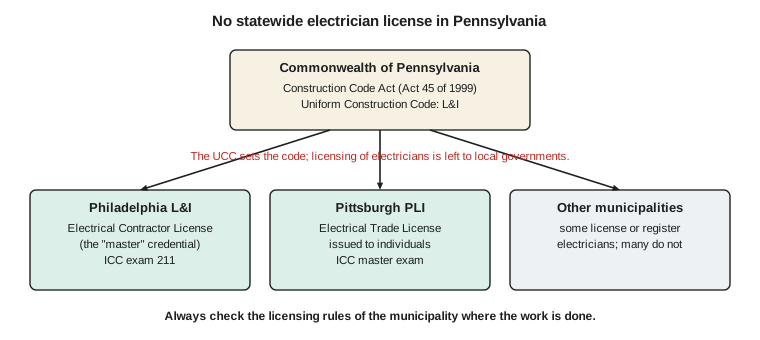
That surprise is where this course begins. Pennsylvania is one of a handful of states with no statewide electrician license. There is no state board that tests master electricians, no state master license and no state journeyman card. What Pennsylvania has instead is a statewide building code, the Uniform Construction Code, which says how electrical work must be installed and inspected, and a patchwork of local licensing in the cities and townships that choose to license electricians. Philadelphia and Pittsburgh are the two largest and the two most structured, and this course uses them as its main examples. Keisha's colleague Owen Kowalski, who is moving back home to Pittsburgh next spring, will carry the Pittsburgh side of the story.
This is the Pennsylvania course in the HSM University master electrician exam prep series. The core courses, MELU-101 through MELU-107, teach the National Electrical Code skills every master exam tests: navigating the code, load calculations, conductors and overcurrent protection, grounding and bonding, motors and transformers, special occupancies, and business and law. This course adds what is specific to Pennsylvania: how local licensing works, who qualifies, how the exams are booked and taken, how the Uniform Construction Code adopts the NEC, how permits and inspections work, what the license holder is responsible for, insurance and home improvement registration, mechanics' liens and prompt payment, workplace safety and worker classification, renewal, and a final practice review.
Two cautions apply throughout. First, local rules change, sometimes several times a year. The facts in this course were checked against the City of Philadelphia Department of Licenses and Inspections, the City of Pittsburgh Department of Permits, Licenses, and Inspections, the Pennsylvania Department of Labor and Industry, the Office of Attorney General and the International Code Council in November 2026. Before you apply, pay a fee or book an exam, read the current official page for the municipality where you will work. Second, the NEC is a copyrighted standard. This course cites article and section numbers and explains them in plain words, but it never reproduces the code's text, tables or figures. Keep your own copy beside you.
Why there is no state license
Pennsylvania has debated a statewide electrician license for decades. Bills to create one have been introduced in the General Assembly session after session, usually with the support of some contractor groups and the opposition of others, and none has become law as of this course. The arguments on both sides are familiar: supporters say a state license would protect the public and let electricians move between towns without retesting, while opponents worry about cost, about grandfathering experienced electricians, and about adding a state bureaucracy on top of local systems that already work. Whatever happens in future sessions, the exam you sit today is a local exam, and the license you hold is a local license.
For an electrician, the practical effect is that the right question is never 'Am I licensed in Pennsylvania?' but 'Am I licensed where this job is?' Keisha's Philadelphia license lets her company pull permits and do electrical work in Philadelphia. It does not, by itself, let her work in Pittsburgh, and it does not mean anything in a township that has no licensing program at all, because there is nothing there to hold. Owen will need a Pittsburgh license to work inside the city limits of Pittsburgh. A job in a suburban township might need a township registration, a business license, a home improvement registration, or nothing beyond the state code and permit, depending on where the line on the map falls.
The Uniform Construction Code
The statewide piece is the Pennsylvania Construction Code Act, Act 45 of 1999, and the Uniform Construction Code it created. The UCC took effect statewide on April 9, 2004, and it replaced most of the building codes that individual municipalities had written for themselves. It adopts the International Code Council's model codes, with Pennsylvania amendments, as the code for building, residential, mechanical, plumbing, fuel gas, energy and existing building work. The building codes in turn reference NFPA 70, the National Electrical Code, for electrical installations, so the NEC edition that applies in Pennsylvania is the one referenced by the adopted edition of the I-codes. Lesson 5 explains this chain in detail and gives the current editions.
The Department of Labor and Industry, usually called L&I, runs the UCC program at the state level. It certifies code officials and third-party inspection agencies, publishes the regulations in Title 34 of the Pennsylvania Code, and enforces the UCC directly in some places. A review and advisory council, made up of industry and government members, reviews new editions of the model codes and recommends which provisions Pennsylvania should adopt. When the council and the department finish that process, the new code is published in the Pennsylvania Bulletin with an effective date. The most recent update, to the 2021 I-codes with Pennsylvania amendments, took effect on January 1, 2026.
One part of the UCC design matters to every electrician: each municipality decided whether to enforce the code itself or leave enforcement to the state and private agencies. Municipalities that opted in enforce the UCC through their own code officials or contracted agencies. In municipalities that opted out, L&I handles commercial work and owners hire certified third-party agencies for residential work. Lesson 6 covers this opt-in and opt-out system and what it means for permits and inspections. Note that the UCC is a building code program: it certifies inspectors, but it does not license electricians.
Local licensing: Philadelphia
Philadelphia's Department of Licenses and Inspections licenses the people and businesses that do electrical work in the city. The key credential is the Electrical Contractor License. In everyday Philadelphia talk, the person who holds it is often called the master electrician, and the exam that qualifies for it is the International Code Council's exam 211, titled Pennsylvania (Philadelphia) Standard Master Electrician. The license requires four years of electrical work for a licensed company, a passing exam score, eight hours of recent NEC education, insurance, a Business Income and Receipts Tax account and a Commercial Activity License, and it renews every year. L&I's permit rules say a licensed electrical contractor must perform all electrical work done under an electrical permit in the city.
Philadelphia also licenses electrical inspectors and electrical inspection agencies, because in Philadelphia the inspections of electrical permit work are done by licensed private agencies rather than by city inspectors. Frank has used the same inspection agency for twenty years and has the inspector's cell number on a sticky note above his desk. Lesson 6 covers how that system works, and Lesson 8 covers the contractor license requirements in full.
Local licensing: Pittsburgh and Allegheny County
Pittsburgh's Department of Permits, Licenses, and Inspections, known as PLI, issues an Electrical Trade License that is required to do electrical work inside the City of Pittsburgh. PLI's page says plainly that trade licenses are issued to individuals, not to companies. A new applicant needs a passing score on a certified standardized test, which PLI identifies as the ICC's National Standard Master Electrician exam, and documentation of at least six years of combined experience and education. The license carries insurance requirements, needs eight hours of continuing education a year, and expires 365 days after it is issued.
Outside the city, the rest of Allegheny County is made up of well over a hundred municipalities, and their approaches vary. Some require contractors to register or hold a license, some accept a license from another jurisdiction, and many rely only on the UCC permit and inspection process. Owen's first job back home is in a borough just south of the city, and he has already learned to call the borough office before he bids. The same habit serves every electrician in Pennsylvania: the local office will tell you what it requires, and the state will not.
Other places and other credentials
Beyond the two big cities, a number of Pennsylvania municipalities license or register electricians, often through their own boards or by accepting a standardized ICC exam. Some count years of experience, some accept a license from a neighboring city, and some register contractors without testing them. A few counties and regional bodies have tried to coordinate testing, but there is no single system. If you plan to work across a region, keep a spreadsheet of each municipality's requirements, renewal dates and insurance certificates, because the paperwork multiplies quickly.
Several statewide requirements apply to electrical contractors even without a state license. The Home Improvement Consumer Protection Act requires most contractors who do home improvement work to register with the Office of Attorney General and carry minimum insurance. Workers' compensation law applies to employers. The Construction Workplace Misclassification Act sets a strict test for treating a worker as an independent contractor. The Mechanics' Lien Law and the Contractor and Subcontractor Payment Act govern getting paid. Federal OSHA rules apply to private employers. Lessons 8 through 10 cover these.
| Body or law | Main role for electricians | Where it applies |
|---|---|---|
| Pennsylvania Construction Code Act (Act 45 of 1999) | Creates the Uniform Construction Code | Statewide |
| Department of Labor and Industry | Runs the UCC; certifies code officials and agencies | Statewide; enforces directly in opt-out areas |
| Philadelphia L&I | Electrical contractor, inspector and agency licenses | City of Philadelphia |
| Pittsburgh PLI | Electrical Trade License for individuals | City of Pittsburgh |
| Other municipalities | Some license or register electricians | Varies; check locally |
| Office of Attorney General | Home improvement contractor registration | Statewide, for home improvement work |
Exams without a state board
Without a state board, the testing role falls to the International Code Council and its testing partner, Pearson VUE. Philadelphia uses an ICC exam written for the city, exam 211. Pittsburgh accepts the ICC's National Standard Master Electrician exam, offered in versions keyed to different NEC editions. Both are open book, timed, multiple-choice exams on the NEC with calculation questions. Lesson 3 covers booking and Lesson 4 the format and references. Because the exams are given through Pearson VUE, the testing experience is similar to other ICC certifications that Keisha's inspector friends have taken.
The ICC exam route has an advantage for electricians who move: passing a national standard exam once can satisfy more than one jurisdiction that accepts it. Pittsburgh says it will also evaluate earlier versions of the exam and passing letters from its own older proctored exam. Philadelphia requires its own city exam and asks that applications reach L&I within twelve months of passing. Check each jurisdiction's rules before assuming a score transfers.
How this course is organized
The lessons follow the path Keisha and Owen walk. Lesson 2 covers eligibility and Lesson 3 the application and exam booking. Lesson 4 describes the exams and the references allowed. Lesson 5 explains how the UCC adopts the NEC and how local amendments work, and Lesson 6 covers permits, inspections and the inspection authority. Lesson 7 sets out the license holder's duties, Lesson 8 contractor licensing, insurance and home improvement registration, and Lesson 9 contracts, mechanics' liens and prompt payment. Lesson 10 covers workplace safety law and OSHA, Lesson 11 renewal and working in other jurisdictions, and Lesson 12 a full practice review with test-day strategy.
The small calculator below shows the kind of planning Keisha did the weekend after Frank's announcement. She listed the steps between today and the day Schuylkill Line could work under her license, with a rough guess at each one, and compared the total with Frank's two-year horizon. Change the numbers to fit your own situation.
# Keisha's planning check (illustrative numbers, in months)
months_until_frank_retires = 24
steps = {
    "collect experience proof and tax records": 1,
    "eight hours of NEC education": 1,
    "study for ICC exam 211": 4,
    "exam, with time for one retake": 3,
    "apply to Philadelphia L&I and get approved": 2,
    "move company permits and insurance to the new license": 1,
}
needed = sum(steps.values())
for step, months in steps.items():
    print(f"{step}: {months}")
print(f"Total: {needed} months; margin before Frank retires: {months_until_frank_retires - needed} months")collect experience proof and tax records: 1 eight hours of NEC education: 1 study for ICC exam 211: 4 exam, with time for one retake: 3 apply to Philadelphia L&I and get approved: 2 move company permits and insurance to the new license: 1 Total: 12 months; margin before Frank retires: 12 months
Common mistakes
MistakeAssuming Pennsylvania has a state master electrician license.
InsteadThere is no statewide electrician license; licensing is local, so check the municipality where the work is.
MistakeThinking a Philadelphia license allows work in Pittsburgh.
InsteadEach city licenses separately; Pittsburgh requires its own Electrical Trade License.
MistakeBelieving the UCC licenses electricians.
InsteadThe UCC is a building code program; it certifies code officials and agencies, not electricians.
MistakeTreating a township with no licensing program as a free-for-all.
InsteadThe UCC, permits, home improvement registration and other state laws still apply.
MistakeAssuming Pittsburgh licenses companies.
InsteadPLI issues trade licenses to individuals, not companies.
Summary and key terms
- Pennsylvania has no statewide electrician license; electricians are licensed locally.
- The Uniform Construction Code, created by Act 45 of 1999 and in effect since April 9, 2004, sets the building code statewide.
- The Department of Labor and Industry runs the UCC and certifies code officials and third-party agencies.
- Philadelphia L&I issues the Electrical Contractor License, qualified by ICC exam 211.
- Pittsburgh PLI issues an Electrical Trade License to individuals, qualified by the ICC National Standard Master Electrician exam.
- State laws on home improvement registration, liens, payment, misclassification and workers' compensation apply everywhere.
- Uniform Construction Code (UCC)
- Pennsylvania's statewide building code, based on the ICC model codes with state amendments.
- Act 45 of 1999
- The Pennsylvania Construction Code Act, which created the UCC.
- L&I
- The Pennsylvania Department of Labor and Industry, or in Philadelphia the city's Department of Licenses and Inspections; context tells you which.
- PLI
- Pittsburgh's Department of Permits, Licenses, and Inspections.
- Electrical Contractor License
- Philadelphia's license for the person who may perform and be responsible for electrical work in the city.
- Electrical Trade License
- Pittsburgh's license, issued to individuals, required to do electrical work in the city.
Practice problems
Work each problem on paper first, then reveal the answer to check.
Name the statute that created the Uniform Construction Code.
Show answer
The Pennsylvania Construction Code Act, Act 45 of 1999.
Which Philadelphia department licenses electrical contractors?
Show answer
The Department of Licenses and Inspections (L&I).
Does Pittsburgh issue its electrical license to companies?
Show answer
No. PLI issues trade licenses to individuals, not to companies.
Keisha takes a job in a township that has no electrician licensing. List two state requirements that may still apply.
Show answer
Any two of: the UCC and its permit and inspection process, Home Improvement Consumer Protection Act registration for home improvement work, workers' compensation, misclassification rules, OSHA.
Why must an electrician always ask where a job is located?
Show answer
Because licensing is local: requirements depend on the municipality, not on the state.
Lesson quiz · 5 questions
Score 60% or more to complete this lesson.
Create a free account to save your progress, take quizzes and earn a certificate.