
MELU-313 · Lesson 12 of 12 · 20 min
Practice exam review and test-day strategy
▶ Video coming soon A video version of this lesson is on the way.
Eleven weeks after booking, Keisha walked into the Pearson VUE center at 7:40 on a gray February Saturday with her tabbed 2020 NEC, her copy of Ugly's, a basic scientific calculator, two forms of ID and a granola bar for the locker. Five hours later she walked out not knowing whether she had passed, because the screen had told her only that her results would be reported according to the bulletin. She called Frank from the parking lot. 'How do you feel?' he asked. 'Tired,' she said. 'And like I looked everything up.' That, it turned out, was the right feeling. This lesson pulls the course together: a review of the Pennsylvania facts, a method for working NEC questions under time, and a test-day plan.
As with every lesson in this course, the Pennsylvania facts summarized here were checked against official sources in November 2026: Philadelphia L&I, Pittsburgh PLI, the Department of Labor and Industry, the Office of Attorney General and the ICC bulletin. The exam itself is an NEC exam; the local facts matter for applying, practicing and staying licensed, and they matter on any local law questions a jurisdiction includes.
The Pennsylvania facts in one place
Pennsylvania has no statewide electrician license; electricians are licensed locally. The Uniform Construction Code, created by Act 45 of 1999 and in effect since April 9, 2004, is the statewide building code, run by the Department of Labor and Industry, and the 2021 I-codes with Pennsylvania amendments took effect January 1, 2026 for permits applied for on or after that date, bringing the 2020 NEC. Municipalities either opted in to enforce the UCC or opted out, leaving commercial work to L&I and residential work to certified third-party agencies.
In Philadelphia, L&I issues the Electrical Contractor License: four years of electrical work for a licensed company, with education counting at two years for one up to two years; a passing score on ICC exam 211, applied for within twelve months; eight hours of NFPA 70 education within the prior twelve months; insurance of 500,000 dollars general liability per occurrence, 300,000 dollars auto and workers' compensation employer's liability of 100,000, 100,000 and 500,000; a BIRT account, a Commercial Activity License and current city taxes; a 262-dollar license fee and 202-dollar annual renewal. A licensed electrical contractor must perform all electrical work under a permit, and the owner or agent must hire a licensed electrical inspection agency for all inspections, after which L&I issues the certificate of approval.
In Pittsburgh, PLI issues the Electrical Trade License to individuals: a passing ICC National Standard Master Electrician exam in the version for the UCC's current NEC, which is T16 for the 2020 NEC; six years of combined experience and education; general liability of 1,000,000 dollars per occurrence and 2,000,000 dollars aggregate with the City as certificate holder and additional insured; a workers' compensation certificate or notarized no-employee statement; a tax compliance letter; eight CEUs a year; expiry 365 days after issue, a late fee from day 31 and lapse on day 61.
Statewide, HICPA requires registration for home improvement work of 5,000 dollars or more a year, with a 50-dollar fee and 50,000-dollar bodily injury and property damage coverage, and the PA number must appear on advertising, contracts, estimates and proposals. The Mechanics' Lien Law requires subcontractors to serve a notice of intent at least 30 days before filing, claims to be filed within six months of last work, service on the owner within a month, and enforcement within two years. CASPA, as amended for contracts from October 10, 2018, requires 14-day written notice to withhold and allows suspension after notice steps. The Construction Workplace Misclassification Act, effective February 11, 2011, sets a three-part test with six business requirements, including 50,000 dollars of liability insurance. Federal OSHA covers private employers.
A method for NEC questions
Every NEC question can be worked the same way. First, read the whole question and identify what it is asking for: a minimum, a maximum, a permitted method, a size, a distance, a number of conductors. Underline the key facts: occupancy type, voltage, conductor material, insulation temperature, ambient temperature, number of current-carrying conductors, location such as wet, damp or hazardous. Second, decide which article covers it, and go there by tab or index. Third, read the whole section, including exceptions and table notes, before choosing. Fourth, answer, and write the section number on your scratch paper. Fifth, sanity-check the answer against the choices and your experience.
For calculations, add three steps. Write the formula before plugging in numbers. Carry units at every step. And do not round until the end unless the code tells you to, as some load calculation methods do. If your answer is not among the choices, rework the problem rather than picking the nearest choice: the wrong answers are often the results of common mistakes, and the nearest one may be one of them.
Worked problem
A practice calculation worked with the method
A practice question asks for the minimum overcurrent device rating for a branch circuit supplying a continuous load of 32 amperes, with no other loads, using the general rule that a continuous load is figured at 125 in 100 of its value. What rating results?
Show solution
- Formula: minimum rating = continuous load × 1.25 (general rule; check the section in your edition).
- Plug in: 32 A × 1.25 = 40 A.
- Standard ratings: 40 A is a standard size, so no rounding up is needed.
- Write the section reference on scratch paper and confirm conductor ampacity separately.
Answer: 40 amperes, using the general continuous-load rule; confirm the section and any exceptions in your code book.
Test-day plan
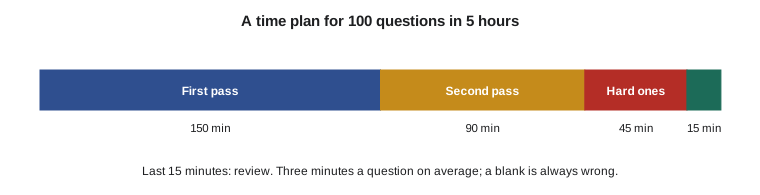
The night before, pack the books, calculator, ID and anything else the bulletin allows, and nothing it does not. Check the test center's address and parking. Sleep. In the morning, eat, arrive early, and expect the check-in to take time. Once seated, take a minute to settle and read the instructions on screen. Then work in passes. On the first pass, answer every question you can do with confidence in a few minutes and flag the rest. On the second pass, work the flagged questions that need a lookup or a moderate calculation. Use the time left for the hardest calculations. Save the last minutes to make sure every question has an answer.
Keisha's checkpoints were simple: question 25 by 75 minutes, question 50 by 150, question 75 by 225, with fifteen minutes left at the end. She was ahead at every checkpoint, which let her slow down on the long calculations in the last quarter. When a question stumped her, she flagged it, made a best guess so it was not blank, and moved on. Twice, a later question jogged her memory about an earlier one, and the flag let her go back.
| Checkpoint | Question number | Minutes used |
|---|---|---|
| First quarter | 25 | 75 |
| Halfway | 50 | 150 |
| Third quarter | 75 | 225 |
| All answered | 100 | 285 |
| Final check | Every question answered | 300 |
A four-week final review
Keisha's last month before the exam followed a simple pattern that any candidate can copy. In week one she took a full-length timed practice exam on a Saturday morning, under test conditions: same books, same calculator, no phone, five hours on the clock. She scored it that afternoon and sorted every miss into a category: could not find it, found the wrong section, misread the question, arithmetic error, or did not know the concept. Most of her misses in week one were in the first two groups, which told her that her tabs and her index skills needed work more than her knowledge did.
In week two she worked only the weak areas. For finding problems, she drilled with the index: Frank would call out a topic from the job, such as a pool bonding question or a generator transfer question, and she would time how long it took to reach the right section. Her average fell from about four minutes to under ninety seconds. For concept gaps, she reread the relevant course lessons and the matching articles, then worked a dozen practice questions on each topic.
In week three she took a second full timed exam, scored it the same way and compared the categories. Finding problems had dropped sharply; misreading had become her largest group, so she started underlining the key words of every question on scratch paper before opening the book. In week four she did short timed sets of twenty-five questions each evening, reviewed her tabs, confirmed her test-center details and stopped heavy study two days before the exam so she would arrive rested.
| Week | Main activity | What it measures |
|---|---|---|
| 1 | Full timed practice exam and error sort | Baseline score and the type of each miss |
| 2 | Targeted drills on the weakest categories | Speed of lookup and grasp of weak topics |
| 3 | Second full timed exam | Whether the weak categories improved |
| 4 | Short timed sets, tab review, logistics | Pacing and readiness without fatigue |
Two habits made the plan work. First, every practice miss went into a notebook with the question topic, the right section and one line on why she missed it; by week four the notebook was a personal guide to her blind spots. Second, she practiced with the exact books she would carry into the test center, so the tabs, highlights and margin notes she relied on were the ones she would have on the day. Check the ICC bulletin for what marking and tabbing of references is allowed, and set up your books to match before you start the final month.
Managing stress
Long exams are tiring, and fatigue makes careful people careless. Stretch your hands and shoulders between sections, drink water if allowed, and look away from the screen for a few seconds every so often. If you hit a run of hard questions, remind yourself that exam writers mix difficulty and that the next few may be easier. Do not change answers without a reason: research and experience both suggest that first answers backed by a lookup are usually right, and changes should come from finding a better reference, not from a vague worry.
The program below is the pacing check Keisha practiced with in her last three weeks. It compares where she was at each checkpoint with where she needed to be.
plan = {25: 75, 50: 150, 75: 225, 100: 285}
actual = {25: 68, 50: 139, 75: 214, 100: 271}   # minutes from a practice exam
for q, target in plan.items():
    diff = target - actual[q]
    status = "ahead" if diff >= 0 else "behind"
    print(f"Question {q:3d}: target {target} min, actual {actual[q]} min, {abs(diff)} min {status}")
print("Minutes left for review:", 300 - actual[100])Question 25: target 75 min, actual 68 min, 7 min ahead Question 50: target 150 min, actual 139 min, 11 min ahead Question 75: target 225 min, actual 214 min, 11 min ahead Question 100: target 285 min, actual 271 min, 14 min ahead Minutes left for review: 29
After the exam
Results are reported as the ICC bulletin describes. If you pass, keep the documentation and apply promptly, within twelve months in Philadelphia. If you fail, read the score report by subject area, plan focused study on the weakest areas, and check the bulletin's rules for retaking. Many strong electricians pass on a second attempt after learning how the exam works. Keisha passed on her first try with room to spare and applied to L&I five weeks later. Owen's old Pittsburgh exam letter was accepted, and he will start his first Pittsburgh job in the spring with a new trade license and a renewal date written in three places.
Frank, for his part, closed his last open permit in May and spent the first week of June at the shore. Schuylkill Line kept working without missing a day, under a new license with the same name on the trucks. That is the goal of this course: not just a passing score, but a license held well.
Common mistakes
MistakeAnswering from memory on an open book exam.
InsteadLook it up, read the whole section including exceptions, and record the reference.
MistakeRounding early in a calculation.
InsteadCarry full values and units to the end unless the code directs rounding at a step.
MistakeSpending fifteen minutes on one question in the first pass.
InsteadFlag it, guess, move on and come back in a later pass.
MistakeChanging answers on a vague feeling.
InsteadChange only when a better reference shows the first answer was wrong.
MistakeWaiting months to apply after passing in Philadelphia.
InsteadApply within twelve months of passing.
Summary and key terms
- Pennsylvania licensing is local; the UCC now references the 2020 NEC.
- Philadelphia: four years, exam 211, eight hours of NFPA 70, insurance, taxes, annual renewal; licensed agencies inspect.
- Pittsburgh: six years, ICC national exam T16, insurance naming the City, eight CEUs, 365-day term, lapse on day 61.
- Statewide rules: HICPA registration, liens, CASPA, misclassification and federal OSHA.
- Work NEC questions with a consistent method and record each reference.
- Use passes and checkpoints so every question gets an answer.
- First pass
- Answering all quick questions and flagging the rest.
- Checkpoint
- A planned question number and time used, for pacing.
- Score report
- The exam result, often broken down by subject area.
- Continuous load
- A load expected to run at maximum current for three hours or more, figured at an increased value for sizing.
- Sanity check
- Comparing an answer with the choices and experience to catch errors.
- Retake
- Sitting the exam again under the bulletin's rules after a failing score.
Practice problems
Work each problem on paper first, then reveal the answer to check.
At three minutes per question, where should you be after 150 minutes on a 100-question exam?
Show answer
Around question 50.
What is the minimum overcurrent rating for a 24-ampere continuous load under the general 125 in 100 rule?
Show answer
30 amperes (24 × 1.25 = 30, a standard size).
Name the five steps of the NEC question method.
Show answer
Read and identify what is asked; locate the article; read the whole section with exceptions; answer and record the reference; sanity-check.
Within what period should a Philadelphia candidate apply after passing?
Show answer
Within twelve months.
What insurance does HICPA require?
Show answer
At least 50,000 dollars for bodily injury and 50,000 dollars for property damage.
Lesson quiz · 5 questions
Score 60% or more to complete this lesson.
Create a free account to save your progress, take quizzes and earn a certificate.