
MELU-313 · Lesson 7 of 12 · 19 min
Duties and responsibilities of the Local Master Electrician Licenses holder
▶ Video coming soon A video version of this lesson is on the way.
The week Keisha passed exam 211, Frank took her to lunch and slid a manila folder across the table. Inside were twenty years of things that had gone wrong: a stop-work order from a job where a subcontractor had worked under Frank's permit without telling him, a letter from L&I about an expired insurance certificate, a correction notice for a panel that a new hire had labeled wrong, and a demand letter from a homeowner who claimed a job was never finished. 'This is what the license really is,' Frank said. 'Passing the test is the easy part. The license means your name is on every one of these.' This lesson is about what holding a Pennsylvania local license means day to day.
Because Pennsylvania licensing is local, the exact duties of a license holder come from each municipality's ordinance and rules. This lesson uses Philadelphia and Pittsburgh as examples, drawing on the official license and permit pages checked in November 2026, and then sets out the general duties that apply wherever you hold a license. Where a duty comes from general practice rather than a specific ordinance, the lesson says so. Read your municipality's ordinance itself, not only summaries, because enforcement actions turn on the exact wording.
The license is personal
In Pittsburgh, PLI says it plainly: trade licenses are issued to individuals, not to companies. In Philadelphia, the Electrical Contractor License is issued to the person who qualifies by experience and exam, and that person's license is what the company uses to pull permits and do electrical work. Either way, the license holder is personally on the hook. A company can employ many electricians, but the license and its responsibilities belong to the person whose name is on it. When Keisha takes over from Frank, every permit Schuylkill Line pulls will carry her license number, and she will answer for the work under it.
That personal responsibility is why license holders are careful about who works under their license. Lending a license, meaning letting another person or company pull permits under your license for work you do not control, is prohibited in licensing systems generally and is a common source of discipline. Frank's stop-work order came from exactly that kind of situation: a subcontractor he had hired for one job pulled a second permit under Frank's license for a job Frank had never seen. Frank had to prove he did not authorize it, and he never worked with that subcontractor again.
Performing and supervising the work
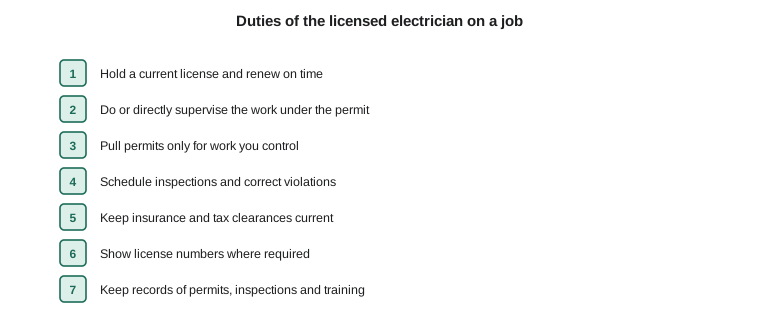
Philadelphia's permit page says a licensed electrical contractor must perform all electrical work done under an electrical permit in the city. In a company with twenty-two people, the license holder obviously does not install every receptacle personally. In practice, the work is performed by the company working under the license, by electricians and apprentices whom the license holder employs and supervises. The license holder sets the standards, assigns qualified people, trains them, reviews the work and stands behind it. Apprentices work under the supervision of qualified electricians, and the ratio and type of supervision should follow the company's apprenticeship standards and any local rules.
Keisha's plan for supervision is practical. Each job has a lead electrician she trusts. She visits every job at least once a week and every job before its rough-in and final inspections. She reviews permit drawings before work starts and panel schedules before finals. And she keeps a list of who is qualified to do what, from service changes to fire alarm work, so that assignments match ability. None of this is written in the city ordinance in so many words, but all of it follows from being responsible for work done under her license.
Permits and inspections
The license holder, or the company working under the license, pulls permits for the work it does, schedules the required inspections, corrects any violations the inspector finds, and closes the permit. In Philadelphia, that includes hiring or coordinating with a licensed electrical inspection agency, unless the owner has hired one. In Pittsburgh, PLI ties permits to a valid license so tightly that permits connected to a lapsed license are suspended until a valid license is connected to the work. Elsewhere, the municipality's ordinance sets the process. The license holder's duty is to make sure work is permitted when the code requires it, inspected at each required stage, and approved before it is used.
Doing work without a required permit is one of the most common violations, and it is the easiest to avoid. Small jobs are where it happens: a service call that turns into adding a circuit, or a fixture swap that becomes a new run. Keisha's rule for the service crew is simple: if the work goes beyond the maintenance that L&I lists as possibly exempt, such as replacing lamps, breakers, fuses or receptacles, call the office before going further, and the office decides whether a permit is needed.
Insurance, taxes and paperwork
Both cities make insurance and tax compliance conditions of holding a license, so keeping them current is a duty in itself. Philadelphia requires proof of active insurance at renewal and current city taxes and fines; Pittsburgh requires insurance certificates naming the City and a tax compliance letter before permits issue. An insurance policy that lapses mid-year, or a city tax bill that goes unpaid, can put the license and every permit under it at risk. Keisha calendared each policy's expiry date a month ahead and asked the company's agent to send renewed certificates to L&I automatically.
Records are the other paperwork duty. Keep permit files, inspection results, correction notices and certificates of approval for every job, along with employee licenses and training records, insurance certificates and renewal confirmations. When a question comes up years later, such as a homeowner selling a house or an inspector asking about an old permit, the records answer it. Frank's folder of problems was also a folder of solutions: in every case, the paper trail is what resolved it.
| Duty | Philadelphia example | Pittsburgh example |
|---|---|---|
| Who holds the license | The qualifying individual contractor licensee | Individuals; not issued to companies |
| Who does the work | A licensed electrical contractor must perform all permitted work | Work in the city requires the trade license |
| Inspections | Owner or agent hires a licensed inspection agency | PLI inspects; permits tied to a valid license |
| Insurance | Proof of active insurance at renewal | Certificates naming the City before permits |
| Taxes | Current city taxes and fines; BIRT and Commercial Activity License | Tax compliance letter from the Department of Finance |
| Education | Eight hours of NFPA 70 education for renewal | Eight CEUs a year |
Continuing education and staying current
Both cities require eight hours of continuing education for renewal: Philadelphia in NFPA 70 from an L&I-approved provider, and Pittsburgh in approved CEUs. That is the minimum. A license holder who supervises others has a broader duty to keep the company current: to know when a new code edition takes effect, to train crews on changes like the 2020 NEC's surge protection and emergency disconnect provisions, and to track new local requirements, such as Philadelphia's EVITP certification for permits that include EV chargers from July 1, 2026. Keisha scheduled two lunch-hour trainings a quarter for the crews, using the core course lessons as material.
Dealing with customers and the public
License holders are also the face of the company to customers. State consumer protection law, especially the Home Improvement Consumer Protection Act covered in Lesson 8, sets rules for home improvement contracts and advertising. Municipal rules may require license numbers on contracts, advertising or vehicles. Good practice goes further: written contracts, clear change orders, honest schedules and prompt responses to complaints. The homeowner's demand letter in Frank's folder ended when Frank produced a signed change order and the final inspection approval; without them, it would have become a lawsuit.
When things go wrong, a license holder responds rather than hides. If an inspector finds a violation, correct it promptly. If a customer complains, investigate and answer in writing. If an employee makes a mistake, fix it, train and document what changed. Licensing offices take complaints seriously, but they also distinguish between a contractor who responds responsibly and one who ignores problems.
Subcontractors and other trades
Electrical work on a bigger job rarely belongs to one company alone. A general contractor coordinates, a fire alarm company may install the alarm system, a low-voltage company may pull data cable, and a solar installer may tie into the panel. Each of those companies needs whatever license the municipality requires for its work, and each should work under its own permits where the code calls for them. When Schuylkill Line subcontracts part of its own scope, such as trenching for a service lateral, Keisha checks that the subcontractor is properly licensed or registered for that work and that its insurance names the right parties. She does not let any outside company work under her permit unless she is supervising that work as part of her own job, because the permit, and the responsibility, are hers.
Coordination is part of the duty too. When a general contractor's schedule pushes the electrical rough-in into the same week as the drywall delivery, the license holder is the one who must make sure the rough-in inspection happens before the walls close. Keisha has learned to put inspection dates into the general contractor's schedule at the first job meeting and to tell the superintendent, in writing, which areas cannot be closed until the agency signs off.
Discipline and enforcement
Licensing offices can act when a license holder breaks the rules. The tools differ by municipality and are set by ordinance, but they commonly include warnings, fines, suspension or revocation of the license, stop-work orders on jobs, and refusals to issue permits. Doing work without a license, doing work without a required permit, lending a license, letting insurance lapse and ignoring correction notices are the usual triggers. Criminal penalties can apply to some violations, such as working without a required license. Because the exact penalties and procedures are local, read your municipality's ordinance and keep a copy of any notice you receive, then respond within the time it allows.
If you receive a complaint or notice, respond promptly, in writing, with documentation. Most problems that reach a licensing office can be resolved by showing the permit, the inspection approvals, the insurance certificate or the correction made. The folder Frank handed Keisha was proof of that: every problem in it had ended, and every ending began with a document.
Changing companies or leaving
Because the license is personal, changes in employment matter. When a license holder leaves a company, the company's ability to pull permits under that license ends, and open permits under it need attention. Frank and Keisha planned their handover carefully: Frank's open permits would stay under his license until they closed, new permits would go under Keisha's license from a set date, and the insurance certificates and employment statement would be updated before the first new permit. The program below is the tracker Keisha built for that transition.
from datetime import date

handover = date(2027, 6, 1)
permits = [
    ("Tasker St kitchen", "Frank", date(2027, 3, 2), "open"),
    ("Fishtown cafe", "Frank", date(2027, 4, 18), "open"),
    ("Passyunk row house", "Keisha", date(2027, 6, 9), "open"),
    ("Grays Ferry service", "Frank", date(2027, 1, 20), "closed"),
]
for job, holder, filed, status in permits:
    note = "close under Frank" if holder == "Frank" and status == "open" else "ok"
    if filed >= handover and holder != "Keisha":
        note = "PROBLEM: new permit must use Keisha's license"
print(f"{job:20s} {holder:7s} {filed} {status:7s} {note}")Tasker St kitchen Frank 2027-03-02 open close under Frank Fishtown cafe Frank 2027-04-18 open close under Frank Passyunk row house Keisha 2027-06-09 open ok Grays Ferry service Frank 2027-01-20 closed ok
Owen faces a different version of the same question. His Pittsburgh license will be his, wherever he works, so if he changes employers, he takes the license with him and his new employer must provide the insurance and documents PLI requires before he pulls permits there. A company that relies on one employee's license should plan for that employee's departure, which is exactly what Frank did by grooming Keisha years in advance.
Common mistakes
MistakeLetting someone else pull permits under your license.
InsteadPull permits only for work you control; lending a license is prohibited and a common cause of discipline.
MistakeThinking a company holds the Pittsburgh trade license.
InsteadPLI issues trade licenses to individuals; the company relies on its licensed people.
MistakeTreating insurance as the agent's problem.
InsteadInsurance and tax compliance are conditions of the license; track expiry dates yourself.
MistakeExpanding a service call without checking whether a permit is needed.
InsteadStop and decide on a permit before going beyond exempt maintenance.
MistakeLeaving open permits behind when a license holder leaves.
InsteadPlan the handover so open permits close and new permits use the right license.
Summary and key terms
- Pennsylvania local licenses are personal: the license holder answers for work done under the license.
- In Philadelphia a licensed electrical contractor must perform all permitted electrical work.
- License holders supervise the work, pull permits only for work they control, and see inspections through to approval.
- Insurance, tax compliance and continuing education are ongoing conditions in both cities.
- Good records resolve most later disputes.
- Plan for changes in employment, because permits follow the license.
- License holder
- The individual whose license qualifies work and permits; personally responsible for them.
- Lending a license
- Allowing others to use your license for work you do not control; prohibited.
- Supervision
- Directing, training and checking the work of electricians and apprentices working under the license.
- Correction notice
- An inspector's written list of violations that must be fixed before approval.
- Open permit
- A permit whose work has not yet been finally approved and closed.
- Handover
- The planned transfer of permits and responsibilities from one license holder to another.
Practice problems
Work each problem on paper first, then reveal the answer to check.
Why is lending a license a serious problem?
Show answer
Because the license holder is responsible for work done under the license, and lending it means permits for work the holder does not control; it is prohibited.
Who must perform electrical work under a Philadelphia electrical permit?
Show answer
A licensed electrical contractor, meaning the company working under the license.
Name two ongoing conditions of holding a license in both cities.
Show answer
Insurance and tax compliance (also continuing education).
What happens to Pittsburgh permits if the trade license lapses?
Show answer
They are suspended until a valid license is connected to the work.
What should a company do before its license holder retires?
Show answer
Plan a handover: close open permits under the old license, move new permits and insurance to the new license holder.
Lesson quiz · 5 questions
Score 60% or more to complete this lesson.
Create a free account to save your progress, take quizzes and earn a certificate.