
MELU-313 · Lesson 10 of 12 · 20 min
Workplace safety law and OSHA for electrical contractors
▶ Video coming soon A video version of this lesson is on the way.
Two winters ago, a Schuylkill Line apprentice named Darnell reached into a panel he believed was dead and took a shock from a backfed circuit. He was lucky: a tingle up his arm, a scare, a trip to urgent care, and no lasting harm. The circuit had been energized through a portable generator a homeowner had connected improperly, and the lockout on the main had not caught it. Frank shut down every job for a morning, held a safety meeting in the shop, and rewrote the company's lockout procedure to require testing every conductor before touching it, no matter what the breaker said. 'The license puts your name on the work,' he told Keisha afterward. 'Safety puts your name on the people.' This lesson covers the safety law that applies to electrical contractors in Pennsylvania.
Pennsylvania does not run its own occupational safety plan for private employers, so private-sector workplaces in the state, including electrical contractors, fall under federal OSHA. Public-sector employees are covered differently. The facts in this lesson about OSHA's standards are stated generally, from the federal regulations as commonly summarized; the facts about Pennsylvania's misclassification law come from a practitioner summary checked in November 2026. Read the current regulations themselves for exact requirements, and remember that safety rules can change with new rulemaking.
Federal OSHA in Pennsylvania
The Occupational Safety and Health Act of 1970 requires employers to provide a workplace free from recognized hazards that are causing or likely to cause death or serious physical harm, and to comply with the standards OSHA issues. Construction work falls under the construction standards in 29 CFR Part 1926, and general industry work, such as maintenance in an existing building, under Part 1910. Electrical contractors often work under both, depending on whether the work is construction or maintenance. OSHA's area offices in Pennsylvania, including offices serving the Philadelphia and Pittsburgh regions, enforce these standards through inspections, which can follow a complaint, a serious injury report, a referral or a planned program.
For electricians, the most important construction standards are in Subpart K, Electrical, which covers installation safety requirements, safety-related work practices, lockout and tagging of circuits, and ground-fault protection for temporary wiring on construction sites. Other subparts matter too: fall protection, ladders and scaffolds, excavations for trenching underground services, personal protective equipment, and training. General industry has its own electrical standards in Subpart S and the control of hazardous energy standard for lockout and tagout during servicing and maintenance.
Safe work practices and NFPA 70E
OSHA's rules set the legal requirements, and NFPA 70E, the Standard for Electrical Safety in the Workplace, is the consensus standard most employers use to meet them. NFPA 70E describes how to establish an electrically safe work condition, how to assess shock and arc flash risk, how to choose protective equipment, and how to set approach boundaries. OSHA does not adopt NFPA 70E word for word, but OSHA has used it as evidence of recognized hazards and feasible protections. Like the NEC, NFPA 70E is copyrighted; refer to your own copy for its requirements.
The core idea in both is that work on energized equipment should be the exception, justified only when de-energizing creates a greater hazard or is infeasible, and that de-energized means verified dead. The steps for an electrically safe work condition, in outline, are to identify all sources, open the disconnects, verify visible breaks where possible, apply lockout and tagout devices, test each conductor for absence of voltage with a properly rated tester verified before and after the test, and ground where stored energy or induced voltage is possible. Darnell's shock happened because one step, testing every conductor, was skipped on the assumption that the breaker told the whole story.
Training, reporting and recordkeeping
OSHA expects employers to train workers on the hazards of their jobs, and Subpart K's safety-related work practices assume trained, qualified people for work near energized parts. Many contractors provide OSHA 10-hour and 30-hour construction outreach training as a baseline, and some owners and municipalities require it on certain jobs. Training should be documented: who was trained, on what, when, and by whom. Keisha now keeps a training matrix for every employee showing lockout, arc flash, fall protection, ladder, trenching and first aid training, with renewal dates.
Federal rules also require employers to report severe injuries to OSHA within short deadlines, generally within eight hours for a work-related fatality and within twenty-four hours for an inpatient hospitalization, amputation or loss of an eye, and to keep injury and illness records on the OSHA 300 log, 300A summary and 301 incident reports, unless a size or industry exemption applies. The summary must be posted each year for the period OSHA specifies, and some employers must submit data electronically. Check OSHA's current recordkeeping rules for the exact deadlines, exemptions and forms, and remember that injury reports to your workers' compensation insurer are a separate obligation.
Workers' compensation
Pennsylvania's Workers' Compensation Act generally requires employers to provide workers' compensation coverage for their employees, through insurance or approved self-insurance, and covers medical treatment and wage loss for work-related injuries. Darnell's urgent care visit was handled as a workers' compensation claim. An employer that fails to carry required coverage faces serious penalties and can be sued directly by an injured worker. Philadelphia's contractor license requires proof of workers' compensation coverage with stated employer's liability limits, and Pittsburgh requires a certificate naming the City or a notarized statement that the business has no employees.
The Construction Workplace Misclassification Act
Pennsylvania has a special law for construction: the Construction Workplace Misclassification Act, effective February 11, 2011. It sets a strict test for when a construction worker may be treated as an independent contractor rather than an employee for workers' compensation and unemployment compensation purposes. The point of the law is to stop contractors from avoiding insurance and taxes by calling employees independent contractors.
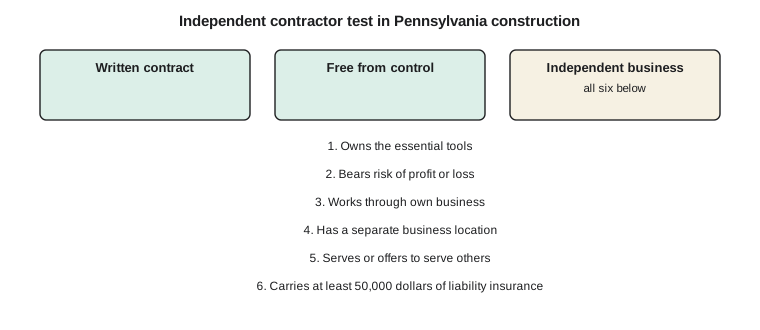
Under the practitioner summary, a worker is an independent contractor only if three criteria are met. The worker must have a written contract to perform the services. The worker must be free from the hiring party's control or direction in performing them. And the worker must be customarily engaged in an independently established trade, occupation, profession or business. For the third criterion, all six of the following must be true: the worker owns the essential tools for the work; the worker bears the risk of profit or loss; the worker works through a business the worker owns at least in part; the worker keeps a business location separate from the hiring party; the worker performs or credibly offers to perform similar services for others; and the worker carries at least 50,000 dollars of liability insurance during the contract. Each requirement must be met.
The penalties are significant. The summary says construction employers who misclassify workers for workers' compensation or unemployment purposes may face fines or even incarceration, as may officers and agents involved and anyone who knowingly contracts with an employer planning to misclassify workers. The act prohibits retaliation against workers who report violations. Enforcement is by the Department of Labor and Industry; the summary notes the act creates no private right of action and that good faith is a defense.
Worked problem
Is this worker an independent contractor?
Schuylkill Line wants to bring in Vic, a licensed electrician who does side work, for a busy month. Vic would use the company's truck and tools, follow the foreman's schedule, carry no business insurance, and work only for Schuylkill Line that month. Does he meet the test?
Show solution
- Written contract: possible, but that is only one criterion.
- Free from control: no; he follows the foreman's schedule and direction.
- Owns essential tools: no; he uses the company's.
- Liability insurance of at least 50,000 dollars: no.
- Several requirements fail, and every one must be met.
Answer: No. Vic must be treated as an employee: on payroll, covered by workers' compensation and unemployment insurance.
Hazards electricians meet beyond shock
Shock and arc flash get the attention, but electricians are hurt in other ways too. Falls from ladders are among the most common serious injuries in the trade: overreaching from a stepladder, using the top step, or carrying material up an extension ladder. Pennsylvania's row houses add steep, narrow stairs and cramped basements to the list. OSHA's ladder and fall protection rules set the basics, such as using the right ladder for the job, keeping three points of contact, and protecting workers at heights above the construction threshold. Trenching for underground service laterals brings excavation hazards: cave-ins, utilities struck by the shovel, and water. Call the state's one-call system before digging, as Pennsylvania law requires, and follow OSHA's excavation rules for protective systems.
Temporary power on construction sites is another frequent problem. OSHA requires ground-fault protection for receptacle outlets on construction sites used by employees, either through GFCI protection or, where allowed, an assured equipment grounding conductor program. Damaged cords, missing grounding pins and daisy-chained extension cords are among the most common citations. Keisha's crews inspect cords and tools at the start of each day and pull damaged ones from service immediately. Heat in summer attics and cold in winter basements round out the list, along with silica dust when cutting masonry and the hazards of working around other trades. A good safety program addresses all of them, not just the panel.
Customers' sites carry their own risks. Older Philadelphia housing can contain asbestos in insulation and old wiring materials, and lead paint is common on trim and walls. Disturbing those materials triggers specific federal and state rules, including the Environmental Protection Agency's lead renovation rules for pre-1978 housing. An electrician who opens walls in old homes should know how to recognize suspect materials and when to stop and call for testing.
Building a safety program
The best contractors treat safety as a system rather than a set of rules. A written safety program covers lockout and tagout, arc flash, fall protection, ladders, trenching, temporary power, first aid and emergency response, and the procedures specific to the company's work. Supervisors run brief daily or weekly toolbox talks. New hires get orientation before they touch a tool. Near misses are reported and discussed without blame, because a near miss is free information about the next injury. And the license holder takes part, not just signs the binder.
Keisha used Darnell's shock as the first case study in her new monthly safety meetings. She walked through what happened, what the procedure said, where it failed, and what changed. She also built the simple tracker below to show the crew how training was progressing toward the company's goal of everyone current on lockout and arc flash.
team = {
    "Darnell": {"lockout": True, "arc_flash": True, "fall": True},
    "Marisol": {"lockout": True, "arc_flash": False, "fall": True},
    "Vic":     {"lockout": False, "arc_flash": False, "fall": True},
    "Keisha":  {"lockout": True, "arc_flash": True, "fall": True},
}
for course in ("lockout", "arc_flash", "fall"):
    done = sum(1 for p in team.values() if p[course])
    print(f"{course:10s} {done} of {len(team)} current")
need = [name for name, p in team.items() if not all(p.values())]
print("Schedule training for:", ", ".join(need))lockout 3 of 4 current arc_flash 2 of 4 current fall 4 of 4 current Schedule training for: Marisol, Vic
Common mistakes
MistakeTrusting an open breaker without testing.
InsteadVerify absence of voltage on every conductor with a tester checked before and after.
MistakeAssuming Pennsylvania has a state OSHA plan for private employers.
InsteadPrivate employers in Pennsylvania fall under federal OSHA.
MistakeCalling a helper an independent contractor because there is a written contract.
InsteadAll three criteria and all six business requirements must be met.
MistakeTreating NFPA 70E as optional because OSHA does not adopt it by name.
InsteadOSHA uses it as evidence of recognized hazards and protections; most employers follow it.
MistakeReporting a hospitalization to the insurer and stopping there.
InsteadOSHA has its own short reporting deadlines for severe injuries.
Summary and key terms
- Private employers in Pennsylvania, including electrical contractors, are covered by federal OSHA.
- Construction electrical safety is in 29 CFR 1926 Subpart K; general industry in Part 1910.
- NFPA 70E guides establishing an electrically safe work condition, including testing for absence of voltage.
- Employers must train workers, report severe injuries promptly and keep injury records unless exempt.
- Pennsylvania generally requires employers to carry workers' compensation coverage.
- The Construction Workplace Misclassification Act, effective February 11, 2011, sets a strict independent contractor test.
- OSHA
- The federal Occupational Safety and Health Administration, which enforces workplace safety for private employers in Pennsylvania.
- Subpart K
- The electrical subpart of OSHA's construction standards, 29 CFR 1926.
- NFPA 70E
- The consensus standard for electrical safety in the workplace.
- Electrically safe work condition
- A state in which equipment is disconnected, locked out, tested and verified de-energized.
- OSHA 300 log
- The employer's record of work-related injuries and illnesses.
- Misclassification
- Treating an employee as an independent contractor without meeting the legal test.
Practice problems
Work each problem on paper first, then reveal the answer to check.
Which agency enforces workplace safety for private electrical contractors in Pennsylvania?
Show answer
Federal OSHA.
What is the key step Darnell's crew skipped?
Show answer
Testing every conductor for absence of voltage before touching it.
Name three of the six independent business requirements under the misclassification act.
Show answer
Any three of: owns essential tools, bears profit or loss risk, works through own business, separate business location, serves or offers to serve others, at least 50,000 dollars of liability insurance.
When did the Construction Workplace Misclassification Act take effect?
Show answer
February 11, 2011.
Which OSHA construction subpart covers electrical work?
Show answer
Subpart K of 29 CFR Part 1926.
Lesson quiz · 5 questions
Score 60% or more to complete this lesson.
Create a free account to save your progress, take quizzes and earn a certificate.