
MELU-312 · Lesson 9 of 12 · 20 min
Contracts and construction liens in Oregon
▶ Video coming soon A video version of this lesson is on the way.
In 2019 Willamette Crest finished the electrical work on a custom home outside Corvallis for a general contractor who then stopped paying his subcontractors. Dale had done everything right on the wiring and almost nothing right on the paperwork. He had not given the owner a notice of right to lien, and by the time he called a lawyer, more than 75 days had passed since his crew's last day on the job. The company never collected the last 31,000 dollars. Since then, Wendy has run every job through a lien calendar, and Dale tells new foremen the story whenever they ask why the office cares so much about dates.
This lesson covers the contract and lien rules that an Oregon electrical contractor uses every week: the written contract and consumer notices on residential work, the information notice to owner that an original contractor must deliver, the notice of right to lien, and the deadlines to perfect and enforce a lien under ORS chapter 87. Many people still call them mechanics' liens; Oregon's statute uses the term construction liens, and this lesson uses the statutory term.
Contracts and consumer notices
Oregon's contractor law, administered by the CCB, requires certain contract terms and notices on residential work. Residential contracts above a threshold must be in writing and must include information such as the contractor's CCB license number and a description of the work, and the CCB requires the contractor to deliver consumer notices, including the information notice to owner about construction liens, at the times its rules set. The CCB's rules and forms list the full set of notices and the thresholds; a supervising electrician who signs contracts or manages residential jobs should keep the current forms on file and use them every time.
Commercial work has fewer statutory notices but higher stakes. A good commercial subcontract defines the scope, the schedule, the payment terms and retainage, the process for change orders and the way disputes are handled. Read it before signing, especially the clauses on pay-when-paid, indemnity and waiver of lien rights. Some contract terms that shift risk to subcontractors are limited by Oregon law, but a contractor should not count on a statute to fix a bad contract.
The information notice to owner
ORS 87.093 requires the original contractor, meaning a contractor with a direct contract with the owner, to deliver the CCB's information notice to owner about construction liens on residential work. It must be delivered to the owner when the contract for residential construction or improvement is signed, and to the first purchaser of a residence the contractor built and sold before completion or within 75 days after. The requirement applies when the aggregate contract price exceeds 2,000 dollars. If a contract starts smaller and later grows past 2,000 dollars, the notice is due within five days after the contractor knows or should know that the price has passed the threshold.
The consequence of skipping it is severe. An original contractor that fails to deliver the notice cannot claim a construction lien for that contract, and the CCB can suspend its license or impose a civil penalty that the statute caps at 5,000 dollars. The notice explains to the owner how liens work, how subcontractors and suppliers can lien the property even if the owner has paid the original contractor and how the owner can protect themselves. Willamette Crest attaches a copy to every residential proposal and has the owner sign a receipt when the contract is signed.
Who can lien and the notice of right to lien
ORS 87.010 gives a lien on an improvement and the land it sits on to people who provide labor, materials, equipment or certain services for it, including electrical contractors and subcontractors. A subcontractor or supplier who does not deal directly with the owner generally must give the owner a notice of right to lien to protect its lien rights. ORS 87.021 says the notice can be given at any time during construction, but it protects only work and materials provided after a date eight days before the notice is delivered or mailed, not counting Saturdays, Sundays and holidays. Work done earlier is not protected by a late notice. Some claimants are exempt from the notice, and the rule differs between residential and commercial improvements, so check the statute for the job at hand.
The practical lesson is to send the notice early. When Willamette Crest works as a subcontractor, Wendy sends the notice of right to lien within the first week on site, by a method that proves delivery, and keeps a copy with the proof. She does it on every job above a small threshold the company has set for itself, because the cost of a notice is a stamp and an hour of time and the cost of a missing notice can be the whole contract.
Perfecting the lien
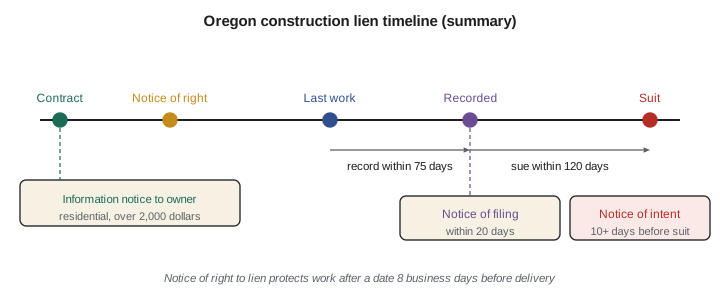
A lien does not exist in a useful form until it is perfected. Under ORS 87.035, a claimant who provided labor or materials must file a claim of lien with the recording officer of the county where the property is located no later than 75 days after the claimant stopped providing labor or materials, or 75 days after completion of construction, whichever comes first. The claim of lien must contain the information the statute requires, such as the amount claimed, the name of the owner and a description of the property, and it must be signed and verified.
After recording, ORS 87.039 requires the claimant to mail a notice of filing to the owner and to any mortgagee within 20 days, with a copy of the claim attached. Missing that notice does not destroy the lien, but it bars the claimant from recovering costs, disbursements and attorney fees, which in a contested case can be most of what is at stake.
| Step | Who | Deadline (summary) | Statute |
|---|---|---|---|
| Information notice to owner | Original contractor on residential work over 2,000 dollars | At contract signing, or within 5 days after the price passes 2,000 dollars | ORS 87.093 |
| Right-to-lien notice | Subcontractors and suppliers not dealing with the owner (exemptions apply) | Protects work after a date 8 days, excluding weekends and holidays, before delivery | ORS 87.021 |
| Record the claim of lien | Claimant | Within 75 days after last work or completion, whichever is first | ORS 87.035 |
| Filing notice to owner | Claimant | Within 20 days after recording | ORS 87.039 |
| Intent-to-foreclose notice | Claimant | At least 10 days before filing suit | ORS 87.057 |
| Foreclosure suit | Claimant | Within 120 days after recording | ORS 87.055 |
Enforcing the lien
A recorded lien does not last forever. ORS 87.055 says the lien does not bind the property for more than 120 days after the claim is filed unless a suit to foreclose is started within that time. If the claim states a credit extension, the period runs from the end of the extension, but any extension cannot keep the lien alive more than two years after filing. Before suing, ORS 87.057 requires the claimant to deliver a written notice of intent to foreclose to the owner and mortgagee at least 10 days before starting the suit, and to provide a list of materials and charges within five days if the owner asks for one. As with the notice of filing, failing to give the notice of intent bars costs and attorney fees.
Foreclosure is a lawsuit, and most lien claims settle before trial. The lien gives the claimant leverage: the owner cannot easily sell or refinance a property with a recorded lien, and the owner may withhold payment from the original contractor until the lien is resolved. That leverage only exists if every deadline has been met, which is why the lien calendar matters more than the lawsuit.
# A lien calendar for one job (study aid; confirm every deadline with a lawyer)
from datetime import date, timedelta
HOLIDAYS = {date(2026, 9, 7)}                       # example holiday list for the year
def back_business_days(d, n):
    while n:
        d -= timedelta(days=1)
        if d.weekday() < 5 and d not in HOLIDAYS:
            n -= 1
    return d
notice_sent = date(2026, 9, 11)
last_work = date(2026, 11, 20)
print("Right-to-lien notice sent:        ", notice_sent)
print("Work protected from:              ", back_business_days(notice_sent, 8))
record_by = last_work + timedelta(days=75)
print("Record claim of lien by:          ", record_by)
recorded = date(2027, 1, 22)
print("Filing notice due by:             ", recorded + timedelta(days=20))
sue_by = recorded + timedelta(days=120)
print("File foreclosure suit by:         ", sue_by)
print("Deliver notice of intent by: ", sue_by - timedelta(days=10))Right-to-lien notice sent: 2026-09-11 Work protected from: 2026-08-31 Record claim of lien by: 2027-02-03 Filing notice due by: 2027-02-11 File foreclosure suit by: 2027-05-22 Deliver notice of intent by: 2027-05-12
The calendar shows each deadline as a date, which is how Wendy wants to see them. The notice of right to lien sent on September 11 protects work from a date eight business days earlier, with the Labor Day holiday skipped. The 75-day recording deadline runs from the last day of work, the 20-day notice and the 120-day suit deadline run from the recording date and the 10-day notice of intent runs back from the day the suit is filed. The aid treats completion as the same day as last work, which is the simple case; when the project's completion comes earlier than the subcontractor's last day, the earlier date controls.
Public projects
Construction liens do not attach to public property. On public improvement contracts, Oregon law instead requires the contractor to post a payment bond, and unpaid subcontractors and suppliers make claims against that bond, with their own notice deadlines under the public contracting statutes. The CCB's separate public works bond, covered in Lesson 8, is a further requirement for contractors on larger public projects. A subcontractor on a school or city project should read the bond claim rules at the start of the job, because the notice periods differ from the private lien steps in this lesson.
Worked problem
A subcontract that goes unpaid
Willamette Crest is a subcontractor on a Salem restaurant remodel for a general contractor. Wendy sent a notice of right to lien to the owner on the third day on site. The crew's last day was November 20, 2026. The general contractor has not paid a 42,000-dollar invoice. What are the deadlines?
Show solution
- The notice of right to lien was sent early, so it protects nearly all of the work.
- The claim of lien must be recorded with the county by February 3, 2027, 75 days after November 20, unless completion of the project came earlier.
- If it is recorded on January 22, 2027, the notice of filing must be mailed by February 11.
- A foreclosure suit must be filed by May 22, 2027, 120 days after recording, with the notice of intent delivered at least 10 days before the suit is filed.
Answer: Record by February 3, 2027; notice of filing within 20 days of recording; notice of intent at least 10 days before suit; suit within 120 days of recording.
Payment, waivers and the lien file
Liens are the last resort, and good payment practices make them rare. On commercial jobs, Willamette Crest bills monthly on the schedule in the subcontract, tracks retainage separately and asks for payment status from the general contractor when an invoice is ten days late. Owners and lenders often ask subcontractors for lien waivers or releases with each payment. Read every waiver before signing it: some release lien rights only for the amount actually paid, and others release more, including amounts not yet received. Sign only for what has been paid, and keep a copy.
Wendy keeps a lien file for every job above the company's threshold. It holds the contract, the notice of right to lien and the proof of delivery, the information notice to owner and its signed receipt on residential jobs, the invoices and payment records, the waivers signed and the date of the last day of work, recorded from the daily logs. If a lien becomes necessary, the lawyer starts with that file. Without it, the lawyer starts by asking questions that may no longer have answers.
Common mistakes
MistakeWaiting to send the notice of right to lien until payment is late.
InsteadThe notice protects only work after a date eight business days before delivery; send it early.
MistakeSkipping the information notice to owner on a small residential job that later grows.
InsteadOnce the price passes 2,000 dollars, the notice is due within five days.
MistakeCounting 75 days from the invoice date.
InsteadThe 75 days run from last work or completion, whichever is first.
MistakeRecording the lien and then waiting a year.
InsteadThe lien lapses unless suit is filed within 120 days of recording.
Summary and key terms
- Oregon's statute calls them construction liens, in ORS 87.001 to 87.093.
- An original contractor on residential work over 2,000 dollars must deliver the information notice to owner, or it loses lien rights and faces CCB penalties.
- Subcontractors and suppliers generally give a notice of right to lien; it protects work after a date eight business days before delivery.
- Record the claim within 75 days of last work or completion, mail notice of filing within 20 days, and sue within 120 days with notice of intent at least 10 days before suit.
- Public property cannot be liened; claims go against the public contract payment bond.
- Original contractor
- A contractor with a direct contract with the owner.
- Information notice to owner
- The CCB notice about construction liens that ORS 87.093 requires on residential work.
- Right-to-lien notice
- The notice a subcontractor or supplier gives the owner to protect its lien rights.
- Perfect
- To record a claim of lien within the statutory deadline.
- Intent-to-foreclose notice
- The written notice due at least 10 days before a foreclosure suit.
Practice problems
Work each problem on paper first, then reveal the answer to check.
Within how many days must a claim of lien be recorded?
Show answer
75 days after last work or completion, whichever is first.
Within how many days of recording must the notice of filing be mailed?
Show answer
20 days.
How long does a recorded lien last without a foreclosure suit?
Show answer
120 days after the claim is filed.
What threshold triggers the information notice to owner?
Show answer
An aggregate residential contract price over 2,000 dollars.
Lesson quiz · 5 questions
Score 60% or more to complete this lesson.
Create a free account to save your progress, take quizzes and earn a certificate.