
MELU-312 · Lesson 7 of 12 · 19 min
Duties of a supervising electrician
▶ Video coming soon A video version of this lesson is on the way.
In June, a month after her license arrived, Priya spent a week shadowing Dale on the supervising side of the business. On Monday she watched him review a permit application for the Corvallis clinic and sign it. On Tuesday they walked the Lebanon warehouse with the foreman before the service inspection. On Wednesday Dale spent an hour checking that a new hire's journeyman license was current and that the two apprentices on the Albany duplexes were registered and properly supervised. On Thursday an inspector's correction notice arrived for a missing bonding jumper at the farm shop, and Dale made sure it was fixed and reinspected before Friday. "None of that is wiring," he told her. "All of it is the job."
This lesson covers the legal duties of a general supervising electrician in Oregon: what the license allows, what OAR 918-282-0140 requires the holder to do, the employment conditions that tie the supervisor to one contractor, and what must happen when a supervising electrician leaves.
What the license allows
OAR 918-282-0140 describes the general supervising electrician's scope in three parts. The holder may supervise electrical installations for or as an electrical contractor. The holder may plan, lay out and design electrical installations for the employer's customers. And the holder is the only person who may supervise the installation or alteration of an electrical service for the contractor. On top of that, the license allows the holder to do any work a general journeyman electrician may do, so a supervising electrician can keep working with the tools.
The scope explains why Oregon ties the license to a contractor. Supervision is not a title; it is a set of decisions about how the contractor's work is planned, staffed, installed and inspected. The rule puts those decisions in the hands of a licensed person who has shown the experience and passed the exam, and it holds that person responsible for them.
The duties in the rule
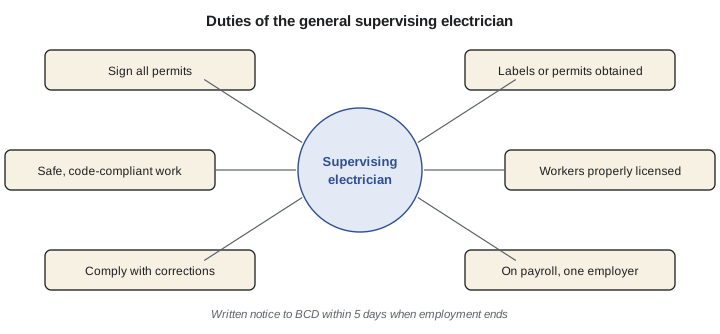
The rule lists the duties in plain terms. The general supervising electrician must sign all electrical permits for the contractor. The supervisor must make sure that the required labels or permits are obtained before work begins. The supervisor must see that the electrical work is done safely and in compliance with the code. The supervisor must make sure that people doing electrical work hold the licenses or registrations their work requires. And the supervisor must make sure that corrective notices from inspectors are complied with. Each duty is a question an investigator can ask after something goes wrong: who signed this permit, why was there no permit, who did this work, and why was this correction ignored?
In practice, Dale meets those duties through routines. Every permit application goes across his desk before it is filed, and he signs only for work he will actually supervise. Wendy checks the license status of every electrician on the payroll each quarter using BCD's public lookup, and she keeps a list of each apprentice's registration and the journeyman assigned to supervise them. Foremen send Dale photos before every cover inspection on commercial jobs. Correction notices go on a whiteboard in the office until they are closed.
| Duty in the rule | How Willamette Crest meets it |
|---|---|
| Sign all permits | The supervising electrician reviews and signs every application |
| Make sure labels or permits are obtained | No job starts without a permit number or a reported label |
| Safe, code-compliant work | Foremen walk-throughs and photo reviews before inspections |
| Workers properly licensed | Quarterly license checks and an apprentice supervision list |
| Comply with corrective notices | Each notice tracked on the board until reinspection passes |
Licensed workers and apprentice supervision
The duty to make sure workers are licensed is broader than it sounds. A journeyman whose license expired last month is not licensed this month. An apprentice must be registered and must work under the supervision that the apprenticeship standards and BCD's rules require, including the ratio of apprentices to licensed electricians on a job and the level of supervision for the work being done. The details are in the apprenticeship rules and BCD's division 282 rules; a supervising electrician should know where to find them and check that each crew meets them.
Priya found the ratio question harder than she expected. On the Albany duplexes, two apprentices worked with one journeyman, and a third apprentice joined for a week while another crew was short. Dale had her read the current ratio rules, call the apprenticeship coordinator and adjust the crews before the third apprentice started. "If an inspector or BCD asks," he said, "we want the answer to be that we checked."
One employer, on the payroll, available
The rule ties the supervising electrician to the contractor in three ways. First, the supervisor must be continuously employed by the contractor, on its regular payroll, and available to supervise. A contractor cannot rent a license by paying a retired electrician to let it use his name. Second, the supervisor may act as supervising electrician for only one employer at a time. Third, when the supervisor's employment ends, written notice must reach BCD within five days, and the contractor may not do work that requires a supervising electrician until a replacement is employed and the notice of the new supervisor is given.
The five-day notice and the stop-work consequence are the parts of the rule most often tested and most often forgotten in practice. The contractor's license stays on BCD's records, but without a supervising electrician the business cannot lawfully perform the work the license exists for. That is the risk Dale described to Priya in January: if he leaves without a replacement in place, the company's electrical work stops until someone is licensed, hired and named.
# When does the notice deadline fall after a supervisor leaves? (study aid)
from datetime import date, timedelta
NOTICE_DAYS = 5          # written notice to BCD after employment ends (check OAR 918-282-0140)
def plan(last_day, replacement_start):
    deadline = last_day + timedelta(days=NOTICE_DAYS)
    gap = (replacement_start - last_day).days
    print("Supervisor's last day:  ", last_day)
    print("Written notice due by:  ", deadline)
    if gap <= 0:
        print("Replacement already employed; give the new-supervisor notice and keep working")
    else:
        print("Days with no supervisor:", gap, "-> no work requiring a supervisor until",
              replacement_start, "and the notice is given")
plan(date(2027, 3, 31), date(2027, 3, 1))     # Priya already on staff
print()
plan(date(2027, 3, 31), date(2027, 4, 12)) # no one readySupervisor's last day: 2027-03-31 Written notice due by: 2027-04-05 Replacement already employed; give the new-supervisor notice and keep working Supervisor's last day: 2027-03-31 Written notice due by: 2027-04-05 Days with no supervisor: 12 -> no work requiring a supervisor until 2027-04-12 and the notice is given
The two runs show why Dale planned the transition the way he did. If Priya is already employed as a supervising electrician when Dale retires, the company gives the required notices and keeps working. If Dale had left with no one ready, the company would have had twelve days in which it could not do work requiring a supervisor, and every job in progress would have stopped. Counting five days is easy; the hard part is making sure the second case never happens.
Responsibility when things go wrong
Because the supervising electrician signs the permits and is responsible for the work, the license can be at risk when the contractor's work is unsafe, unpermitted or done by unlicensed people. ORS chapter 479 and BCD's rules allow civil penalties and license discipline for violations, and BCD can act against both the contractor and the individual. A supervising electrician who is told to sign a permit for work he will not supervise, or to ignore a correction notice, should refuse and document the refusal. The license is personal, and the supervisor carries it to the next employer.
Worked problem
A new supervisor's first week
Dale retires on March 31, 2027, and Priya becomes Willamette Crest's general supervising electrician. List the steps she and Wendy should take in the first week.
Show solution
- Give BCD the required written notices: that Dale's employment as supervisor has ended and that Priya is the new supervising electrician, within five days of the change.
- Confirm in BCD's records that the contractor license now shows Priya as supervisor.
- Review all open permits and their inspection status, because she is now responsible for compliance on those jobs.
- Check license and registration status for every electrician and apprentice, and review the crew ratios.
- Close or schedule every open correction notice.
Answer: Written notices to BCD within five days, confirmation of the record, a review of open permits, a license check and a plan for every open correction.
Supervising more than one job at a time
A supervising electrician at a company with eighteen electricians cannot stand beside every crew. The rule does not expect that. It expects the supervisor to be employed, available and responsible, and to organize the work so that the duties are met on every job. In practice, that means delegating the daily direction of each crew to a licensed foreman while keeping the supervisor's own review at the points that matter most: permit applications, service work, cover inspections on commercial jobs, correction notices and any work outside the company's usual range.
Priya built a weekly routine for this. On Monday she reviews every new permit application and the inspection schedule for the week. On Tuesday and Wednesday she visits the jobs with service work or upcoming cover inspections. On Thursday she reviews photos from the other jobs and answers foremen's code questions. On Friday she checks the correction board and the license list. The routine leaves room for her own work with the tools on most days, which is one reason she wanted the supervising license rather than an office role.
| Day | Supervisor's focus |
|---|---|
| Monday | Permit applications and the week's inspections |
| Tuesday and Wednesday | Site visits for service work and cover inspections |
| Thursday | Photo reviews and foremen's code questions |
| Friday | Correction notices, license and apprentice checks |
The routine is also evidence. If BCD or an investigator ever asks how the supervisor met the duties on a particular job, a calendar of site visits, a folder of photo reviews and a log of correction notices answer the question better than any memory. Supervision that leaves no record is hard to prove.
The one thing a supervisor should never delegate is the signature. Signing a permit is a statement that the supervisor will supervise the work. A supervisor who lets an office manager sign permits in their name, or who signs a stack of blank applications before a vacation, has given away the control that the rule is built on.
Priya also learned that supervision includes saying no. In her first month as a supervisor, a customer asked a Willamette Crest crew to add a circuit on a job whose permit did not cover it, and the foreman called her from the site. She told him to stop, called the customer to explain that the change needed a revised permit and filed it that afternoon. The customer was impatient for a day. The inspector, who saw the revised permit on the next visit, said nothing at all, which in an inspection is the best possible outcome.
Common mistakes
MistakeLending a supervising license to a contractor that does not employ you.
InsteadThe supervisor must be continuously employed on the contractor's regular payroll and available.
MistakeSupervising for two companies at once.
InsteadA general supervising electrician may supervise for only one employer at a time.
MistakeWaiting a month to tell BCD that the supervisor left.
InsteadWritten notice is due within five days, and work requiring a supervisor stops until a replacement is in place.
MistakeSigning a permit for a job someone else will supervise.
InsteadThe supervisor signs permits for work they actually supervise and is responsible for it.
Summary and key terms
- A general supervising electrician may supervise for or as a contractor, plan and design installations for the employer's customers and supervise service installations, and may do journeyman work.
- Duties: sign all permits, make sure labels or permits are obtained, see that work is safe and compliant, make sure workers are licensed, comply with corrective notices.
- The supervisor must be continuously employed on the contractor's regular payroll, available, and may supervise for one employer only.
- When employment ends, written notice is due to BCD within five days.
- The contractor may not do work requiring a supervisor until a replacement is employed and notice is given.
- Supervising electrician
- The licensed individual employed by a contractor to supervise its electrical work and sign its permits.
- Regular payroll
- Employment by the contractor as an ordinary employee, not a name lent for a fee.
- One-employer rule
- The rule that a supervising electrician may supervise for only one employer at a time.
- Five-day notice
- The written notice to BCD due within five days after a supervisor's employment ends.
- Apprentice ratio
- The limit on how many apprentices may work per licensed electrician, set by the applicable rules.
Practice problems
Work each problem on paper first, then reveal the answer to check.
Within how many days must BCD receive written notice after a supervisor's employment ends?
Show answer
Five days.
May a general supervising electrician supervise for two contractors?
Show answer
No. Only one employer at a time.
Who signs the contractor's electrical permits?
Show answer
The general supervising electrician.
What may the contractor not do after its supervisor leaves?
Show answer
Work that requires a supervising electrician, until a replacement is employed and notice is given.
Lesson quiz · 5 questions
Score 60% or more to complete this lesson.
Create a free account to save your progress, take quizzes and earn a certificate.