
MELU-312 · Lesson 1 of 12 · 20 min
How electrical licensing works in Oregon
▶ Video coming soon A video version of this lesson is on the way.
Dale Hutchins opened Willamette Crest Electric in a rented bay off Pacific Boulevard in Albany in 2001, with one service van, one journeyman and a general supervising electrician license he had earned three years earlier. Twenty-five years later the company has eighteen electricians and apprentices and works up and down the mid-Willamette Valley: clinic remodels in Corvallis, duplexes and small apartment buildings in Albany, a distribution warehouse in Lebanon, farm shops and well pumps across rural Linn County and the occasional restaurant in Salem. For most of that time Dale has been the company's supervising electrician, the licensed person who signs its electrical permits and answers to the state for the quality and safety of its installations.
On a gray Monday in January, Dale asked his lead foreman, Priya Sandoval, and the office manager, Wendy Carlisle, to stay after the morning meeting. "I'm sixty-three," he said. "Our contractor license only works while a general supervising electrician is on the payroll full time. If I retire, or if something happens to me, we can't pull a permit until somebody else is licensed and named. I want you to sit the supervising exam this spring." Priya had held an Oregon general journeyman license since 2018 and had finished the master electrician core courses on the National Electrical Code, load calculations, grounding and bonding, motors and transformers, special occupancies, and business and law. This course takes that preparation and applies it to Oregon: who licenses electrical work, how the general supervising electrician license works, how the exam is built, which code applies, how permits and inspections run, and the state law on contracts, liens, safety and renewal that the exam and the job both demand.
One division, one board, one statewide code
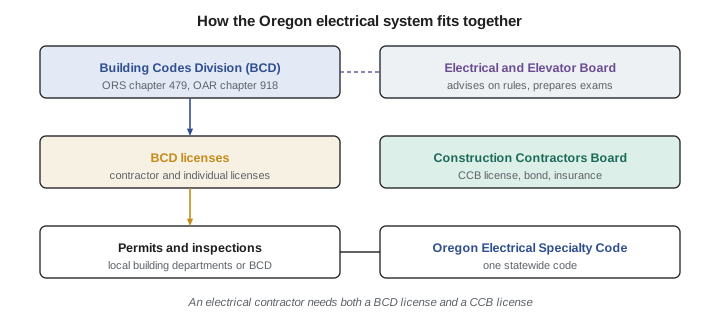
Oregon builds its electrical system around a single state agency. The Building Codes Division, shortened to BCD, is part of the Department of Consumer and Business Services. BCD adopts and administers the statewide building codes, including the Oregon Electrical Specialty Code, and it licenses the businesses and individuals who do electrical work. The same division runs the minor label program for small installations, keeps the public license lookup and handles complaints and enforcement against people who work without the required license.
BCD does not act alone. The Electrical and Elevator Board is the state board, made up of members from the trade, inspection and the public, that advises BCD on electrical rules, prepares the electrical licensing exams and takes part in enforcement. The board's role shows up in several places in this course: it helps decide which code amendments Oregon adopts, it approves the exam content that BCD administers and it reviews disciplinary matters. You do not need to memorize its membership, but you should know that the board writes the exam and that BCD gives it.
Two sources of law sit underneath the system. The statute is ORS chapter 479, the part of the Oregon Revised Statutes that covers electrical safety, installations, licensing and inspection. The detailed rules are in OAR chapter 918, the Oregon Administrative Rules adopted by BCD and its boards. Division 282 of that chapter covers electrical licensing, including the general supervising electrician license, and other divisions cover permits, inspections, continuing education and the adoption of the electrical code. Both the statute and the rules appear on the approved exam materials list, which tells you that the exam will ask about them.
Licenses for businesses and licenses for people
Oregon separates the business that sells electrical work from the people who do and supervise it. A business that offers or performs electrical installations for others needs an electrical contractor license from BCD. That license is issued to the business entity, and it carries a condition that sits at the center of this course: the business must employ a full-time general supervising electrician, or a supervising electrician of the right limited type, who supervises the work and signs the permits. Lesson 8 covers the contractor license, its fee and renewal.
The people hold individual licenses. A general journeyman electrician may do electrical work of any type, but not as a supervisor. A general supervising electrician may do everything a journeyman can and may also supervise electrical installations for or as an electrical contractor, plan and lay out installations for the employer's customers and sign the permits. Oregon also issues limited licenses for narrower scopes, such as limited residential, limited energy and limited maintenance work, each with its own supervising and journeyman levels. Apprentices work under a registered apprenticeship program while they gain the hours needed for a journeyman license.
| License | Who holds it | What it allows |
|---|---|---|
| Electrical contractor license | The business | Offering and performing electrical work for others, while employing a full-time supervising electrician |
| General supervising electrician | An individual | Doing electrical work, supervising installations for a contractor and signing permits |
| General journeyman electrician | An individual | Doing electrical work of any type, but not supervising as the contractor's supervising electrician |
| Limited licenses (residential, energy, maintenance and others) | An individual or a business | Work within the narrower scope written into the rule for that license |
| Apprentice registration | An individual | Doing electrical work under supervision while gaining experience |
Two agencies, two licenses for one contractor
Oregon's electrical contractors deal with two licensing agencies, and the exam expects you to know which one does what. BCD licenses the electrical business and its electricians. The Construction Contractors Board, the CCB, licenses construction contractors of every trade, electrical included, and it is the CCB that requires the bond, the liability insurance and the workers' compensation status that protect customers and workers. BCD's own rules say that the electrical license is in addition to the CCB license and bond, not a substitute for it. A company like Willamette Crest therefore holds an active CCB license with the right endorsements and an electrical contractor license from BCD, and it has to keep both current.
The two licenses support each other. BCD will not issue an electrical contractor license unless the business has an active CCB license, and the CCB's bond and insurance requirements apply to the electrical contractor just as they apply to a roofer or a general contractor. Lesson 8 walks through the CCB endorsements, bond amounts and insurance minimums. For now, remember the division of labor: BCD asks whether the people and the installations meet the electrical standard; the CCB asks whether the business is registered, bonded and insured.
Who does not need a license
The statute lists exemptions, and the exam tests the edges of them. In general, anyone who does electrical installations for another person needs a license, and the people doing the work need the right individual licenses. Property owners have a limited right to do electrical work on their own property, with conditions, permits and inspections, and with limits on work on property intended for sale, lease or rent. Some employers may have their own employees do maintenance on the employer's premises under specific licensing categories. Certain utility work, some low-voltage and communications work and some appliance work fall under their own rules. When a question asks whether a license is needed, read it for three facts: who is doing the work, whose property it is and what kind of system is involved.
Dale's favorite example is his neighbor, who built a pole barn on his own land outside Scio. As the owner, he could buy an owner's electrical permit from the county and wire the barn himself, and the inspector checked it like any other installation. When the neighbor later asked Willamette Crest to add a subpanel for a welder, the work had to be done under the company's contractor license and permit, by licensed electricians, because the crew was working for someone else.
Who issues permits and inspects
Licensing is statewide, but most permits and inspections are local. Many Oregon cities and counties run their own building departments, and many of those include an electrical program that sells electrical permits and employs state-certified electrical inspectors. Where a city or county does not run an electrical program, BCD provides the service. Either way, the inspector applies the same statewide Oregon Electrical Specialty Code, because local governments in Oregon cannot write their own electrical code. Lesson 6 covers this in detail, including how to find the right building department for a job address.
Wendy keeps a sheet that lists the building department for every active job. A clinic remodel inside Corvallis city limits goes to the city. A farm shop on a rural road is handled by the county building program or by BCD, depending on who provides electrical service there. The company's license and the supervising electrician's license are the same everywhere; only the permit counter changes.
# Which building department handles the electrical permit? (study aid; check the
# BCD Local Building Department Directory for the real answer for each address)
PROGRAMS = {                       # invented examples for practice only
    ("Corvallis", "city"): "City of Corvallis",
    ("Albany", "city"): "City of Albany",
    ("Lebanon", "city"): "City of Lebanon",
    ("Linn County", "rural"): "County building program",
    ("Salem", "city"): "City of Salem",
}
jobs = [
    ("Clinic tenant improvement", "Corvallis", "city"),
    ("Two duplexes", "Albany", "city"),
    ("Distribution warehouse", "Lebanon", "city"),
    ("Farm shop and well pump", "Linn County", "rural"),
    ("Restaurant remodel", "Salem", "city"),
    ("Cabin in a county with no local program", "Elsewhere", "rural"),
]
for name, place, kind in jobs:
    who = PROGRAMS.get((place, kind), "BCD (state provides the service)")
print(name.ljust(40), "->", who)Clinic tenant improvement -> City of Corvallis Two duplexes -> City of Albany Distribution warehouse -> City of Lebanon Farm shop and well pump -> County building program Restaurant remodel -> City of Salem Cabin in a county with no local program -> BCD (state provides the service)
The calculator mirrors the decision Wendy makes for every new job. If the address falls inside a jurisdiction that runs an electrical program, that jurisdiction sells the permit and inspects. If it does not, BCD does. The real check always uses the exact address, because city limits do not follow mailing addresses and a jurisdiction can change what services it provides. A job with an Albany mailing address can sit outside the city, in an area served by the county.
Worked problem
Sorting Willamette Crest's spring jobs
Wendy lists five new jobs: a clinic remodel inside Corvallis city limits, two duplexes in Albany, a warehouse in Lebanon, a farm shop in rural Linn County and a restaurant in Salem. Which licenses does the company need, and where does it get each permit?
Show solution
- The licenses do not change by job: an active CCB license with the right endorsements, a BCD electrical contractor license and a full-time general supervising electrician on the payroll.
- Each permit comes from the building department that provides electrical service at the job address, which Wendy confirms in BCD's directory.
- Inside a city that runs an electrical program, the city sells the permit; in rural areas, the county program or BCD does.
- Every inspector applies the same Oregon Electrical Specialty Code.
Answer: Same licenses for all five jobs; the permit for each comes from the jurisdiction that serves that address, and the code is the same everywhere.
Where the rules live
Oregon electrical contractors work under several layers of law, and the exam rewards knowing which layer answers which question. ORS chapter 479 sets the framework for electrical licensing, installations and inspections. OAR chapter 918 fills in the details, from the license categories and experience rules in division 282 to the adoption of the electrical code and the permit rules. The Oregon Electrical Specialty Code is the technical standard, based on the National Electrical Code with Oregon amendments. Other statutes govern the business: ORS chapter 701 for the CCB, ORS chapter 87 for construction liens, the Oregon Safe Employment Act in ORS chapter 654 for workplace safety and ORS chapter 656 for workers' compensation. When a question comes up on the job or on the exam, start by asking which of these layers it belongs to.
Common mistakes
MistakeAssuming the BCD electrical contractor license replaces the CCB license.
InsteadBCD's rules say the electrical license is in addition to CCB licensing and bonding; the contractor needs both.
MistakeThinking the contractor license belongs to the supervising electrician.
InsteadThe contractor license belongs to the business; the supervising electrician is an employee who can change.
MistakeExpecting each city to have its own electrical code.
InsteadOregon has one statewide electrical specialty code; local programs enforce it but do not rewrite it.
MistakeTreating a journeyman license as enough to supervise for a contractor.
InsteadOnly a supervising electrician of the right type may supervise as the contractor's supervisor and sign its permits.
Summary and key terms
- BCD, part of the Department of Consumer and Business Services, licenses electrical businesses and individuals and administers the Oregon Electrical Specialty Code.
- The Electrical and Elevator Board advises BCD, helps shape the rules and prepares the licensing exams.
- ORS chapter 479 and OAR chapter 918, especially division 282, govern electrical licensing.
- An electrical contractor needs a BCD electrical contractor license and an active CCB license, and must employ a full-time supervising electrician.
- Permits and inspections are handled by local building departments with electrical programs, or by BCD where none exists.
- BCD
- The Building Codes Division of the Oregon Department of Consumer and Business Services.
- Electrical and Elevator Board
- The state board that advises BCD on electrical rules and prepares the licensing exams.
- ORS chapter 479
- The Oregon statute on electrical safety, installations, licensing and inspection.
- OAR chapter 918
- The administrative rules adopted by BCD and its boards, including division 282 on electrical licensing.
- General supervising electrician
- The individual license that allows a person to supervise installations for an electrical contractor and sign permits.
Practice problems
Work each problem on paper first, then reveal the answer to check.
Which agency licenses electrical contractors and supervising electricians in Oregon?
Show answer
The Building Codes Division (BCD).
Name the statute and the rule chapter that govern electrical licensing in Oregon.
Show answer
ORS chapter 479 and OAR chapter 918, especially division 282.
Does a BCD electrical contractor license excuse a company from CCB licensing?
Show answer
No. The electrical license is in addition to the CCB license and bond.
A job sits in a county with no local electrical program. Who sells the permit?
Show answer
BCD provides the permit and inspection service there.
Lesson quiz · 5 questions
Score 60% or more to complete this lesson.
Create a free account to save your progress, take quizzes and earn a certificate.