
MELU-312 · Lesson 4 of 12 · 19 min
The exam format and the references allowed
▶ Video coming soon A video version of this lesson is on the way.
Two weeks after her letter of authorization arrived, Priya sat at the shop's break table with a stack of books and a printout of BCD's approved exam materials list. Dale had taken the supervising exam in 1998 and remembered it as long, open book and harder on the clock than on the code. "Nobody fails because they can't find an article," he said. "They fail because they spend ten minutes on one question and run out of time on the calculations." Priya's goal for the afternoon was to understand exactly what the exam looks like, what she may bring into the room and how to set up her books so that every minute counts.
This lesson covers the format of the Oregon general supervising electrician exam as the state describes it, the approved reference list and its limits on tabs, highlighting and notes, and a pacing plan for a four-hour open-book test. Lesson 12 returns to strategy with a full practice review.
The shape of the exam
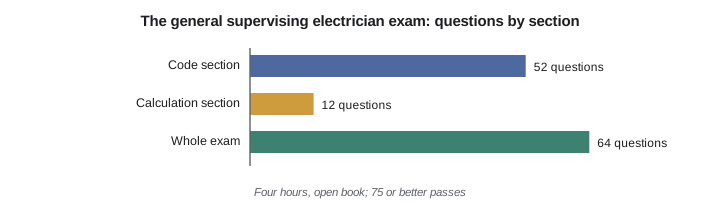
The state's license listing describes the general supervising electrician exam as a four-hour, open-book exam in two sections: 52 code questions and 12 calculation questions, for 64 questions in all. The Electrical and Elevator Board prepares the exam and BCD administers it. Questions are multiple choice. The code questions ask the candidate to find and apply requirements in the Oregon Electrical Specialty Code and the Oregon electrical statutes and rules; the calculation questions ask the candidate to work problems such as service and feeder loads, conductor sizing, voltage drop and motor circuits, using the code and a calculator.
The numbers tell you how the time divides. Sixty-four questions in 240 minutes is an average of about three and three-quarter minutes per question, but the questions are not equal. A code lookup that you can find through the index in a minute should take a minute. A dwelling service calculation may take ten. The pacing plan later in this lesson gives the calculation questions more time per question and asks you to bank time on the code questions to pay for it.
BCD's passing score on its licensing exams is 75 or better. On a 64-question exam that means at least 48 correct answers if the score is a simple share of the total. The exam information does not promise how the two sections are combined or weighted, so treat 75 as the target on each section and confirm the scoring method in the materials that come with your letter.
What you may bring
BCD's approved exam materials list for electrical license exams is specific. It allows the National Electrical Code as adopted in Oregon with the Oregon amendments and errata, and the NEC Handbook. It allows ORS chapter 479 and the electrical rules in OAR chapter 918. And it lists a set of commercial reference books that electricians have long used for exam preparation, such as electrical calculation references, pocket reference guides and published indexes to the NEC. Because the list names particular titles and editions, check that the books you own appear on it before you tab them.
The same list allows one silent, non-printing, non-programmable calculator. A phone, a tablet, a smartwatch or a calculator that stores text is not allowed. Scratch paper is provided at the site. Pencils are the candidate's to bring.
| Item | Allowed? | Conditions (summary) |
|---|---|---|
| NEC as adopted in Oregon, with Oregon amendments and errata | Yes | The edition on the current list |
| NEC Handbook | Yes | The edition on the current list |
| ORS chapter 479 and OAR chapter 918 | Yes | Printed copies |
| Listed commercial references and indexes | Yes | Only titles that appear on the current list |
| Tabs and highlighting | Yes | Commercial or self-made tabs and highlighting are allowed |
| Handwritten margin notes | Limited | Only cross-references and code amendment notes |
| Practice tests, class notes, worked calculations, added pages | No | Not allowed in the books or the room |
| Calculator | One | Silent, non-printing, non-programmable |
Tabs, highlighting and notes
The approved list allows tabs, either commercial tab sets or tabs the candidate makes, and it allows highlighting. It allows handwritten notes in the margins only for cross-references and for marking Oregon amendments. It does not allow practice test questions, class notes, worked calculations or pages added to the books. A proctor can inspect the books, and a book that breaks the rules can be refused, so the safest approach is to keep the books clean: tabs, highlighter and short cross-references such as see 250.66 or Oregon amendment.
Priya set up her code book in three layers. First, she placed a commercial tab set on the main articles, so that every chapter and the most used articles in chapters 2 and 3 had a tab. Second, she used one highlighter color for definitions in Article 100 and another for the requirements she looked up most often in practice tests. Third, she marked each Oregon amendment in the margin with a short note, so that she would not answer a question from the national text when Oregon has changed it. She did not write formulas or worked examples anywhere.
Using the index and the references
Open-book exams reward people who can find things quickly. The NEC's index is the first tool: learn its style, which lists topics under the noun with qualifiers beneath, and practice with it until a lookup takes less than a minute. The allowed commercial indexes and pocket guides can be faster for some lookups, especially for tables and calculation steps. The Handbook adds commentary and diagrams that explain the requirements, but reading commentary takes time on an exam, so use it when the code text alone is not enough.
For the calculation section, the references help most with method. A candidate who has worked dozens of dwelling, multifamily and commercial load calculations before the exam needs the code only for the factors and the tables. A candidate who is learning the method during the exam is in trouble. The master electrician core course on load calculations is the place to build that skill; this course assumes it.
# A pacing plan for a 4-hour, 64-question open-book exam (study aid)
total_min = 240
code_q, calc_q = 52, 12
reserve = 20                                   # minutes held back for review
code_min_each = 2.5
code_block = code_q * code_min_each
calc_block = total_min - reserve - code_block
print("Code section:", code_q, "questions at", code_min_each, "min =", code_block, "min")
print("Calc section:", calc_q, "questions in", calc_block, "min =", round(calc_block / calc_q, 1), "min each")
print("Review reserve:", reserve, "min")
for checkpoint in (13, 26, 39, 52):
    print("  by code question", str(checkpoint).rjust(2), "-> about", round(checkpoint * code_min_each), "min used")
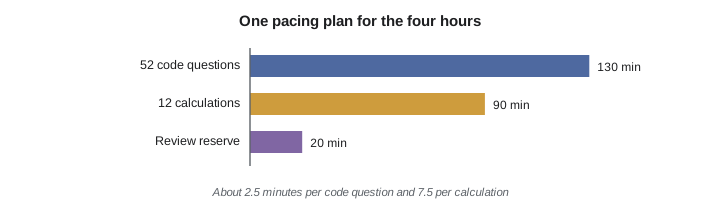
print("Pass target: at least", -(-64 * 75 // 100), "of 64 correct")Code section: 52 questions at 2.5 min = 130.0 min Calc section: 12 questions in 90.0 min = 7.5 min each Review reserve: 20 min by code question 13 -> about 32 min used by code question 26 -> about 65 min used by code question 39 -> about 98 min used by code question 52 -> about 130 min used Pass target: at least 48 of 64 correct
The plan gives each code question two and a half minutes and each calculation about eight minutes, with twenty minutes held back. The checkpoints make the plan usable in the room: if Priya reaches code question 26 after about an hour, she is on pace. If she is behind, she marks the hard questions, answers the quick ones and comes back. The last line converts the 75 passing score into a count, rounding up: 48 of 64.
Worked problem
Planning around a slow start
In her first full practice exam, Priya reached code question 20 after 70 minutes, because she read every Handbook commentary she found. How far behind her plan was she, and what should she change?
Show solution
- Her plan puts question 20 at about 50 minutes (20 questions at 2.5 minutes).
- She was about 20 minutes behind, the whole review reserve.
- She should answer from the code text when it is clear and use the Handbook only when the code alone does not settle the question.
- She should mark any question that takes more than four minutes and move on, returning in the reserve time.
Answer: About 20 minutes behind; she should read commentary only when needed and mark slow questions for later.
Reading the question before the code
Open-book exams tempt candidates to start flipping pages before they know what they are looking for. A better habit is to read the question twice: once for the facts and once for the ask. The facts tell you which part of the code applies: the occupancy, the voltage, the type of equipment, the location. The ask tells you what to find: a minimum, a maximum, a permitted method or an exception. Words such as not, except, minimum and maximum change the answer, and they are easy to miss when the clock is running.
Once you know the ask, decide where to look before you open the book. A definition question goes to Article 100. A question about a dwelling service load goes to the load calculation articles and the tables they refer to. A question about an Oregon rule goes to ORS chapter 479 or OAR chapter 918, not to the NEC at all. Making that decision first saves the minute that a random search through the index would cost.
Kinds of questions
Most questions on a licensing exam fall into a few types. Direct lookups ask for a single requirement that can be found in one place. Applied lookups describe a situation and ask which requirement applies, which takes reading the conditions of the rule as well as the rule itself. Calculations ask for a number, often in several steps. Law and rules questions ask about licensing, permits, duties and enforcement. Each type rewards a different skill, and practice exams should cover all of them.
| Question type | What it tests | How to practice |
|---|---|---|
| Direct lookup | Finding one requirement quickly | Timed index drills |
| Applied lookup | Reading conditions and exceptions | Practice questions with written reasons |
| Calculation | Method, factors and arithmetic | Worked problems with every step written |
| Law and rules | Licensing, permits, duties, enforcement | Reading ORS 479 and OAR 918 with a highlighter |
Practice under the same conditions as the exam whenever you can: the same books, the same tabs, the same calculator and a timer. A tab that is in a different place in the practice book than in the exam book costs time on exam day. So does a calculator with a different key layout. Priya bought the exact calculator model she planned to use in the exam and used nothing else for six weeks.
Finally, rehearse the day itself at least once. Priya's second full practice exam started at the same time of day as her real exam, in a quiet room at the public library, with her books in the bag she would carry and a sandwich left in the car for afterward. She found that her calculator's keys were stiff in the cold room, that she wanted a second pencil and that her tabs on the most used tables had started to tear. Each problem was small, and each was easier to fix in April than on exam morning.
Common mistakes
MistakeBringing a book that is not on the approved list.
InsteadOnly the titles and editions on BCD's current list are allowed.
MistakeWriting formulas or worked examples in the margins.
InsteadMargin notes are limited to cross-references and amendment notes.
MistakeTreating every question as worth the same time.
InsteadBank time on quick code lookups and spend it on the calculations.
MistakeBringing a phone as a calculator.
InsteadOnly one silent, non-printing, non-programmable calculator is allowed.
Summary and key terms
- The general supervising electrician exam is four hours, open book, with 52 code questions and 12 calculation questions.
- The Electrical and Elevator Board prepares the exam; BCD administers it; 75 or better passes.
- BCD's approved list allows the NEC with Oregon amendments, the NEC Handbook, ORS 479, OAR chapter 918 and listed commercial references.
- Tabs and highlighting are allowed; margin notes only for cross-references and amendments; no practice tests, notes, calculations or added pages.
- Plan the time: about two and a half minutes per code question and eight per calculation, with a review reserve.
- Open book
- An exam in which the candidate may use the approved references.
- Approved exam materials list
- BCD's list of the books, tabs, notes and calculator allowed in the exam room.
- Code section
- The 52 questions that require finding and applying code and law requirements.
- Calculation section
- The 12 questions that require working electrical calculations.
- Review reserve
- Time held back at the end to return to marked questions.
Practice problems
Work each problem on paper first, then reveal the answer to check.
How many questions are on the exam in total?
Show answer
64: 52 code and 12 calculation.
What kinds of margin notes are allowed?
Show answer
Cross-references and notes marking code amendments.
How many correct answers make 75 on a 64-question exam, rounding up?
Show answer
48.
Is the NEC Handbook allowed?
Show answer
Yes, on BCD's approved list.
Lesson quiz · 5 questions
Score 60% or more to complete this lesson.
Create a free account to save your progress, take quizzes and earn a certificate.