
MELU-312 · Lesson 10 of 12 · 20 min
Workplace safety law and OSHA for electrical contractors
▶ Video coming soon A video version of this lesson is on the way.
Four years ago, Marcus Oyelaran was working in a commercial panel in Lebanon that a customer's maintenance man had told him was dead. It was not. Marcus was wearing his gloves and face shield because Dale's policy required them for any panel work until the crew verified the absence of voltage, and he walked away with a burned sleeve and a story instead of a hospital stay. That afternoon Dale gathered the whole company in the shop, went through what had happened and changed one line in the company's written procedures: no one relies on anyone else's word that a circuit is dead. Every electrician tests it, every time.
Safety is part of the supervising electrician's job in the rule itself: OAR 918-282-0140 makes the supervisor responsible for seeing that electrical work is done safely. This lesson covers the law that governs workplace safety in Oregon, Oregon OSHA's injury reporting deadlines, the workers' compensation duties of an employer when a worker is hurt and the injury rate that customers and insurers use to judge a contractor's safety record.
Oregon OSHA and the state plan
Oregon runs its own occupational safety and health program under a state plan approved by federal OSHA. The law is the Oregon Safe Employment Act, in ORS chapter 654, and the agency is Oregon OSHA, a division of the Department of Consumer and Business Services, the same department that houses BCD. Oregon OSHA adopts rules that must be at least as effective as the federal standards, enforces them through inspections and penalties, and offers consultation and training. Its rules are in OAR chapter 437, with divisions for general industry, construction and other sectors, many of which adopt federal standards by reference and add Oregon requirements.
So the catalog's phrase OSHA for electrical contractors means two things in Oregon. Federal OSHA's standards shape most of the requirements, and Oregon OSHA is the agency that inspects private employers, enforces the rules and receives injury reports. An Oregon electrical contractor deals with Oregon OSHA, not with federal OSHA, for its work in the state, except in the limited areas the state plan does not cover.
The rules that matter most on electrical jobs
For electrical contractors, the rules on electrical safety, lockout and tagout of hazardous energy, fall protection, ladders and scaffolds, excavations and trenching, personal protective equipment and hazard communication come up every week. The construction division covers most of an electrical contractor's field work. Work in an existing facility can also fall under general industry rules. Industry consensus standards such as NFPA 70E, which describes safe work practices around energized equipment, are not themselves Oregon OSHA rules, but Oregon OSHA and the courts can look to them when deciding whether an employer protected its workers, and many customers require them by contract.
Every Oregon employer is also expected to have a safety program suited to its size and work. Oregon's rules require many employers to have a safety committee or hold safety meetings, with the details depending on the number of employees. The rules on committees and meetings have changed in recent years, so check the current requirements for your company's size. Willamette Crest holds a monthly safety committee meeting with members from the field and the office, and foremen hold a short toolbox talk at the start of each week on every job.
Reporting serious injuries
Oregon OSHA requires employers to report serious work-related events within short deadlines. Its reporting page lists them: a work-related death or a catastrophe, which Oregon defines as two or more employees killed or three or more admitted to a hospital or clinic from the same incident, must be reported within 8 hours. An in-patient hospitalization, the loss of an eye, or an amputation or avulsion that involves bone loss must be reported within 24 hours. The clock starts when the employer or its agent learns of the event. Reports can be made in person, by phone to Oregon OSHA's toll-free line or by calling the nearest field office.
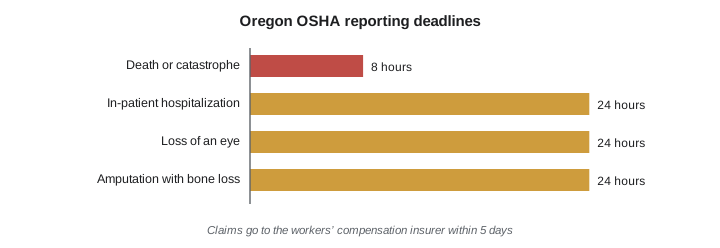
The report to Oregon OSHA is separate from the workers' compensation claim and from the employer's injury records. A serious event usually triggers all three: the phone report to Oregon OSHA within the deadline, the claim report to the workers' compensation insurer and an entry in the employer's injury and illness log if the employer is required to keep one.
Workers' compensation when a worker is hurt
Oregon's workers' compensation law, in ORS chapter 656, requires employers with workers to carry coverage and sets the steps when a worker is hurt. The Workers' Compensation Division's rule in OAR 436-060-0010 lists the employer's duties. The employer must accept notice of a claim from the worker. An employer that is not self-insured must report a claim to its insurer within five days after it has notice or knowledge of a possibly compensable injury; knowledge begins when a supervisor or manager has enough facts to see that a claim may follow. The employer must keep the Report of Job Injury or Illness, Form 801, available and provide it to the worker immediately on request or when the employer learns of an accident that may be compensable, and give the worker the state's guide for workers recently hurt on the job.
Minor injuries that need no medical treatment generally do not have to be reported to the insurer, unless the worker files a claim, is billed for treatment or the employer learns of medical services, disability or death. The employer still keeps records of those injuries. The worker chooses the medical provider; an employer that restricts that choice can face a civil penalty. Late reporting is penalized too: the division may penalize an employer that reports too many of its claims late in a quarter.
| Event | Report to | Deadline (summary) |
|---|---|---|
| Work-related death or catastrophe | Oregon OSHA | 8 hours |
| In-patient hospitalization, loss of an eye, amputation with bone loss | Oregon OSHA | 24 hours |
| Possibly compensable injury | Workers' compensation insurer | 5 days after notice or knowledge |
| Worker asks for the claim form | Worker | Provide Form 801 immediately |
| Injury with no medical treatment | Keep in the employer's records | Report if a claim or treatment follows |
Measuring the safety record
Customers, general contractors and insurers judge a contractor's safety record with a few standard measures. The most common is the total recordable incident rate: the number of recordable injuries and illnesses times 200,000, divided by the hours worked. The 200,000 stands for 100 full-time workers working 40 hours a week for 50 weeks, so the rate reads as cases per 100 full-time workers per year. Another is the experience modification factor that insurers use to adjust workers' compensation premiums based on the contractor's claims history compared with similar businesses.
# Total recordable incident rate (study aid)
def trir(cases, hours):
    return cases * 200000 / hours
years = {2024: (2, 38500), 2025: (1, 41200), 2026: (0, 43800)}   # (recordable cases, hours worked)
for yr, (cases, hrs) in years.items():
    print(yr, "cases", cases, "hours", f"{hrs:,}", "-> TRIR", round(trir(cases, hrs), 2))
three_year = trir(sum(c for c, h in years.values()), sum(h for c, h in years.values()))
print("Three-year TRIR:", round(three_year, 2))2024 cases 2 hours 38,500 -> TRIR 10.39 2025 cases 1 hours 41,200 -> TRIR 4.85 2026 cases 0 hours 43,800 -> TRIR 0.0 Three-year TRIR: 4.86
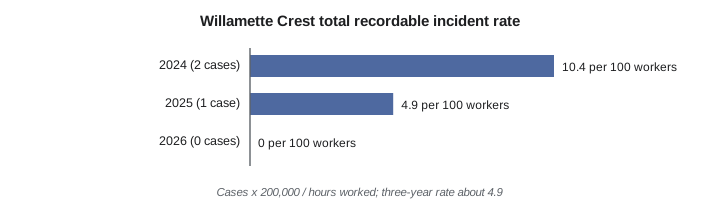
The aid computes Willamette Crest's rate for three years. Two recordable cases in 38,500 hours gives a rate of about 10.4, which is high for a single year but reflects how much one or two cases move the rate for a small company. A clean year brings it to zero, and the three-year figure smooths the swings. General contractors often ask for both the yearly rates and the three-year rate on prequalification forms.
Worked problem
A fall from a ladder
At 2:15 on a Thursday afternoon, apprentice Eli Brandt falls from a stepladder at the Albany duplexes and is taken to the hospital, where he is admitted overnight with a fractured wrist. What must Willamette Crest do, and by when?
Show solution
- An in-patient hospitalization must be reported to Oregon OSHA within 24 hours of the employer learning of it, so by Friday afternoon at the latest.
- The company provides Eli with Form 801 and the state's guide for injured workers, and reports the claim to its insurer within five days.
- Eli chooses his own medical provider; the company does not direct his care.
- Priya, as supervising electrician, reviews the ladder use with the crew and documents the corrective steps.
Answer: Report to Oregon OSHA within 24 hours, provide Form 801 and report the claim to the insurer within five days, and investigate the cause.
A written electrical safety program
Marcus's near miss is the reason Willamette Crest's written electrical safety program begins with one sentence: treat every conductor as energized until you have personally tested it. The program then sets out how the company does that. It describes who is a qualified person for each kind of work, the training each person receives and how it is documented. It requires lockout and tagout for work on equipment that can be de-energized, with the company's own locks and tags and a test for absence of voltage before work starts. It sets out when energized work is allowed, which is only when de-energizing would create a greater hazard or is not feasible, and requires a written permit and the right protective equipment when it is.
The program also covers the things that injure electricians more often than shock: ladders, falls from roofs and lifts, cuts, eye injuries and back strains. Each crew carries a first aid kit and at least one person trained in first aid and CPR. New hires get an orientation before their first day on a job, and apprentices are paired with journeymen who know the program well.
A written program is only as good as its use. Priya reviews it with each crew once a year, the safety committee reviews every incident and near miss and the program is updated when the rules or the work change. When a general contractor's safety manager asks for the company's program on a prequalification form, Wendy sends the current version and the training records that show it is in use.
Practice problems
Work each problem on paper first, then reveal the answer to check.
When is energized work allowed under the company's program?
Show answer
Only when de-energizing would create a greater hazard or is not feasible, with a written permit and proper protective equipment.
What should happen before work on equipment that can be de-energized?
Show answer
Lockout and tagout and a test for absence of voltage.
Safety also has a business side. Workers' compensation premiums depend in part on the company's claims history, and general contractors often screen subcontractors by their incident rates and experience modification factors before inviting them to bid. A company with a strong record wins work that a company with a poor one never sees. Dale explains it to new hires in one sentence: the cheapest injury is the one that never happens, and the second cheapest is the one reported on time.
Common mistakes
MistakeCalling federal OSHA to report an Oregon injury.
InsteadOregon runs a state plan; report to Oregon OSHA.
MistakeWaiting until Monday to report a Thursday hospitalization.
InsteadIn-patient hospitalizations are reported within 24 hours.
MistakeHolding the claim until the worker returns to work.
InsteadThe employer reports a possibly compensable claim to its insurer within five days.
MistakeChoosing the injured worker's doctor.
InsteadThe worker chooses the medical provider; restricting the choice can bring a penalty.
Summary and key terms
- Oregon runs an OSHA-approved state plan under the Oregon Safe Employment Act, ORS chapter 654; Oregon OSHA enforces it with rules in OAR chapter 437.
- Deaths and catastrophes are reported to Oregon OSHA within 8 hours; in-patient hospitalizations, loss of an eye and amputations with bone loss within 24 hours.
- Employers report possibly compensable claims to their insurer within 5 days and provide Form 801.
- The total recordable incident rate is cases times 200,000 divided by hours worked.
- The supervising electrician is responsible for seeing that electrical work is done safely.
- Oregon OSHA
- The Oregon Occupational Safety and Health Division of DCBS, which runs the state plan.
- State plan
- A state safety and health program approved by federal OSHA.
- Catastrophe
- Two or more employees killed, or three or more hospitalized, from one incident.
- Form 801
- The Report of Job Injury or Illness used to start a workers' compensation claim.
- TRIR
- Total recordable incident rate: recordable cases per 100 full-time workers per year.
Practice problems
Work each problem on paper first, then reveal the answer to check.
Within how many hours must a work-related death be reported to Oregon OSHA?
Show answer
8 hours.
Within how many days must an employer report a possibly compensable claim to its insurer?
Show answer
5 days.
What is the TRIR for 1 case in 50,000 hours?
Show answer
4.0.
Which statute is the Oregon Safe Employment Act?
Show answer
ORS chapter 654.
Lesson quiz · 5 questions
Score 60% or more to complete this lesson.
Create a free account to save your progress, take quizzes and earn a certificate.