
MELU-312 · Lesson 12 of 12 · 19 min
Practice exam review and test-day strategy
▶ Video coming soon A video version of this lesson is on the way.
Five weeks before her exam, Priya took her first full practice test at the kitchen table on a Saturday morning, with a timer, her tabbed code book and nothing else. She scored 68. She was annoyed for an hour and then did what Dale told her to do with every failed inspection: she sorted the misses by cause. Eleven were code lookups she found too slowly or not at all, four were Oregon rules questions she had never studied, three were calculation errors she could see as soon as she looked again and two were questions she had read wrong. Three weeks later, after a plan built on that list, she scored 82. On exam day she passed.
This lesson pulls the course together into a study plan for the Oregon general supervising electrician exam: how to build the plan, how to use practice exams to find weak areas, how to review misses and how to handle the four hours on test day. It assumes you have the code, the allowed references and the knowledge from the master electrician core courses.
Build the plan backward from the exam date
A study plan starts with the exam date and works backward. Priya's letter of authorization arrived on March 19, 2026, and she booked April 28, leaving about six weeks. She had started reviewing while the application was under BCD's review, so the six weeks were for focused practice rather than first learning. Her plan had four phases: setting up the books in the first week, topic review with short timed drills in weeks two to four, full practice exams and review in weeks four and five, and a light final week.
The time had to fit around full-time work. Priya planned eight to ten hours a week: an hour on four weeknights and a longer block on Saturday. She kept Sunday free, because a plan that leaves no rest tends to collapse in week three. Dale gave her two Friday afternoons off in the last month for full practice exams under exam conditions.
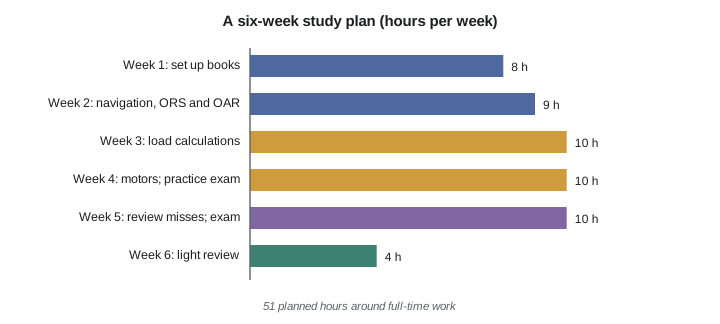
# A six-week study plan, hours by week and focus (study aid)
plan = [
    (1, "Set up books: tabs, highlights, Oregon amendment notes", 8),
    (2, "Code navigation drills; ORS 479 and OAR 918 review", 9),
    (3, "Load calculations: dwelling, multifamily, commercial", 10),
    (4, "Motors, conductors, voltage drop; first full practice exam", 10),
    (5, "Review misses by cause; second full practice exam", 10),
    (6, "Light review, logistics, rest", 4),
]
total = 0
for week, focus, hours in plan:
    total += hours
    print("Week", week, str(hours).rjust(2), "h ", focus)
print("Total planned hours:", total)Week 1 8 h Set up books: tabs, highlights, Oregon amendment notes Week 2 9 h Code navigation drills; ORS 479 and OAR 918 review Week 3 10 h Load calculations: dwelling, multifamily, commercial Week 4 10 h Motors, conductors, voltage drop; first full practice exam Week 5 10 h Review misses by cause; second full practice exam Week 6 4 h Light review, logistics, rest Total planned hours: 51
The plan totals 51 hours. That is not a magic number; a candidate who is weaker on calculations or newer to the Oregon rules may need more. The point of writing it down is to make the trade-offs visible. If week three's calculation review takes longer than planned, something in week four has to give, and the plan shows what.
Using practice exams
A practice exam has two jobs: to measure where you are and to show where to spend the next week. To do both, take it under exam conditions: the full time, the allowed books only, a silent non-programmable calculator and no breaks beyond what the real exam allows. Score it, and then spend at least as long reviewing it as you spent taking it. A practice exam that is scored and put away teaches very little.
Score by topic as well as in total. The Oregon exam has a code section and a calculation section, and within the code section, questions draw on the code itself and on the Oregon statutes and rules. A total of 70 can hide a calculation score of 50, which would fail the real calculation section if it is scored separately. Track each area against the 75 passing score, and spend the next week on the weakest one.
| Cause of a miss | What it looks like | The fix |
|---|---|---|
| Could not find it | Ran out of time or gave up on a lookup | Index drills; better tabs; learn the article layout |
| Did not know it | Oregon rule or amendment never studied | Read ORS 479, OAR 918 and the amendment table; mark the book |
| Calculation error | Right method, wrong number | Write every step on scratch paper; check units and rounding |
| Misread the question | Answered a different question | Underline the ask; watch for not, except and minimum |
| Guessed between two | Narrowed it down, picked wrong | Find the exact code text that separates the choices |
Reviewing misses by cause
Sorting misses by cause, as Priya did, turns a score into a plan. Questions you could not find call for navigation practice: timed index drills in which you look up twenty topics in twenty minutes, then check which ones took longest. Questions you did not know call for reading: the Oregon statutes and rules, the amendment table and the sections of the code you have never opened. Calculation errors call for slower, written work in practice so that the steps become automatic. Misreads call for a habit: read the last sentence of the question first, so you know what is being asked before you read the details.
Priya's eleven navigation misses shrank to three by her second practice exam, mostly because she changed two tabs and drilled the index every night for a week. Her four Oregon rules misses went to zero after she read OAR 918-282-0140 and the contractor license rules twice and marked the key duties in the margin with cross-references. Her calculation errors went from three to one when she started writing every step instead of keying long chains into the calculator.
# Scoring a practice exam by area against the 75 passing score (study aid)
PASS = 75
results = {          # area: (correct, asked)
    "Code: NEC lookups": (34, 42),
    "Code: Oregon statutes and rules": (6, 10),
    "Calculations": (8, 12),
}
total_c = sum(c for c, n in results.values()); total_n = sum(n for c, n in results.values())
for area, (c, n) in results.items():
    score = round(100 * c / n)
    print(area.ljust(34), str(score).rjust(3), "OK" if score >= PASS else "<- focus here")
print("Overall".ljust(34), str(round(100 * total_c / total_n)).rjust(3))Code: NEC lookups 81 OK Code: Oregon statutes and rules 60 <- focus here Calculations 67 <- focus here Overall 75
The overall score of 75 would pass on its own, but the area scores tell a different story: the Oregon rules questions and the calculations are both below the passing score. If those areas are weighted or scored separately on the real exam, or if the real exam happens to draw more questions from them, this candidate is at risk. The next week goes to the rules and the calculations, not to more NEC lookups.
The week before
The last week is for confidence and logistics, not for new material. Take a short timed drill or two, reread the list of Oregon amendments marked in the book and look over the notes on your most common mistakes. Check the logistics: the address of the testing site and how long it takes to get there, the parking, the start time and the items on BCD's list. Pack the night before: the letter of authorization, photo identification, pencils, the calculator with a fresh battery and every approved book, with no loose papers inside them.
Test day
Arrive early. Once the exam starts, follow the pacing plan from Lesson 4. Work the code section in passes: answer every question you can find quickly, mark the slow ones and come back. Do not spend more than about four minutes on any code question on the first pass. In the calculation section, read the whole question, note the code references you need, write the steps on scratch paper and check the answer against common sense: a dwelling service of 1,200 amperes or a voltage drop of half the supply voltage means a mistake somewhere.
Answer every question. There is no reason to leave a multiple-choice question blank, so if time is short, make the best choice you can on each marked question before the end. In the last minutes, check that every question has an answer and stop changing answers unless you have found a clear error; first answers that were based on a careful lookup are usually right.
Worked problem
Planning the last forty minutes
With forty minutes left, Priya has answered all 52 code questions, with six marked for review, and has finished nine of the twelve calculations. How should she use the time?
Show solution
- The three unfinished calculations are worth the same as any other question, and she knows how to do them, so they come first: about eight minutes each, twenty-four minutes in all.
- That leaves about sixteen minutes for the six marked code questions, a little over two and a half minutes each.
- If a calculation runs long, she makes her best estimate from the steps done, marks it and moves on.
- In the last two minutes she checks that all 64 questions have an answer.
Answer: Finish the three calculations first, then the six marked code questions, and make sure every question is answered.
After the exam
Results arrive by mail, normally within about two weeks. If you pass, BCD mails the license, and the steps in Lessons 7 and 11 begin: the notices that name you as a supervising electrician and the continuing education for your first cycle. If you do not pass, the 30-day wait after a failure gives time for a focused plan. Use the score report, if it shows areas, and your own memory of the questions that gave you trouble, and build the next plan around them. Many good supervising electricians passed on the second attempt.
Common traps in licensing exam questions
Some questions are hard because the topic is hard. Others are hard because of how they are written. A few patterns cause most of the trouble. A question may describe a situation that sounds like one rule but falls under an exception, so read the conditions of every rule you find. A question may ask for the minimum when the code states a maximum, or the reverse. A question may use a term defined in Article 100 in a way that differs from how electricians use it on the job, such as the difference between a grounded conductor and a grounding conductor. And a calculation may give more information than you need, to see whether you know which facts matter.
The Oregon rules questions have their own traps. A question about who may supervise may hinge on the difference between a general and a limited license. A question about notices may hinge on the difference between days after an event and days before it. A question about a contractor may hinge on whether BCD or the CCB is the agency that acts. When you mark such a question, write the key distinction on your scratch paper, such as BCD or CCB, before you look up the answer, so that you look in the right place.
| Trap | How to spot it |
|---|---|
| An exception changes the answer | Read the conditions and exceptions beside the rule |
| Minimum versus maximum | Underline the word in the question |
| Defined terms used precisely | Check Article 100 when a term matters |
| Extra information in a calculation | List the facts the method needs before you start |
| Wrong agency | Decide whether the question is about BCD, the CCB or another agency |
The best defense is practice with honest review. Each time a trap catches you on a practice exam, write it down. By the end of the study plan, the list becomes a short page of reminders to read the night before the exam.
Common mistakes
MistakeTaking practice exams without reviewing them.
InsteadSpend as long reviewing as taking, and sort misses by cause.
MistakeLooking only at the total score.
InsteadScore each area against 75; a passing total can hide a weak section.
MistakeLearning new material the night before.
InsteadUse the last week for light review, logistics and rest.
MistakeLeaving questions blank when time runs short.
InsteadAnswer every question; make the best choice on marked ones before time ends.
Summary and key terms
- Build the plan backward from the exam date, with phases for setup, topic review, practice exams and a light final week.
- Take practice exams under exam conditions and review them for at least as long as they took.
- Score by area and sort misses by cause: could not find, did not know, calculation error, misread, guessed between two.
- Pack the letter, photo ID, pencils, an approved calculator and the approved books; no practice tests or loose papers.
- On test day, work in passes, follow the pacing plan, check calculations for sense and answer every question.
- Study plan
- A schedule of topics and hours built backward from the exam date.
- Exam conditions
- Full time, approved books only, an approved calculator and no outside help.
- Miss analysis
- Sorting wrong answers by cause to decide what to study next.
- First pass
- Answering the quick questions first and marking slow ones for later.
- Sense check
- Comparing a calculated answer with what is reasonable for the installation.
Practice problems
Work each problem on paper first, then reveal the answer to check.
What should you do with a practice exam after scoring it?
Show answer
Review every miss and sort the misses by cause.
Why score by area as well as in total?
Show answer
A passing total can hide an area below 75.
Name four items to bring on test day.
Show answer
Any four of: letter of authorization, photo ID, pencils, approved calculator, approved books.
Should you leave a question blank if time runs short?
Show answer
No. Answer every question.
Lesson quiz · 5 questions
Score 60% or more to complete this lesson.
Create a free account to save your progress, take quizzes and earn a certificate.