
MELU-312 · Lesson 3 of 12 · 21 min
Applying, approval and booking the exam
▶ Video coming soon A video version of this lesson is on the way.
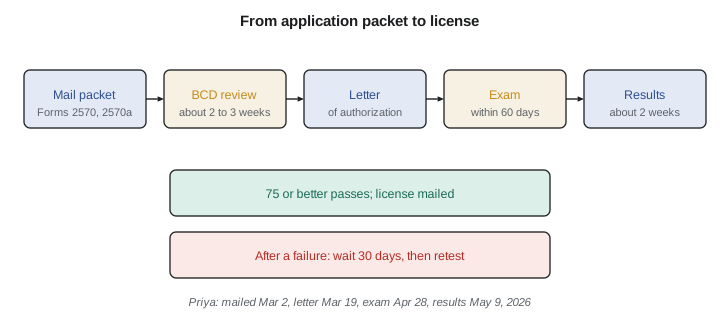
Once Wendy and Priya were satisfied that the hours were there, the work moved from counting to paperwork. Oregon's process for the general supervising electrician license runs in a fixed order: the candidate applies to BCD with a complete packet, BCD reviews it, BCD mails a letter of authorization, the candidate schedules and sits the exam within the window the letter allows, and BCD mails the result and, for a passing candidate, the license. Each step has its own rules, and a mistake at any step costs weeks.
Priya decided to aim for a spring exam date, with the busy summer season still ahead. She blocked out two evenings in February to complete the forms, asked Dale to sign the experience verification for her years at Willamette Crest and called the two contractors she had worked for during her apprenticeship to ask whether they still had her records. This lesson follows her packet from the kitchen table to the exam room.
Step one: the application packet
The packet starts with BCD's electrical license application, Form 2570. The application asks for the license type, personal and contact details, a work history and the candidate's preferred exam location, and it ends with an applicant affidavit that the candidate signs. BCD publishes a checklist, Form 2570i, that lists what must go with the application, and the checklist is worth following line by line. For experience, the candidate attaches the electrical experience verification form, Form 2570a, completed by each employer, showing hours in the categories of work the rules require.
The state's license listing names the other items: the fee, proof of a high school diploma, a GED or an equivalent, proof of apprenticeship completion if the candidate qualified that way, any other experience documents and a photo. The listing gives the license fee for the general supervising electrician as 100 dollars and a typical processing time of two to three weeks, and it warns that incomplete applications delay processing. BCD's application page asks for the whole packet to be mailed or faxed together and says not to email documents.
Priya's packet had seven pieces: the signed application, three experience verification forms (one from Willamette Crest and one from each apprenticeship employer, which were needed only to show her journeyman qualification history), a copy of her apprenticeship completion certificate, a copy of her high school diploma and a passport photo. Wendy made a copy of every page and wrote the date she mailed it, March 2, 2026, on the folder.
Step two: review and the letter of authorization
BCD's licensing staff review the packet against the rules. They check that the forms are complete and signed, that the experience totals meet the requirement and fall in the right categories, and that the education and identity documents are there. If something is missing, BCD contacts the candidate, and the clock stops until the missing piece arrives. If the packet is complete and the candidate qualifies, BCD approves the application and mails a letter of authorization.
The letter of authorization is the candidate's ticket to the exam. BCD's exam information document says the candidate must test within 60 days of the letter and must bring it to the exam, together with photo identification. The letter explains how to schedule, which sites are available and what to bring. Priya's letter was dated March 19, 2026, seventeen days after Wendy mailed the packet, which was inside the two-to-three-week range the state lists.
Step three: scheduling the exam
Oregon's electrical license exams are prepared by the Electrical and Elevator Board and administered by BCD through approved testing locations. The candidate schedules directly with the proctoring site named in the letter's instructions. BCD's licensing questions page notes that changing the exam location after scheduling can mean paying the fee again, so choose the site with care. Some states use a national testing vendor for every license exam; Oregon's process for electrical exams runs through BCD's own arrangements, so follow the letter rather than a coworker's memory of how another state did it.
A good scheduling choice balances three things: enough study time, the 60-day limit and the candidate's work calendar. Priya chose a Tuesday morning, April 28, 2026, at a site in Salem, forty days after her letter. That left her five full weeks of focused study after the approval, plus the weeks she had already spent while the packet was under review. She avoided Mondays, when she usually handles crew problems from the weekend, and she avoided the week the Lebanon warehouse was scheduled for final inspection.
# Checking the scheduling window (study aid)
from datetime import date, timedelta
mailed = date(2026, 3, 2)
letter = date(2026, 3, 19)
window_end = letter + timedelta(days=60)
exam = date(2026, 4, 28)
print("Review took", (letter - mailed).days, "days")
print("Letter dated  ", letter)
print("Must test by  ", window_end, "(60 days after the letter)")
print("Exam booked   ", exam, "->", "inside window" if exam <= window_end else "too late")
print("Study days between letter and exam:", (exam - letter).days)
print("Results expected by about", exam + timedelta(days=14))Review took 17 days Letter dated 2026-03-19 Must test by 2026-05-18 (60 days after the letter) Exam booked 2026-04-28 -> inside window Study days between letter and exam: 40 Results expected by about 2026-05-12
The arithmetic is simple, but it is the kind candidates get wrong under pressure. The 60 days run from the letter, not from the day the candidate opens it, so a letter that sits in a mailbox during a week-long job out of town still counts down. Write the deadline on the calendar the day the letter arrives, and book early, because popular sites and times fill up. If a candidate cannot test inside the window, the letter explains what to do; expect to contact BCD rather than simply showing up late.
Step four: exam day and results
BCD's exam information document lists what to bring: the letter of authorization, photo identification, pencils and a silent, non-programmable, non-printing calculator. Scratch paper is provided. The candidate also brings the approved reference materials, which Lesson 4 covers in detail. Arrive early; a candidate who is late may not be admitted, and the rules for rescheduling are set by the site and BCD.
BCD mails results no later than about two weeks after the exam. A passing score on all of BCD's licensing exams is 75 or better. If the candidate passes, BCD mails the license. If the candidate fails, the exam information document requires a 30-day wait before taking the exam again, and the candidate must follow BCD's process to schedule a retake, which normally means paying the exam fee again. Priya's result letter arrived on May 9, 2026, eleven days after the exam: she had passed. Her license arrived a week later.
| Step | Who acts | Key rule or timing |
|---|---|---|
| Application packet | Candidate | Form 2570, checklist 2570i, experience forms 2570a, fee, education proof, photo; mail or fax, no email |
| Review | BCD | Typical processing two to three weeks; incomplete packets delay |
| Letter of authorization | BCD | Explains scheduling; test within 60 days |
| Exam | Candidate | Bring the letter, photo ID, pencils, approved calculator and references |
| Results | BCD | Mailed about two weeks after the exam; 75 or better to pass; 30-day wait after a failure |
Worked problem
A packet that comes back
Marcus Oyelaran, another Willamette Crest journeyman, applied in 2025 and heard back from BCD three weeks later: his packet was incomplete. He had sent the application and one experience verification form, but his hours at a previous employer in Eugene were missing. What should he do, and how does it affect his timeline?
Show solution
- The review stops until BCD has every required document.
- Marcus contacts the Eugene employer, asks it to complete and sign Form 2570a for his hours there and sends it to BCD in the way BCD asks.
- When the packet is complete, BCD finishes its review and, if he qualifies, mails the letter of authorization.
- His 60-day exam window starts with the letter date, so the delay pushes his exam date back by the weeks it took to fix the packet.
Answer: He completes the missing verification and resubmits; the exam window starts only when the letter is issued.
After the license arrives
A new license is not the end of the process. The license only lets the holder act as a contractor's supervising electrician when the contractor's records with BCD show the supervisor, and BCD's rules require notices when a supervising electrician starts or ends employment with a contractor. Lesson 7 covers those notices. Priya's plan was to work alongside Dale for a season as a second supervising electrician at the company, learning the permit and inspection side, and then become the company's named supervisor when he retired. Wendy put a note in the folder to check BCD's current notice form before that change.
Keeping the application file
Wendy keeps a folder for every license application the company supports, and the folder for Priya's application became the model for the others. It holds a copy of every page that was mailed, the date and method of mailing, the fax confirmation if the packet was faxed, the letter of authorization, the exam booking confirmation, the result letter and a copy of the license. It also holds notes of every phone call with BCD: the date, the name of the person who answered and what they said. When a question came up months later about Priya's first renewal cycle, the answer was in the folder.
The folder also protects the candidate if something goes wrong. If a packet is lost in the mail, a complete copy can be sent again the same day. If BCD asks for a missing document, the copy shows what was sent. If the 60-day window is about to close because of an illness or a family emergency, the notes show when the letter arrived and who at BCD was contacted. Agencies handle thousands of applications, and a clear, dated record makes every conversation shorter.
When plans change
Plans change. A candidate may be sent to a job out of town for a month, may fall ill or may simply decide that more study time is needed. The letter of authorization explains what to do if the candidate cannot test within the window, and BCD's licensing staff can explain the options. What a candidate should not do is let the window close without a word, because that usually means starting over and paying again. If the exam site must be changed, remember BCD's note that a change of location can mean paying the fee again, and weigh that against the reason for the change.
Employers can help. Dale gave Priya first choice of local jobs for the six weeks before the exam, so that she would not be sent to an out-of-town project in the middle of her study plan, and he moved the Lebanon final inspection to a week after the exam. Small decisions like these cost the company little and remove the most common reasons candidates miss their windows.
Practice problems
Work each problem on paper first, then reveal the answer to check.
What should go into an application file?
Show answer
Copies of every page sent, mailing proof, the letter of authorization, the booking, the results, the license and notes of calls with BCD.
What should a candidate do if they cannot test within the window?
Show answer
Follow the letter's instructions and contact BCD before the window closes.
Common mistakes
MistakeEmailing a scan of the application to BCD.
InsteadBCD asks for the packet by mail or fax and says not to email documents.
MistakeCounting the 60-day window from the exam booking.
InsteadThe window runs from the letter of authorization.
MistakeChanging the exam site at the last minute.
InsteadBCD notes that changing the location can mean paying the fee again.
MistakeRetaking the exam the next week after a failure.
InsteadBCD requires a 30-day wait after a failed attempt.
Summary and key terms
- Apply with Form 2570, follow checklist 2570i and attach experience verification Form 2570a from each employer, plus fee, education proof, any apprenticeship proof and a photo.
- BCD lists a typical processing time of two to three weeks; incomplete packets cause delays.
- The letter of authorization explains scheduling; the candidate must test within 60 days and bring the letter and photo ID.
- A score of 75 or better passes; results are mailed within about two weeks.
- After a failure the candidate waits 30 days before retesting.
- Form 2570
- BCD's electrical license application.
- Form 2570a
- BCD's electrical experience verification form, one per employer.
- Letter of authorization
- BCD's approval letter that allows the candidate to schedule the exam.
- Proctor site
- An approved location that administers BCD's licensing exams.
- Retake wait
- The 30-day period a candidate must wait after failing before testing again.
Practice problems
Work each problem on paper first, then reveal the answer to check.
Within how many days of the letter of authorization must a candidate test?
Show answer
60 days.
What score is needed to pass an Oregon electrical licensing exam?
Show answer
75 or better.
What must a candidate bring to the exam besides references?
Show answer
The letter of authorization, photo identification, pencils and an approved calculator.
How long must a candidate wait after a failed attempt?
Show answer
30 days.
Lesson quiz · 5 questions
Score 60% or more to complete this lesson.
Create a free account to save your progress, take quizzes and earn a certificate.