
MELU-312 · Lesson 8 of 12 · 21 min
Contractor licensing, insurance and bonding
▶ Video coming soon A video version of this lesson is on the way.
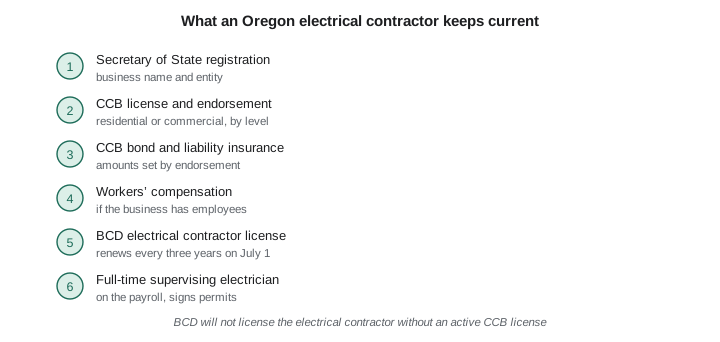
Every July Wendy blocks out a morning for what she calls license day. She checks that Willamette Crest's CCB license is active and its bonds and insurance are on file, that the BCD electrical contractor license shows the right supervising electrician and a future expiration date, that the business registration with the Secretary of State is current and that the workers' compensation policy has renewed. Most years nothing needs fixing. The year she found the insurance certificate had been sent to the CCB under an old company address, she fixed it in a day, and she has never skipped license day since.
This lesson covers the licenses and protections an Oregon electrical contractor must keep: business registration, the BCD electrical contractor license, the CCB license with its endorsements, the CCB surety bond and liability insurance, and workers' compensation. It ends with the renewal calendar Wendy uses.
Business registration first
An Oregon contractor starts as a registered business. The state's license listing for the electrical contractor license asks for the business name to be registered with the Oregon Secretary of State, and the CCB license is issued to the business entity under that name. A corporation or limited liability company registers as an entity; a sole proprietor using a name other than their own registers an assumed business name. The names on the Secretary of State record, the CCB license, the BCD license, the bond and the insurance certificate should match exactly. Mismatched names are one of the most common reasons a renewal stalls.
The BCD electrical contractor license
The electrical contractor license is BCD's license for a business that does electrical installations for others. The state's listing describes its conditions: the business name registered with the Secretary of State, an active CCB license and a full-time supervising electrician employed by the business who signs its permits. There is no exam for the contractor license itself, because the exam is taken by the individual supervisor, and the contractor license is exempt from continuing education. The listing gives the fee as 375 dollars, a renewal cycle of three years with July 1 as the renewal date and a typical processing time of one to three days once the application is complete.
Oregon also issues narrower contractor licenses, such as limited energy and limited residential electrical contractor licenses, each requiring a supervising electrician of the matching type. A business that holds a narrower license may only do work within that scope. Willamette Crest holds the general electrical contractor license because its work covers every type of installation.
The CCB license and its endorsements
Every construction contractor in Oregon, including every electrical contractor, needs an active CCB license. The CCB license carries one or more endorsements that describe the type of work and customer. Residential endorsements cover work on residential structures; commercial endorsements cover work on commercial structures. Within each, there are levels and types: a specialty contractor does one trade or a limited range of work, and a general contractor manages multiple trades. Commercial specialty contractors have two levels, with level 1 for larger and more established businesses and level 2 for smaller ones, each with its own bond and insurance amounts.
Getting a CCB license requires more than a form. The CCB requires a responsible person for the business to complete pre-license training and pass a test, unless an exemption applies, and it requires the bond, the insurance and a statement about workers' compensation status. The details of the training and test change from time to time, so check the CCB's current licensing steps before applying. Willamette Crest holds a residential specialty endorsement and a commercial specialty level 1 endorsement, because it does both kinds of work and has the size and history for level 1.
Bond amounts
The CCB surety bond protects customers and others who may file claims against the contractor for work not done right, or for unpaid wages, materials or equipment. It is not insurance for the contractor: if the surety pays a claim, the contractor must repay the surety. House Bill 2922 raised the bond amounts by 5,000 dollars, effective January 1, 2024. The CCB's endorsement chart now lists bonds of 20,000 dollars for a residential specialty contractor, 25,000 dollars for a residential general contractor, 55,000 dollars for a commercial specialty contractor level 1 and 25,000 dollars for level 2, and 80,000 dollars for a commercial general contractor level 1 and 25,000 dollars for level 2. A contractor that works on public projects over 100,000 dollars also needs a separate public works bond, which the CCB lists at 30,000 dollars.
| Endorsement | Bond (dollars) | Liability insurance (summary) |
|---|---|---|
| Residential specialty contractor | 20,000 | 300,000 per occurrence |
| Residential general contractor | 25,000 | See the CCB chart |
| Commercial specialty contractor level 1 | 55,000 | 1,000,000 aggregate |
| Commercial specialty contractor level 2 | 25,000 | 500,000 per occurrence |
| Commercial general contractor level 1 | 80,000 | See the CCB chart |
| Commercial general contractor level 2 | 25,000 | See the CCB chart |
| Public works bond (projects over 100,000) | 30,000 | Separate from the license bond |
Liability insurance
The CCB also requires commercial general liability insurance, with minimums that depend on the endorsement. The chart lists 300,000 dollars per occurrence for a residential specialty contractor, 500,000 dollars per occurrence for a commercial specialty contractor level 2 and 1,000,000 dollars in the aggregate for a commercial specialty contractor level 1, with other amounts for general contractors. A contractor with both residential and commercial endorsements needs two bonds, one for each, but can carry one insurance policy at the higher of the required amounts. The insurer files the certificate with the CCB, and the policy must stay in force for the license to stay active.
# Bond and insurance for a contractor with more than one endorsement (study aid; CCB chart as of 2024)
BOND = {"RSC": 20000, "RGC": 25000, "CSC1": 55000, "CSC2": 25000, "CGC1": 80000, "CGC2": 25000}
INSURANCE = {"RSC": 300000, "CSC2": 500000, "CSC1": 1000000}   # see the chart for the type of limit
def needs(endorsements, public_works=False):
    bonds = sum(BOND[e] for e in endorsements)          # one bond per endorsement
    if public_works:
        bonds += 30000                                  # separate public works bond
    policy = max(INSURANCE.get(e, 0) for e in endorsements)  # one policy at the higher amount
    return bonds, policy
for case in (["RSC"], ["CSC2"], ["RSC", "CSC1"]):
    b, p = needs(case)
    print("+".join(case).ljust(9), "bonds", f"{b:,}", "dollars; insurance at least", f"{p:,}", "dollars")
b, p = needs(["RSC", "CSC1"], public_works=True)
print("RSC+CSC1 with public works: bonds", f"{b:,}", "dollars")RSC bonds 20,000 dollars; insurance at least 300,000 dollars CSC2 bonds 25,000 dollars; insurance at least 500,000 dollars RSC+CSC1 bonds 75,000 dollars; insurance at least 1,000,000 dollars RSC+CSC1 with public works: bonds 105,000 dollars
For Willamette Crest, the arithmetic gives two bonds totaling 75,000 dollars and one liability policy at the commercial level 1 amount. The company also bids public school work in Linn County, so it carries the separate public works bond, bringing its bonds to 105,000 dollars. Wendy keeps the bond numbers and the insurance certificate dates on one sheet so that a lapse in either is caught before the CCB suspends the license.
Workers' compensation and employees
Oregon requires employers with workers to carry workers' compensation coverage, through the state-chartered insurer SAIF, a private insurer or approved self-insurance. The CCB asks every applicant to state whether the business has employees and, if it does, requires proof of workers' compensation coverage. A business without employees may hold a license as an exempt contractor, but it may not then hire workers without changing its status and getting coverage. Lesson 10 covers workers' compensation claims and the employer's reporting duties.
Employers also register with the Oregon Department of Revenue and the Employment Department for payroll taxes and unemployment insurance. These are separate from the licensing system, but the CCB and BCD may act on information that a contractor is employing workers without coverage, and an injured worker of an uninsured employer has remedies that can cost the employer far more than the premiums.
Worked problem
A start-up electrical contractor
Eli Brandt's former supervisor, Tess Monroe, holds a general supervising electrician license and wants to start her own company doing residential service changes, with one employee. What must she have before she can pull her first permit?
Show solution
- Register the business name with the Oregon Secretary of State.
- Get a CCB license with a residential specialty endorsement: complete the CCB's pre-license requirements, post the 20,000-dollar bond, file liability insurance of at least 300,000 dollars per occurrence and show workers' compensation coverage for her employee.
- Apply for the BCD electrical contractor license, naming herself as the full-time supervising electrician, and pay the fee the state lists as 375 dollars.
- Once both licenses are active, she can sign permits as the company's supervising electrician.
Answer: Business registration, a CCB residential specialty license with bond, insurance and workers' compensation, and a BCD electrical contractor license with herself as supervisor.
The renewal calendar
Each license renews on its own schedule. The state's listing gives three years with July 1 as the renewal date for the BCD electrical contractor license, and three years with October 1 for the general supervising electrician license. The CCB license renews on its own cycle, with the bond and insurance kept continuously in force. The Secretary of State business registration renews on its own schedule, which depends on the type of entity. Wendy's license day each July covers all of them, and she sets reminders ninety days ahead of each renewal date.
When a customer files a complaint
The CCB does more than issue licenses. It handles disputes between contractors and the people they work for, and claims against the contractor's bond. A homeowner who believes the work was defective or not completed, a subcontractor who was not paid or a supplier with an unpaid invoice may be able to file a claim with the CCB, which then works through its dispute process and, where a claim is upheld, the bond. Because the surety will expect to be repaid, a bond claim is a debt for the contractor, and unpaid claims can lead to license suspension.
Most disputes are cheaper to settle early than to fight through the CCB process. Willamette Crest's practice is to answer every complaint within a day, visit the job within a week and fix anything that is clearly the company's fault without argument. Disputes that remain go to Dale, and now to Priya, who decide with the company's lawyer whether to settle or contest. Good contracts, change orders signed before extra work is done and photos of finished work make those decisions easier.
Checking the people you hire
The same lookups that the public uses to check a contractor are useful to the contractor. Before hiring a subcontractor for trenching, fire alarm or low-voltage work, Wendy checks its CCB license, bond and insurance status and, for electrical work, its BCD license. Before hiring an electrician, she checks the individual license in BCD's lookup. A subcontractor whose CCB license is suspended, or a new hire whose journeyman license has expired, can cause trouble for the company that hired them, and the lookup takes only a minute.
Insurance certificates deserve a second look. A certificate shows the policy limits and dates on the day it was issued; a policy can be canceled the following week. For long jobs, Wendy asks subcontractors to name Willamette Crest as a certificate holder so that the insurer notifies the company of a cancellation, and she rechecks the CCB record before the final payment.
Practice problems
Work each problem on paper first, then reveal the answer to check.
Why is a bond claim a debt for the contractor?
Show answer
The surety pays the claim and then expects the contractor to repay it.
What should a contractor check before hiring an electrical subcontractor?
Show answer
Its CCB license, bond and insurance status and its BCD electrical license.
Common mistakes
MistakeTreating the CCB bond as insurance for the contractor.
InsteadThe bond protects claimants; the contractor must repay the surety for any claim it pays.
MistakeBuying one bond for residential and commercial endorsements.
InsteadA contractor with both needs two bonds, though one insurance policy at the higher amount is enough.
MistakeUsing the bond amounts from before 2024.
InsteadHB 2922 raised the amounts by 5,000 dollars effective January 1, 2024.
MistakeHiring a first employee while licensed as exempt.
InsteadThe contractor must change its status and get workers' compensation coverage first.
Summary and key terms
- An electrical contractor needs Secretary of State business registration, an active CCB license and a BCD electrical contractor license.
- The BCD contractor license requires a full-time supervising electrician; the state lists a 375-dollar fee and a three-year renewal on July 1.
- CCB bonds after January 1, 2024: 20,000 for residential specialty, 55,000 and 25,000 for commercial specialty levels 1 and 2, among others.
- CCB liability insurance minimums depend on the endorsement; one policy at the higher amount covers a contractor with two endorsements.
- Employers with workers must carry workers' compensation; contractors without employees may be licensed as exempt.
- CCB
- The Oregon Construction Contractors Board, which licenses construction contractors.
- Endorsement
- The part of a CCB license that states the type of work and customer, such as residential or commercial specialty.
- Surety bond
- A bond that pays valid claims against the contractor, which the contractor must repay to the surety.
- Public works bond
- A separate bond required for public projects over 100,000 dollars.
- Exempt contractor
- A CCB licensee without employees, not required to carry workers' compensation.
Practice problems
Work each problem on paper first, then reveal the answer to check.
What bond does a residential specialty contractor need after January 1, 2024?
Show answer
20,000 dollars.
How often does the BCD electrical contractor license renew, and on what date?
Show answer
Every three years, on July 1.
Does a contractor with residential and commercial endorsements need one bond or two?
Show answer
Two bonds; one insurance policy at the higher amount can cover both.
Which BCD license requires no exam?
Show answer
The electrical contractor license; the supervisor takes the exam.
Lesson quiz · 5 questions
Score 60% or more to complete this lesson.
Create a free account to save your progress, take quizzes and earn a certificate.