
MELU-312 · Lesson 6 of 12 · 21 min
Permits, inspections and the inspection authority
▶ Video coming soon A video version of this lesson is on the way.
Every Monday morning Wendy prints a list of Willamette Crest's open permits. In a typical week it shows a dozen: a clinic remodel in Corvallis waiting for a cover inspection, two duplexes in Albany ready for rough-in, a warehouse in Lebanon near final, a farm shop in rural Linn County, a restaurant in Salem and a handful of small jobs done under minor labels. Each permit has a number, a building department, a list of inspections still to come and, at the bottom, the name of the supervising electrician who signed it. For most of the company's life that name has been Dale's. Soon it will be Priya's.
This lesson covers who issues electrical permits and performs inspections in Oregon, how the permit and inspection cycle works, what happens when an inspector writes a correction, and two state programs that change the routine for small jobs and large facilities: the minor label program and the master permit program.
Who has the inspection authority
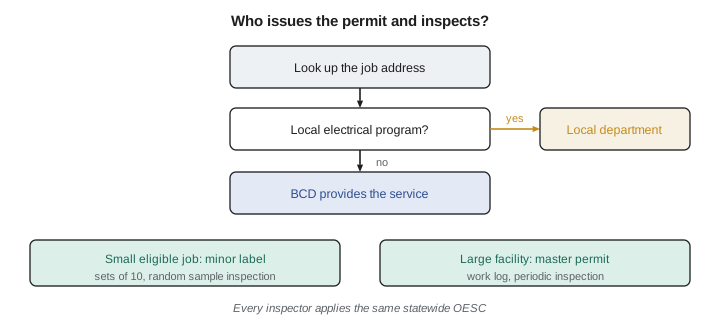
Oregon's electrical code is statewide, but the inspection authority is usually local. Many cities and counties operate building departments that include an electrical program: they sell electrical permits, review plans where required and employ electrical inspectors certified by the state. Where a local government does not run an electrical program, BCD provides the permit and inspection service itself. BCD also runs building department services for a small number of counties and offers online permitting through its ePermitting system, which many jurisdictions use. The practical rule is simple: the building department responsible for the job's address issues the permit and inspects.
Finding that department takes a lookup, not a guess. City limits do not follow mailing addresses, and some cities contract with a county or with BCD for electrical service. BCD's Local Building Department Directory lists the responsible jurisdiction for each area, and a call to the department confirms it. Wendy checks every new job address in the directory and notes the department and its inspection request method in the job file.
The permit
Before work starts, the contractor obtains an electrical permit from the inspection authority. The permit identifies the job address, the scope of work and the contractor, and it is signed by the supervising electrician who will supervise the work. OAR 918-282-0140 lists signing all permits among the general supervising electrician's duties, along with making sure that the required labels or permits are obtained. A permit pulled under the wrong license, or signed by someone who is not the contractor's supervising electrician, is a problem for the contractor and for the person who signed it.
Permits are priced by the jurisdiction, usually by the type of installation and its size, such as the service ampacity, the number of branch circuits or the square footage of a dwelling. Larger commercial jobs may need plan review before the permit is issued. Fees, plan review thresholds and permit forms vary from one department to the next, so check the local fee schedule for each job.
The inspection cycle
Inspections follow the work. A typical new building has a cover or rough-in inspection before walls and ceilings are closed, a service inspection before the utility connects permanent power and a final inspection when the installation is complete. Some jobs need more: an underground or slab inspection before concrete is poured, a separate inspection for a temporary service or for a feeder to another building, or special inspections for fire alarm or other systems. The contractor requests each inspection by the department's method, usually online or by phone, and must leave the work accessible until it is approved.
When the inspector finds a violation, the inspector issues a correction notice describing what must be fixed. OAR 918-282-0140 makes compliance with corrective notices a duty of the general supervising electrician. The crew fixes the work, the contractor requests a reinspection and the inspector checks it. A correction that is ignored can lead to a stop-work order, a refusal to approve the service connection or enforcement action. A pattern of corrections on a contractor's jobs draws attention to the supervising electrician who signed the permits.
| Inspection | When | What it checks (typical) |
|---|---|---|
| Underground or slab | Before trenches are backfilled or concrete is poured | Raceways, conductors, burial depth and grounding electrodes |
| Cover or rough-in | Before insulation and wall coverings | Boxes, wiring methods, support, grounding and bonding |
| Service | Before the utility connects permanent power | Service equipment, grounding electrode system, clearances and labeling |
| Final | When the installation is complete | Devices, equipment, panel directories, labeling and overall compliance |
The minor label program
Small jobs do not always need a full permit. BCD's minor label program lets licensed contractors buy labels for minor installations and repairs, such as replacing a limited number of devices or adding a small circuit, within a scope that BCD publishes. BCD's program page says only licensed contractors may buy labels, which means the business needs both a BCD contractor license and a CCB license. Labels are sold in sets of ten, and the page gives the price as 140 dollars per set, including one inspection fee. One label is used per project per job site; if the work grows beyond the label's scope, the contractor needs a full permit from the local building department.
Inspections under the program are by random sample. After the ten labels in a set are reported online, one installation is chosen at random for inspection, and the local building department for that job site is notified to inspect it. If the inspection fails, the contractor has ten calendar days to dispute it, pays the inspection fee to the jurisdiction at its hourly rate and has another label from the same set selected for inspection at an added fee, which the page gives as 75 dollars. If three inspections from the same set fail, every remaining label in that set requires a full permit. The program saves time on small jobs, but it puts the quality burden squarely on the contractor and its supervising electrician.
# Minor label sets: cost per label and the effect of failed sample inspections (study aid)
SET_PRICE, LABELS, RESAMPLE_FEE = 140, 10, 75      # from BCD's program page; check current fees
def set_cost(failed_samples):
    extra = failed_samples * RESAMPLE_FEE
    return SET_PRICE + extra
for fails in (0, 1, 2, 3):
    cost = set_cost(fails)
    status = "remaining labels need full permits" if fails >= 3 else "labels still usable"
    print(fails, "failed samples ->", cost, "dollars for the set,",
round(cost / LABELS, 2), "dollars per label;", status)0 failed samples -> 140 dollars for the set, 14.0 dollars per label; labels still usable 1 failed samples -> 215 dollars for the set, 21.5 dollars per label; labels still usable 2 failed samples -> 290 dollars for the set, 29.0 dollars per label; labels still usable 3 failed samples -> 365 dollars for the set, 36.5 dollars per label; remaining labels need full permits
The aid shows why quality matters even on small jobs. A clean set costs fourteen dollars per label. Each failed sample adds a resampling fee, and the jurisdiction's hourly inspection charges come on top. After three failures, the remaining labels stop being useful, and every job in the set needs a full permit. Dale tells new foremen that the label program is a privilege that the company can lose one sloppy outlet at a time.
The master permit program
Large facilities with ongoing electrical work, such as hospitals, manufacturing plants and campuses, can use a master permit program in many jurisdictions. Instead of buying a separate permit for each small change, the facility or its contractor holds a master permit, keeps a log of the work and has an inspector visit on a regular schedule to review it. BCD publishes guidance on the program, and local departments set the details. A supervising electrician who works on such a facility should learn the program's logging and inspection rules before the first job, because the log replaces the permit trail that ordinary jobs leave.
Worked problem
Choosing the permit path
Willamette Crest gets three calls in one week: a homeowner in Albany who wants two worn receptacles replaced and one added in a bedroom, a Lebanon food plant that wants ongoing changes to its production lines and a Corvallis clinic that wants a new 400-ampere service. Which permit path fits each?
Show solution
- The homeowner's job is small; Priya checks BCD's published label scope and, if it fits, uses one minor label for the project.
- The food plant may be eligible for a master permit with the local building department, which would cover ongoing changes with periodic inspections.
- The clinic's new service needs a full permit, probably with plan review, from the department that serves the clinic's address.
- In every case, the supervising electrician signs the permit or reports the label and makes sure the work passes inspection.
Answer: A minor label for the small residential job if it fits the scope, a master permit for the plant if the jurisdiction offers one, and a full permit for the clinic service.
Working well with inspectors
Inspectors are busy, and the contractors who get the smoothest inspections are the ones who make the inspector's job easy. Request inspections only when the work is ready, not when it will probably be ready by the time the inspector arrives. Leave the permit card or permit number posted where the inspector can find it. Make sure someone who knows the job is on site or reachable by phone. Have the plans, the panel schedules and any engineering documents on hand for commercial work. And when an inspector points out a problem, listen first and argue later, if at all.
A failed inspection costs more than the reinspection fee. It costs the crew's time to return, the schedule delay for the trades waiting to close walls and the general contractor's patience. Willamette Crest tracks its first-time pass rate on every job, and foremen whose jobs pass on the first visit get recognized at the monthly meeting. The rate also tells Priya, as supervising electrician, where to look: a foreman whose jobs keep failing cover inspections needs coaching before the pattern reaches the company's record with the building department.
Temporary power and service connections
Two inspections affect other trades more than any others: temporary power and the permanent service. Temporary power lets the whole site start work, so it is usually the first electrical inspection on a new building. The permanent service inspection decides when the utility will connect the building, and on many projects the owner's move-in date depends on it. Both need coordination with the utility, which has its own requirements for metering, clearances and the point of connection. The supervising electrician should know each utility's requirements for the areas the company works in and should involve the utility early on larger services.
Willamette Crest works in the service areas of more than one utility, and each publishes its own service requirements. Wendy keeps the current versions in the job files, and Ray checks them before pricing any new service. A meter base in the wrong place or a service mast that does not meet the utility's height requirement can fail inspection even when it meets the code, because the utility will not connect it.
Practice problems
Work each problem on paper first, then reveal the answer to check.
Name three ways to make an inspection go smoothly.
Show answer
Any three of: request only when ready, post the permit, have a knowledgeable person available, keep plans on hand, listen to the inspector.
Why do utility requirements matter at the service inspection?
Show answer
The utility has its own metering and connection requirements and may not connect a service that does not meet them.
Common mistakes
MistakeBuying permits from the city named in the mailing address.
InsteadUse the jurisdiction responsible for the job address, from BCD's directory.
MistakeUsing one minor label for several projects at once.
InsteadThe rules allow one label per project per job site.
MistakeTreating a correction notice as optional.
InsteadComplying with corrective notices is a duty of the supervising electrician.
MistakeCovering work before the rough-in inspection is approved.
InsteadWork must stay accessible until it is inspected and approved.
Summary and key terms
- The inspection authority is the building department responsible for the job address, or BCD where no local electrical program exists.
- The general supervising electrician signs permits, makes sure labels or permits are obtained and complies with corrective notices.
- Typical inspections are underground, cover, service and final, requested by the contractor.
- Minor labels are sold to licensed contractors in sets of ten, one label per project, with random sample inspections.
- Master permit programs let large facilities log ongoing work and have it inspected periodically.
- Inspection authority
- The building department or BCD office that issues the permit and inspects the work.
- Correction notice
- An inspector's written list of violations to fix before approval.
- Minor label
- A BCD label used in place of a permit for minor work within a published scope.
- Random sample inspection
- The inspection of one installation chosen at random from a reported set of labels.
- Master permit
- A permit for ongoing work at a facility, inspected periodically from a work log.
Practice problems
Work each problem on paper first, then reveal the answer to check.
Who issues the permit when the job address has no local electrical program?
Show answer
BCD provides the service.
How many labels are in a minor label set, according to BCD's program page?
Show answer
Ten.
How many failed sample inspections in a set mean the remaining labels need full permits?
Show answer
Three.
Who must sign the electrical permit for a contractor's job?
Show answer
The contractor's supervising electrician.
Lesson quiz · 5 questions
Score 60% or more to complete this lesson.
Create a free account to save your progress, take quizzes and earn a certificate.