
MELU-312 · Lesson 11 of 12 · 20 min
Renewal and continuing education
▶ Video coming soon A video version of this lesson is on the way.
Dale keeps a framed copy of his first supervising license on the office wall, but the license that matters is the one in BCD's online records, and that one has an expiration date. Over twenty-eight years he has renewed it nine times. Twice he came close to missing the deadline: once when a renewal notice went to an old address, and once when he discovered in September that a code class he had taken had never been reported to BCD. Both times he fixed the problem before October 1. Both times, he told Priya, he would have been working without a license on October 2 if he had not.
This lesson covers the renewal of the general supervising electrician license, the continuing education it requires, how hours are reported and tracked, and what happens when a license lapses. It also covers the contractor license renewal, which runs on a different date and has no continuing education requirement.
The renewal cycle
The state's license listing describes the general supervising electrician license as renewing every three years, with October 1 as the renewal date. BCD mails a renewal notice several weeks before expiration; the listing says about six weeks, and BCD's licensing questions page describes notices sent ahead of the date and online renewal before it. The renewal form explains the fee and the continuing education the licensee must have completed. Because the renewal date is fixed, a license issued partway through a cycle may have a first term shorter than three years; check the expiration date printed on the license and in BCD's records.
Priya's license was issued in May 2026. Her record showed an expiration date of October 1, 2028, so her first cycle was about two years and four months. She asked BCD's licensing staff whether the full continuing education requirement applied to the shortened first cycle and noted the answer in her file. Candidates in the same position should ask too, because the answer depends on the current rule and BCD's practice.
How many hours, and which kinds
OAR 918-030-0120 sets the continuing education for a general supervising electrician at 24 hours in each three-year cycle. At least 12 of those hours must be code change education, which covers the changes in the newly adopted electrical code. In addition to the code change hours, the licensee must complete a four-hour Oregon rules and laws course that meets the content standards in OAR 918-035-0055, when the rule requires it for the cycle. The remaining hours can come from other approved electrical courses, such as code topics, electrical theory and safety, within the categories the rule allows.
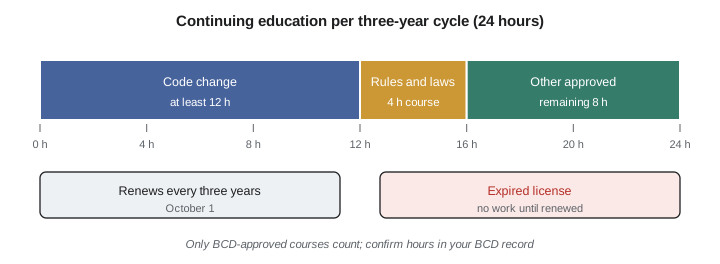
The split matters because a licensee can have 24 hours and still fail the requirement. Thirty hours of motor control classes with no code change course does not meet the rule. Neither does 24 hours that include a code change course but no Oregon rules and laws course when the rule requires one. Plan the cycle by category, not by total.
| Category | Hours (summary) | Notes |
|---|---|---|
| Code change | At least 12 | On the newly adopted code |
| Oregon rules and laws course | 4 | In addition to the code change hours; content set by OAR 918-035-0055 |
| Other approved electrical courses | Remaining hours | Within the categories the rule allows |
| Total per three-year cycle | 24 | For the general supervising electrician license |
Taking and reporting courses
Courses must be approved by BCD for electrical continuing education, and BCD's continuing education pages list approved courses and providers. A licensee can take courses at any time during the cycle; there is no rule that all hours must be taken in the last year. Approved providers report the hours to BCD for their students, which is why Dale's unreported class caused trouble: the provider had failed to report it, and he needed the certificate of completion to get it fixed. Some kinds of training, such as first aid and CPR or OSHA 10-hour and 30-hour courses, are self-reported by the licensee in the way BCD describes, and whether and how much they count depends on the current rule.
A sensible tracking system has three parts. Keep every certificate of completion, scanned or in a folder. Check BCD's online record after each course to confirm that the hours were posted. And keep a running tally by category, so that the code change hours and the rules and laws course are never left to the last month.
# Tracking CE hours by category against the requirement (study aid; check OAR 918-030-0120)
REQUIRED_TOTAL, CODE_CHANGE, RULES_LAWS = 24, 12, 4
courses = [  # (date, title, hours, category, posted_by_provider)
    ("2026-07-14", "2026 OESC code changes, part 1", 6, "code change", True),
    ("2026-11-03", "2026 OESC code changes, part 2", 6, "code change", True),
    ("2027-02-09", "Oregon electrical rules and laws", 4, "rules and laws", False),
    ("2027-06-21", "Grounding and bonding review", 4, "other", True),
    ("2028-01-17", "Motor control circuits", 4, "other", True),
]
by = {}
for d, title, h, cat, posted in courses:
    by[cat] = by.get(cat, 0) + h
total = sum(by.values())
print("Hours by category:", by)
print("Total", total, "of", REQUIRED_TOTAL, "->", "met" if total >= REQUIRED_TOTAL else "short")
print("Code change", by.get("code change", 0), "of", CODE_CHANGE)
print("Rules and laws", by.get("rules and laws", 0), "of", RULES_LAWS)
for d, title, h, cat, posted in courses:
    if not posted:
print("Check BCD record: not yet posted ->", d, title)Hours by category: {'code change': 12, 'rules and laws': 4, 'other': 8}
Total 24 of 24 -> met
Code change 12 of 12
Rules and laws 4 of 4
Check BCD record: not yet posted -> 2027-02-09 Oregon electrical rules and lawsPriya's plan meets the requirement on paper, with 12 code change hours, the four-hour rules and laws course and 8 other hours. The last line is the one Dale cares about: the rules and laws course has not been posted to her BCD record yet. She calls the provider with her certificate of completion the week the course ends, not the week the license expires.
When a license lapses
If the license is not renewed by the expiration date, it is no longer active. BCD's continuing education page explains that a license that has not been renewed enters an expired status during which it may still be renewed for a period, often with a late fee, but the holder may not do work under it until it is renewed. For a supervising electrician, that is not only a personal problem. Under Lesson 7's rules, the contractor that employs the supervisor may not do work requiring a supervising electrician while it has no licensed supervisor. A lapsed supervising license can stop a whole company.
If a license stays expired past the renewal period, the holder may have to apply again and, depending on the rules, retest. The details and the length of the renewal period are set by BCD's rules, so check them for any lapse. The practical advice is simpler: renew early. BCD allows renewal before the expiration date, and there is no benefit to waiting.
The contractor license renewal
The electrical contractor license renews on a different schedule. The state's license listing gives a three-year cycle with July 1 as the renewal date. The contractor license has no continuing education requirement of its own, but it can only be renewed if its conditions are met: an active CCB license and a supervising electrician employed full time. That is why Wendy's license day falls in July: it lines up with the contractor license renewal and catches any problem with the CCB bond, the insurance or the supervisor's license in time to fix it before October.
Worked problem
A September surprise
On September 10, 2028, Priya checks her BCD record and finds 20 hours posted: 12 code change hours, 4 other hours and the 4-hour rules and laws course, which the provider posted late. Her license expires October 1, 2028. What should she do?
Show solution
- She needs 24 hours, so she is 4 hours short in total; her code change and rules and laws hours are complete.
- She signs up for a four-hour approved electrical course before the end of September and checks that the provider reports it.
- She checks her record again a few days after the course to confirm the hours posted.
- She renews online as soon as the record shows 24 hours, well before October 1.
Answer: She takes four more approved hours, confirms they post and renews before October 1.
Choosing courses that do double duty
Continuing education is a requirement, but it is also a chance to learn something useful. The best courses do double duty: they meet a category in the rule and they help the company. A code change course in the first year after a new adoption is the obvious example, because it meets the code change requirement and prepares the supervisor for the permits that will fall under the new code. A course on a topic where the company has had correction notices, such as grounding and bonding or emergency systems, meets the other hours and improves the company's inspection record.
Timing matters too. Code change courses are most useful soon after an adoption, when the changes are new and the first jobs under the new code are being priced. Priya took her first code change course in July 2026, three months before the 2026 OESC took effect, and the second in November, after she had seen the first permits under the new code. The Oregon rules and laws course is useful at any time, but taking it early in the cycle means the requirement cannot be forgotten.
Companies can make continuing education easier. Willamette Crest pays for approved courses and gives electricians paid time to attend them, and it keeps a shared calendar of approved courses in the area. In return, the company asks each electrician to share one useful point from each course at the next safety meeting. The practice spreads the learning and gives the office a record of who has taken what.
Practice problems
Work each problem on paper first, then reveal the answer to check.
Why take a code change course soon after a new adoption?
Show answer
It meets the requirement and prepares the supervisor for permits under the new code.
Why take the rules and laws course early in the cycle?
Show answer
So the requirement cannot be forgotten near the deadline.
Keep the requirement in view across the whole cycle, not just at the end. Priya put three reminders in her calendar for each cycle: one at the start, to plan the courses; one at the halfway point, to check the BCD record against her certificates; and one six months before the renewal date, to fill any gap. She also kept a copy of OAR 918-030-0120 in her license folder, because the rule can change between cycles and the version she read last time might not be the version that applies next time. The same habit works for the contractor license renewal, where the condition to watch is the CCB record rather than course hours.
Common mistakes
MistakeCounting total hours without checking the categories.
InsteadAt least 12 hours must be code change, plus the four-hour rules and laws course where required.
MistakeAssuming the provider reported every course.
InsteadCheck BCD's record after each course and keep certificates.
MistakeWorking on an expired license during the renewal period.
InsteadThe holder may not work under an expired license until it is renewed.
MistakeExpecting continuing education for the contractor license.
InsteadThe contractor license has no CE requirement but needs a licensed full-time supervisor.
Summary and key terms
- The general supervising electrician license renews every three years, with October 1 as the renewal date.
- The license requires 24 hours of approved continuing education per cycle, including at least 12 hours of code change.
- A four-hour Oregon rules and laws course is required in addition to the code change hours where the rule applies.
- Approved providers report hours; licensees should confirm them in BCD's record.
- An expired license cannot be worked under; the contractor license renews July 1 and has no CE requirement.
- Code change hours
- Continuing education on the changes in the newly adopted electrical code.
- Rules and laws course
- The four-hour Oregon electrical rules and laws course set by OAR 918-035-0055.
- Approved provider
- A continuing education provider whose courses BCD has approved and who reports hours.
- Renewal cycle
- The three-year period between license renewals.
- Expired license
- A license past its expiration date, which may still be renewable for a period but cannot be worked under.
Practice problems
Work each problem on paper first, then reveal the answer to check.
How many CE hours does a general supervising electrician need per cycle?
Show answer
24 hours.
How many of those must be code change hours?
Show answer
At least 12.
On what date does the general supervising electrician license renew?
Show answer
October 1, every three years.
Can a supervisor keep working while the license is expired but renewable?
Show answer
No. The license must be renewed first.
Lesson quiz · 5 questions
Score 60% or more to complete this lesson.
Create a free account to save your progress, take quizzes and earn a certificate.