
MELU-312 · Lesson 2 of 12 · 19 min
Eligibility for the General Supervising Electrician License
▶ Video coming soon A video version of this lesson is on the way.
Before Priya bought a single tab for her code book, Wendy asked the question that decides everything else: does she qualify? BCD does not let anyone sit the general supervising electrician exam simply because they want to. The application must show the experience the rules require, verified by the employers who supervised it, and BCD reviews the packet before it issues a letter that allows the candidate to schedule the exam. A candidate who guesses at the rule and applies early loses weeks and an application fee. A candidate who reads the rule, counts the hours and gathers the paperwork first usually gets a clean approval.
Priya's history is typical of an Oregon supervising candidate. She finished a four-year inside wireman apprenticeship in 2018, passed the general journeyman exam that summer and has worked for Willamette Crest as a licensed journeyman ever since, first on residential crews and then as a foreman on commercial jobs. This lesson walks through the two routes to eligibility in OAR 918-282-0140, the documents the application needs and the mistakes that most often slow an approval.
What the license allows
It helps to start with what the license is for, because the experience requirement follows from it. Under OAR 918-282-0140 a general supervising electrician may supervise electrical installations for or as an electrical contractor, may plan, lay out and design installations for the employer's customers, and is the person who supervises the installation or alteration of electrical services. The license also allows the holder to do any electrical work a general journeyman may do. In short, it is the license that lets a person take responsibility for a contractor's work, which is why Oregon requires substantial experience beyond the journeyman level.
The license is a general license. It covers every type of electrical installation within the scope of the Oregon Electrical Specialty Code, unlike the limited supervising licenses that cover only residential, limited energy, maintenance or other narrower scopes. A company that does commercial, industrial and residential work, like Willamette Crest, needs a general supervising electrician to supervise all of it.
Route one: a licensed Oregon journeyman plus 8,000 hours
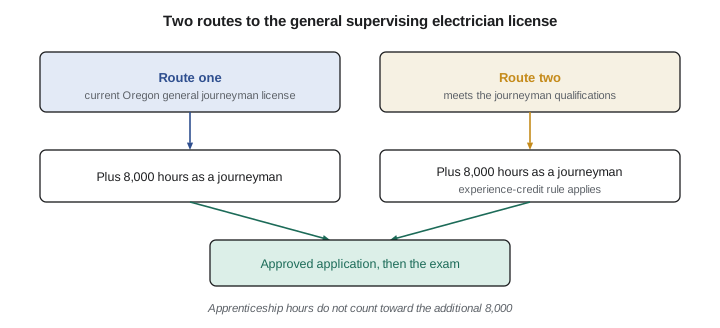
The most common route starts with an Oregon general journeyman electrician license. A candidate who holds that license may qualify by showing an additional 8,000 hours of on-the-job experience as a journeyman electrician. In practice that means roughly four years of full-time work after the journeyman license, although the rule counts hours, not years. The hours must be electrical work of the kind the rules describe, verified by the employers who supervised it.
The word additional matters. The 8,000 hours a candidate spent as an apprentice earning the journeyman license do not count toward the supervising requirement. Only journeyman-level hours after the candidate qualified as a journeyman count. That is why Priya started her count in the summer of 2018, when her journeyman license was issued, and not in 2014, when her apprenticeship began.
Route two: journeyman qualifications plus 8,000 hours
The second route is for a candidate who does not hold an Oregon journeyman license but can show the experience that would qualify for one, plus another 8,000 hours at the journeyman level. This route matters for electricians from other states, from the military or from work that Oregon did not license, because it lets them qualify without first becoming an Oregon journeyman. The state's license listing notes that a special rule on how experience is credited applies to this route, so a candidate using it should read the current rule closely and call BCD's licensing staff before applying.
The journeyman-qualifying part of route two follows OAR 918-282-0170, which sets out the hours and the categories of work a general journeyman needs. Read it for the current list of categories and the minimum hours in each, because BCD checks the verification forms against them. The candidate must document both blocks of experience: the block that would qualify for the journeyman license and the additional block at journeyman level. Experience gained in another state may count if it is equivalent, but the burden is on the candidate to show it with employer verification.
| Route | Starting point | Additional experience | Typical documents |
|---|---|---|---|
| One | Current Oregon general journeyman license | 8,000 hours as a journeyman | Application, experience verification from each employer, education proof, photo |
| Two | Meets the Oregon journeyman qualifications | 8,000 hours as a journeyman, beyond the journeyman-qualifying block | Application, verification for both blocks, apprenticeship or equivalent records, education proof, photo |
Reciprocity
BCD has reciprocal agreements with some other states for the general supervising electrician and general journeyman licenses. A candidate licensed in a state with an agreement may be able to get an Oregon license without the full process, subject to the terms of the agreement, which usually require that the out-of-state license was earned by examination and is in good standing. Agreements are added, changed and ended, so a candidate from another state should check BCD's current list before assuming either way.
The documents
BCD's electrical license application packet asks for more than a list of jobs. The state's license listing names the core documents: the completed application with the fee, proof of a high school diploma, a GED or an equivalent, proof of completing an apprenticeship if that is how the candidate qualified, the experience documentation the license requires and a photo. The application asks for a work history and a signed applicant affidavit, and it asks the candidate to choose a preferred exam location. Experience is documented on BCD's electrical experience verification form, completed for each employer and listing the hours in each category of work the rules require.
Employer verification is where most delays happen. A foreman who worked for five contractors over eight years needs five forms, and some of those employers may have closed, merged or lost their records. Candidates should start collecting verification early, keep copies of pay stubs and W-2 forms that support their hours, and ask former employers to sign only what their records support. BCD asks for the whole packet to be sent together by mail or fax, and its application page warns against sending documents by email.
# Counting journeyman-level hours toward the 8,000-hour requirement (study aid)
REQUIRED = 8000
journeyman_license_issued = (2018, 7)          # year, month
history = [                                    # (employer, from, to, hours verified)
    ("Willamette Crest Electric", (2018, 7), (2019, 6), 1960),
    ("Willamette Crest Electric", (2019, 7), (2021, 12), 4850),
    ("Willamette Crest Electric", (2022, 1), (2023, 12), 3920),
]
apprentice_hours = 8000                        # earned before the license; not counted
total = 0
for emp, start, end, hrs in history:
    if start >= journeyman_license_issued:
        total += hrs
print("Journeyman-level hours counted:", total)
print("Required additional hours:     ", REQUIRED)
print("Eligible now?", total >= REQUIRED)
print("Hours beyond the minimum: ", total - REQUIRED)Journeyman-level hours counted: 10730 Required additional hours: 8000 Eligible now? True Hours beyond the minimum: 2730
The count shows why Priya qualified by early 2024 even though she did not apply until 2026. Her verified journeyman hours passed 8,000 during her fifth year as a journeyman, because overtime on the Lebanon warehouse pushed her yearly totals above 2,000. The apprenticeship hours appear in the code only to show that they are left out. A candidate with gaps, part-time years or out-of-state work would do the same arithmetic employer by employer, using the hours each employer is willing to verify.
Worked problem
Checking a candidate with out-of-state experience
Eli Brandt's cousin, Nora, worked six years as a licensed journeyman in another state and has just moved to Salem. She holds no Oregon license. Which route fits her, and what should she check first?
Show solution
- Nora does not hold an Oregon journeyman license, so route one is not available unless she first gets that license.
- Route two lets her qualify if she can show journeyman-qualifying experience plus 8,000 more hours at the journeyman level.
- Six years of full-time journeyman work may total about 12,000 hours, but she also needs the journeyman-qualifying block, usually from her apprenticeship.
- She should check whether BCD has a reciprocal agreement with her former state and read the experience-credit rule that applies to route two before applying.
Answer: Route two or reciprocity, depending on her former state; she should confirm both with BCD before she applies.
Other conditions
Eligibility is not only about hours. BCD can deny an application, or later suspend or revoke a license, for reasons the statute and rules list, such as fraud in the application or serious violations of the electrical law. An applicant who has had a license disciplined in Oregon or elsewhere should expect questions and should answer them honestly. The application's affidavit is a sworn statement, and a false statement about experience is a ground for denial on its own.
The candidate also needs a plan for using the license. The supervising electrician's duties, covered in Lesson 7, require the license holder to be employed by one electrical contractor at a time, on its regular payroll. A candidate who plans to supervise for two companies, or to supervise as an outside consultant while working elsewhere, should read those rules before assuming the license will fit the plan.
Building the record before you need it
Most candidates count their hours once, in a hurry, the month they decide to apply. A better habit is to keep the record as you go. Priya started a simple log the year she became a journeyman: each employer, start and end dates, hours from her pay stubs and a few words on the kind of work, such as service changes, commercial tenant improvements, motor control or residential remodels. When she finally applied, the log matched the pay records and Dale could sign the verification form in ten minutes, because every number had a source.
The categories matter as much as the total. BCD reviews the verification forms against the kinds of work the rules require, and an electrician who spent eight years on one narrow type of job may find that some categories are thin. If your work has been narrow, talk to your employer about rotating onto other kinds of jobs well before you apply. A year on service and feeder work, or on a commercial crew after years of residential remodels, broadens the record and makes you a better supervisor.
Experience from the military, from industrial plants or from other states raises its own questions. Military electrical work can count when it is equivalent, but the candidate needs records that show the work and the hours, which may mean requesting service records months in advance. Plant maintenance work may have been done under a limited maintenance license rather than a general license, which affects how it is credited. Out-of-state hours need verification from the out-of-state employer and, where the candidate held a license there, a record of that license. In each case the safest approach is to describe the history to BCD's licensing staff before applying and ask how it will be counted.
| Kind of experience | What to gather early |
|---|---|
| Oregon journeyman work | Pay stubs or W-2 forms, a log of jobs and categories, a contact at each employer |
| Out-of-state work | Employer verification, the out-of-state license record and any reciprocity terms |
| Military electrical work | Service records that show duties and hours, requested well in advance |
| Plant maintenance work | The license held at the time and a description of the work |
One more record is easy to overlook: your own license history. Check your journeyman license in BCD's public lookup and make sure the issue date, status and any past renewals match what you expect. A lapse you forgot about, or a license issued under a different name, is easier to explain before the application than after BCD has flagged it.
Common mistakes
MistakeCounting apprenticeship hours toward the supervising requirement.
InsteadOnly journeyman-level hours beyond journeyman qualification count toward the additional 8,000 hours.
MistakeTreating years as the requirement.
InsteadThe rule counts hours; part-time years count only for the hours actually verified.
MistakeSending documents one at a time by email.
InsteadBCD asks for one complete packet by mail or fax and says not to email documents.
MistakeAssuming a license from any other state transfers.
InsteadReciprocity depends on BCD's current agreements, which cover specific states and licenses.
Summary and key terms
- A general supervising electrician may supervise installations for an electrical contractor, design and lay out work for the employer's customers and supervise service installations.
- Route one: a current Oregon general journeyman license plus 8,000 additional hours as a journeyman.
- Route two: the journeyman qualifications plus 8,000 additional hours, with a special experience-credit rule noted by the state.
- The packet includes the application and fee, experience verification from each employer, proof of education, any apprenticeship proof and a photo.
- Reciprocal agreements exist for the general supervising and general journeyman licenses with some states.
- OAR 918-282-0140
- The rule that defines the general supervising electrician license, its scope, duties and experience routes.
- OAR 918-282-0170
- The rule on general journeyman electrician experience, referenced by route two.
- Experience verification form
- BCD's form on which each employer verifies the candidate's hours by category of work.
- Applicant affidavit
- The sworn statement in the application that the information is true.
- Reciprocity
- An agreement under which BCD recognizes another state's license on stated terms.
Practice problems
Work each problem on paper first, then reveal the answer to check.
How many additional journeyman hours does each route require?
Show answer
8,000 hours.
Do apprenticeship hours count toward the supervising requirement?
Show answer
No. They count toward journeyman qualification, not the additional block.
Name three documents in the application packet.
Show answer
Any three of: the application with fee, experience verification forms, proof of education, apprenticeship proof and a photo.
Which route fits an experienced electrician from another state with no Oregon license?
Show answer
Route two, or reciprocity if BCD has an agreement with that state.
Lesson quiz · 5 questions
Score 60% or more to complete this lesson.
Create a free account to save your progress, take quizzes and earn a certificate.