
MELU-312 · Lesson 5 of 12 · 21 min
The NEC as adopted in Oregon and state amendments
▶ Video coming soon A video version of this lesson is on the way.
In early October 2026, Ray Tanaka, Willamette Crest's estimator, walked into the office holding two bids for the same kind of job. "The duplex bid from August and the one I'm doing today don't match," he said. "Same plans, different code." He was right. On October 1, 2026, Oregon's new electrical specialty code took effect, based on the 2026 edition of the National Electrical Code with Oregon amendments. Jobs permitted under the earlier code kept their rules; new work moved to the new one, with a few requirements phased in later. Knowing which code applies, and how Oregon's version differs from the national text, is part of the supervising electrician's job and part of the exam.
This lesson explains how Oregon adopts the NEC, what the Oregon Electrical Specialty Code is, how the 2026 adoption and its phase-in dates work and how to keep the exam edition and the job edition straight. It does not reproduce code text. Use your own copy of the code and the amendments to see the actual requirements.
A state code, not a local one
Oregon has a statewide building code, and the electrical part of it is the Oregon Electrical Specialty Code, often shortened to the OESC. BCD adopts it by rule, after review by the Electrical and Elevator Board, and the rule in OAR 918-305-0100 adopts both the OESC and the National Electrical Safety Code for the utility installations it covers. Every jurisdiction in the state enforces the same OESC. A city building department can run the electrical program, sell permits and employ inspectors, but it does not write its own electrical code. That is a major difference from states where large cities adopt local electrical codes.
The OESC is built on the NEC. BCD adopts a particular NEC edition and then adds Oregon amendments: changes that delete, replace or add to the national text. Some amendments make a requirement less strict, for example by delaying or removing a new national requirement that Oregon judges unready. Others add Oregon-specific requirements. Together, the NEC and the amendments are the code. A candidate who knows the national text but not the amendments will miss exam questions that turn on them, and a contractor who installs to the national text alone can fail an inspection.
The 2026 adoption
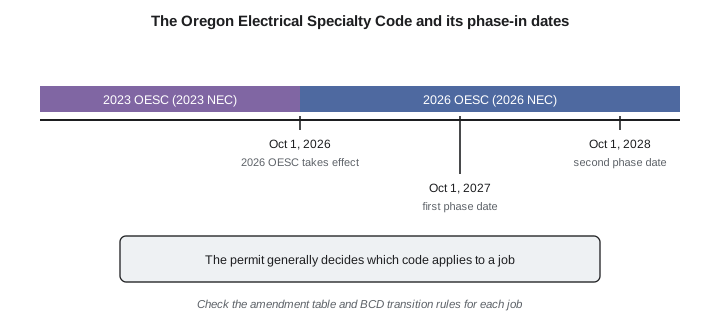
BCD's adoption announcement for the 2026 OESC states that the new code is based on the 2026 NEC and took effect on October 1, 2026. The previous code was the 2023 OESC, based on the 2023 NEC. With the new adoption, BCD withdrew the interpretations it had issued under the earlier code and reissued the ones that still apply, and it published the amendments in a single table in the adoption documents. Supervising electricians should read the amendment table as a whole at least once, because it is short compared with the code and it changes the answer to several common questions.
The 2026 adoption also phases in several requirements. BCD's announcement lists amendments that delay parts of the national text until October 1, 2027, including parts of the surge-protection requirements for feeders and services, a service marking requirement and amendments affecting weather-resistant receptacles. It lists a second group of amendments that expire on October 1, 2028, after which the national requirements apply, involving service disconnect and panelboard provisions. The exact section numbers and the details are in the adoption documents. For an estimator, the phase-ins matter because a job permitted in 2027 and one permitted in 2029 may need different equipment even under the same adopted code.
Which code applies to a job
The code that applies to a job is generally tied to the permit, not to the date the crew shows up. A job whose permit was applied for and issued under the 2023 OESC continues under that code, and work on a new permit after the effective date follows the 2026 OESC. The adoption documents and the local building department explain the transition rules for permits that were in process on the effective date, and those details are worth checking for any job that straddles the change. When in doubt, ask the building department in writing which edition applies, and keep the answer in the job file.
Ray's two duplex bids fit that pattern. The August bid was for a permit Willamette Crest pulled in September, so it stayed under the 2023 OESC. The October bid was for a new project that would not be permitted until November, so it fell under the 2026 OESC. The difference in his material list came from new national requirements that Oregon adopted without delay, and from his need to check whether any phased requirement would apply on the expected permit date.
# Which Oregon electrical code applies on a permit date? (study aid)
from datetime import date
EDITIONS = [(date(2023, 10, 1), "2023 OESC (2023 NEC base)"),
            (date(2026, 10, 1), "2026 OESC (2026 NEC base)")]
PHASES = [(date(2027, 10, 1), "first group of phased amendments ends"),
          (date(2028, 10, 1), "second group of phased amendments expires")]
def code_for(permit):
    current = "earlier code"
    for start, name in EDITIONS:
        if permit >= start:
            current = name
    notes = [what for when, what in PHASES if permit >= when]
    return current, notes
for d in (date(2026, 9, 15), date(2026, 11, 2), date(2027, 11, 1), date(2028, 12, 1)):
    name, notes = code_for(d)
print(d, "->", name, "|", "; ".join(notes) if notes else "no phase dates passed")2026-09-15 -> 2023 OESC (2023 NEC base) | no phase dates passed 2026-11-02 -> 2026 OESC (2026 NEC base) | no phase dates passed 2027-11-01 -> 2026 OESC (2026 NEC base) | first group of phased amendments ends 2028-12-01 -> 2026 OESC (2026 NEC base) | first group of phased amendments ends; second group of phased amendments expires
The study aid is a simplification. It shows the edition by permit date and which phase dates have passed, but the real question for any job is which specific requirements apply, and that needs the amendment table. The aid also assumes the earlier edition took effect on October 1, 2023, which is consistent with Oregon's recent pattern of October adoptions but should be confirmed in BCD's records. Treat the dates as markers that tell you when to look again.
The exam edition and the job edition
The exam has its own edition. BCD's approved exam materials list allows the NEC as adopted in Oregon with the Oregon amendments and errata, and BCD decides when the exam moves to a new adoption. A candidate who sits the exam soon after October 2026 should confirm which edition the exam uses, because exam updates can lag behind code adoptions. Bring the edition the list names, with the matching Oregon amendments marked, and do not assume that the edition used on your current jobs is the exam edition.
Priya tested in April 2026, before the new adoption took effect, so her exam used the earlier code. After her license arrived, she spent part of the summer marking the 2026 amendments in a new code book, because her first permits as a supervising electrician would fall under the new edition. Dale bought the code update course for both of them, which also counted toward continuing education, covered in Lesson 11.
| Question | Where to look |
|---|---|
| Which NEC edition is the base of the current OESC? | BCD's adoption announcement and OAR chapter 918, division 305 |
| What did Oregon change from the national text? | The Oregon amendment table published with the adoption |
| When do delayed requirements start or end? | The phase-in dates in the adoption documents |
| Which code applies to an existing permit? | The transition rules and the local building department |
| Which edition does the exam use? | BCD's current approved exam materials list |
Interpretations and code questions
When a code requirement is unclear, Oregon has a process for official interpretations, and BCD publishes the ones in effect. Interpretations are tied to the code edition, which is why BCD withdrew the earlier set and reissued the ones that still apply when the 2026 OESC took effect. A supervising electrician who disagrees with an inspector's reading of the code can ask the inspector's supervisor, then use the state's appeal or interpretation process. On the exam, questions are answered from the code and amendments in the allowed books, not from local practice.
Worked problem
Pricing a service change across the phase dates
Ray is bidding a residential service upgrade in Albany. The owner wants to start in December 2026, but may wait until early 2028. Which code governs each start date, and what should Ray check?
Show solution
- A permit issued in December 2026 falls under the 2026 OESC, with the first group of phased amendments still in place.
- A permit issued in early 2028 is still under the 2026 OESC, but the first group of phased amendments ended on October 1, 2027.
- Ray should read the amendment table for the service requirements affected by the phase-ins and price both cases.
- He should note the code basis in the proposal so the owner understands why the price may change.
Answer: Both dates are under the 2026 OESC, but the later start falls after the first phase date, so some requirements may differ.
Reading and marking an amendment
An amendment table can look intimidating, but each entry follows the same pattern: the section of the national code it affects and what Oregon does to it. Some entries delete a national requirement. Some replace a sentence or a list item with Oregon's own wording. Some add a new item or a new requirement. Some, like the phase-in amendments in the 2026 adoption, keep an older approach in place until a stated date. To use an amendment correctly, you need to know which kind it is and exactly what part of the section it touches.
Priya marked her book in three steps for each amendment. First, she found the national section and drew a light line in the margin beside the part that Oregon changes. Second, she wrote a short cross-reference such as Oregon amendment, see table, which BCD's approved materials list allows. Third, for phase-in amendments, she noted the end date in the margin. She did not copy the amendment's text into the book, because the list does not allow added notes of that kind and the table itself is allowed in the exam room as part of the adopted code.
The habit pays off in two ways. On the exam, a mark in the margin stops you from answering from the national text when Oregon has changed it. On the job, the same mark reminds an estimator or a foreman that a requirement works differently in Oregon. Several of Willamette Crest's correction notices in earlier years came from crews trained in other states who installed to the national text without knowing the Oregon amendment.
Code questions on the job
Not every code question has a clear answer in the book. When a foreman and an inspector disagree, the first step is to read the section together, including any Oregon amendment and any BCD interpretation. Many disagreements end there. If they do not, the supervising electrician can ask the inspector's supervisor or the building official, and then use the state's process for interpretations or appeals. Keep the discussion professional and in writing, and keep copies. An inspector who sees that a contractor reads the code carefully tends to give that contractor's arguments a careful hearing.
Practice problems
Work each problem on paper first, then reveal the answer to check.
What are four kinds of amendment entries?
Show answer
Deleting, replacing or adding to national text, and delaying a requirement to a stated date.
What may you write in the margin to mark an amendment?
Show answer
A short cross-reference noting the Oregon amendment, as BCD's list allows.
Common mistakes
MistakeAssuming Portland or another city has its own electrical code.
InsteadOregon has one statewide OESC; local programs enforce it.
MistakeAnswering an exam question from the national text without checking the Oregon amendments.
InsteadThe Oregon amendments change the answer to some questions.
MistakeUsing the job's code edition for the exam without checking.
InsteadThe exam edition is set by BCD's approved materials list.
MistakeApplying the new code to every job on October 1.
InsteadThe code generally follows the permit; check the transition rules for permits in process.
Summary and key terms
- The Oregon Electrical Specialty Code is the statewide electrical code: an NEC edition plus Oregon amendments.
- OAR 918-305-0100 adopts the OESC and the National Electrical Safety Code.
- The 2026 OESC, based on the 2026 NEC, took effect October 1, 2026; it replaced the 2023 OESC.
- Phase-in dates fall on October 1, 2027 and October 1, 2028 for groups of amendments listed by BCD.
- The exam edition is set by BCD's approved materials list and can differ from the job edition.
- OESC
- The Oregon Electrical Specialty Code, the statewide electrical code.
- Oregon amendment
- A change Oregon makes to the national NEC text when adopting it.
- Phase-in date
- A date on which a delayed requirement begins to apply or a temporary amendment ends.
- NESC
- The National Electrical Safety Code, adopted for the utility installations it covers.
- Interpretation
- An official BCD reading of a code requirement, tied to a code edition.
Practice problems
Work each problem on paper first, then reveal the answer to check.
Which NEC edition is the base of the 2026 OESC?
Show answer
The 2026 NEC.
When did the 2026 OESC take effect?
Show answer
October 1, 2026.
Can a city in Oregon adopt its own electrical code?
Show answer
No. The OESC applies statewide; local programs enforce it.
Where do you find which edition the exam uses?
Show answer
BCD's current approved exam materials list.
Lesson quiz · 5 questions
Score 60% or more to complete this lesson.
Create a free account to save your progress, take quizzes and earn a certificate.