
MELU-309 · Lesson 9 of 12 · 20 min
Contracts and construction liens in North Dakota
▶ Video coming soon A video version of this lesson is on the way.
Last winter Souris Bend wired a new machine shop on the edge of Minot for a developer who ran out of money. The general contractor stopped paying its subcontractors in February, and Souris Bend was owed about 38,000 dollars. Dale got paid in the end, because Arlo knew the North Dakota lien deadlines and met every one of them. This lesson covers the contract basics a master needs and the state's construction lien law, Century Code chapter 35-27: who may claim a lien, the notice that must come first, the deadlines to record and to sue, priority, and what to do on public work, where no lien is available.
A note on words. Many states and many exam outlines call these mechanics' liens. North Dakota's statute calls them construction liens, and that is the term this lesson uses. The idea is the same: a contractor, subcontractor or supplier who improves real estate and is not paid can claim a security interest in the property.
Contract basics
Every job starts with an agreement, written or not, and the disputes that lead to liens usually start with a vague one. A good electrical contract states the parties, the property and its legal description or address, the scope of work and the drawings or specifications it is based on, the price or the method of pricing, the payment schedule, how changes are approved and priced, the schedule, and who is responsible for the wiring certificate and fees. Lesson 8 covered two statutory terms: retainage limited to one tenth of each estimate until the project is half complete, and the warranty notice procedure for homes and improvements over 2,000 dollars.
Arlo's rule for change orders is simple: no extra work without a signed change order that states the price. Extra work is where most payment disputes start, and an itemized, signed change order is the best evidence of what was agreed. Lien waivers deserve the same care. A signed waiver of lien rights bars the lien under section 35-27-02, so Souris Bend signs waivers only for amounts actually received.
Who may claim a construction lien
Under section 35-27-02, a person who improves real estate under a contract with the owner, or with the owner's agent, trustee, contractor or subcontractor, has a lien for the price or value of the contribution. The definitions in section 35-27-01 are broad. Improving real estate includes furnishing labor or materials, and the term subcontractor reaches down the chain to anyone who contracts with a subcontractor. Souris Bend, as a subcontractor to the general contractor on the machine shop, had lien rights.
The lien has limits. It is capped at the unpaid amount: if the owner has paid the contract price in full, there is no lien, and otherwise the lien is limited to the difference between the owner's price and what has been paid, up to the value of the claimant's contribution. A valid lien waiver signed by the claimant bars the lien. Knowingly demanding more than is justly due defeats the lien entirely under section 35-27-16.
The notice that comes first
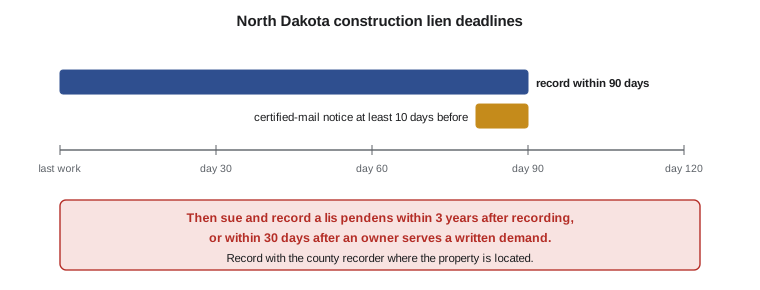
Before recording a lien, the claimant must give the owner written notice. Section 35-27-02 requires that written notice that a lien will be claimed be sent to the legal or equitable owner by certified mail at least ten days before the lien is recorded. A party who contracts with someone other than the owner may also demand evidence of the property's legal description and the owner's name, which helps a subcontractor get the details right.
There is no requirement in chapter 35-27 for a preliminary notice at the start of the job, as some states have. The owner may, however, ask for information. Under section 35-27-09, within 15 days after completion the owner may require a claimant to furnish an itemized, verified account of the claim, and the claimant cannot begin enforcement until 10 days after furnishing it. A claimant may also serve the owner with notice of the claim at any time.
Recording the lien
Section 35-27-13 sets the main deadline. The lien statement is recorded with the county recorder in the county where the property is located within ninety days after all of the claimant's contribution is done. It must describe the property, state the amount due, give the dates of the first and last contribution, and name the person the claimant contracted with. Errors in the details do not void the lien, but the claimant is bound by the first and last dates stated and the lien cannot exceed the amount claimed.
North Dakota's statute is less harsh than some about the 90 days. Under section 35-27-14, recording late does not defeat the lien altogether. It does defeat it against a good-faith purchaser or lender whose rights vested before the lien was recorded, and against the owner to the extent the owner paid the contractor before the lien was recorded. In practice, a late lien is weak, because the money it would have protected has often been paid out. There is also an outer limit: no lien may be recorded more than three years after the first item of material is furnished.
Enforcing the lien
A recorded lien is security, not payment. To collect, the claimant must enforce it in the district court of the county where the property is located. Section 35-27-25 sets the deadline: the lien is not valid or enforceable unless the claimant sues and records a lis pendens, a notice of the pending suit, within three years after the lien is recorded. If no lis pendens is recorded within that time, the lien is treated as satisfied.
The owner can shorten that time. Under the same section, an owner may serve a written demand on the lien claimant and file it with the county recorder. The claimant then has 30 days from delivery to sue and record a lis pendens, or the lien is forfeited. The demand must tell the claimant about that consequence. Before suing, the claimant must also give the owner written notice of intent to enforce, either personally served at least 10 days before suit or sent by registered mail to the owner's last known address at least 20 days before suit, under section 35-27-24.
| Step | Deadline or rule | Section |
|---|---|---|
| Owner notice before recording | Certified mail to the owner at least 10 days before recording | 35-27-02 |
| Record the lien | Within 90 days after the claimant's contribution is done | 35-27-13 |
| Outer limit to record | No more than 3 years after first material is furnished | 35-27-14 |
| Pre-suit notice | Personal service 10 days or registered mail 20 days before suit | 35-27-24 |
| Sue and record lis pendens | Within 3 years after recording | 35-27-25 |
| After owner's demand | Sue and record lis pendens within 30 days | 35-27-25 |
One more rule makes care essential. Under section 35-27-24.1, an owner who successfully contests the validity or accuracy of a construction lien in district court must be awarded full costs and reasonable attorney's fees. An inflated or careless lien can cost the claimant the owner's legal bill.
Priority
A construction lien attaches as of the first furnishing of labor or materials on the improvement, under section 35-27-03, which can give it priority over a mortgage recorded later, subject to the rules for mortgages that fund the work. Among lien claimants, section 35-27-22 sets an order: manual labor first, then materials, then subcontractors other than manual laborers, then original contractors, and claims recorded within the 90-day period share ratably within their class. The owner may also withhold payment from the contractor to cover lien claims and pay them directly, deducting the cost, under section 35-27-09.
Worked problem
Working the machine shop deadlines
Souris Bend finished its last work on the machine shop on December 20. It was not paid. What dates should Arlo calendar?
Show solution
- Ninety days after December 20 is about March 20; the lien must be recorded by then.
- The certified-mail notice to the owner must go out at least ten days before recording, so by about March 10, and sooner is better.
- Record the lien with the county recorder in Ward County.
- Calendar three years from the recording date to sue and record a lis pendens, and watch for any owner's demand, which shortens the time to 30 days.
Answer: Send notice by about March 10, record by about March 20, and sue within three years or within 30 days of a demand.
# Construction lien calendar for Souris Bend's machine shop claim (illustrative dates)
from datetime import date, timedelta
last_work = date(2025, 12, 20)
record_by = last_work + timedelta(days=90)
notice_by = record_by - timedelta(days=10)
recorded = date(2026, 2, 10)          # when Arlo actually recorded it
suit_by = date(recorded.year + 3, recorded.month, recorded.day)
print(f"Last work: {last_work}")
print(f"Send certified-mail notice by: {notice_by}")
print(f"Record lien by: {record_by}")
print(f"Recorded: {recorded}; sue and record lis pendens by: {suit_by}")
print("If the owner serves a demand: sue within 30 days of delivery.")Last work: 2025-12-20 Send certified-mail notice by: 2026-03-10 Record lien by: 2026-03-20 Recorded: 2026-02-10; sue and record lis pendens by: 2029-02-10 If the owner serves a demand: sue within 30 days of delivery.
Unlicensed contractors and liens
Lesson 8 noted that a contractor without a required Secretary of State license may not bring or maintain a claim in court related to its contracting business. Because a lien is enforced by a suit in district court, an unlicensed contractor may have no practical way to enforce one. A master who lets the company's Secretary of State license lapse puts its lien rights at risk along with everything else.
Public work: bonds instead of liens
Construction liens attach to private real estate. They do not attach to public property such as a school, a county building or a state highway project. On public work, the protection for subcontractors and suppliers is the contractor's bond. Section 48-01.2-10 requires a surety bond at least equal to the contract price on public improvement contracts over 250,000 dollars, conditioned on the contractor and its subcontractors paying for labor, supplies and materials, and anyone with a lawful claim may sue on it. Bond claims have their own notice and time rules, so a subcontractor on public work should read the bond and the statute at the start of the job.
Special property
The lien chapter has special rules for a few kinds of property. Section 35-27-13 requires a lien on a wind turbine or other electric energy conversion facility built on leased land to state, in large type, that it attaches only to the leasehold interest. Leasehold improvements, complete buildings that can be removed, and railways have their own sections. A contractor working on a wind farm, an oil-country lease or a tenant's space should read those sections before relying on a lien.
Kari added one more habit to the company's routine. When the last work on a job is done, the job file gets a note with the date and the 90-day recording deadline, whether or not anyone expects a payment problem. If payment is late, the deadlines are already on the calendar.
Common mistakes
MistakeCalling them mechanics' liens on a North Dakota form.
InsteadChapter 35-27 uses the term construction lien.
MistakeRecording a lien without sending notice first.
InsteadSend written notice by certified mail at least ten days before recording.
MistakeWaiting the full three years to sue after an owner's demand.
InsteadA demand shortens the time to 30 days from delivery.
MistakeClaiming more than is owed to gain leverage.
InsteadKnowingly overstating the amount defeats the lien, and a successful owner recovers costs and attorney's fees.
MistakeRecording a lien against a school building.
InsteadLiens do not attach to public property; claim against the public improvement bond.
Summary and key terms
- North Dakota's lien law is the construction lien chapter, NDCC 35-27.
- Anyone who improves real estate under a contract with the owner or the owner's chain of contractors may claim a lien, capped at the unpaid amount.
- Send certified-mail notice at least 10 days before recording, and record within 90 days after the contribution is done.
- Sue and record a lis pendens within three years after recording, or within 30 days after an owner's demand.
- An owner who successfully contests a lien recovers costs and attorney's fees.
- On public work, claim against the surety bond required for public improvements over 250,000 dollars.
- Construction lien
- A security interest in real estate for unpaid labor or materials that improved it, under NDCC 35-27.
- Lis pendens
- A recorded notice that a lawsuit affecting the property is pending.
- Owner's demand
- A written demand that the lien claimant sue within 30 days or forfeit the lien.
- Lien waiver
- A signed release of lien rights, usually given for payment received.
- Retainage
- Part of each payment held back until the work is complete, limited by NDCC 43-07-23.
Practice problems
Work each problem on paper first, then reveal the answer to check.
How must the pre-recording notice be sent?
Show answer
In writing by certified mail to the legal or equitable owner at least ten days before recording.
Where is a lien on a Minot property recorded?
Show answer
With the county recorder of Ward County.
An owner serves a demand on Souris Bend on May 1. What happens if the company does not sue by May 31?
Show answer
The lien is forfeited.
Can Souris Bend record a lien against a county shop building?
Show answer
No; it should claim against the contractor's public improvement bond.
What does the lien statement have to include?
Show answer
The property description, amount due, dates of first and last contribution and the person the claimant contracted with.
Lesson quiz · 5 questions
Score 60% or more to complete this lesson.
Create a free account to save your progress, take quizzes and earn a certificate.