
MELU-309 · Lesson 11 of 12 · 20 min
Renewal and continuing education
▶ Video coming soon A video version of this lesson is on the way.
Every spring the Souris Bend office goes through the same routine. In January Arlo prints a list of everyone's license and registration, with the expiration date and the continuing education hours the board shows on file. In February the apprentices' registrations are renewed, the Secretary of State contractor license is renewed before March 2, and anyone short of education hours signs up for a class. In March the journeymen renew. In April Dale renews his master license. A master who misses a step can lose the right to contract on May 1, and a company can find itself unable to file wiring certificates in the middle of the spring rush. This lesson covers renewal for each license class, the continuing education rules, what happens after a lapse, and how a North Dakota license works in neighboring states.
Annual renewal and expiration dates
North Dakota electrician licenses are annual. Section 43-09-15 of the Century Code says licenses last one year and are renewed for a fee without re-examination. The board's fee rule, N.D. Admin. Code 24.1-03-01-01, sets the expiration dates: master, class B and power limited licenses expire April 30, journeyman licenses expire March 31, and apprentice and power limited apprentice registrations expire January 31. The board's renewal page says renewals open on January 1 each year.
| Credential | Expires | Annual fee |
|---|---|---|
| Apprentice registration | January 31 | 10 dollars |
| Journeyman | March 31 | 25 dollars |
| Master | April 30 | 50 dollars |
| Class B | April 30 | 40 dollars |
| Power limited | April 30 | 50 dollars |
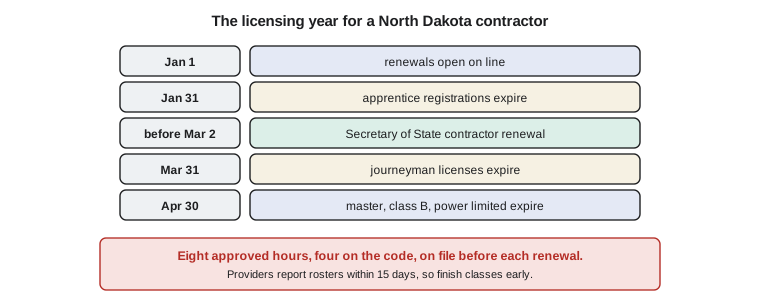
To renew online, the board's page asks for the license number, the last four digits of the Social Security number and a credit card. The renewal also asks the licensee to certify that, if he or she does electrical work in North Dakota, the work is done under a contracting North Dakota master electrician. For a journeyman, that is a reminder that a journeyman never works on his or her own account.
The board has announced a change of online systems for early 2027, with a short period during which online renewals and wiring certificates cannot be filed and new logins will be issued. Its notice says renewals will be postponed until the new system opens, current licenses and registrations will remain valid, and no late fees will be charged during the changeover. Keep your email address current with the board and watch its notices, since the exact dates and steps are set by the board.
Continuing education
Section 43-09-15.1 requires continuing education for renewal. The statute sets a floor and a ceiling: at least eight hours of education in each biennium, and the board may not require more than sixteen hours. The board must offer education sessions in at least six locations in the state each year and may charge up to 10 dollars per attendee per session for its own sessions.
The board's rule and renewal pages set the working requirement. Under N.D. Admin. Code 24.1-04-01-01, renewal of a master, journeyman, power limited or class B license requires eight hours of continuing education, with at least half on the current code edition, the 2026 NEC, and the rest related to the electrical industry. The board's pages state it as eight hours, four of them code, that must be on file with the board before you renew. The board's approved course list adds that from July 1, 2026, all continuing education courses must be on the 2026 NEC.
Read the statute and the rule together carefully. The statute speaks of a biennium, while the board's pages tell licensees that the eight hours must be on file to renew. Because licenses renew every year and credits can be banked, as explained below, the safest course is to have eight approved hours, at least four on the code, on file with the board before each renewal unless the board tells you that your hours on file already cover it. The board's continuing education lookup shows what it has on file for you.
Approved classes and how credit reaches the board
Only approved classes count. Under 24.1-04-01-02, classes, apprenticeship programs and instructors need the board's approval in advance, requested at least 30 days before instruction begins, and approval of continuing education classes and instructors expires when the board adopts a new NEC edition. That is why classes approved on the 2023 code stopped counting toward code hours when the 2026 standards took effect.
The provider, not the electrician, reports attendance. The provider must send the board the attendance list within 15 days after the class and give each attendee a certificate of completion. The board's approved course page says it requires proof of completion to come from the provider and does not accept individual certificates. Kari learned this the hard way in 2022, when she took a class two weeks before her March 31 renewal and the roster had not reached the board by the time she tried to renew. Now she finishes her hours by the end of January.
Two more rules affect planning. Credits can be deposited with the board for up to two renewal periods, so a licensee who takes extra approved hours one year can carry them forward. And no credit is given for repeating the same class, meaning the same sponsor, title and approval number, within one code cycle.
Worked problem
Planning education hours across renewals
In January 2027 Kari takes a 12-hour approved class on the 2026 NEC. Her master license will renew on April 30, 2027 and again on April 30, 2028. How might the hours count?
Show solution
- She needs eight hours, at least four on the code, on file before each renewal.
- The 12 hours cover the 2027 renewal with four hours left over.
- Credits can be banked for up to two renewal periods, so the extra four code hours can count toward 2028.
- She will need at least four more approved hours, from a different class than the one she has already taken this code cycle, before April 30, 2028.
Answer: Eight hours for 2027, four banked toward 2028, plus four new hours before the 2028 renewal.
# Tracking continuing education across renewals (illustrative; confirm with the board's lookup)
need_total, need_code = 8, 4
classes = [("2027-01", "2026 NEC changes, part 1", 12, 12),
           ("2027-11", "Grounding and bonding review", 4, 4)]
bank_total = bank_code = 0
for month, title, hours, code_hours in classes:
    bank_total += hours; bank_code += code_hours
for renewal in ("2027-04-30", "2028-04-30"):
    ok = bank_total >= need_total and bank_code >= need_code
    print(f"{renewal}: on file {bank_total} h ({bank_code} code) -> {'renews' if ok else 'short'}")
    used_code = min(bank_code, need_total)
bank_total -= need_total; bank_code -= used_code2027-04-30: on file 16 h (16 code) -> renews 2028-04-30: on file 8 h (8 code) -> renews
Late renewal, lapse and re-examination
The board's fee rule does not set a separate late fee. Instead, a license or registration that has expired requires a reinstatement fee equal to the annual fee, along with the renewal fee and the education hours. But an expired license is still expired. A contracting master whose license lapses on April 30 cannot contract, supervise or file wiring certificates until it is reinstated, and any work done in the gap is unlicensed work.
There is also a hard limit. Under section 43-09-15, a licensee who fails to renew for three or more consecutive years must take the examination again. A master who leaves the trade for a few years and lets the license lapse should expect to sit the exam again on return.
Renewal can also be refused. The grounds for discipline in 43-09-15 include failing to meet the insurance requirement, unpaid debts to the board and failing to certify the required education, any of which can lead the board to refuse renewal.
Working in neighboring states
Souris Bend's service area runs to the Canadian border and toward Montana. Kari has also been asked about jobs in Minnesota and South Dakota. A North Dakota license is good only in North Dakota. Work in another state requires that state's license, unless that state grants a reciprocal license.
The board's reciprocity page lists master reciprocity with Iowa, Minnesota and South Dakota, and journeyman reciprocity with a longer list of states, including Montana. Reciprocity works in both directions only to the extent the other state's rules allow, and each state has its own application. Applicants for a North Dakota reciprocal license whose home state does not require continuing education must show an eight-hour code class approved by North Dakota. A North Dakota master who wants a Minnesota license should apply to Minnesota and read its requirements, which may include its own contractor licensing, insurance or bond rules.
| Neighboring state | Board's reciprocity listing with North Dakota |
|---|---|
| Minnesota | Master and journeyman |
| South Dakota | Master and journeyman |
| Iowa | Master and journeyman |
| Montana | Journeyman only |
Working across the border in Canada is a different matter entirely, with provincial licensing and the Canadian Electrical Code. That is outside this course.
A renewal checklist
Arlo's checklist for each license holder at Souris Bend is short. Check the expiration date. Check the board's continuing education lookup for hours on file and code hours. Finish any missing approved hours by the end of January so the roster reaches the board. For the contracting master, confirm the liability insurance certificate on file with the board is current. Renew online after January 1 and before the expiration date. File the Secretary of State contractor renewal before March 2 with a current insurance certificate naming the registrar and a WSI statement. Note any business changes and report them to the board immediately.
Keeping records of your own hours
The board's lookup is the record that counts, but a licensee should keep a personal record too: the date, provider, title, approval number and hours of each class, with the code hours marked. If a roster goes missing, the provider can be asked to resend it, and the personal record shows what to ask for. It also prevents the mistake of repeating the same class within a code cycle, which earns no credit. Kari keeps hers on a single page in the back of her license folder, with each class's approval number written next to its date.
A master also needs to track the hours of the people he or she supervises. A journeyman whose license lapses on March 31 because education hours were not on file cannot legally do electrical work on April 1, and the contracting master is responsible for who is on the crew. Arlo's January list catches those problems while there is still time to take a class.
Common mistakes
MistakeRenewing a master license on December 31.
InsteadMaster licenses expire April 30; renewals open January 1.
MistakeSending your own course certificate to the board.
InsteadThe provider sends the roster within 15 days; the board does not accept individual certificates.
MistakeCounting a 2023 NEC class toward code hours after July 1, 2026.
InsteadCourse approvals expire when a new edition is adopted; courses must now be on the 2026 NEC.
MistakeTaking the same approved class twice in one code cycle for credit.
InsteadRepeating the same class within a code cycle earns no credit.
MistakeLetting a license lapse for three years and expecting to renew.
InsteadAfter three or more consecutive years without renewal, the exam must be retaken.
Summary and key terms
- Licenses are annual: journeymen expire March 31, masters, class B and power limited April 30, apprentices January 31.
- Renewal requires eight approved hours, at least four on the 2026 NEC, on file with the board.
- Providers report attendance within 15 days; credits can be banked for up to two renewal periods.
- An expired license needs a reinstatement fee equal to the annual fee; three or more years without renewal means retesting.
- Master reciprocity is listed with Iowa, Minnesota and South Dakota; check each state's own rules.
- Watch the board's notices about its online system and keep contact details current.
- Continuing education
- Approved classes a licensee must complete for renewal.
- Code hours
- Continuing education hours on the current NEC edition, at least four of the eight.
- Banking
- Depositing extra credits with the board for use at up to two later renewals.
- Reinstatement fee
- The fee, equal to the annual fee, to restore an expired license.
- Code cycle
- The period during which one NEC edition is in force.
Practice problems
Work each problem on paper first, then reveal the answer to check.
When does Kari's journeyman license expire each year?
Show answer
March 31.
How many continuing education hours, and how many on the code, must be on file before a master renews?
Show answer
Eight hours, at least four on the code.
Kari takes an approved class on March 25 and plans to renew on March 30. What is the risk?
Show answer
The provider has 15 days to send the roster, so the hours may not be on file in time.
A master has not renewed since 2022. What must he do to be licensed again in 2026?
Show answer
Take the examination again, because he has gone three or more consecutive years without renewal.
Which neighboring states does the board list for master reciprocity?
Show answer
Minnesota and South Dakota, along with Iowa.
Lesson quiz · 5 questions
Score 60% or more to complete this lesson.
Create a free account to save your progress, take quizzes and earn a certificate.