
MELU-309 · Lesson 4 of 12 · 20 min
The exam format and the references allowed
▶ Video coming soon A video version of this lesson is on the way.
Kari had taken one board exam before, for her journeyman license in 2019, so she knew the room and the routine. But the master exam is harder, the code edition is new, and a few facts about the North Dakota format change how a candidate should study. The most important is that the board supplies the code book. A candidate does not bring a tabbed, highlighted personal copy into the exam. This lesson describes what the board publishes about the format, what it does not publish, and how to prepare for an exam with two parts, one closed book and one open book, using a code book you have never marked.
What the board publishes
The board's exam dates and information page gives the core facts. The examinations are based on fundamental electricity, the laws, rules and wiring standards of North Dakota, and the current edition of the National Electrical Code. Exams from December 2026 are based on the 2026 NEC and the 2026 North Dakota laws, rules, wiring and conveyance standards. The passing grade is 70. The board provides code books, calculators and pencils. And the page lists the time for each part of each exam.
| Exam | Closed book part | Open book part |
|---|---|---|
| Master | 1 hour | 3.5 hours |
| Journeyman | 1 hour | 3.5 hours |
| Class B | 1 hour | 3.5 hours |
| Power limited | none listed | 4.5 hours |
The page does not say how many questions each part has, how the two parts are weighted or combined into a score, or exactly which topics fall in the closed part. It does not say whether the 70 applies to each part or to the whole. Those details can change, and the board can answer them for a particular session. In this lesson, any question counts or paces are illustrative, labeled as such, and meant to show method rather than the real exam.
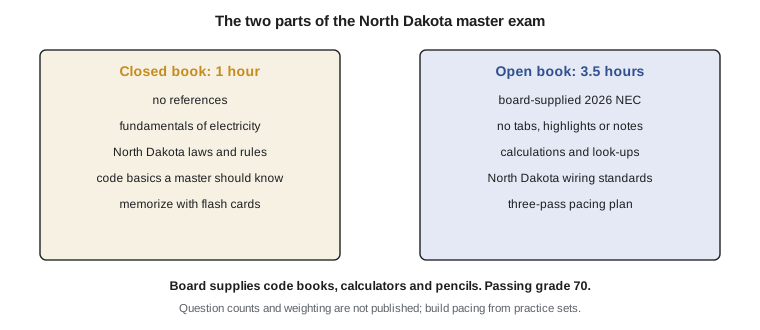
The closed book part
A closed book part tests what a master is expected to know without looking it up. The board's list of subjects suggests what that is likely to include: fundamental electricity such as Ohm's law, power, series and parallel circuits and power factor; North Dakota law and rules, such as who may contract, the license classes, apprentice supervision and wiring certificates; and the code rules a master uses so often that they should be second nature. Treat this as an informed guess, not a published outline.
Studying for a closed book part means memorizing, and memorizing works best with short, repeated sessions. Kari made a deck of cards: one side a question, the other the answer and its source. Her law cards came from Lessons 1 to 3 and 5 to 11 of this course, and her fundamentals cards came from MELU-101. She went through them for fifteen minutes every morning before work and sorted out the cards she missed for an extra pass at night.
- Statute and rule facts: license classes, who may contract, experience hours, fees and expiration dates, apprentice ratio, insurance amount, renewal and education hours.
- Wiring certificate facts: the 500-dollar threshold, the startup copy, the 15-day completion deadline, the 12-month life of small certificates, and the late and reinspection charges.
- Fundamentals: Ohm's law, power formulas for single-phase and three-phase circuits, voltage drop, series and parallel combinations, and power factor.
- Code basics a master should know cold: the layout of the chapters, common definitions and the main articles for services, feeders, branch circuits, grounding and overcurrent protection.
The open book part
The open book part tests whether a master can find and apply the code under time pressure. Three and a half hours is long, but a master exam fills it with calculations and look-ups. The board's own copy of the code will be on the desk. It will be the correct edition, and it will have no tabs, highlighting or notes. That changes how to practice.
Many candidates in other states rely on permanent tabs and a highlighted personal copy. In North Dakota that habit can backfire. A candidate who has always found Article 250 by grabbing a colored tab may be slow with a clean book. Kari did all her practice in a second, unmarked copy of the 2026 NEC, kept separate from her work copy, and used only the index, the table of contents and the article numbers printed at the top of each page. She found that learning the order of the chapters and the approximate page range of the busiest articles saved more time than tabs ever had.
- Learn the chapter order: general rules in Chapters 1 to 4, special occupancies in 5, special equipment in 6, special conditions in 7, communications in 8 and tables in Chapter 9 and the annexes.
- Learn where the big articles sit: definitions in Article 100, general requirements in 110, branch circuits in 210, feeders in 215, load calculations in 220, services in 230, overcurrent protection in 240 and grounding and bonding in 250.
- Use the index with key words from the question, then check the article's scope before trusting a rule.
- Read exceptions and informational notes around any rule you find, since many exam questions turn on an exception.
The North Dakota wiring standards are a separate document. The board's page says the exam is based on the state's laws, rules and wiring standards as well as the NEC, but it does not say which documents are on the desk for which part. Assume you must know the state amendments well enough to answer without the text, and treat any state material provided at the exam as a bonus. Lesson 5 covers the amendments.
Pacing
The real question count is not published, so Kari built her pacing from a practice set. Her practice exam for the open book part had 70 questions in 210 minutes, which is three minutes per question. She planned three passes. In the first pass she answered every question she could solve in under two minutes and marked the rest. In the second she worked the marked questions that needed a calculation or a longer search. In the last she made her best choice on anything left and checked her answer sheet. Lesson 12 covers this plan in more detail.
# Illustrative pacing for a 3.5-hour open book part (the real question count is not published)
minutes = 3.5 * 60
questions = 70                    # Kari's practice set, not the real exam
per_question = minutes / questions
pass1 = 0.55 * minutes            # quick answers, mark the rest
pass2 = 0.35 * minutes            # calculations and long look-ups
pass3 = minutes - pass1 - pass2   # final choices and answer-sheet check
print(f"Average: {per_question:.1f} minutes per question")
print(f"Pass 1: {pass1:.0f} min, pass 2: {pass2:.0f} min, pass 3: {pass3:.0f} min")Average: 3.0 minutes per question Pass 1: 116 min, pass 2: 74 min, pass 3: 21 min
For the closed book part, one hour is short, and closed book questions are usually quick: either you know the answer or you do not. Kari planned to go through once at a steady pace, mark anything she was unsure about, and come back with whatever time was left.
Calculators and other items
The board provides calculators. A candidate should therefore practice with a basic scientific calculator that has square root and memory functions, rather than relying on a programmable model or a phone app that will not be allowed. Kari bought an inexpensive scientific calculator and used only that one for every practice problem, so that she would not be slowed by unfamiliar keys on exam day. Check with the board office about what else you may bring, such as a photo identification, which you will need, and whether a watch is allowed in the room.
How the exam is scored and reported
The board grades the exam and reports the score to the candidate. Because the board no longer provides exam reviews, the score is all the feedback a candidate receives. A pass leads to the license once the fee is paid. A score below 70 leads to the waiting periods in Lesson 3. Because the board does not publish how the closed and open book parts combine, a candidate should aim to do well on both and not count on a strong open book part to carry a weak closed book part.
Worked problem
Planning the open book part with a clean code book
Kari's practice question asks for the minimum size of a copper grounding electrode conductor for a service with given conductors. She has a clean code book. What is her search path?
Show solution
- Recognize the topic: grounding electrode conductor sizing, which is in Article 250.
- Open near the middle of Chapter 2, find Article 250 from the page headers, and look for the part on grounding electrode conductors.
- Find the sizing table that Article 250 refers to for grounding electrode conductors, read the row for the service conductor size, and note any notes under the table.
- Check for a North Dakota amendment to Article 250 that changes the connection point, which Lesson 5 covers.
Answer: A path that relies on the chapter order and page headers rather than tabs.
Building a closed book deck
Kari's deck grew to about 180 cards by exam week. She grouped them by source so she could see what she was weakest on: the Century Code, the board's licensing rules, the wiring certificate and fee rules, the wiring standards, the Secretary of State contractor law, the lien chapter, safety and workers compensation, and fundamentals. Each card gave the source on the back, such as 24.1-05-01-01 or 43-09-20, which helped her recognize the rule when a question was worded differently from her card.
She also made a one-page sheet of numbers, because North Dakota law questions are often about numbers: 500 dollars for a wiring certificate, 15 days to file the final, 12 months for a small certificate, 2,000 hours for a master, 8,000 for a journeyman, 3,000 for class B, three apprentices per licensed electrician, 500,000 dollars of liability insurance, 4,000 dollars for a Secretary of State license, 90 days to record a lien, eight hours of education with four on the code, and the April 30 and March 31 expiration dates. She read the sheet every night for the last two weeks.
Fundamentals still matter
Master candidates who have spent years in the field sometimes neglect the theory. The board lists fundamental electricity as one of the exam's subjects, and fundamentals questions are often the easiest points on the exam for a candidate who has practiced them and the hardest for one who has not. Review Ohm's law and the power formulas, three-phase relationships between line and phase values, the effect of power factor on current, voltage drop calculations, and series and parallel combinations of resistance. MELU-101 and MELU-102 have practice sets on each.
On exam morning Kari planned to spend the first two minutes of the open book part paging once through the board's copy to get a feel for its layout, checking that it was the 2026 edition and finding where Chapter 9 and the index begin. A clean book from the same printing as her study copy would match page for page, but she did not count on it.
Common mistakes
MistakeBringing a tabbed personal code book.
InsteadThe board provides the code books; plan to use an unmarked copy.
MistakeStudying only from the code for the closed book part.
InsteadThe closed book part likely includes North Dakota law and rules and fundamentals, which must be memorized.
MistakeAssuming the question count from another state's exam.
InsteadThe board does not publish its question count; use practice sets to build pacing.
MistakePracticing with a programmable calculator.
InsteadThe board provides calculators; practice with a basic scientific model.
MistakeCounting on a strong open book score to make up a weak closed book part.
InsteadThe board does not publish how the parts combine; prepare for both.
Summary and key terms
- The master exam has a one-hour closed book part and a three-and-a-half-hour open book part.
- Exams are based on fundamentals, North Dakota laws, rules and wiring standards, and the current NEC; from December 2026, the 2026 editions.
- The board provides code books, calculators and pencils; practice in a clean code book.
- The passing grade is 70; the board does not publish question counts or how the parts combine.
- Memorize law, rule and fundamentals facts for the closed part; learn the code's layout for the open part.
- Plan a pace from practice sets and use a three-pass approach on the open part.
- Closed book
- An exam part taken without reference materials.
- Open book
- An exam part in which a reference, here the board-supplied code book, may be used.
- Wiring standards
- The North Dakota rules in N.D. Admin. Code article 24.1-06 that amend the NEC.
- Pacing plan
- A plan for how much time to spend on each pass through an exam part.
- Exam review
- A look at missed questions after an exam, which the board stopped providing in 2012.
Practice problems
Work each problem on paper first, then reveal the answer to check.
How long is the closed book part of the master exam?
Show answer
One hour.
How long is the open book part?
Show answer
Three and a half hours.
Who provides the code book at the exam?
Show answer
The State Electrical Board.
Which code edition will a candidate use in a December 2026 exam?
Show answer
The 2026 NEC, with the 2026 North Dakota laws, rules and standards.
Why should a candidate practice with a clean code book?
Show answer
Because the board's code book has no tabs or notes, and search habits built on tabs will be slower.
Lesson quiz · 5 questions
Score 60% or more to complete this lesson.
Create a free account to save your progress, take quizzes and earn a certificate.