
MELU-309 · Lesson 2 of 12 · 20 min
Eligibility for the Master Electrician License
▶ Video coming soon A video version of this lesson is on the way.
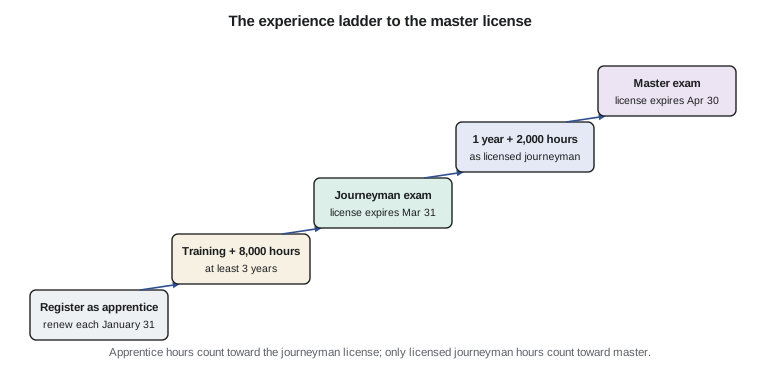
Before Kari could plan her studying, she had to answer a simpler question: was she eligible to sit the master exam at all? In North Dakota the answer turns on experience. The statute and the rules set a ladder of hours, and each rung has to be documented and verified by the board before an exam invitation goes out. This lesson walks up the ladder from apprentice registration to the master license, explains how hours are counted and credited, and shows how Kari checked her own record before she applied.
The statutory rule
Section 43-09-11 of the Century Code sets the basic qualification for each class. For a master electrician, the statute requires one year of experience as a licensed journeyman electrician. The board's rule in N.D. Admin. Code 24.1-03-01-02 adds the measure the board actually checks: at least 2,000 hours of experience working as a licensed journeyman electrician, under a contracting master or master of record. Both parts matter. A journeyman who has held the license for a full year but worked only part-time may not yet have 2,000 hours, and hours worked before the journeyman license was issued do not count toward the master requirement, however many there are.
The requirement is short compared with many states, but it sits on top of a long journeyman requirement. A North Dakota master has, at minimum, 8,000 hours as a registered apprentice over at least three years, a passed journeyman exam, and then 2,000 more hours as a licensed journeyman. In practice most master candidates have far more than the minimum.
The journeyman rung
Because the master requirement builds on the journeyman license, a master candidate should understand how that license was earned, especially if the candidate was licensed elsewhere or may supervise apprentices who are now climbing the same ladder. Under N.D. Admin. Code 24.1-03-01-03, a journeyman needs 8,000 hours of experience, taking no less than three years, while registered as an apprentice and working under a contracting master or master of record in a jurisdiction with licensing and inspection requirements similar to North Dakota's. The apprentice must also complete apprentice training.
The rule then sets limits on how the 8,000 hours may be made up. At least 4,000 hours must be practical wiring and installation experience. Graduates of a board-accepted electrical school of two years or more may receive 2,000 hours of credit. Some kinds of work count only up to a cap: repair work and light, heat and power up to 1,000 hours, fire alarm circuits or systems up to 1,000 hours, process control or power limited systems up to 2,000 hours, and board-approved electrical construction work in the armed forces up to 2,000 hours. Up to 3,000 hours of class B experience may count toward the journeyman license.
| Kind of experience or credit | How it counts toward 8,000 journeyman hours |
|---|---|
| Wiring and installation | At least 4,000 hours required; up to 8,000 credited |
| Two-year or longer electrical school | Up to 2,000 hours |
| Repair work and light, heat and power | Up to 1,000 hours |
| Fire alarm circuits or systems | Up to 1,000 hours |
| Process control or power limited systems | Up to 2,000 hours |
| Board-approved armed forces electrical work | Up to 2,000 hours |
Apprentice training itself has a rule. Under N.D. Admin. Code 24.1-03-01-07, an apprentice qualifies to sit for the journeyman or class B exam after either at least two years of board-approved electrical school, or 576 hours of training classes or a board-recognized professional electrician program. An apprentice who has not completed one of those can still register and work, but cannot sit the exam. Hours worked under a power limited electrician do not count toward the master, journeyman or class B licenses.
The master rung in practice
Kari's record was straightforward. She completed a two-year electrical program, which the board credited with 2,000 hours, then worked as a registered apprentice for Souris Bend for just over three years, logging about 6,400 hours of wiring and installation. She passed the journeyman exam and received her license in March 2019. Since then she has worked full time for Souris Bend under Dale's license, about 2,000 hours a year. By September 2026 she had more than seven years and well over 2,000 hours as a licensed journeyman, so she met the master requirement with a wide margin.
Not every candidate is so simple. Arlo Haugen, Souris Bend's office manager, keeps the files for two other electricians who have asked about the master exam. One is a journeyman who spent three of his licensed years working in Montana. The other is a journeyman who worked several years for a plant as a maintenance electrician under a master of record. Each case turns on the same questions: was the person licensed as a journeyman during the hours claimed, were the hours under a contracting master or master of record, and can an employer verify them in writing?
Worked problem
Counting master hours
A journeyman licensed on March 15, 2025 worked full time at 40 hours a week for 48 weeks a year. When will she have one year and 2,000 hours as a licensed journeyman?
Show solution
- One year of licensure is reached on March 15, 2026.
- 48 weeks at 40 hours is 1,920 hours in a year of work.
- She needs 80 more hours after March 15, 2026, about two more weeks at 40 hours.
- Hours worked before March 15, 2025, as an apprentice, do not count toward the master requirement.
Answer: About the end of March 2026, when both the one-year and the 2,000-hour tests are met.
# Checking both parts of the master requirement (illustrative)
from datetime import date, timedelta
licensed = date(2025, 3, 15)
hours_per_week, weeks_per_year = 40, 48
hours_per_year = hours_per_week * weeks_per_year
one_year = date(licensed.year + 1, licensed.month, licensed.day)
short = max(0, 2000 - hours_per_year)
extra_weeks = -(-short // hours_per_week)
eligible = one_year + timedelta(weeks=extra_weeks)
print(f"Hours in first licensed year: {hours_per_year}")
print(f"Short of 2,000 after one year: {short} hours, about {extra_weeks} weeks")
print(f"Earliest date both tests are met: {eligible}")Hours in first licensed year: 1920 Short of 2,000 after one year: 80 hours, about 2 weeks Earliest date both tests are met: 2026-03-29
Experience gained in other states
Experience earned outside North Dakota can count, but it has to meet the same standard: supervised work in a jurisdiction with licensing and inspection requirements similar to North Dakota's. For journeyman-level applicants with experience from another state, the apprentice rule allows the board to require a placement exam to verify practical experience, and a candidate who fails that placement exam may not retake it, though a written appeal to the board within 30 days is possible. The rules also close a loophole: a person who was licensed in another state on the basis of experience gained mostly in North Dakota cannot use that license to take the North Dakota exam or get a reciprocal license.
Reciprocity is a separate path to a North Dakota license, without the written exam. Section 43-09-25 lets the board license an electrician from another state in the same class if that state offers reciprocal licensing and its qualifications match North Dakota's. The board's reciprocity page lists master reciprocity with Iowa, Minnesota and South Dakota, and a longer list of states for the journeyman license. A reciprocal master applicant must have passed the written exam in the home state, hold a current license in good standing, have held it continuously for the year before applying, and show 10,000 hours of supervised experience under a contracting master in a state with similar rules. Lesson 11 returns to reciprocity in both directions.
Class B and power limited are not steps to master
The class B license is a separate path, not a rung below the master. A class B electrician needs 3,000 hours over at least 18 months of farmstead or residential wiring in one- and two-family dwellings, under a master or class B electrician, and commercial work does not count. Graduates of a board-approved two-year electrical school may receive 1,000 hours of credit. A class B holder may contract within the class B scope. To become a master, a class B electrician must still earn the journeyman license and then the master hours, although up to 3,000 class B hours can help toward the journeyman requirement.
The power limited license is a separate path too, for electricians who plan and supervise power limited systems such as signaling, communications and control wiring. It requires 6,000 hours over at least two and a half years as a registered power limited apprentice, or a recognized certification, and its hours do not count toward the master. A power limited electrician may contract for power limited installations only.
Character and conduct
The board looks at more than hours. Section 43-09-09.1 says a criminal conviction does not by itself bar a license unless the board finds that the offense has a direct bearing on the person's ability to serve the public as an electrician, or that the person is not sufficiently rehabilitated. Past discipline matters as well. The board can deny a license for the same reasons it can discipline one, including fraud in an application. Every statement in the application and the experience verification should be accurate and complete.
Documenting the hours
The board decides eligibility from the employment verification of electrical construction experience that comes with the application. Each employer for the period claimed confirms the dates, hours and kind of work, and the board compares the dates with its own license records. A candidate who changed employers, worked out of state or was self-employed should gather this paperwork early. Kari asked Dale to sign her verification in August, then asked Arlo to check the hours against the company's payroll records so that the numbers on the form matched what the company could prove if the board asked.
Arlo's checklist for any master applicant is short: the date of the journeyman license, the employer or employers since then, the total hours since licensure, the name of the contracting master or master of record for each period, and the kind of work. If the employer has closed or will not sign, the candidate should call the board before applying to ask what other proof will be accepted.
A note on part-time and seasonal work
North Dakota electrical work is seasonal for many shops. Farm service, grain handling and oil-country work peak in different months, and some journeymen work part of the year in another trade or another state. The master rule measures hours, not just time, so a journeyman who works only part of each year needs to count carefully. Keep pay stubs or a simple log of hours by month from the day the journeyman license is issued. If the hours came from more than one contracting master, each should sign for his or her share. Board staff can tell a candidate before filing whether a particular pattern of work will be accepted.
Common mistakes
MistakeCounting apprentice hours toward the 2,000 master hours.
InsteadOnly hours as a licensed journeyman count toward the master requirement.
MistakeTreating one year of licensure alone as enough.
InsteadThe rule also requires at least 2,000 hours as a licensed journeyman.
MistakeThinking a class B license is a step on the way to master.
InsteadClass B is a separate license; a master needs the journeyman license first.
MistakeAssuming power limited hours count toward the master license.
InsteadHours worked under a power limited electrician do not count toward master, journeyman or class B.
MistakeApplying for reciprocity with a license earned mostly on North Dakota experience.
InsteadThe rules bar that use of an out-of-state license.
Summary and key terms
- A master needs one year and at least 2,000 hours as a licensed journeyman, under a contracting master or master of record.
- A journeyman needs 8,000 hours over at least three years as a registered apprentice, with at least 4,000 hours of wiring and installation.
- School and some kinds of work count only up to set caps.
- Class B and power limited licenses are separate paths, not steps toward master.
- Master reciprocity is listed with Iowa, Minnesota and South Dakota, with 10,000 supervised hours and a passed written exam.
- The board decides eligibility from a signed employment verification, so gather proof early.
- Employment verification
- The form on which employers confirm an applicant's dates, hours and kind of electrical work.
- Registered apprentice
- A person registered with the board who learns the trade under direct, constant supervision.
- Placement exam
- An exam the board may require to verify practical experience gained outside North Dakota.
- Reciprocity
- Licensing in the same class, without the written exam, for a qualified holder from a state with a reciprocal agreement.
- Class B electrician
- A license for farmstead wiring and one- and two-family dwellings in cities of 2,500 or fewer.
Practice problems
Work each problem on paper first, then reveal the answer to check.
A journeyman has held her license for 14 months and worked 1,700 hours. Is she eligible for the master exam?
Show answer
Not yet; she meets the one-year test but needs 2,000 hours as a licensed journeyman.
Do the 6,400 hours Kari worked as an apprentice count toward the master?
Show answer
No; they counted toward her journeyman license.
How many hours of credit can a two-year electrical school give toward the journeyman license?
Show answer
Up to 2,000 hours.
Which states does the board list for master reciprocity?
Show answer
Iowa, Minnesota and South Dakota; confirm the current list before applying.
Can a power limited electrician use those hours toward a master license?
Show answer
No; power limited hours do not count toward master, journeyman or class B.
Lesson quiz · 5 questions
Score 60% or more to complete this lesson.
Create a free account to save your progress, take quizzes and earn a certificate.