
MELU-309 · Lesson 5 of 12 · 20 min
The NEC as adopted in North Dakota and state amendments
▶ Video coming soon A video version of this lesson is on the way.
On July 1, 2026, the rules changed for every electrical job in North Dakota. That day the State Electrical Board's updated wiring standards took effect, adopting the 2026 edition of the National Electrical Code with the board's own North Dakota amendments. Souris Bend had jobs under way on both sides of the date, and Arlo spent a week in June sorting the company's open wiring certificates into those started under the old rules and those that would start under the new ones. For Kari, the change meant that the master exam she would sit in December would test the 2026 code, not the 2023 code she had used for most of her career. This lesson explains how North Dakota adopts the NEC, what the state amendments cover, how they interact with other codes, and how to handle a job that spans an adoption date.
Statewide adoption by rule
In some states each city adopts its own electrical code, and editions differ from town to town. North Dakota does it once, for the whole state. The board adopts the National Electrical Code by rule in N.D. Admin. Code article 24.1-06, the wiring standards, and the general policy rule in 24.1-02-01-02 states the goal: uniform rules for installation and inspection across North Dakota, based on the National Electrical Code. The same edition and the same amendments apply in Minot, in Fargo, on a farmstead in Ward County and on an oil-country site in McKenzie County.
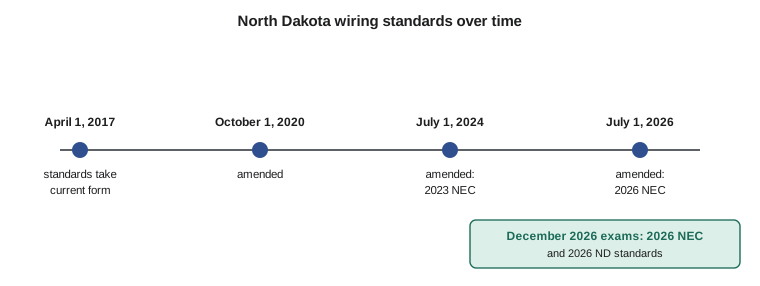
The adoption history shows the pattern. The wiring standards first took their current form effective April 1, 2017, and the board has amended them each time it moved to a new edition: October 1, 2020, July 1, 2024 and July 1, 2026. The section history notes in each chapter of article 24.1-06 list these dates. The July 1, 2024 change adopted the 2023 NEC. The July 1, 2026 change adopted the 2026 NEC, which the rules describe as the 2026 edition, first version printed in 2025.
How the wiring standards are organized
Article 24.1-06 mirrors the structure of the NEC. Chapter 24.1-06-01 covers general requirements, 24.1-06-02 wiring and protection, 24.1-06-03 wiring methods and materials, 24.1-06-04 equipment for general use, 24.1-06-05 special occupancies and 24.1-06-06 special equipment. Within each chapter, the section number follows the NEC article it amends. Section 24.1-06-02-30 amends Article 230, section 24.1-06-02-50 amends Article 250, and section 24.1-06-05-01 amends Article 500. Sections with nothing to add are marked reserved.
That pattern is worth memorizing for the exam. If a question asks about a North Dakota rule on services, the amendment is in 24.1-06-02-30. If it asks about grounding, look to 24.1-06-02-50. Each section typically adopts the NEC article and then adds or changes specific requirements. Where the state is silent, the NEC rule applies as published.
What the amendments cover
The amendments are not long, but they change rules that come up every week on a North Dakota job. The summaries below are in plain words. They describe what each section addresses; they do not reproduce the text, and they are no substitute for reading the current rule.
| Section | NEC article | What the North Dakota rule addresses |
|---|---|---|
| 24.1-06-01-10 | General | Adequate capacity, a limit on voltage drop at the farthest outlet, listed materials, approval of unlisted methods, extra rules for schools, healthcare facilities and aluminum wiring, and energy-related rules for new construction |
| 24.1-06-01-20 | General | Replacing or reconditioning water-damaged electrical equipment |
| 24.1-06-01-40 | General | Smoke, heat and carbon monoxide alarms: installed by a master or class B electrician, powered by building wiring with battery backup in new construction, interconnected where required |
| 24.1-06-02-10 | 210 | Branch circuits: load balancing, kitchen and bathroom circuits, GFCI and AFCI protection, and corridor cleaning outlets |
| 24.1-06-02-15 | 215 | Feeders: dwelling units and certain sleeping rooms exempted from feeder surge protection |
| 24.1-06-02-30 | 230 | Services: service masts, outdoor switch height, one service location in single-family homes, minimum 100-ampere panels on certain work, sizing for electric heat, and fire-wall separation |
| 24.1-06-02-40 | 240 | Overcurrent protection: exterior devices at least two feet above grade, and no panelboards in bathrooms, closets, stairways or crawl spaces |
| 24.1-06-02-50 | 250 | Grounding and bonding: flexible conduit to motors, metal outdoor lighting poles over 12 feet, and the grounding electrode conductor connection at the service disconnect |
| 24.1-06-03-01 | 300 | Wiring methods: agricultural buildings, limits on EMT and aluminum conduit, PVC expansion, and metal raceway or MC cable in hospitals, nursing homes and assembly occupancies |
| 24.1-06-03-14 | 314 | Boxes: one extension ring per box unless the inspector permits more |
| 24.1-06-05-01 | 500 | Hazardous locations: classification documented by a qualified person, oilfield guidance, surge arrestors on grain elevator services and hot bearing detection |
| 24.1-06-05-50 | 550 | Manufactured homes: service equipment on the home only in limited cases on owned land with a permanent foundation |
Several of these amendments reflect North Dakota's work. The agricultural building rules in the wiring methods section and the grain elevator surge arrestor and hot bearing detection rules in the hazardous locations section exist because farm and grain work is a large share of the state's electrical work. The oilfield reference in the hazardous locations section reflects the Bakken. The rule on outdoor overcurrent devices above grade reflects snow. A master candidate in North Dakota should expect exam questions on these rules, because they are what makes the state's code different.
Alarms are electrician work
The alarm rule in 24.1-06-01-40 deserves special attention because it reaches beyond the NEC. It requires smoke alarms, heat alarms in new attached garages, fire alarm systems and carbon monoxide alarms where they are required for evacuation and life safety, and it requires that they be installed by a master or class B electrician. In new construction they must be powered by the building wiring with battery backup and interconnected where required. Carbon monoxide alarms are required where there are fuel-fired appliances or an attached garage. A homeowner who buys a battery smoke alarm can hang it, but the alarm system in a new house is part of the electrical installation, on the wiring certificate and subject to inspection.
Other codes and the more restrictive rule
The NEC is not the only document that touches electrical work. The policy rule in 24.1-02-01-02 says that where the wiring standards conflict with NFPA 70, NFPA 101 or the fire-related provisions of a locally adopted code or the State Building Code, the more restrictive requirement applies as the minimum. The administrative powers rule in 24.1-02-01-03 lists the codes the executive director enforces: NFPA 70, the electrical code; NFPA 72, the fire alarm code; NFPA 101, the life safety code; and NFPA 110, for emergency and standby power systems, along with the fire-related provisions of locally adopted codes and the State Building Code. The egress lighting rule in 24.1-06-01-30 points to the life safety code for exit marking and emergency lighting.
The practical rule for a master is simple. When two adopted documents differ, follow the stricter one, and when in doubt, ask the inspector before the work is installed. A rule that conflicts with a city's building code fire provisions is resolved the same way.
Special permission
The NEC allows special permission in some sections, meaning written consent of the authority having jurisdiction. In North Dakota that authority is the executive director of the board, acting under 24.1-02-01-03. The executive director may approve a modification or waiver in writing, but only before the work begins, and only where the rules allow it or where advances in technology make it advisable in the public interest. A master who installs something nonstandard first and asks later has no special permission to rely on. Some amendments give the electrical inspector a similar role, such as the rule allowing more than one extension ring on a box only with the inspector's permission.
Jobs that span an adoption date
When the board adopts a new edition, the question every contractor asks is which edition applies to a job already under way. The rules set an effective date for the new standards, but they do not spell out a transition rule for every case. Arlo's practice at Souris Bend is to apply the edition in effect when the wiring certificate's startup copy is filed and work begins, and to call the district inspector about any job that started under the old edition and will finish under the new one. The inspector's answer goes in the job file. For new work that starts after July 1, 2026, the 2026 code and the 2026 North Dakota standards apply.
Worked problem
Which edition applies?
Souris Bend filed a wiring certificate and started rough-in on a machine shed on June 15, 2026. A second shed on the same farm was started on July 20, 2026. Which code applies to each?
Show solution
- July 1, 2026 is the effective date of the 2026 standards.
- The first shed started under the 2023 NEC and the July 1, 2024 standards; confirm with the district inspector how it will be inspected at final.
- The second shed started after July 1, 2026, so the 2026 NEC and the 2026 North Dakota standards apply.
- Record the inspector's answer in each job file.
Answer: The second shed is under the 2026 rules; the first should be confirmed with the inspector.
# Sorting open jobs around the July 1, 2026 adoption date (illustrative)
from datetime import date
effective = date(2026, 7, 1)
jobs = {"machine shed A": date(2026, 6, 15), "machine shed B": date(2026, 7, 20),
        "shop addition": date(2026, 5, 2), "new house": date(2026, 9, 8)}
for name, started in sorted(jobs.items(), key=lambda kv: kv[1]):
    rule = "2026 NEC and 2026 ND standards" if started >= effective else "started under 2023 rules: confirm with inspector"
print(f"{name} (started {started}): {rule}")shop addition (started 2026-05-02): started under 2023 rules: confirm with inspector machine shed A (started 2026-06-15): started under 2023 rules: confirm with inspector machine shed B (started 2026-07-20): 2026 NEC and 2026 ND standards new house (started 2026-09-08): 2026 NEC and 2026 ND standards
Reading an amendment the right way
Each amendment section in article 24.1-06 adopts an NEC article and then adds or changes specific requirements. Read the NEC section first to understand the baseline, then read the North Dakota section to see what is added, deleted or made stricter. Where an amendment adds a requirement, the NEC rule still applies alongside it. Where an amendment replaces a rule, the state text controls. Kari kept a list of the amended NEC sections in the margin of her study copy, so that when she looked up a rule in one of those articles she remembered to check the state text too.
The amendments also change from edition to edition. When the board moved from the 2023 to the 2026 code, several sections were amended again on July 1, 2026, and some earlier changes were dropped because the new NEC already covered them. Study the current text, not notes from a class taken under the old edition.
Common mistakes
MistakeAssuming cities adopt their own electrical code editions.
InsteadThe board adopts the NEC and its amendments statewide by rule.
MistakeStudying the 2023 NEC for current North Dakota work.
InsteadThe 2026 NEC with the 2026 North Dakota standards has applied since July 1, 2026.
MistakeTreating smoke and carbon monoxide alarms as outside electrical work.
InsteadRule 24.1-06-01-40 requires a master or class B electrician to install them.
MistakeAsking for special permission after the work is installed.
InsteadThe executive director may grant it in writing only before the work begins.
MistakeFollowing the NEC where a stricter adopted fire or life safety rule applies.
InsteadThe more restrictive requirement applies as the minimum.
Summary and key terms
- The board adopts the NEC statewide by rule in N.D. Admin. Code article 24.1-06.
- The 2026 NEC with North Dakota amendments took effect July 1, 2026; the 2023 NEC applied from July 1, 2024.
- Rule section numbers follow the NEC article: 24.1-06-02-30 for Article 230, 24.1-06-02-50 for Article 250.
- Amendments cover alarms, branch circuits, services, overcurrent device location, grounding, wiring methods, boxes, hazardous locations and manufactured homes.
- Where adopted documents conflict, the more restrictive requirement applies.
- Special permission comes in writing from the executive director before work begins.
- Wiring standards
- The North Dakota rules in article 24.1-06 that adopt and amend the NEC.
- State amendment
- A North Dakota rule that adds to or changes a requirement of the NEC.
- Special permission
- Written consent of the authority having jurisdiction, here the executive director, given before work begins.
- More restrictive rule
- The principle in 24.1-02-01-02 that the stricter of conflicting adopted requirements applies.
- Effective date
- The date an adopted edition and its amendments begin to apply.
Practice problems
Work each problem on paper first, then reveal the answer to check.
Which rule section amends NEC Article 240?
Show answer
24.1-06-02-40.
Who may install smoke alarms in a new North Dakota house?
Show answer
A master or class B electrician, under 24.1-06-01-40.
Can a city in North Dakota adopt the 2020 NEC for its own electrical work?
Show answer
No; the board's standards apply statewide.
A design uses an alternative method the code allows only with special permission. When must the master get it?
Show answer
In writing from the executive director before work begins.
Where may a panelboard not be placed under the North Dakota rule?
Show answer
In bathrooms, closets, stairways or crawl spaces, under 24.1-06-02-40.
Lesson quiz · 5 questions
Score 60% or more to complete this lesson.
Create a free account to save your progress, take quizzes and earn a certificate.