
MELU-309 · Lesson 12 of 12 · 20 min
Practice exam review and test-day strategy
▶ Video coming soon A video version of this lesson is on the way.
Eight weeks before her December exam, Kari took her first full practice exam at the dining room table: a one-hour closed book set and a three-and-a-half-hour open book set, timed, in a clean copy of the 2026 NEC, with the same basic calculator she would be handed in Bismarck. She scored 64 on the closed part and 71 on the open part. Three weeks later she scored 70 and 76, and the week before the exam 78 and 82. The improvement did not come from reading more of the code. It came from studying her mistakes. This last lesson sets out the method she used: how to take a practice exam, how to review it, how to turn the review into a plan, and how to manage the clock and the book on test day. It ends with what happens after the score arrives.
The numbers in this lesson are illustrative. The board does not publish its question counts, so build your own pacing from practice sets with the board's published times: one hour closed book and three and a half hours open book for the master exam.
Taking a practice exam properly
A practice exam is useful only if it is taken the way the real exam will be. That means both parts in one sitting with a short break, the real time limits, a code book with no tabs or notes, the same basic calculator, and no looking at answers until the end. North Dakota adds a special condition: for the closed book part, nothing at all. Kari put her phone and code book in another room for the first hour.
Use practice questions written for the right edition and the right level. Questions written for the 2023 NEC can teach the wrong answer after the 2026 changes, and journeyman questions will not show the depth of a master exam. For the North Dakota law and wiring standards questions, write your own from Lessons 1 to 11 of this course, because national practice books do not cover them. The core courses in this series, MELU-101 through MELU-107, include practice questions by topic for drilling between full exams.
Reviewing every question
The review is where the learning happens, and it should take longer than the exam. Go through every question, not just the wrong ones, because a right answer reached by a lucky guess is a weakness too. For each question, find the code section or North Dakota rule that answers it, confirm the answer, and if you got it wrong or guessed, decide why. Kari sorted every miss into one of six causes.
- Did not know a North Dakota fact: a statute or rule detail, such as a deadline, fee, ratio or license scope, that had to be memorized.
- Did not know where to look: the code section was not familiar and the index search in a clean book failed or took too long.
- Found the wrong rule: the right article but the wrong section, exception or table, or missed a North Dakota amendment.
- Misread the question: missed a word such as minimum, maximum, not or except, or a detail such as the voltage or the occupancy.
- Calculation error: a wrong step, a skipped factor or a keying mistake.
- Ran out of time: never reached the question or guessed in the last minutes.
Each cause has its own fix. Missing North Dakota facts calls for more flash cards. Not knowing where to look calls for more index practice in a clean book. Finding the wrong rule calls for reading the whole section, including exceptions, and checking for an amendment in article 24.1-06. Misreading calls for slowing down on the question stem. Calculation errors call for working each calculation the same way every time and checking units. Running out of time calls for the pacing plan below.
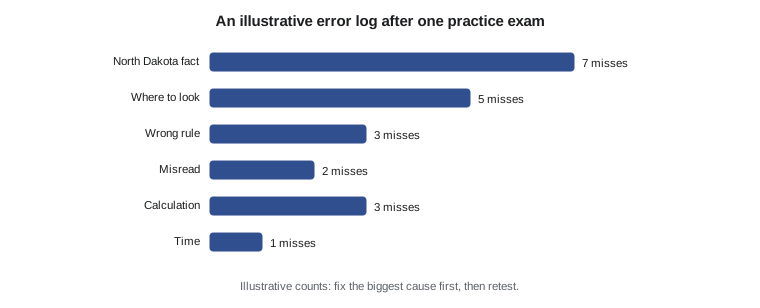
The error log
Kari kept an error log: one line for each missed or guessed question, giving the part of the exam, the topic, the source, the cause and a one-sentence note on what she should have done. After each practice exam, she counted misses by cause and by topic. After her first exam the biggest cause was North Dakota facts, almost all in the closed part, so she spent two weeks on her flash card deck. After her second, the biggest cause was where to look in the open part, mostly in Chapters 5 and 6, so she drilled the index for those chapters.
# Error log summary after a practice exam (illustrative entries)
from collections import Counter
log = [("closed", "wiring certificates", "ND fact"), ("closed", "apprentices", "ND fact"),
       ("open", "hazardous locations", "where to look"), ("open", "load calculation", "calc error"),
       ("closed", "liens", "ND fact"), ("open", "services", "wrong rule"),
       ("open", "motors", "calc error"), ("open", "special equipment", "where to look"),
       ("closed", "contractor license", "ND fact"), ("open", "grounding", "misread")]
by_cause = Counter(cause for _, _, cause in log)
by_part = Counter(part for part, _, _ in log)
print("By cause:", ", ".join(f"{c} {n}" for c, n in by_cause.most_common()))
print("By part:", ", ".join(f"{p} {n}" for p, n in by_part.most_common()))By cause: ND fact 4, where to look 2, calc error 2, wrong rule 1, misread 1 By part: open 6, closed 4
A study plan from the log
The log turns into a plan. Kari's eight-week plan had three phases. In weeks one to three she worked through the North Dakota material and the topics where her first practice exam showed the most misses. In weeks four to six she drilled calculations and index searches, took a second full exam, and reworked her weakest topics. In weeks seven and eight she took a final full exam, reviewed every miss, and spent the last few days only on flash cards and light review. She stopped serious studying two days before the exam and slept.
| Week | Focus | Full practice exam |
|---|---|---|
| 1 to 3 | North Dakota law, rules and wiring standards; weakest code topics | Week 1 |
| 4 to 6 | Calculations, index drills in a clean book, second review of weak topics | Week 4 |
| 7 to 8 | Final review, flash cards, rest | Week 7 |
The closed book part on test day
The closed part is one hour, and its questions are quick: you know the answer or you do not. Kari's plan was one steady pass, answering every question she was sure of and marking the rest, then a second pass on the marked questions with whatever time was left. She did not change answers on the second pass unless she found a clear reason. With no reference allowed, the best preparation is the flash card deck built from Lessons 1 to 11: license classes, contracting rules, experience hours, fees and expiration dates, the apprentice ratio, wiring certificate deadlines and fees, insurance, the Secretary of State classes, lien deadlines, the reporting clocks and continuing education.
The open book part on test day
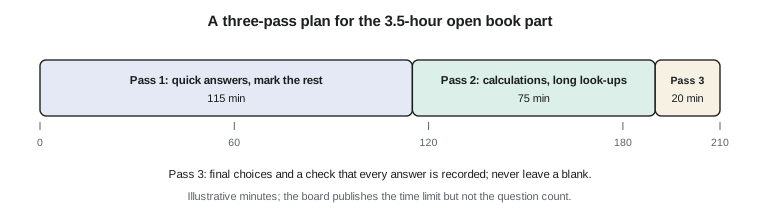
The open book part is three and a half hours with a board-supplied code book. Kari used a three-pass plan. In the first pass she answered every question she could solve in under two minutes, which was most of the definitions and straightforward look-ups, and marked the rest. In the second she worked the marked questions that needed a calculation or a longer search. In the third she made her best choice on anything left and checked that every answer was recorded. Because there is no penalty stated for a wrong answer, a blank answer is a lost point; never leave one blank at the end.
# Checking progress at the halfway point of the open book part (illustrative)
total_minutes = 210
practice_questions = 70
answered_at_half = 41
expected_at_half = practice_questions / 2
ahead = answered_at_half - expected_at_half
print(f"At {total_minutes // 2} minutes: answered {answered_at_half}, expected about {expected_at_half:.0f}")
print("On pace" if ahead >= 0 else f"Behind by {-ahead:.0f}: skip long look-ups until pass two")At 105 minutes: answered 41, expected about 35 On pace
Working a question in a clean code book
With no tabs, every open book question starts with the topic. Kari asked herself which chapter the question belonged to before she opened the book: general rules in Chapters 1 to 4, special occupancies in 5, special equipment in 6, special conditions in 7, communications in 8 and the tables in Chapter 9. Then she went to the index with the key words from the question, checked the article's scope, found the section, and read the exceptions. If the question was about a rule North Dakota amends, such as services, overcurrent device location or grounding, she paused to ask whether the state rule changed the answer, because the exam is based on the North Dakota wiring standards too.
Worked problem
Spotting the North Dakota twist
A practice question asks whether a panelboard may be installed in a clothes closet of a new house in Minot. The NEC rule on overcurrent device location is in Article 240. What should Kari check?
Show solution
- Find the location rules for overcurrent devices in Article 240.
- Check whether the NEC allows the location in a clothes closet; it does not.
- Check the North Dakota amendment in 24.1-06-02-40, which also keeps panelboards out of bathrooms, closets, stairways and crawl spaces.
- Answer from the stricter rule.
Answer: No; both the NEC and the North Dakota amendment prohibit it, and the state rule extends the list.
The night before and the morning of
The board supplies code books, calculators and pencils, so the list of things to bring is short: a government photo identification, the exam invitation or confirmation, and anything the board's instructions say to bring. Check the location and the start time the night before, plan for winter driving to Bismarck in December, and arrive early. Eat breakfast. Use the restroom before the exam starts. In the room, take a minute at the start of each part to read the instructions and check the time.
After the score arrives
The board grades the exam and reports the score. A 70 or better is a pass, and the license issues once the fee is paid. Then the master who will contract files proof of liability insurance with the board before contracting, as Lesson 8 explains, and the company updates its records. For Souris Bend that means the April 30, 2027 handover in Lesson 7: Kari's insurance certificate with the board, the e-cert account in her name, and the Secretary of State file updated.
A score below 70 is not the end. A 60 to 69 can retest with no waiting period; a 50 to 59 waits three months; 49 or below waits six months. Because the board does not review missed questions with candidates, your error log is the only record of what to fix. Write down what you remember about the exam's topics as soon as you leave the room, without trying to reconstruct questions, and build your next plan from that list and your log.
Common mistakes
MistakeTaking practice exams with a tabbed code book.
InsteadThe board supplies an unmarked book; practice in a clean copy.
MistakeReviewing only the questions you got wrong.
InsteadReview every question, including lucky guesses.
MistakeLeaving hard questions blank.
InsteadMake a best choice on every question before time runs out.
MistakeIgnoring North Dakota amendments in the open book part.
InsteadCheck whether a state rule changes the NEC answer.
MistakeUsing practice questions written for the 2023 NEC.
InsteadDecember 2026 exams are based on the 2026 NEC and 2026 North Dakota standards.
Summary and key terms
- Take full practice exams under real conditions: both parts, timed, clean code book, basic calculator.
- Review every question and sort misses by cause; fix the biggest cause first.
- Turn the error log into a phased study plan and stop studying hard two days before the exam.
- Answer the one-hour closed part in one steady pass and a review pass.
- Use a three-pass plan for the open part and never leave an answer blank.
- A score of 70 passes; lower scores retest after the waiting period set by the score.
- Error log
- A list of missed or guessed practice questions with topic, source and cause.
- Three-pass plan
- A pacing method: quick answers, then long problems, then final choices and checks.
- Clean code book
- An unmarked copy of the code, like the one the board supplies at the exam.
- Stem
- The part of a question that asks it, where key words such as not or minimum appear.
- Waiting period
- The time a candidate must wait before retesting, set by the score.
Practice problems
Work each problem on paper first, then reveal the answer to check.
What should a candidate practice with for the open book part?
Show answer
A clean, untabbed copy of the 2026 NEC and a basic calculator.
Kari's log shows most misses are North Dakota facts. What should she do?
Show answer
Spend more time on flash cards for statute and rule details.
Should a candidate leave a question blank if unsure?
Show answer
No; make a best choice before time runs out.
A candidate scores 58. When can she retest?
Show answer
After a three-month wait, with a re-exam application and fee.
What is the first thing a new contracting master must do before contracting?
Show answer
File proof of liability insurance with the board.
Lesson quiz · 5 questions
Score 60% or more to complete this lesson.
Create a free account to save your progress, take quizzes and earn a certificate.