
MELU-309 · Lesson 6 of 12 · 19 min
Permits, inspections and the inspection authority
▶ Video coming soon A video version of this lesson is on the way.
Most states run electrical work through permits issued by a city or county building department. North Dakota uses a different tool. The document that starts a job, notifies the inspector and the power company, carries the inspection fee and stays on the panel when the job is done is the wiring certificate, filed with the State Electrical Board by the supervising master, class B or power limited electrician. A master who files certificates for a company is the person the board holds responsible for every one of them. This lesson covers when a certificate is required, how it moves through the start, inspection and completion of a job, how the fee is calculated, who inspects in each part of the state, and what happens when work fails inspection.
When a wiring certificate is required
Under N.D. Admin. Code 24.1-05-01-01, the supervising master, class B or power limited electrician files a wiring certificate for any electrical installation valued at 500 dollars or more. Power limited installations in the special occupancies of NEC Articles 500 to 517, such as hazardous locations and healthcare facilities, are included. A project with work at more than one address needs a separate certificate for each location.
Some kinds of work need a certificate before work begins regardless of the job's size. The rule lists a new service, an altered or repaired existing service, a building that is moved, a mobile home service or feeder, and repair or added work costing over 500 dollars. The board's inspection page adds that an inspection is required before electrical work is concealed. Section 43-09-05 of the Century Code sets the inspector's matching duty: on notice of completion of an installation worth 500 dollars or more, an inspector must inspect it and approve or condemn it.
The four copies and two deadlines
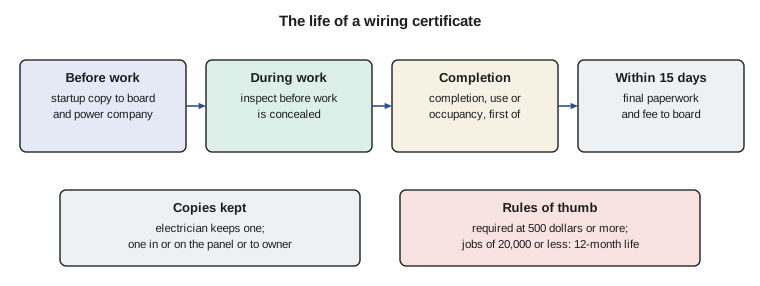
The certificate has distinct steps, and the exam likes to ask about each of them. First, a startup copy goes to the board and to the power company before work begins and before the installation is energized. Second, the final paperwork, with the fee and a description of the location and the completed work, goes to the board within 15 days of completion, use or occupancy, whichever comes first. Third, the electrician keeps a copy. Fourth, a copy stays in or on the panel or goes to the owner.
Most certificates are now filed electronically. An e-cert is the electronic version of a wiring certificate, available on application to any master, class B or power limited electrician with a current license. The electrician is responsible for every certificate issued to or by them, which is why Dale has never let anyone else at Souris Bend use his e-cert login. A paper certificate that is lost costs 25 dollars unless it is returned. The board has announced a move to a new online system, so watch its notices for any break in online filing and for new login instructions.
A certificate does not last forever. Certificates for jobs costing 20,000 dollars or less expire 12 months after filing, and unfinished work then needs a new certificate. Larger jobs, such as a school addition that runs for two years, are not subject to that 12-month rule.
Energizing
Section 43-09-21 of the Century Code says an installation may not be energized until proof of compliance with the state's requirements has been furnished to the energy supplier. The startup copy of the wiring certificate that goes to the power company before work begins is how that proof starts. In practice, power suppliers in North Dakota will not set a meter or connect a new or altered service without it. A contractor who asks a utility to connect a service with no certificate on file will be told to file one first.
How the fee is calculated
The inspection fee is set by N.D. Admin. Code 24.1-05-01-02 and is based on the total contract price or the total cost to the owner, including extras. Some items are excluded from the cost, including appliances, HVAC units, electric motors, programmable logic controllers, generators and industrial machines. The contractor collects the fee. If the owner supplies materials, the owner tells the contractor their cost, and donated materials or labor are estimated and included. Contractors must keep job records for four years and let the board examine and copy them. Charging or collecting more than the fee in effect is grounds for discipline.
| Total job cost | Fee under the schedule effective July 1, 2024 |
|---|---|
| Up to 500 dollars | 50 dollars minimum |
| 500 to 20,000 dollars | 50 dollars for the first 500, plus 2 dollars for each 100 dollars of the balance |
| Over 20,000 dollars | 440 dollars for the first 20,000, plus 1 dollar for each 1,000 dollars of the balance |
The rule has two schedules: one effective October 1, 2020 and a higher one effective July 1, 2024. The 2024 schedule applies to current work. The breakpoints are easy to check: 50 dollars plus 2 dollars for each 100 dollars of the 19,500 dollars between 500 and 20,000 is 50 plus 390, or 440 dollars, which is exactly the starting point for larger jobs.
Worked problem
Calculating a certificate fee
Souris Bend's contract for a shop addition is 64,000 dollars, of which 9,000 dollars is for a standby generator that the owner is buying through the contract. What is the inspection fee?
Show solution
- Generators are excluded from the cost, so the fee is based on 64,000 minus 9,000, or 55,000 dollars.
- The job is over 20,000 dollars, so start with 440 dollars.
- The balance over 20,000 is 35,000 dollars; at 1 dollar for each 1,000 dollars, that adds 35 dollars.
- Total fee: 440 plus 35 dollars.
Answer: 475 dollars.
# Wiring certificate fee under the schedule effective July 1, 2024 (check the current rule)
def cert_fee(cost):
    if cost <= 500:
        return 50.0
    if cost <= 20000:
        return 50 + 2 * (cost - 500) / 100
    return 440 + 1 * (cost - 20000) / 1000

for cost in (350, 4500, 20000, 55000, 250000):
print(f"job cost {cost:>7,} dollars: fee {cert_fee(cost):,.2f} dollars")job cost 350 dollars: fee 50.00 dollars job cost 4,500 dollars: fee 130.00 dollars job cost 20,000 dollars: fee 440.00 dollars job cost 55,000 dollars: fee 475.00 dollars job cost 250,000 dollars: fee 670.00 dollars
Late certificates, corrections and reinspections
The rules attach charges to the common mistakes. If work starts or is used without a required certificate, the certificate is treated as late, the inspection fee rises by 50 dollars, and the board may charge an investigative fee of 50 dollars an hour plus mileage for staff time spent getting the certificate filed. If a correction order is not completed on time, the electrician pays a 50-dollar administration charge. A reinspection costs at least 100 dollars, paid by the contractor, and an investigative fee may apply. Other inspections or services cost 50 dollars an hour, including travel, plus mileage.
Who inspects
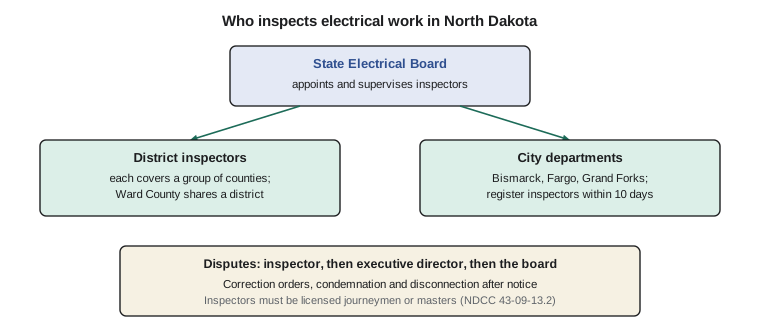
The board appoints the state's electrical inspectors under section 43-09-05, and section 43-09-13.2 requires each inspector to be a licensed journeyman or master electrician. The board's inspection districts page divides the state into districts, each with an assigned inspector and a list of counties. Souris Bend's home county, Ward, is in a district that also includes Bottineau, McHenry, Pierce and Rolette counties. Oil-country counties such as McKenzie, Williams, Mountrail and Dunn each have their own district, a sign of how much work the Bakken brings.
Cities may also inspect. Section 43-09-22 lets a city provide for inspection of electrical installations within its limits, and the board's page lists city electrical inspection departments in Bismarck, Fargo and Grand Forks. A city that inspects must register its inspectors with the board within ten days, and may not require inspections of work outside the board's jurisdiction. Inside those cities the city inspector does the inspection, but the state license, the state wiring standards and the board's authority still apply, and a contractor should check with the city about how certificates and fees are handled there.
Correction orders, condemnation and appeals
When an inspector finds a violation, the usual tool is a correction order: a written notice to the responsible person listing the violations, with a time to correct them. The installation is not approved until it is corrected. Under section 43-09-22, the board has jurisdiction over all electrical and power limited installations. The executive director may condemn an installation that is hazardous, order corrections, or order it disconnected after notice. The owner may appeal to the board.
Disputes about inspections follow a ladder. A contractor who disagrees with an inspector's decision takes the dispute to the executive director, whose decision may be appealed to the board. The board may charge inspection fees to the responsible electrician. Inspectors may enter land to inspect, but except in an emergency involving imminent danger they must ask permission before entering a dwelling or other enclosed place, and if refused, the board may ask a district court for an order.
Owners who wire their own property
North Dakota allows some owners to do their own electrical work. Under 24.1-05-01-01, an owner who owns and occupies a residential property or farmstead may apply to the board, review the plans with the local electrical inspector, pay the fees, with a 50-dollar minimum, and follow the same certificate and inspection rules as a contractor. The owner's work is inspected to the same standards. A master advising a customer should explain that an owner who wires a rental property or a building he does not occupy does not qualify.
Keeping certificates organized
A busy contractor can have dozens of certificates open at once. Arlo's e-cert list at Souris Bend shows, for each job, the date the startup copy was filed, the inspection status, the date of completion or occupancy, and whether the final has been filed with the fee. Every Friday he looks for two things: any job finished more than ten days ago without a final, and any small job approaching the 12-month expiration. Both are cheap to fix early and expensive to fix late.
He also keeps the inspector's reports in the job file. When a correction order arrives, he notes the deadline, assigns the correction to a crew, and records the date it was done and the reinspection result. If the company disagrees with an order, the file shows what was installed and why, which is the first thing the executive director will ask for.
Common mistakes
MistakeWaiting until the job is finished to file the certificate.
InsteadA startup copy goes to the board and the power company before work begins.
MistakeFiling the final paperwork 30 days after completion.
InsteadThe final goes to the board within 15 days of completion, use or occupancy, whichever comes first.
MistakeIncluding the generator and appliances in the fee calculation.
InsteadAppliances, HVAC units, motors, PLCs, generators and industrial machines are excluded.
MistakeAssuming the city building department issues the electrical permit.
InsteadIn North Dakota the wiring certificate filed with the board serves that purpose; three cities run inspection departments.
MistakeLetting another employee use the master's e-cert login.
InsteadThe electrician is responsible for every certificate issued to or by them.
Summary and key terms
- A wiring certificate is required for installations of 500 dollars or more and for service, moved building and mobile home work.
- The startup copy goes to the board and the power company before work begins; the final goes to the board within 15 days.
- Certificates for jobs of 20,000 dollars or less expire after 12 months.
- The fee follows the July 1, 2024 schedule, based on total cost with listed equipment excluded.
- State district inspectors inspect most work; Bismarck, Fargo and Grand Forks have city inspection departments.
- Correction orders, condemnation and disconnection are enforcement tools; disputes go to the executive director and then the board.
- Wiring certificate
- The document certifying an installation complies with chapter 43-09 and the board's rules, filed by the supervising electrician.
- E-cert
- The electronic version of a wiring certificate.
- Startup copy
- The certificate copy sent to the board and the power company before work begins.
- Correction order
- A written notice from an inspector listing violations to be corrected within a set time.
- Inspection district
- An area of counties assigned to a state electrical inspector.
Practice problems
Work each problem on paper first, then reveal the answer to check.
Kari is adding a 200-dollar receptacle in a customer's garage. Does she need a wiring certificate?
Show answer
Not under the 500-dollar threshold, unless the work is a service change or another listed case; the work must still meet the code.
A new service is being installed for a grain bin. When must the certificate be filed?
Show answer
Before work begins, with the startup copy to the board and the power company.
What is the fee for a job costing 4,500 dollars?
Show answer
50 plus 2 dollars for each 100 dollars of 4,000, or 130 dollars.
Who inspects a new house in Fargo?
Show answer
The City of Fargo's electrical inspection department.
A contractor disagrees with an inspector's correction order. Where does he go first?
Show answer
To the executive director of the board, with an appeal to the board.
Lesson quiz · 5 questions
Score 60% or more to complete this lesson.
Create a free account to save your progress, take quizzes and earn a certificate.