
MELU-309 · Lesson 3 of 12 · 20 min
Applying, approval and booking the exam
▶ Video coming soon A video version of this lesson is on the way.
In many states a master candidate books a national exam with a testing company and then sends the score to a licensing office. North Dakota works the other way around. The State Electrical Board runs its own examination, and a candidate cannot choose a date until the board has approved the application and sent an exam invitation. This lesson follows Kari's application from the forms on her kitchen table in August 2026 to the exam session she signed up for in December, and it sets out the rules on deadlines, cancellations and retests that can cost a candidate months if they are ignored.
The order of steps
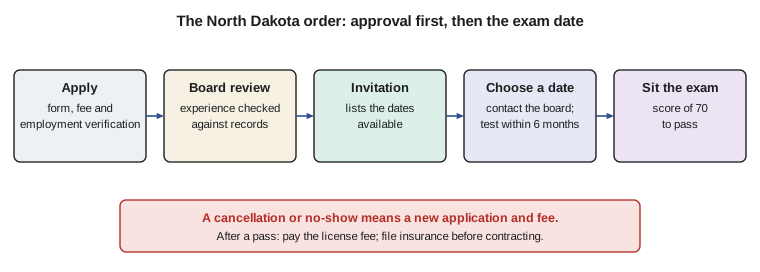
The board's rule, N.D. Admin. Code 24.1-03-01-01, describes the process in one sentence: after the board approves the applicant's employment verification of electrical construction experience, it sends an exam invitation listing test dates, and the applicant contacts the board with the chosen date. The board's exam page adds the details. A candidate must apply and be approved before signing up for a date. The invitation lists the dates available at the time of approval. The candidate must test within six months of receiving the invitation. And any cancellation or no-show requires a new application and a new fee.
Section 43-09-12 of the Century Code sets the statutory floor. Each applicant pays the examination fee, takes an oath and submits written proof of the required experience. Section 43-09-09 requires that applicants pass a technical and practical examination that tests knowledge of electrical skills and of the law. The board signs and seals each license.
The application packet
The board publishes the application forms on its licensing pages. For a master candidate, the packet usually contains four things: the application itself, the employment verification of electrical construction experience signed by each employer, the application fee and any supporting documents the form asks for. The application fee for the master license in N.D. Admin. Code 24.1-03-01-01 is 50 dollars. The annual license fee, also 50 dollars for a master, is paid when the license is issued and at each renewal. The application form itself sets out the current details, and the board's office can answer questions by phone in Bismarck.
| License | Application fee | Annual fee | Expires |
|---|---|---|---|
| Master | 50 dollars | 50 dollars | April 30 |
| Journeyman | 25 dollars | 25 dollars | March 31 |
| Class B | 40 dollars | 40 dollars | April 30 |
| Power limited | 50 dollars | 50 dollars | April 30 |
| Apprentice registration | 10 dollars | 10 dollars | January 31 |
Kari filled out her application in late August. Dale signed the employment verification for her seven years as a journeyman with Souris Bend, and Arlo attached a short summary of her hours drawn from payroll. She double-checked three things before mailing it: that her name matched her journeyman license exactly, that the dates on the verification matched the date her journeyman license was issued, and that the form named Dale as the contracting master she worked under. Mismatched names and dates are the most common reason an application comes back for more information.
Approval and the exam invitation
The board reviews the experience claimed and compares it with its records. If the hours or the supervision are unclear, the office asks for more information. If the experience meets the rule, the board approves the application and sends the invitation. Kari's approval came in October 2026, and her invitation listed the remaining 2026 sessions and the 2027 sessions open at the time.
The board's published schedule for the coming year shows sessions roughly once a month, each over two consecutive days: November 16 to 17 and December 14 to 15 in 2026, then sessions from January through December 2027. The page also gives a timing note that every candidate should read. Exams conducted in December 2026 are based on the 2026 NEC and the 2026 North Dakota laws, rules, wiring and conveyance standards. A candidate who had been studying from the 2023 code would need to move to the new edition before sitting a December exam.
Kari chose the December 14 to 15, 2026 session. It gave her eight weeks of study after approval, it uses the 2026 code she had already started learning for her continuing education, and if she needed a retest, a score in the 60s would let her sit again in January or February with time to spare before Dale's April 30 deadline. She called the board's office with her choice, as the rule requires, and wrote the confirmation in her calendar.
The six-month window
The invitation is not open-ended. A candidate must test within six months of receiving it. If the window passes, the candidate files a new application and fee. The same is true of a cancellation or a no-show. There is no free reschedule: a candidate who signs up for a date and does not appear has to start again with a new application. Choose a date you can keep, and keep it.
Worked problem
Working the window
A candidate receives her invitation on October 5. What is the last month in which she can test without reapplying, and what happens if she signs up for a March date and cancels?
Show solution
- Six months from October 5 runs to about April 5.
- She can choose any listed session before then, such as one in March.
- If she cancels or misses the March session, she must file another application and fee.
- A new application goes back through approval before she can sign up again.
Answer: Test by early April; a cancellation or no-show means reapplying.
If the result is not a pass
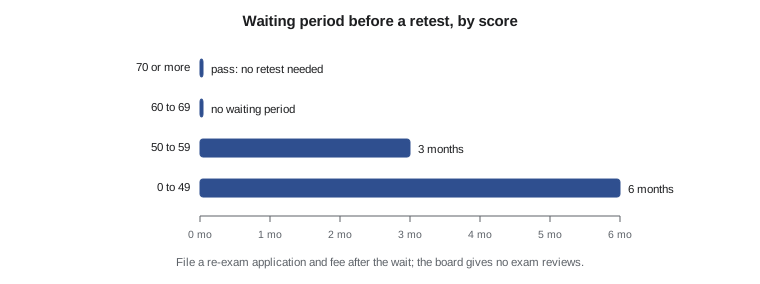
The passing grade on the board's exams is 70. The exam page sets a waiting period before a retest that depends on the score. A candidate who scores from 60 to 69 may retest with no waiting period. A score from 50 to 59 means a three-month wait, and a score of 49 or below means a six-month wait. After the wait, the candidate files the re-exam application for an electrical license with the fee, receives a new invitation and signs up for a date. The board stopped giving exam reviews in 2012, so a candidate does not see the questions missed. The only feedback is the score.
| Score | Waiting period before retest |
|---|---|
| 70 or more | None: a pass |
| 60 to 69 | No waiting period |
| 50 to 59 | Three months |
| 0 to 49 | Six months |
# When could a candidate retest after a December 14, 2026 exam? (illustrative)
from datetime import date
exam = date(2026, 12, 14)
def wait_months(score):
    if score >= 70: return None
    if score >= 60: return 0
    if score >= 50: return 3
    return 6
for score in (72, 66, 55, 41):
    w = wait_months(score)
    if w is None:
        print(f"score {score}: pass")
        continue
    m = exam.month - 1 + w
    yr, mo = divmod(m, 12)
    earliest = date(exam.year + yr, mo + 1, 1)
    names = ["January", "February", "March", "April", "May", "June", "July", "August", "September", "October", "November", "December"]
print(f"score {score}: wait {w} months, re-exam application from about {names[earliest.month - 1]} {earliest.year}")score 72: pass score 66: wait 0 months, re-exam application from about December 2026 score 55: wait 3 months, re-exam application from about March 2027 score 41: wait 6 months, re-exam application from about June 2027
The waiting rule shapes the study plan. A candidate who sits the exam unprepared and scores in the 40s loses six months, which for Kari would have meant missing Dale's deadline. A candidate who is close but not quite there can retest at the next session. The lesson is not to take the exam as a practice run.
After a pass
When a candidate passes, the board issues the license after the license fee is paid. The board's rule requires licensed electricians to carry the board's identification card and a government photo identification while working, and section 43-09-09 requires licensees to report their licensing and renewals to the local electrical inspector where one exists. A new master who will contract must also give the board proof of liability insurance before contracting, as Lesson 8 explains, and must tell the board immediately about any change in the status of the business the master qualifies.
For Souris Bend, a pass in December would let the company plan the change from Dale to Kari well before April 30. Arlo has already listed what will change: the contracting master named on the company's records with the board, the insurance certificate filed with the board, the Secretary of State contractor license file and the name on the e-cert account the company uses to file wiring certificates.
Exam accommodations and special cases
Candidates who need testing accommodations should ask the board in writing with the application, so that the request can be handled before a date is chosen. Military spouses and military members moving to North Dakota may qualify for provisional licensing under section 43-51-11.1, which the board's rules adopt by reference. Candidates licensed in a reciprocal state apply for a reciprocal license instead and do not take the written exam, as Lesson 2 explains.
Common reasons an application is delayed
Arlo has helped six Souris Bend electricians apply for licenses over the years, and the delays have always come from the same few problems. The first is a name that does not match the board's records, often a married name or a middle initial. The second is a verification signed by the wrong person, such as a foreman rather than the contracting master or an authorized officer of the company. The third is hours that do not add up, usually because a candidate counted apprentice hours toward the master. The fourth is a missing fee or an outdated form downloaded long ago. Each one sends the application back for correction and pushes the invitation later.
The fix is a careful final check before mailing. Download the current form from the board's site the week you apply, compare every name and date against your license card, have the contracting master sign the verification, attach a short hours summary that ties to payroll, and keep a copy of everything you send. If you are unsure whether experience will be accepted, call the board first; a five-minute call can save a month.
Choosing a session
Because the board offers sessions about once a month and the invitation is good for six months, most candidates have several dates to choose from. Pick a session that leaves enough time to study but not so much that motivation fades, avoid dates that clash with the company's busiest weeks, and leave room for a retest before any deadline that matters, such as a retiring master's last renewal. Remember the edition change too: a candidate approved in the fall of 2026 who sits in December or later is tested on the 2026 code and the 2026 North Dakota standards, so all study material should be on that edition.
Common mistakes
MistakeBooking a date with a testing company before applying.
InsteadThe board approves the application first and then sends an invitation listing dates.
MistakeAssuming a canceled exam can be rescheduled for free.
InsteadA cancellation or no-show requires another application and fee.
MistakeWaiting more than six months after the invitation.
InsteadThe candidate must test within six months of receiving the invitation.
MistakeExpecting a review of missed questions.
InsteadThe board stopped giving exam reviews in 2012; only the score is reported.
MistakeStudying the 2023 NEC for a December 2026 exam.
InsteadExams from December 2026 are based on the 2026 NEC and the 2026 North Dakota standards.
Summary and key terms
- Apply with the fee and an employment verification; the board approves the experience before any date is chosen.
- The invitation lists available dates; the candidate contacts the board with a choice.
- Test within six months of the invitation; a cancellation or no-show means reapplying.
- The passing grade is 70; scores of 50 to 59 wait three months and 49 or below wait six months before a retest.
- Exams from December 2026 use the 2026 NEC and 2026 North Dakota laws, rules and standards.
- After a pass, pay the license fee, carry the board ID card and photo ID, and file insurance before contracting.
- Exam invitation
- The board's notice to an approved applicant listing the exam dates available.
- Re-exam application
- The form and fee a candidate files to retest after the waiting period.
- Waiting period
- The time a candidate must wait before retesting, set by the score.
- Oath
- The statement each applicant makes under NDCC 43-09-12 as part of the application.
- Annual license fee
- The fee paid when the license is issued and at each yearly renewal.
Practice problems
Work each problem on paper first, then reveal the answer to check.
Kari's invitation arrived in October 2026. By when must she test?
Show answer
Within six months, so by about April 2027.
A candidate scores 64. When can he retest?
Show answer
There is no waiting period; he files the re-exam application and fee and signs up for the next available date on his new invitation.
What is the master application fee?
Show answer
50 dollars under N.D. Admin. Code 24.1-03-01-01; confirm the current amount.
Which NEC edition is a December 2026 master exam based on?
Show answer
The 2026 NEC, with the 2026 North Dakota laws, rules and standards.
A candidate does not show up for his exam. What must he do?
Show answer
File another application and fee.
Lesson quiz · 5 questions
Score 60% or more to complete this lesson.
Create a free account to save your progress, take quizzes and earn a certificate.